How to Get Over a Breakup: A Recovery Plan That Actually Helps
How to get over a breakup, step by step: what to do in the first 72 hours, a 12-week recovery plan, what research says helps, and when to get support.
 By the UnLink Editorial Team · General educational guidance, not therapy
You get over a breakup by working on three things at once: protecting your brain from fresh hits of your ex (distance and no contact), steadying your body (sleep, food, movement, people), and rebuilding the parts of your identity the relationship took with it. Pain eases in waves over weeks to months, and most people recover better than they expect.
- Breakup pain is real pain. Brain scans of people recently rejected in love show activity in systems linked to craving, reward and physical pain.
- People reliably overestimate how bad they will feel and for how long. Your worst day is not a forecast.
- Distance speeds recovery. Checking an ex’s social media is linked to more distress, more longing and less personal growth.
- Thinking honestly about the ex’s flaws lowers love feelings, and distraction lifts mood. Use both, on purpose.
- The core work is rebuilding “who am I without them?” A clearer sense of self predicts less distress after a breakup.
- Get professional support if you cannot sleep, eat or work for more than two weeks, or if you have any thoughts of harming yourself. In the US, call or text 988.
Why does a breakup hurt this much?
A breakup is rarely the loss of one thing. It takes a daily routine, a future you had already half-lived in your head, a shared “we”, and often a home, a friend group or a pet. It also takes the person you would normally call when something hurts, at the exact moment something hurts most. That is why it can feel unbearable even when you know it had to end.
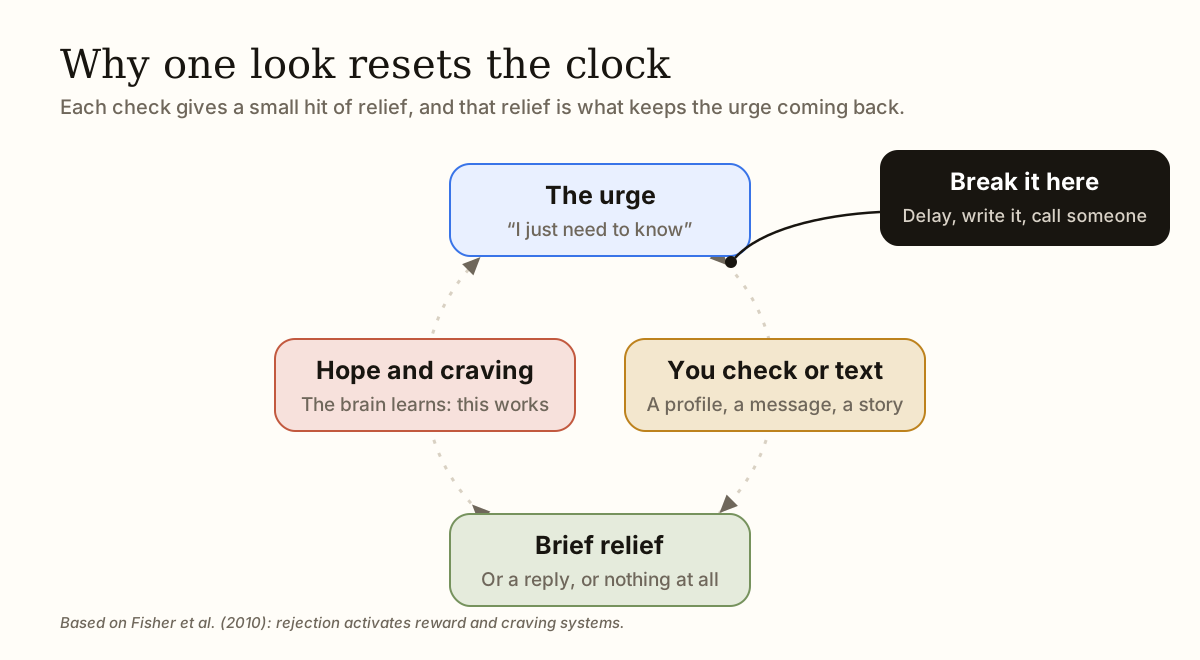
Your brain is part of the problem, and understanding how makes the next few weeks less frightening.
- It works like withdrawal. Fisher and colleagues (2010) scanned people who had recently been rejected but were still in love. Looking at a photo of the ex activated brain areas tied to reward, motivation and craving, the same system involved in addiction. The pull to text, check or “just see them once” is a craving. It is not a sign you are meant to be together.
- It registers like physical pain. Kross and colleagues (2011) found that recalling an intense rejection engaged brain regions that also process physical pain. The chest ache, the nausea and the heavy limbs are real.
- It strains your stress system. In a study of people who had recently been through a breakup, a large share showed raised depressive symptoms, and researchers now use breakups as a model for stress-related low mood (Verhallen et al., 2019). Poor sleep, low appetite and a foggy head are common responses, not personal failings.
- It shakes your identity. People whose sense of self was more tangled up with their partner report more confusion about who they are after a breakup, and that confusion predicts more emotional distress (Slotter et al., 2010).
How long does it take to get over a breakup?
There is no reliable number, and anyone who gives you one (“half the length of the relationship”, “three months”) is guessing. What the research offers is more useful than a number.
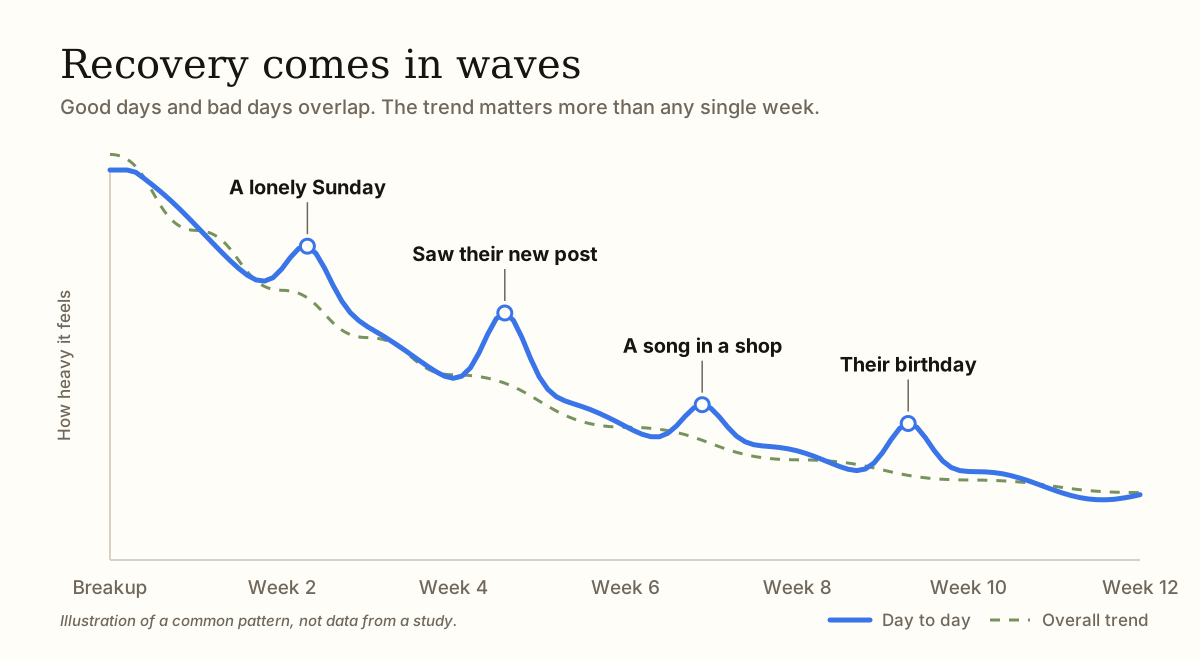
First, you will probably feel better sooner than you expect. In a study that followed people in relationships over several months, those who went on to break up had predicted far more distress than they actually felt, and their real distress faded faster than their own forecasts (Eastwick et al., 2008). Second, recovery moves in waves. A good week followed by a terrible Sunday is the normal shape, not a relapse. Third, contact resets the clock. Each conversation, hookup or profile check re-triggers the craving system, which is why some people feel stuck at week one for months.
As a rough guide, the acute phase (constant thoughts, broken sleep, no appetite) often eases within a few weeks to two months, and the deeper rebuilding takes several months. Long relationships, a shared home or children, a sudden or betrayal-based ending, and a history of anxiety or depression can all stretch that out. If several months have passed and things are getting worse rather than better, that is a reason to get support, not a reason to blame yourself. For the no-contact side of the question, see how long no contact should last, or get a personal starting point from the no contact calculator.
There is more on what the research says, and what lengthens or shortens recovery, in how long it takes to get over a breakup.
What to do in the first 72 hours
The first three days are damage control, not insight. You do not need to understand the breakup yet. You need to get through it without doing something you will spend the next month regretting.
Avoid the moves that feel urgent and rarely help: the long message asking for answers, closure or “one more chance”; posting about the breakup or about them; big decisions such as moving city, quitting a job or cutting off friends; and drinking to numb it. Alcohol wrecks sleep, lowers impulse control (this is where the 2 a.m. texts come from) and deepens low mood the next day.
What is the 72-hour rule? It is an informal rule of no contact for at least 72 hours after a breakup, so the first wave of shock settles before you say or do anything. It is not a scientific law, but giving your emotions time to come down before you act is sound. Treat 72 hours as the minimum, not the goal.
The 12-week recovery plan
Recovery is not linear, so read this as a map rather than a schedule. If you are in week six and have a week-two kind of day, nothing has gone wrong. Move at your own pace and go back a phase whenever you need to.
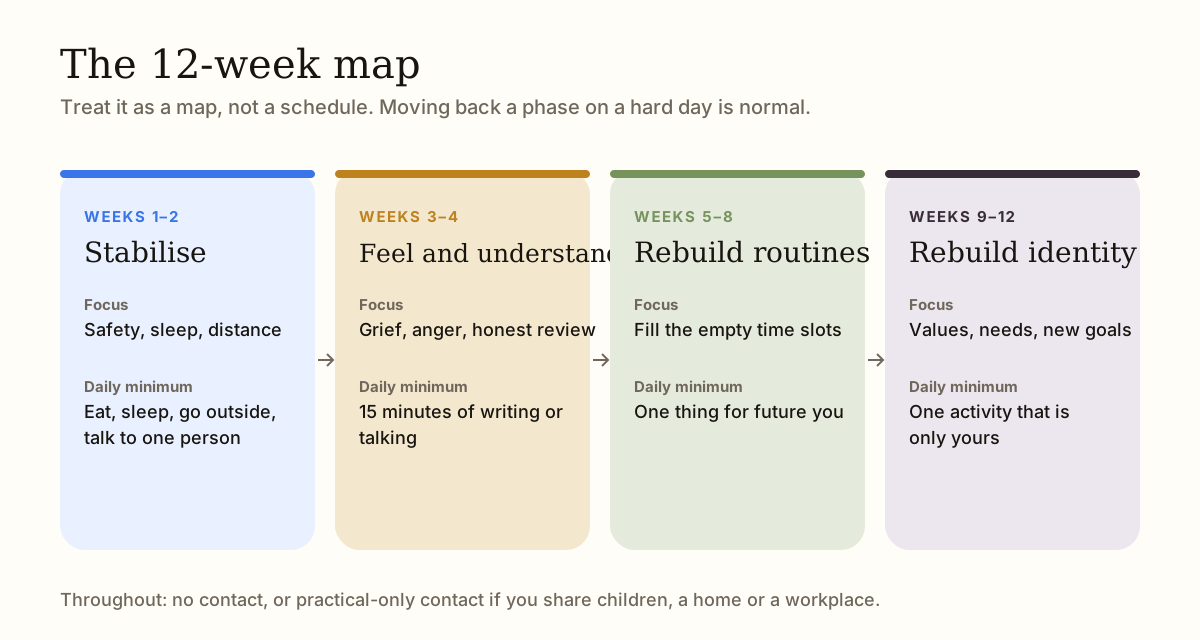
| Phase | Weeks | What is usually going on | Your focus | Daily minimum |
|---|---|---|---|---|
| 1. Stabilise | 1–2 | Shock, crying, craving, broken sleep | Safety, basics, distance | Eat, sleep, step outside, one human contact, no contact with your ex |
| 2. Feel and understand | 3–4 | Waves of sadness, anger and bargaining | Grieving and an honest look at the relationship | 15 minutes of writing or talking it through |
| 3. Rebuild routines | 5–8 | Fewer bad days; boredom and loneliness show up | New routines, your body, friendships | One thing for your future self |
| 4. Rebuild identity | 9–12 | Thoughts of them are less frequent and less sharp | Values, goals, what you need next time | One activity that is “you without them” |
Weeks 1–2: stabilise
The only job in these two weeks is to stop the bleeding. Insight can wait.
- Go no contact. Unless you share children, a lease or a workplace, stop all contact for at least 30 days. This is not a game to make them miss you. It gives your brain time to stop being re-triggered. If you do share logistics, use modified no contact: brief, practical, written messages only.
- Remove the triggers. Mute or unfollow them everywhere. Put photos, gifts and their clothes in a box out of sight. You do not have to throw anything away. You just should not have to look at it every morning.
- Write a craving plan. Decide now what you will do when the urge to text hits: who you will call, where you will walk, what you will write instead. Our list of what to do instead of texting your ex has more than 30 ideas, and the 90-second reset works in the moment.
- Lean on people. Isolation makes everything heavier. Say yes to invitations even when you do not feel like it, and leave after an hour if that is all you have.
- Move your body. A walk counts. Exercise is one of the best-supported mood helpers there is, and it gives the restless energy of a breakup somewhere to go.
Weeks 3–4: feel it and understand it
Once the shock fades, the feelings you have been holding back usually arrive. This is the phase where grief does its work, so make room for it rather than fighting it.
- Schedule time to grieve. A sad playlist, a long cry, a walk where you let yourself think about them. Feelings that get time and space tend to pass. Feelings you fight tend to come back louder.
- Write with structure. Expressive writing, where you write about your deepest thoughts and feelings for 15 to 20 minutes over several days, has been linked to better health and wellbeing (Pennebaker, 1997). Try three prompts across three days: What happened? What did I lose? What do I know now that I did not know before?
- See the relationship as it was. Make a reality list: the times you felt anxious, lonely, unheard or small, the needs that went unmet, the reasons it ended. Read it when your memory starts editing in only the good parts. Thinking about an ex’s negative qualities has been shown to lower feelings of love for them (Langeslag and Sanchez, 2018).
- Separate reflection from rumination. Looping the same questions at 3 a.m. is rumination. A focused look that ends in a lesson is reflection. Our guide on how to stop thinking about your ex shows how to set a daily “worry window” so the thoughts stop taking the whole day.
Weeks 5–8: rebuild your routines
By now the bad days are usually fewer, and something quieter shows up instead: boredom and loneliness. The relationship left holes in your week, and this phase is about filling them on purpose.
- Fill the empty time slots. The Friday night, the morning call, the Sunday routine. Plan something specific for each one: a class, a standing call with a friend, a long run, a new café.
- Re-route your phone habits. If you used to text them at lunch, put a different person or app in that slot. Our guide on how to stop checking your ex’s social media covers the setup.
- Reconnect with old friends. Relationships often crowd out friendships. This is a good time to message the people you drifted from.
- Add something new. New experiences help you build a sense of self that is not tied to your ex. Pick something you have never done, or something you stopped doing because your partner did not like it.
Weeks 9–12: rebuild your identity
This is the part that turns “getting over them” into getting on with your life. It is slower and quieter than the early weeks, and it is where most of the lasting change happens.
- Write down your values. What matters to you in work, friendship, health and love? What did you compromise on that you will not compromise on next time?
- Name your needs. Feeling safe, being respected, being a priority, having space, sharing a future. Which did this relationship meet, and which did it not?
- Set one three-month goal that is only yours. Fitness, a skill, travel, a savings target, a creative project. Something that grows the part of your life that had nothing to do with them.
- Notice growth without forcing it. Many people report real personal growth after a breakup: more confidence, clearer standards, a better sense of what they want (Tashiro and Frazier, 2003). People leaving a low-quality relationship often report more positive emotions and self-growth afterwards (Lewandowski and Bizzoco, 2007). You do not have to feel grateful for the breakup. Just notice what you have learned.
The 10 things that actually help, and why
Every list online says “practise self-care”. Here is what helps, with the reason each one works, so you can choose what fits your situation.
- Distance and no contact. Every message, like or “how are you?” is a small reward that keeps the craving system hoping. No contact is a recovery boundary, not a tactic. Read what the no contact rule is, how the first 30 days usually go, and what to do if you slip. A slip is a setback, not a restart from zero.
- Stop monitoring them online. In a study of more than 400 people after a breakup, those who kept checking their ex’s Facebook reported more distress, more longing and less personal growth than those who did not (Marshall, 2012). The less you see, the less there is to process.
- Reappraise the ex, on purpose. Thinking about an ex’s annoying habits and the relationship’s problems lowered love feelings but made people feel a bit worse in the moment. Distraction lifted mood but did not change love feelings. Accepting the feelings (“it is okay to still love someone who is not right for me”) made them less of a fight (Langeslag and Sanchez, 2018). In practice: read your reality list, then follow it with a walk or a friend so you do not sink.
- Structured reflection, not endless replaying. People who reflected on their breakup in a structured way recovered a clearer sense of self, and that was linked to less distress (Larson and Sbarra, 2015). Structured means a set time, a prompt and an ending.
- Expressive and unsent writing. An unsent letter gives the urge to say one last thing somewhere to go without restarting contact.
- Sleep, food and movement. Not glamorous, but your mood rests on them. Keep a fixed wake-up time, eat regular small meals, and move for 20 to 30 minutes most days. If you cannot sleep, get out of bed for 20 minutes rather than scrolling in it.
- People, not just “support”. Ask for specific help: a weekend visit, a daily check-in text, someone to sit with you while you delete the photos. Also spend time with people where the breakup is not the topic.
- Rebuild your sense of self. List what you like, what you are good at and what you want, with no reference to your ex, then do one of those things each week.
- Make progress visible. Recovery feels invisible because bad days stand out and good ones do not. Count your no-contact days, note your mood, and keep a list of small wins: “Did not check their profile today.” “Laughed at work.” A slow upward trend is strong evidence on the days your brain insists nothing is changing. This is what UnLink is built for: a private no-contact counter, urge logging and a journal that stays on your iPhone.
- Professional help when you need it. A therapist is not only for a crisis. Therapy can help you understand patterns, such as why you keep choosing the same kind of partner or why this one hit so hard.
What slows recovery down
Most of these feel like relief in the moment. That is exactly why they are easy to fall into.
- Staying friends too early. Friendship may be possible later, but not while you still hope for more. Pretending you are fine around them keeps the wound open.
- Hooking up with your ex. It feels like relief and then sends you back to day one, usually with extra confusion.
- Checking their profiles, and their new partner’s. See above. There is nothing on there that helps you heal.
- Numbing. Alcohol, endless scrolling, overworking or nonstop swiping can hold the feelings off for a while, but they are still there when you stop.
- Waiting for closure from them. Closure is something you make, not something they hand you. Most “closure conversations” become another round of the same argument.
- Rebounds? It depends. Common advice says never rebound, but the research is more mixed. One study found that people who started a new relationship sooner reported higher self-esteem and wellbeing, and were not more hung up on their ex (Brumbaugh and Fraley, 2015). The honest rule: a new relationship is fine if you want that person, not if you are using them to avoid the loss or to make your ex jealous.
- Blaming yourself for everything. Relationships end because of both people and their circumstances. “We were not right for each other” is usually closer to the truth than “I ruined it”.
How to get over a breakup when you still love them
This is the hardest version, and the most common one. Still loving someone does not mean you should be together, and it does not mean you are not healing.
If you are thinking “but what if we are meant to be?”, read does no contact work? We look at no contact as a way to heal, not a strategy to win someone back.
- Accept that love and incompatibility can both be true. “I love them, and the relationship did not work” is a complete sentence.
- Stop testing your feelings. Looking at photos or rereading texts to check whether you still care keeps the feeling fresh. Feelings fade with time and distance, not with tests.
- Use your reality list daily for the first few weeks, then as needed.
- Grieve the future, not just the person. Often what hurts most is the future you imagined: the trip, the wedding, the kids, growing old. Write that future down, then let yourself be sad that it will not happen.
- Give big decisions a time frame. If you are tempted to reach out, commit to 30 days of no contact first, then use the Should I text my ex? tool. Most urges look different after a month.
Getting over it, by situation
The basics above apply to almost everyone. What changes from one breakup to the next is which part is hardest.
| Situation | What is different | What helps most |
|---|---|---|
| You were dumped | Rejection, the unanswered “why”, loss of control | No contact, a reality list, structured writing about what you can control now |
| You did the breaking up | Guilt, doubt, “did I make a mistake?” | Write down your reasons while they are fresh, allow grief anyway, do not reopen contact to ease guilt |
| A long-term relationship or marriage | Identity, home, money and friends all tangled together | Sort the practical side first (housing, money), expect a longer timeline, consider therapy |
| You still live together | No physical distance | Separate rooms and schedules, a move-out date, written practical-only messages |
| You share children | Contact cannot stop | Parallel parenting, a co-parenting app or email, child-focused messages only (see modified no contact) |
| A situationship | The grief feels “not allowed” | Treat it as a real loss; see no contact after a situationship |
| They cheated | Betrayal, broken trust, self-blame | Remember the cheating was their choice; get tested if relevant; consider therapy for the trust injury |
| A toxic, controlling or abusive relationship | Trauma bond, safety risk, possible hoovering | Safety first: tell someone, keep evidence, contact a domestic violence service. See our safety page, and the grey rock method for contact you cannot avoid |
| You work or study together | Daily contact | Polite, brief, task-only interactions; change routes and seating where you can; involve HR if needed |
Are the “stages of a breakup” real?
You will often see breakups mapped to the five stages of grief: denial, anger, bargaining, depression and acceptance. The model came from work on death and dying, and research on grief suggests these feelings do show up, but not in a neat order or one at a time. Use the stages as vocabulary, not as a schedule. You can move through three of them in a single afternoon.
Bargaining (“if I just change this one thing, it will work”) deserves a special warning. It is the stage when people send the long message. For the no-contact version of this, see the stages of no contact.
How to tell you are healing
You do not wake up one morning “over it”. You start noticing smaller things instead, usually in hindsight.
- You go hours, then days, without thinking about them.
- Their name or a song still stings, but it no longer wrecks your day.
- You can remember the good and the bad without idealising either.
- You stop checking their profiles, and the pull to look comes less often.
- You make plans that have nothing to do with them, and you look forward to them.
- You feel curious about the future rather than scared of it.
- When you think about dating again, it is because you want to, not to prove a point.
When to get professional help
Breakup grief is normal. But speak to a doctor or therapist if, for more than about two weeks, you cannot sleep, eat or get through work or school; you feel hopeless, worthless or numb most of the day; you are relying on alcohol or drugs to cope; you are having panic attacks or cannot stop obsessive checking; or the breakup has reopened older trauma or followed an abusive relationship.
If you have any thoughts of harming yourself, get help now. In the US, call or text 988 (Suicide & Crisis Lifeline). In the UK and Ireland, call Samaritans on 116 123. In India, call Tele-MANAS on 14416. Elsewhere, contact your local emergency number or visit findahelpline.com. If you are in danger from a partner or ex, in the US call the National Domestic Violence Hotline on 1-800-799-7233.
Step-by-step plan
- Tell two or three steady people
Pick the friends or family who calm you down, not the ones who will hype you up to confront your ex. Ask for something specific: “Can you check on me tonight?” or “Can I stay at yours this weekend?”
- Cover the basics
Drink water, eat something with protein even if it is small, shower, and go outside once a day. Your body is under real stress.
- Protect your sleep
Charge your phone outside the bedroom. The urge to text peaks late at night, and our guide on why you want to text your ex at night explains why.
- Pause all contact
Mute, archive the chat and move them out of your favourites. You can decide about blocking later. For now, just make contact harder. See how to block yourself from texting someone.
- Write it instead of sending it
Open a note and write everything you want to say to them. Do not send it. The unsent letter guide walks you through it.
You do not have to solve the whole relationship tonight. Take one private step that creates space between the feeling and the action.
Count your no-contact days →Common questions
How do I get over a breakup fast?
There is no shortcut, but you can stop slowing yourself down: cut contact, stop checking their social media, protect your sleep, see people every day, and reflect in a structured way rather than ruminating. These remove the things that keep resetting your recovery.
What should I do right after a breakup?
Tell two or three people you trust, cover the basics (water, food, sleep, a shower), put distance between you and your ex for at least 72 hours, and write down anything you want to say instead of sending it. Avoid big decisions and alcohol in the first week.
What is the 72-hour rule after a breakup?
It is an informal rule of no contact for at least 72 hours after a breakup, so the first wave of emotion settles before you say or do something you regret. It is not research-based, but letting emotions settle is sound, and many people find 30 days of no contact works better.
What are the 5 stages of a breakup?
People often borrow the five stages of grief: denial, anger, bargaining, depression and acceptance. They are a helpful way to name feelings, but most people move between them in no fixed order, and some skip stages entirely.
Is it normal to still miss my ex months later?
Yes. Missing someone can outlast the acute pain by a long way, and it often comes in waves around anniversaries and big life moments. What matters is the trend: are the waves getting smaller and further apart? If the pain is getting worse over time, talk to a professional.
Should I stay friends with my ex?
Not while you still have feelings or hope for more. Friendship can sometimes work later, once you are genuinely over them and both of you want it for its own sake. Take at least a few months of distance first.
Should I block my ex?
Blocking is a tool, not a statement. If you keep checking their profiles or feel tempted to message, blocking or muting protects your recovery. If you share children or work together, mute instead. See should you block your ex?
Why does it hurt more when I was the one who got dumped?
Being rejected adds a hit to your self-worth and takes away your control over the ending. Brain imaging suggests rejection activates craving and pain systems. Focus on what you can control now: your routine, your distance and your next steps.
What if my ex texts me while I am trying to move on?
You do not have to reply right away, or at all. If you share logistics, reply briefly and practically. If not, wait at least 24 hours and ask whether replying helps your recovery. See what to do when your ex texts you during no contact, or check a message with Does this break no contact?
Can an app help me get over a breakup?
An app cannot do the emotional work for you, but it can help with the parts people struggle with most: not texting, seeing progress and having somewhere private to write. UnLink counts your no-contact days, logs urges and keeps a private journal on your iPhone, with no account required.
If contact involves threats, stalking, coercion, shared children, housing or immediate safety, a general no-contact rule may not fit. Read the safety guidance and seek qualified local help where appropriate.
Sources and further help
- Brumbaugh & Fraley (2015) — Too fast, too soon? An empirical investigation into rebound relationships
- Eastwick et al. (2008) — Mispredicting distress following romantic breakup
- Fisher et al. (2010) — Reward, addiction, and emotion regulation systems associated with rejection in love
- Kross et al. (2011) — Social rejection shares somatosensory representations with physical pain
- Langeslag & Sanchez (2018) — Down-regulation of love feelings after a romantic break-up
- Larson & Sbarra (2015) — Participating in research on romantic breakups promotes emotional recovery via changes in self-concept clarity
- Lewandowski & Bizzoco (2007) — Addition through subtraction: growth following the dissolution of a low quality relationship
- Marshall (2012) — Facebook surveillance of former romantic partners
- Pennebaker (1997) — Writing about emotional experiences as a therapeutic process
- Slotter, Gardner & Finkel (2010) — Who am I without you? The influence of romantic breakup on the self-concept
- Tashiro & Frazier (2003) — Personal growth following romantic relationship breakups
- Verhallen et al. (2019) — Romantic relationship breakup: an experimental model to study effects of stress on depression (-like) symptoms
- National Domestic Violence Hotline — safety planning
- 988 Suicide & Crisis Lifeline — US crisis support
Research is cited to explain general patterns, not to diagnose or predict any individual outcome. Sources do not endorse UnLink. Read our editorial principles.
Keep this support one tap away.
UnLink is a free, private no-contact tracker for iPhone: count your days, get through urges and restart without losing your history.