How Do You Write an Unsent Letter to Your Ex?
How to write an unsent letter to your ex: a two-draft method, 12 prompts, a sample, what to do with it, and when writing makes things worse instead of better.
 By the UnLink Editorial Team · General educational guidance, not therapy
To write an unsent letter to your ex, set a 15-minute timer, address them by name and write what you feel without editing for their reaction. Use a prompt such as what you miss or what you never said. Keep the letter private, do not send it, and decide afterwards whether to keep, reread or delete it.
- An unsent letter is a private piece of expressive writing that puts feelings into words without sending them to your ex.
- Short, timed sessions with specific prompts work better than open-ended writing that loops back into rumination.
- The research on expressive writing shows a real but small average benefit, so treat the letter as one tool, not a cure.
- Store the letter somewhere private, reread it after a couple of days, and note what has changed rather than rewriting it endlessly.
- If writing leaves you more hooked, or the relationship was abusive, stop and switch to a different kind of support.
What is an unsent letter, and does it work?
An unsent letter is a letter you write to an ex, or to the relationship, that you never deliver. The point is to give your feelings a place to go. Anger, grief, relief, confusion and longing can all be written down, often for the first time, without any need to protect the other person or win an argument.
The idea draws on expressive writing research. In his 1997 paper “Writing about emotional experiences as a therapeutic process,” James Pennebaker describes how writing about emotional experiences has been linked with benefits across a range of studies. A later meta-analysis of 146 randomized studies found that expressive writing worked on average, with a small effect size (Frattaroli, 2006). Small is not nothing, and it varied by who wrote and how, but it is not a miracle either.
Both bodies of research are about writing about emotional experiences in general, not breakups specifically, and an unsent letter is not a substitute for therapy. It is a private tool you can use alongside other support. One more reason it appeals after a breakup: it gives the urge to say something a place to land that does not involve their phone.
How to write an unsent letter, step by step
The method is simple, and it works best with a few ground rules. The first is privacy: write somewhere nobody else can read it, and where a glance at the screen will not tempt you to send it. Many people prefer paper because it cannot be sent by accident. There is no strong evidence that handwriting beats typing, so choose the one you will actually use.
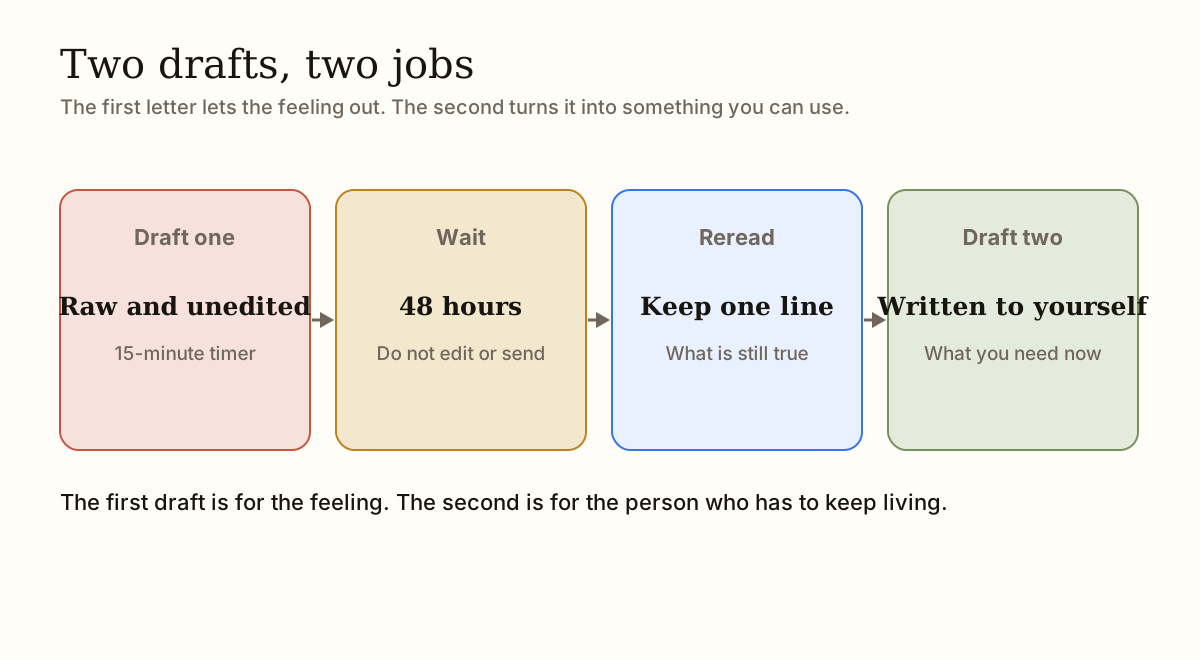
The second rule is time. A timer keeps the session finite and cuts the urge to keep polishing. The third is to write two drafts, not one. The first draft is for the feeling. The second, a couple of days later, is for you: what you need now.
12 prompts to start your unsent letter to an ex
If you do not know where to begin, choose one prompt and finish the sentence in as many ways as you like. Do not try to answer all of them in one sitting. Prompts about your own experience, rather than their behavior, keep the writing focused on you.
- What I miss most is…
- What I am still angry about is…
- The moment I knew it was over was…
- What I wish you had understood about me is…
- What I was afraid of losing was…
- What I never said at the time is…
- What I am grieving right now is…
- The version of us I still picture is…
- What I hope for myself, without you in it, is…
- What I needed to hear from you, and will probably never hear, is…
- One thing this relationship taught me about what I need is…
- What I am choosing to put down today is…
An example unsent letter
The example below is invented for illustration. It is not based on a real person or relationship, and you do not need to write in this style. Notice that it describes feelings, names what was lost and ends with a decision about the next step, not with a request for a reply.
Dear Sam, I am writing this at eleven at night with my phone in the other room, so I can say the things I keep rehearsing. I miss the way you made me laugh in the car. I am angry that you ended things by text and then acted as if we had never talked about the future. I wanted you to understand how much I wanted to feel enough, and I am still sad that I was not the person you chose. I do not need an answer. I need to stop waiting for one. Tonight I am going to make tea, go to bed and see how I feel in the morning. Love, me.
Which kind of unsent letter should you write?
Not every letter does the same job. If you are not sure which to write, start with the raw draft, then pick a second letter by what is left over. You can write one a week for as long as it helps.
| Letter | What it is for | Rule that keeps it useful |
|---|---|---|
| The raw draft | Getting anger, grief or longing out of your head | 15 minutes, no editing, no rereading until 48 hours later |
| The “what I need” letter | Turning the feeling into a request you can meet yourself | Ends with one thing you will do for yourself today |
| The goodbye | Marking an ending when there will be no conversation | Write it once; do not keep revising it |
| The letter from your future self | Gaining distance, six months ahead | Write what you hope you will have learned, not what you hope they will do |
What to do with your unsent letter afterwards
Once the timer ends, decide what the letter is for now. Some people keep it and reread it occasionally. Others close the document and never open it again. There is no single right choice, but a deliberate decision beats leaving the file open for the next late-night session.
Reflection can help here. In a study of romantic breakups, structured reflection was associated with improved self-concept clarity, which related to less emotional distress (Larson & Sbarra, 2015). Rereading your letter after a few days and noting what still feels true is a gentle way of seeing how your thinking is changing.
If you are writing because you want to feel finished, closure after a breakup explains what closure can and cannot do. The closure letter builder walks you through a structured version step by step.
- Keep the letter in a private place, such as the UnLink Vault if you use Premium, or a locked note on your phone.
- Reread it after 48 hours and mark one sentence that still feels true and one that no longer does.
- Tear up or delete the letter as a ritual, if that feels like a clean ending.
- Write a short reply from your future self, dated six months ahead, about what you hope you will have learned.
- Notice what triggered the letter, such as a notification, a birthday or a late night, and add that to your trigger log.
When writing makes things worse
Writing is not always helpful. Some people find that an unsent letter becomes another way of staying stuck in the relationship. You might reread it dozens of times, edit it to make them see your side, or use it to replay every painful moment. If that happens, the letter has stopped doing its job.
The research on ex-partner monitoring is a useful warning sign. In one study, more monitoring of an ex’s Facebook was associated with more distress, more desire for the ex and less personal growth (Marshall, 2012). The study is correlational, so it cannot show cause and effect, but it suggests that staying close to an ex’s life can work against recovery. The same caution applies to a letter that keeps the relationship at the center of your attention.
If the relationship was abusive, or the memories are traumatic, be careful. Writing in detail can stir up distress, and prompts that ask you to understand their side can push you toward excusing harm. Skip those prompts, keep sessions short, stop if you feel flooded, and never keep the letter anywhere they could find it. Consider doing the exercise with a therapist. If you are not safe, see our safety page and the National Domestic Violence Hotline (1-800-799-7233, or text START to 88788).
- You reread the letter many times in one evening.
- You keep editing it so that it would persuade the other person.
- You feel more hooked afterwards, or check their profile after writing. How to stop checking your ex’s social media covers that urge.
- You spend the next day replaying scenes from the relationship.
- Your sleep or work is affected by the time you spend on it.
Should you ever send an unsent letter?
For most people in the early stages of no contact, no. The letter is written at the peak of emotion and usually asks, openly or not, for a response, which keeps you waiting on the outcome. If you feel you must send something, pause, check whether it would count as contact, and wait until the feeling has eased.
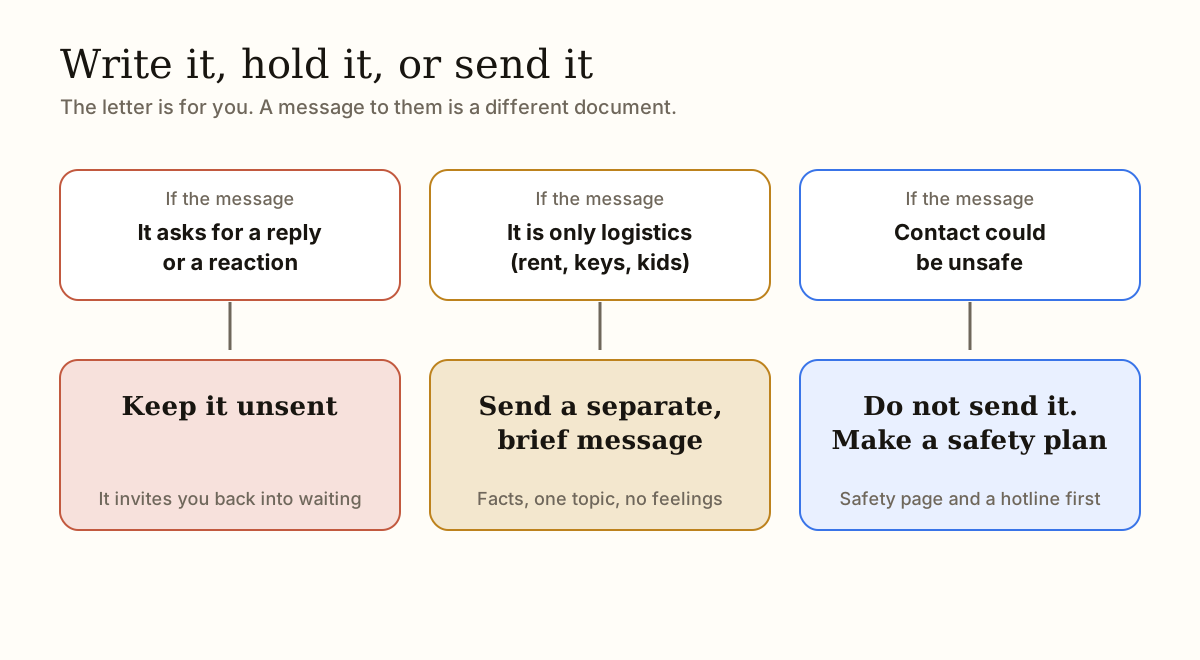
Practical matters are a separate document. If there is shared housing, children or money to sort out, keep that message brief, factual and limited to the issue. Mixing the letter and the logistics tends to make both harder. If you need help deciding, the private decision tool can help you think through the next step.
Where to go next
An unsent letter is one part of recovery, not the whole process. Writing can help you name what happened, but you will also need daily structure, support from people who are present and a plan for the moments when the urge to contact is strongest. How to stop thinking about your ex covers the rumination that often follows a breakup, and what to do instead of texting your ex gives you options for the hardest moments.
If you want a private place to put a message you were about to send, the 90-second urge reset includes an unsent-message box. UnLink, a free no-contact tracker for iPhone, also has a Vault in Premium that holds unsent letters alongside reasons and future-self notes, all on your device.
Step-by-step plan
- Choose a private place and set a timer
Pick a place where nobody can read your screen, and set a timer for 15 minutes so the session has a clear end.
- Start with “Dear [first name],”
Begin the letter with the person’s name, then keep writing without stopping to edit or reread what you have written.
- Answer one or two prompts
Choose a prompt from the list, such as “What I miss most is…”, and finish the sentence in several ways if you want to.
- Stop when the timer ends
Finish the sentence you are on and stop writing, even if you feel there is more to say. You can return tomorrow.
- Write one closing line for yourself
Finish with one sentence about what you need from yourself today, such as rest, a walk or a call with a friend.
- Save it privately and step away
Store the letter in a private note or in your Vault, close the app and do something physical or social.
- Reread after 48 hours
Reread the letter once, note one sentence that still feels true and one that has changed, then decide whether to keep it.
You do not have to solve the whole relationship tonight. Take one private step that creates space between the feeling and the action.
Try the closure letter builder →Common questions
How do you write an unsent letter to an ex?
Set a timer, address the letter to your ex by name, and write without editing for their reaction. Use a prompt such as what you miss or what you are angry about. Keep it private, do not send it, and decide later whether to keep, reread or delete it.
What should I write in an unsent letter?
Write about your own experience: what you miss, what you wish they understood, what you are grieving and what you need from yourself now. Avoid writing to win an argument or to get a particular reaction, since that keeps you focused on their response.
Do unsent letters to an ex actually work?
For many people they help, but the evidence is modest. A meta-analysis of 146 randomized studies found a small average benefit from expressive writing (Frattaroli, 2006). It tends to work best in short sessions and alongside other support, not as a stand-alone fix.
Is writing an unsent letter to my ex healthy?
It can be, if it helps you put feelings into words and you stop after a set time. It becomes unhelpful if you reread it constantly, edit it to persuade them, or feel more hooked afterwards. If that happens, stop and switch to a different form of support.
Should I send my unsent letter to my ex?
In the early stages of no contact, sending it is usually not a good idea, because it is written at the height of emotion and tends to invite a reply. Practical messages about shared responsibilities are different, and should be brief and factual.
What do I do with an unsent letter after I write it?
Save it privately, reread it after a couple of days, and note what still feels true. Some people delete or tear up the letter as a ritual. Others keep it in a private vault or note. The important part is a deliberate decision rather than returning to it at night.
How long should an unsent letter be?
There is no required length. A 15-minute session is a good guide, which for most people means one to three pages. Stopping when the timer ends matters more than finishing every thought, and you can write another letter tomorrow.
Can an unsent letter give me closure?
It can help you feel more finished, because you say what you never got to say. It cannot give you their answers or an apology. Closure that you build yourself tends to hold up better than waiting for a reply that may not come.
If contact involves threats, stalking, coercion, shared children, housing or immediate safety, a general no-contact rule may not fit. Read the safety guidance and seek qualified local help where appropriate.
Sources and further help
- Pennebaker JW (1997), Writing about emotional experiences as a therapeutic process, Psychological Science
- Frattaroli J (2006), Experimental disclosure and its moderators: a meta-analysis, Psychological Bulletin
- Larson GM & Sbarra DA (2015), Participating in research on romantic breakups promotes emotional recovery via changes in self-concept clarity
- Marshall TC (2012), Facebook surveillance of former romantic partners: associations with postbreakup recovery and personal growth, Cyberpsychology, Behavior, and Social Networking
- National Domestic Violence Hotline: Plan for safety
- 988 Suicide & Crisis Lifeline — US crisis support
Research is cited to explain general patterns, not to diagnose or predict any individual outcome. Sources do not endorse UnLink. Read our editorial principles.
Keep this support one tap away.
UnLink is a free, private no-contact tracker for iPhone: count your days, get through urges and restart without losing your history.