Why Do I Miss My Ex? What the Missing Is Really Made Of
Why do I miss my ex? Five things hide inside the missing, plus a test for each, a lonely-or-them check, and what to do on a bad night. No ex-mind-reading.
 By the UnLink Editorial Team · General educational guidance, not therapy
You miss your ex because attachment, routine and identity don’t switch off when a relationship ends, and your brain treats the loss like a craving. Missing someone is normal. It doesn’t prove the relationship was right or that they miss you. It tells you what you lost, and that is worth reading before you act on it.
- Missing an ex is a normal reaction to losing a person, a routine and a version of yourself at once. It says nothing about whether you should get back together.
- A brain-imaging study of people recently rejected in love found that looking at the ex activated reward and craving regions (Fisher et al., 2010). The pull is a craving, not a verdict.
- Five different things hide inside “I miss them”: a routine gap, an identity gap, an unfinished story, a body habit and fear of being alone. Each has a test question and needs a different response.
- The missing often gets louder once early shock and logistics wear off, and it spikes around quiet evenings and shared dates. Spikes are not a sign you are going backwards.
- The missing does not have to disappear to stop steering your decisions. Name it, find the driver, do one small matching thing, and write the message instead of sending it.
Why do I miss my ex so much?
Because a breakup takes away several things at once, and your mind files all of them under one name. The person is gone. So is the Tuesday-night routine, the plans you had half-built, the friend group that came as a package, and the version of you who was one half of a pair. “I miss them” is often shorthand for all of it.
Part of the pull is biology you didn’t choose. Fisher and colleagues (2010) scanned people who had recently been rejected but were still in love while they looked at photos of their ex. Regions linked to reward, motivation and craving became active. It is a small imaging study, so treat it as a clue and not a rulebook, but it fits what many people describe: the missing feels less like a thought and more like wanting.
That is why “I miss them” can feel urgent even when you know, in daylight, that the relationship wasn’t working. Wanting and judging are two separate systems, and they don’t always agree.
Does missing my ex mean we should get back together?
No. Missing tells you what you lost. It does not tell you whether the relationship worked, whether the problems that ended it have changed, or whether the other person misses you.
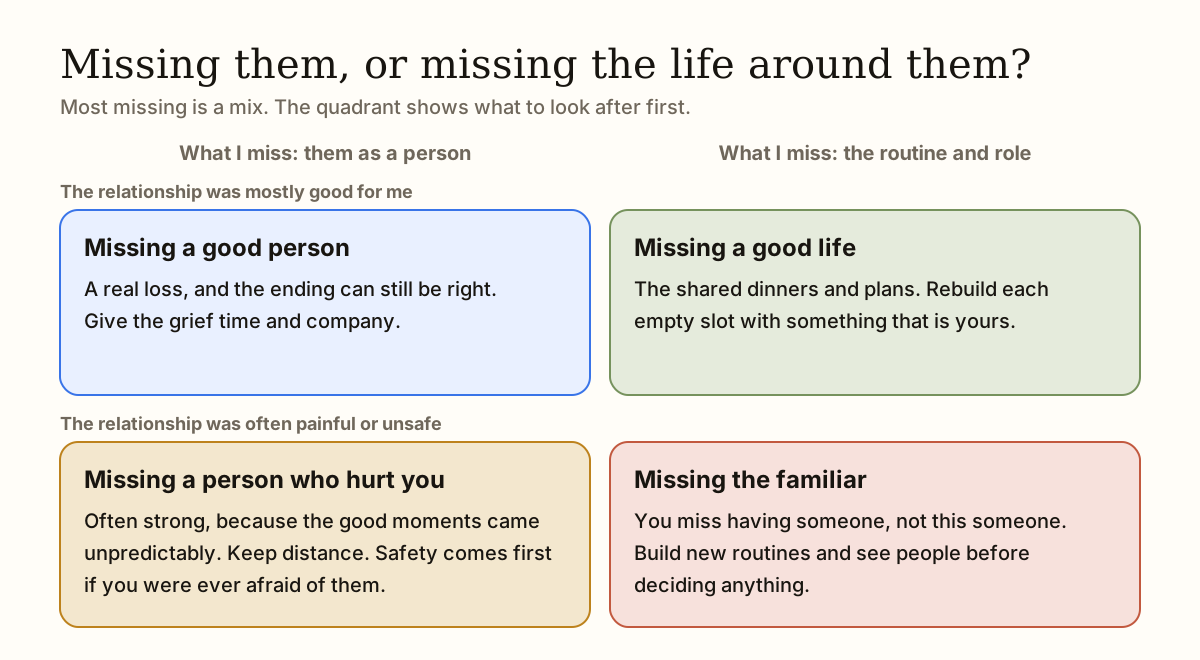
People miss relationships that were good for them and relationships that weren’t, so the feeling alone can’t sort them. What can help is asking two questions instead of one: what am I missing (them specifically, or the life around them), and how was the relationship day to day. The grid below puts the four combinations side by side.
- Top left, a good person. This is the hardest one. The loss is real, and the ending can still be right. Give the grief time and don’t treat it as a sign you made an error.
- Top right, a good life. You miss Sunday dinners and the plans. The routine can be rebuilt without the person.
- Bottom left, someone who hurt you. Strong pull, and a poor guide to what is good for you. More on this below.
- Bottom right, the familiar. You want to have someone, and they are who you had. New routines and other people test this quickly.
Am I missing my ex, or am I just lonely?
Often both, and they are separable. Loneliness is wanting company. Missing a particular person is wanting that person. The NHS notes that you don’t have to be on your own to feel lonely, and that people feel lonely in relationships and around friends and family too (NHS, “Get help with loneliness”). A breakup can leave you lonely and missing someone in the same hour.
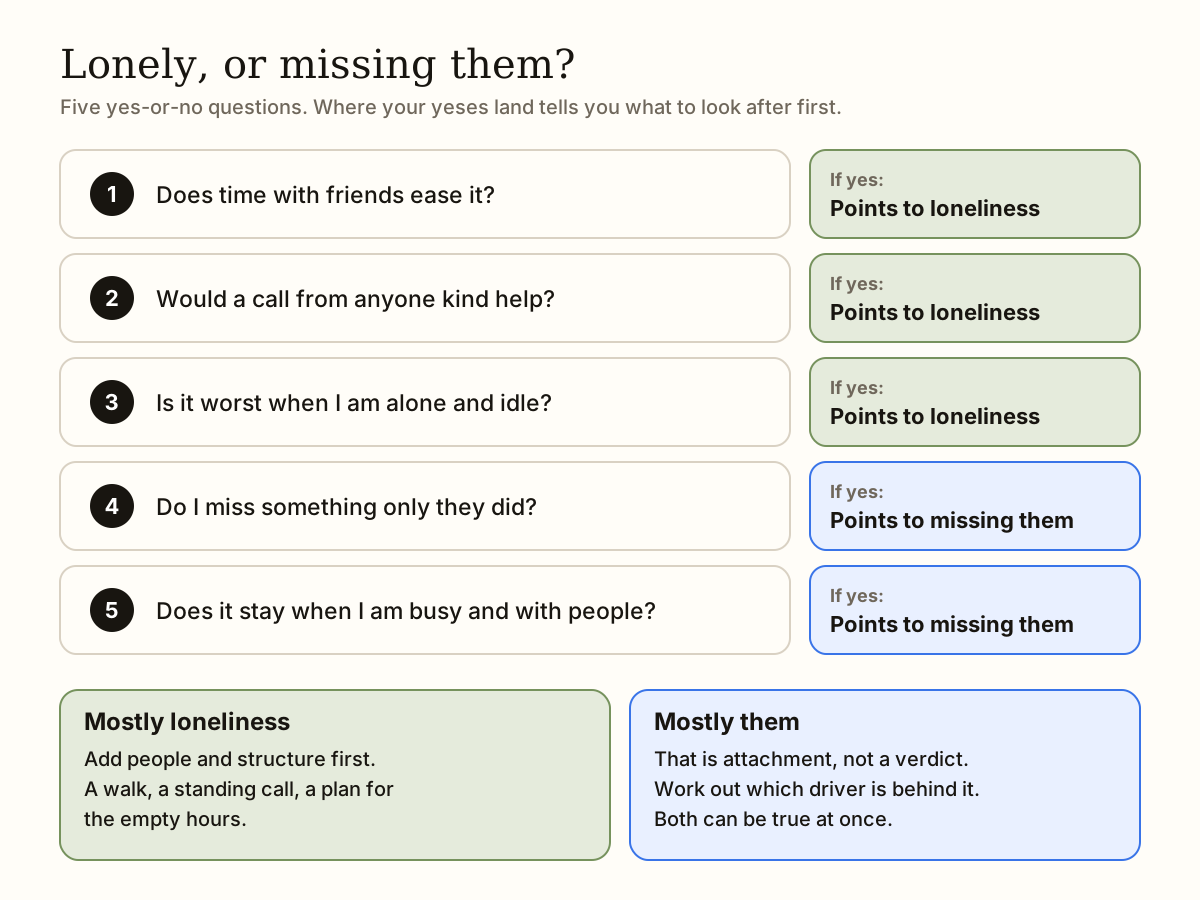
Try the friend-call test. Picture a warm, easy phone call with someone you like. If that would take the edge off, a good part of what you are feeling is loneliness. If the edge stays and only their voice would do, it is closer to missing them.
- Mostly loneliness: the fix is people and structure. A standing call, a class, a walk with someone, a plan for the hours that used to be theirs. The recovery plan in our breakup guide has a week-by-week version.
- Mostly them: loneliness advice won’t finish the job. Read the five drivers further down and find which one is behind it.
Why do I miss my ex more now than I did a month ago?
Because what was holding the missing off has worn away. In the first stretch there is shock, anger, logistics, friends checking in and a head too busy to feel much. Then the practical things get sorted, the messages thin out, and the quiet arrives. For many people, that is when the missing gets louder, not quieter. It can feel like going backwards. It usually isn’t.
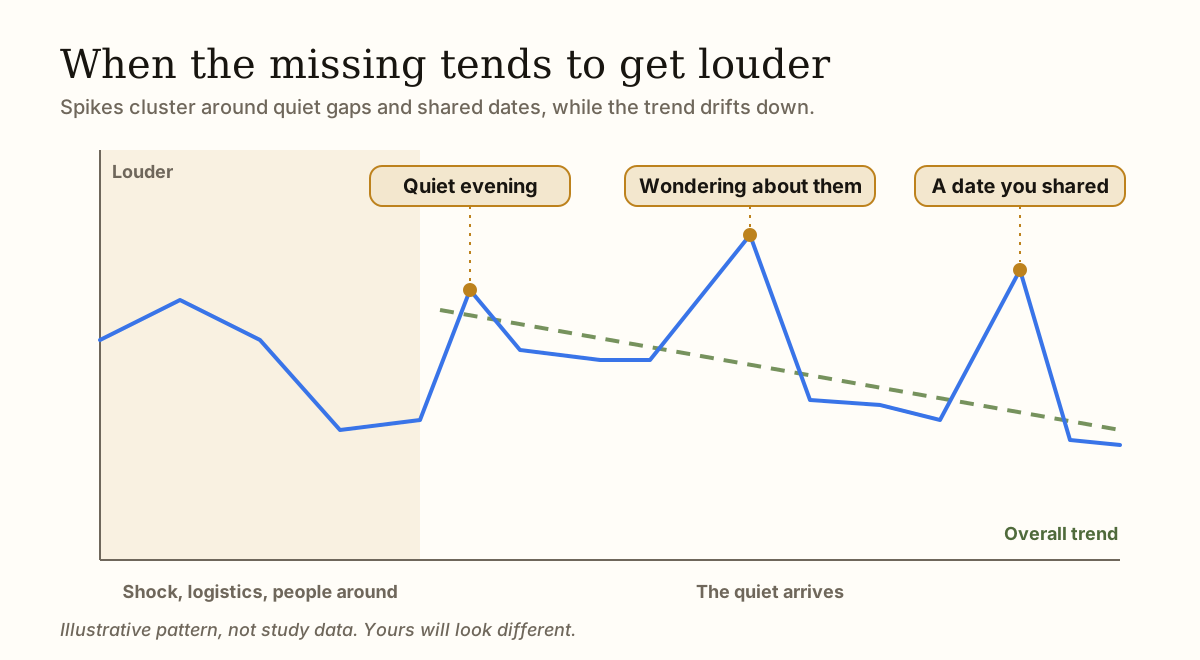
It also tends to cluster. Quiet evenings, a song in a shop, a date you used to share, a mutual friend’s mention of them. If it spikes after you have looked at their profile, that matters too: a 2012 study of 464 people after a breakup found that monitoring an ex’s Facebook was associated with more distress and longing and with less personal growth (Marshall, 2012). That study is correlational, so it can’t say which came first, but it is a reason to check how much looking has crept back in. Our guide on how to stop checking your ex’s social media covers the setup.
A forecasting study may take some pressure off. Eastwick and colleagues (2008) followed people through breakups and found that they overestimated how intense their distress would be, and the error came from expecting the first reaction to be worse than it was. A bad week is not a prediction of the next ten.
What is the missing actually made of?
“I miss them” bundles up to five different things. Most people have two or three running at once. The test question in the last column is the quickest way to tell which is loudest, and the answer matters because each one responds to something different.
| Driver | What it feels like | A missing-them thought that signals it | A test question |
|---|---|---|---|
| Routine gap | Restless at the same time every day. The hand reaches for the phone out of habit. | “It’s 6 p.m. and there’s nobody to tell about my day.” | Does it come at the same times, and ease when I fill that slot with someone or something? |
| Identity gap | Not sure what you like, what to do with a weekend, or who you are on your own. | “I was better when I was with them.” | Can I name three things I enjoy that never involved them? Do I feel like myself around old friends? |
| Unfinished story | Replaying the ending, rehearsing what you would say, wanting answers. | “If I could just explain what I meant.” | If they gave the answer I want, what would I actually do with it? Would I still have questions? |
| Body habit | A physical pull: chest tightness, the urge to check, a wave that rises and falls. | “I just need to see their name.” | Does it crest and fade within an hour, and spike after I look at something of theirs? |
| Fear of being alone | Dread about the future more than longing for this person. Almost anyone would do. | “What if nobody else ever comes along?” | Is the worry about who they are, or about being on my own? |
How do I tell which kind of missing I have right now?
Run the thought through the five drivers and see what it points at. The same sentence can ask for completely different things.
Example: week 6. It’s Sunday at 7 p.m. and you think, I miss them. Here are three ways that thought can be built, and what each suggests.
- Routine gap. Sunday at 7 was dinner together. The missing is about the empty slot. Move it: call a friend at that hour, or cook the dish they didn’t like.
- Unfinished story. You have been replaying the last conversation since lunch and drafting replies in your head. The missing is about the ending. Write the message into a note or an unsent letter and leave it unsent.
- Fear of being alone. You have been scrolling couples on your feed and the thought is “what if it’s always like this”. The missing is about the future. Tell one person how you feel, and run the lonely-or-them check above.
Why do I only remember the good times?
Because longing is an editor. When you are lonely and the evening is quiet, the mind pulls up the highlights: the trip, the in-joke, the way they laughed. The Tuesday argument and the three nights you felt small are filed somewhere less handy. The relationship you miss is rarely the whole relationship you had.
The fix isn’t to talk yourself into hating them. It is to put the missing back next to the rest. When the highlight reel starts, finish this sentence honestly: To miss the whole relationship, I would also have to miss…
- the argument we kept having and never finished
- the nights I felt lonely while we were in the same room
- something I stopped asking for to keep the peace
- the way I changed to fit, and what I gave up
- the reason it ended, said in their words and in mine
Is it normal to miss someone who treated me badly?
Yes, and it is more common than people admit. Missing doesn’t grade the relationship. It reflects attachment, habit and, when the warmth came unpredictably, a pattern that is especially hard to drop. A 2009 study of on-again, off-again couples found that they reported more uncertainty and fewer positives than couples who hadn’t broken up and renewed (Dailey et al., 2009). Unpredictable closeness can make the good moments feel more valuable than steady ones, which is part of why they can be so hard to leave behind. If that sounds familiar, read why you miss an abusive ex and limerence vs love.
If they ever frightened, controlled or hurt you: safety planning comes before any contact strategy, and leaving can raise risk. The National Domestic Violence Hotline is 1-800-799-7233, or text START to 88788. Our safety page has more, including international lines.
How do I stop missing my ex without pretending I never cared?
You don’t have to stop feeling it. You have to stop letting it make decisions. Missing someone you cared about is allowed to hurt. What you control is what happens between the feeling and the action.
A plan decided in advance works better than willpower in the moment. Gollwitzer (1999) reviewed research on if-then plans, where you decide beforehand “if X happens, I will do Y”, and found they help people follow through on intentions. Example: If I catch myself drafting a message, then I’ll write it in my notes and go for a ten-minute walk.
For rumination techniques, such as scheduling worry time and surfing urges, see how to stop thinking about your ex. For the late-night version, see why you want to text your ex at night. Nobody can promise how long it takes. Our guide on how long it takes to get over a breakup covers what lengthens it and what shortens it.
When is missing someone a sign to get support?
When it stops being missing and starts taking over your life. The NHS advises seeing a GP if you have symptoms of depression for most of the day, every day, for more than two weeks (NHS, “Symptoms: clinical depression”). Warning signs include barely eating or sleeping, being unable to work, pulling away from everyone, or relying on alcohol to get through the evening.
If you have thoughts of harming yourself or of not wanting to be here, get help now. In the US, call or text 988. In the UK and Ireland, call Samaritans on 116 123. In India, call Tele-MANAS on 14416. Elsewhere, contact your local emergency number. More options are on our safety page.
Step-by-step plan
- Name it without arguing with it
Say it plainly in your head or in a note: “I’m missing them right now.” You are not agreeing to act on it, only to stop fighting it.
- Find the driver
Run the thought through the five drivers: routine, identity, unfinished story, body habit, fear of being alone. Pick the closest match, even if it’s two.
- Do one small matching thing
Routine gap: fill the slot. Identity gap: do something that is yours. Unfinished story: write it down. Body habit: move, or ride the wave for a few minutes. Fear of being alone: tell a person.
- Put the message in a note, not in Messages
If you want to say something to them, write it where it can’t be delivered. Reread it tomorrow, and decide then.
- Log what came before it
Note the time, what you had been doing and what triggered it. After a week or two, the pattern usually shows itself.
You do not have to solve the whole relationship tonight. Take one private step that creates space between the feeling and the action.
Take the “Do I miss my ex?” quiz →Common questions
Is missing my ex a sign I made a mistake?
Not by itself. Missing is a reaction to loss, and it shows up after good decisions as well as bad ones. If you are wondering whether you made a mistake, compare the reasons it ended with how things were day to day, and wait until the pull is quieter before deciding.
Does missing someone mean they feel the same way?
No. Your feelings don’t tell you what is happening in another person’s head, and guessing keeps you stuck checking. Some people miss someone and still know the relationship was wrong. Focus on what you can know: how you feel and what you need.
How long does missing an ex usually last?
There is no reliable number. It often eases in waves, with spikes around quiet times and shared dates, and the trend matters more than any single night. Contact, looking at their profile and a long relationship can all stretch it. If it is getting worse over months, talk to a professional.
Why do I miss my ex even though they hurt me?
Missing reflects attachment, routine and the good moments, and it doesn’t cancel out the hurt. When warmth was unpredictable, the pull can be stronger, not weaker. If they were abusive, safety planning comes first. See why you miss an abusive ex.
Can missing someone be a sign of attachment anxiety?
It can be part of it. Attachment anxiety describes a tendency to worry about closeness and to feel distress when a bond is threatened, and it can make missing louder. It is a lens, not a diagnosis, and you can’t tell from missing alone. See anxious attachment after a breakup.
Should I text my ex because I miss them?
Missing someone is not a good enough reason on its own. A text sent at the peak of the pull usually resets it, and you can’t control the reply. Write the message in a note, wait until the wave drops, and then ask whether it serves your recovery. The Should I text my ex? tool walks you through it.
Is missing my ex normal if I ended the relationship?
Yes. You can end a relationship for good reasons and still grieve it. People who initiate breakups miss the routine, the person and the future they had planned, and often feel guilty on top. Missing them doesn’t mean you were wrong to leave.
Is it normal to still miss someone months later?
Yes, especially around anniversaries and big life moments. What matters is the trend: are the waves smaller and further apart? If the missing is getting heavier, or you can’t function, speak to a GP or therapist. The breakup recovery plan has a week-by-week map.
If contact involves threats, stalking, coercion, shared children, housing or immediate safety, a general no-contact rule may not fit. Read the safety guidance and seek qualified local help where appropriate.
Sources and further help
- Fisher et al. (2010) — Reward, addiction, and emotion regulation systems associated with rejection in love
- Eastwick et al. (2008) — Mispredicting distress following romantic breakup: revealing the time course of the affective forecasting error
- Marshall (2012) — Facebook surveillance of former romantic partners: associations with postbreakup recovery and personal growth
- Dailey et al. (2009) — On-again/off-again dating relationships: how are they different from other dating relationships?
- Gollwitzer (1999) — Implementation intentions: strong effects of simple plans
- NHS — Get help with loneliness
- NHS — Symptoms: clinical depression
- The National Domestic Violence Hotline — Plan for safety
- 988 Suicide & Crisis Lifeline — US crisis support
Research is cited to explain general patterns, not to diagnose or predict any individual outcome. Sources do not endorse UnLink. Read our editorial principles.
Keep this support one tap away.
UnLink is a free, private no-contact tracker for iPhone: count your days, get through urges and restart without losing your history.