Why Do I Keep Dreaming About My Ex?
Why do I keep dreaming about my ex? Dreams like this are common after a breakup. What the research supports, what it does not, and what to do the morning after.
 By the UnLink Editorial Team · General educational guidance, not therapy
You keep dreaming about your ex most likely because they are still on your mind while awake, and your sleep is probably lighter than usual. It does not mean they miss you, and it is not a sign to reconnect. In the one small study on this, dreams of an ex tracked waking concern about them.
- Dreaming about an ex is common after a breakup, and the most likely explanation is the plainest one: they are on your mind during the day, and your sleep is under strain.
- No research shows that a dream reflects what your ex is thinking, predicts the future or is a sign to get back in touch.
- Dream science is real but limited. A leading hypothesis says REM sleep helps process emotional memories; it is a hypothesis, not proof that any particular dream is doing that job.
- The morning after is where you have control. A three-line note, no messages and a normal breakfast keep the dream from running your day.
- If the dreams are nightmares, wake you every night, or come from an abusive relationship, treat the sleep problem as its own problem and get support.
Why do I keep dreaming about my ex?
You keep dreaming about your ex because they are still a large part of your waking thoughts, and your sleep is probably less settled than usual. That is the plain version, and it is better supported than any symbol.
The best study we found comes from the psychologist Rosalind Cartwright and colleagues, published in 2006 in Psychiatry Research. They followed 30 people going through a divorce for five months (20 were depressed and 10 were not), and woke them during REM periods to record their dreams. The degree of waking concern about the ex-spouse correlated significantly with the number of dreams in which the ex appeared. In other words, the more someone was thinking about their ex during the day, the more often the ex turned up at night.
It is a small study of divorcing adults, so we should not stretch it. It does back up something most people already half know: your mind keeps working on what it cannot put down. If you want techniques for the daytime side of that, how to stop thinking about your ex covers them, and why do I miss my ex explains what the missing is made of.
You can dream about someone you are certain you are over, and about someone you have not spoken to in a year. A dream is not a measurement.
Does dreaming about my ex mean they miss me?
No. We found no research showing that your dream reflects what another person is thinking or feeling. A dream is made in your own head, from your own memories, and it tells you about you.
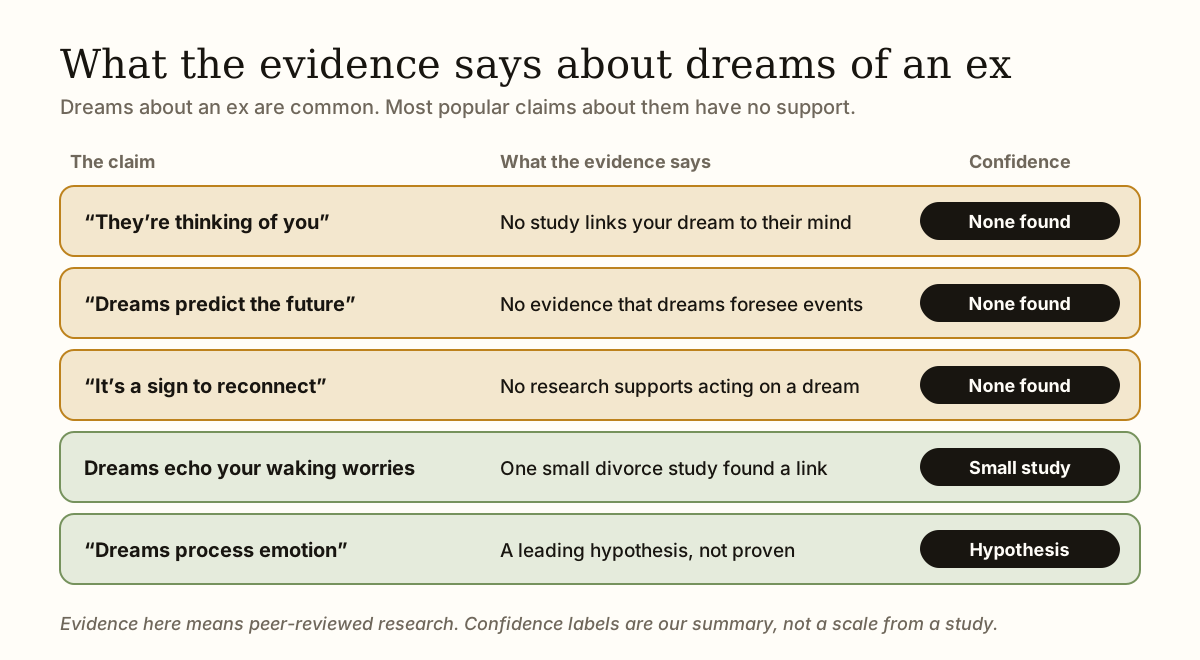
This is the claim readers hope is true, which is why so many pages repeat it. Being honest here matters more than being comforting, because a hopeful myth leads straight to the thread you are trying not to open. This table sorts the common claims by what the evidence supports.
| The claim | What the evidence says | How much weight it deserves |
|---|---|---|
| “It means they are thinking of you” | We found no study that links your dream to another person’s thoughts. Dreams are produced by your own brain. | None. Do not act on it. |
| “Dreams predict the future” | No evidence that dreams foresee events, including whether you will get back together. | None. |
| “It is a sign to reconnect” | A dream is not a decision, and no research shows that dreaming of an ex improves a reunion or your wellbeing. | None. The feeling is real; the instruction is not. |
| “Dreams echo what you are worried about” | Cartwright and colleagues (2006) found that waking concern about an ex-spouse correlated with how many dreams featured them, in 30 divorcing adults. | Modest. One small study, correlational, in divorce. |
| “Dreams help process emotion” | A review by Walker and van der Helm (2009) proposes that REM sleep reprocesses recent emotional experience. It is a model and a hypothesis, not a finding about any single dream. | Limited. Plausible, and still debated. |
Do dreams about an ex mean anything?
They can mean something about you, but we cannot read it like a code. The research supports two cautious ideas: dreams follow what is on your mind, and sleep seems to play a role in how emotional memories are handled.
The second idea has a name. In a 2009 review in Psychological Bulletin, Matthew Walker and Els van der Helm outlined a model in which sleep, and REM sleep in particular, reprocesses recent emotional experiences so that the next day’s emotional reactions are calmer. They proposed it as a hypothesis, and the review is not a study of people after a breakup. So the claim that “your brain is healing you while you sleep” is a theory with some support, not a fact you can promise anyone.
What the research does not support is symbolism: the idea that a flooded house stands for X or that seeing them with a new partner stands for Y. Those meanings are stories, and they are usually told with a confidence the science does not have.
A useful rule: a finding says what was measured in some people. A theory explains why it might happen. A page that gives your dream one fixed meaning is selling a theory.
What might the dream be carrying?
Treat the dream as a set of prompts, not symbols. Look at what was in it, then ask yourself a question you can answer while awake. The goal is to learn something about your current week, not to decode the dream.
| Pattern in the dream | What it might be carrying | A question to ask yourself |
|---|---|---|
| An unfinished conversation, or you could not speak | Words you have not said, which may belong in a letter you do not send | What do I most want them to know? Could I write it down instead? (Unsent letter guide) |
| A familiar place: the kitchen, the car, their street | A memory of routine, the way a place holds a feeling | What part of my daily routine used to include them, and what could replace it? |
| A body memory: waking up warm, or feeling held | Missing touch or company, which is a physical need as well as an emotional one | Who else can I spend time with this week, and when did I last be touched kindly? |
| The time of day: the dream is always an evening or a morning | A time when you used to talk, text or see them | Is this the hour I used to hear from them? What can I put in that hour? |
| Something stressful in waking life, with your ex as the backdrop | Your mind reaching for a familiar figure while you are under pressure | What is stressing me this week that has nothing to do with them? |
Why are the dreams worse some nights?
Dreams about an ex tend to be worse on nights when your sleep is disrupted or your mind has been on them, such as after checking their profile or after a drink. We did not find a study that tested dreams of an ex against alcohol or phone use, so this is a reasoned pattern, not a measured one.
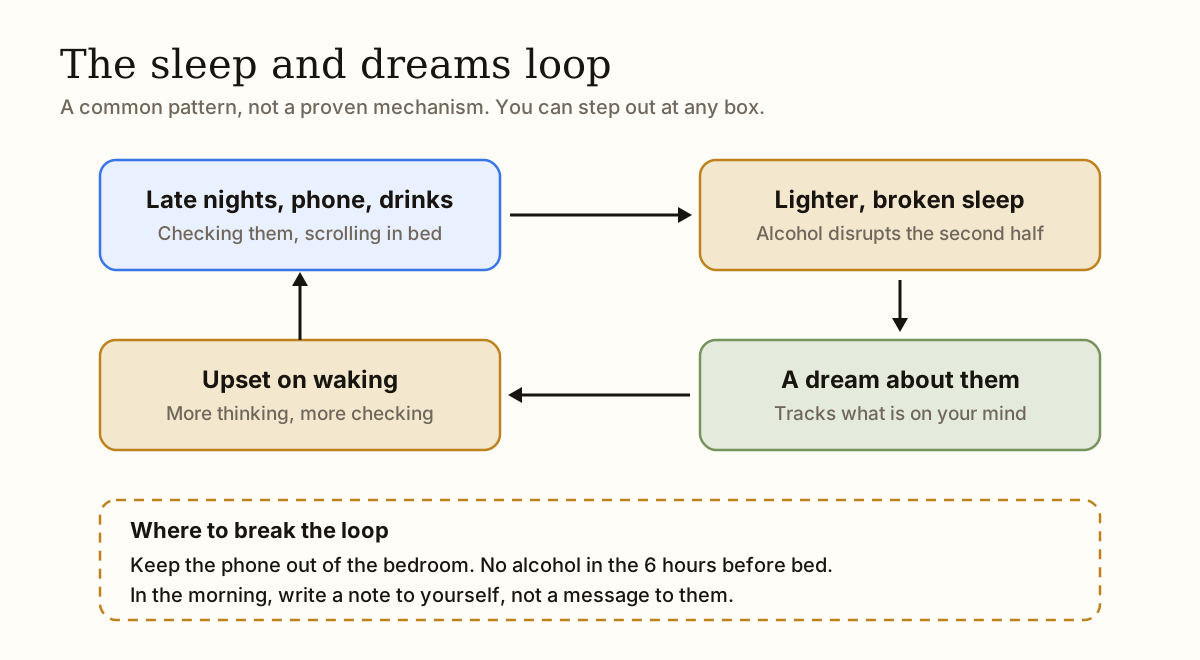
What is established is how alcohol affects sleep. A 2013 review of the studies in healthy volunteers by Ebrahim and colleagues found that alcohol shortens the time to fall asleep, but increases sleep disruption in the second half of the night, and that total REM sleep percentage fell in most studies at moderate and high doses. That is the opposite of the restful sleep you want while your brain is working through a breakup.
The NHS advises avoiding alcohol, smoking and caffeine for at least six hours before bed, and putting down your phone and other devices before sleep. That advice is for insomnia in general, but it is a sensible baseline here too.
Add the daytime piece from the Cartwright study, and you get a loop: late-night checking and drinking, broken sleep, a dream about them, an upset morning, and more checking. You can step out at any box. If the night is the hard part, why you want to text your ex at night and can’t sleep after a breakup go further, and how to stop checking your ex’s social media covers the scrolling.
What should I do the morning after a dream about my ex?
Write three lines, then get up and do something ordinary. The morning is when the dream either runs your day or gets filed away, and a short note filed in your own phone is the difference. Do not reach for your phone to check on them first.
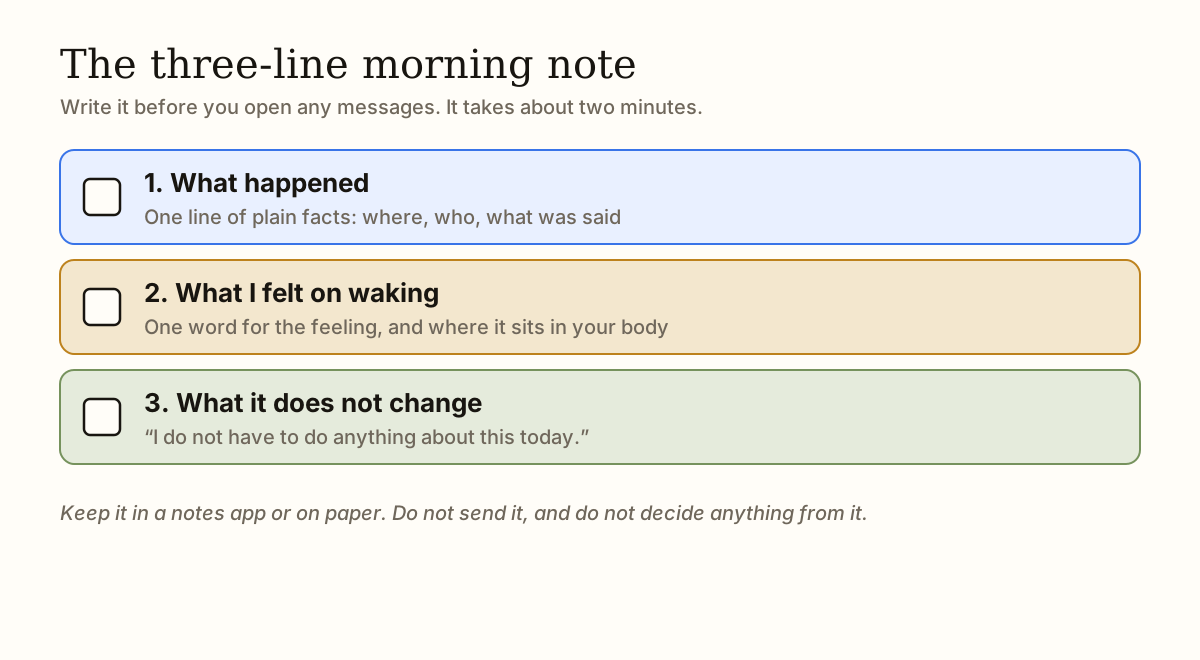
Expressive writing has a modest evidence base. In a 1997 paper, James Pennebaker described studies in which people who wrote about emotional experiences showed better health and wellbeing outcomes than those who wrote about neutral topics. A three-line note is a very small version of that, and it gives the feeling somewhere to go that is not their inbox.
Example: week 4. You wake up at 6:40 a.m. after dreaming that you were in your old kitchen, and they were making coffee as if nothing had changed. Your chest feels heavy. Before you look at your phone, you write: “Dreamed of the kitchen. They were just there, making coffee.” “Sad and a bit hopeful, in my chest.” “This does not change anything about today.” You close the notes app, drink water, and take a shower. At 7:15 a.m. you feel flat, not good. That is allowed. The dream was not an instruction.
Should I contact my ex after dreaming about them?
No, and you do not need to tell them about the dream either. A dream is a reason to look after yourself, not a reason to message someone. If the plan is to send a message because of a dream, nothing in the dream has changed what you decided about no contact.
Telling an ex “I dreamed about you” usually does one of two things: it sparks a conversation you were not ready for, or it gets silence and leaves you feeling worse. Both are worse than a note in your own phone. If you want an outlet, what to do instead of texting your ex has options for the first hour after you wake.
If you are asking whether the dream means you should get back together, the honest answer is that the dream does not know. A fresh feeling at 6:40 a.m. is a poor moment to decide anything. The do I miss my ex quiz separates the missing from a wish to reunite, and closure after a breakup is for the questions the dream keeps raising.
How long do dreams about an ex last, and how do I stop them?
Nobody can give you a number, and we will not invent one. If dreams of an ex follow waking concern, as the Cartwright study found, they tend to fade as the waking preoccupation fades. That is a reasoned expectation rather than a measured one.
You cannot switch dreams off, but you can influence the conditions. Protect your sleep, go easy on alcohol, keep the phone out of bed, and give the waking thoughts a time and place, such as a short note or a walk. The timeline for the wider recovery is in how long it takes to get over a breakup.
Signs the dreams are easing: they come less often, they are less vivid, you wake up less upset, or your ex appears as a minor figure rather than the center. One strange dream a month later does not mean you are back at the start. Zoom out to the weeks, not the single night. The wider plan for recovery is in how to get over a breakup.
When should I worry about dreams of an ex?
Worry when the dreams are nightmares, when they wake you most nights for weeks, or when you dread going to sleep. Ordinary dreams of an ex are upsetting but common. Disturbed sleep that lasts is a health matter in its own right.
The NHS notes that if changing your habits has not helped, if you have had trouble sleeping for months, or if poor sleep makes daily life hard to manage, you should see a GP. It defines short-term insomnia as under three months. If you are in the US, a primary care doctor or therapist is the equivalent first step.
If your ex was frightening, controlling or abusive, vivid dreams or nightmares are not a sign you should go back, and the pull you feel does not mean the relationship was good. Why do I miss my abusive ex explains that pull. Our safety page lists support, including the National Domestic Violence Hotline (1-800-799-7233, or text START to 88788).
If low mood, hopelessness or thoughts of self-harm come with the sleep trouble, contact someone today. In the US, call or text 988. In the UK and Ireland, Samaritans is on 116 123. In India, Tele-MANAS is 14416.
You do not have to solve the whole relationship tonight. Take one private step that creates space between the feeling and the action.
Take the do I miss my ex quiz →Common questions
Do dreams about your ex mean anything?
They can tell you something about what is on your mind or what you are missing, and that is all the research supports. A small 2006 study of divorcing adults found that waking concern about the ex tracked how often the ex appeared in dreams. No research supports fixed symbolic meanings.
Is it normal to dream about an ex months after a breakup?
Yes. Dreams do not follow a calendar, and an old relationship can show up in sleep long after it ends, especially during stress or poor sleep. A dream months later does not mean you are back at the start. Look at the trend across weeks.
Can dreaming about someone mean they are thinking about you?
No. We found no research showing that your dream reflects another person’s thoughts or feelings. A dream is built from your memories and what is on your mind. Please do not take it as a reason to reach out.
Why do I dream about my ex when we are not talking?
Not talking does not mean not thinking. Your mind can keep returning to a person you are not in contact with, and dreams tend to follow what is on your mind. If you are in no contact, the dreams are not a sign it is failing.
Does alcohol make dreams about an ex more likely?
We found no study that tested that exact question. Alcohol does disrupt sleep, and a 2013 review found it increases disruption in the second half of the night and tends to reduce total REM at moderate and high doses. Disturbed sleep is a reasonable suspect, not a proven cause.
Should I tell my ex about the dream?
No. Telling them rarely goes the way you hope, and it breaks no contact. Write the dream down in your own phone instead. If you still want to say something in a month, you can decide then, with a calmer head.
Why do I wake up upset after dreaming about my ex?
A dream can feel real, so you wake up with the feeling before you have caught up with the facts. Write three lines, drink water, get light and move your body before you check your phone.
Why do I keep dreaming about my ex after no contact?
No contact removes the messages, not the memories. Your mind is still doing the work of letting go, and dreams can follow that work. Dreams after no contact are not a sign you did it wrong, and they are not a reason to reach out.
How do I stop having dreams about my ex every night?
You cannot turn dreams off, but you can improve your sleep: keep the phone out of bed, avoid alcohol for six hours before sleep, keep regular hours and write a short note in the morning. If nightly dreams are nightmares or you are not sleeping, speak to a doctor.
If contact involves threats, stalking, coercion, shared children, housing or immediate safety, a general no-contact rule may not fit. Read the safety guidance and seek qualified local help where appropriate.
Sources and further help
- Cartwright, Agargun, Kirkby & Friedman (2006). Relation of dreams to waking concerns. Psychiatry Research, 141(3), 261-270.
- Walker & van der Helm (2009). Overnight therapy? The role of sleep in emotional brain processing. Psychological Bulletin, 135(5), 731-748.
- Ebrahim, Shapiro, Williams & Fenwick (2013). Alcohol and sleep I: effects on normal sleep. Alcoholism: Clinical and Experimental Research.
- NHS. Insomnia: self-help tips and when to see a GP.
- Pennebaker (1997). Writing about emotional experiences as a therapeutic process. Psychological Science.
- National Domestic Violence Hotline: plan for safety.
- 988 Suicide & Crisis Lifeline.
Research is cited to explain general patterns, not to diagnose or predict any individual outcome. Sources do not endorse UnLink. Read our editorial principles.
Keep this support one tap away.
UnLink is a free, private no-contact tracker for iPhone: count your days, get through urges and restart without losing your history.