What Is Closure in a Relationship? How to Find It Without Them
What is closure in a relationship, and can you get it without your ex? What you can build alone, what depends on them, and when asking is unsafe.
 By the UnLink Editorial Team · General educational guidance, not therapy
Closure in a relationship is the sense that it has ended and you can stop waiting for it to resolve. It is not a conversation with your ex, and it usually doesn’t need one. Most of it you build yourself: your own account of what happened, a decision about what to keep, and an end to waiting.
- Closure is a feeling of an ending, not an event. It is not a validated clinical measure, and the word means different things to different people.
- Most of what people want from closure can be built alone: an account of what happened, a decision about what to take forward, and permission to stop waiting.
- Asking an ex for closure often reopens contact. In a 2026 study of 859 adults, continuing to try to contact an ex went with less closure, though that is an association, not proof of cause.
- If you ask anyway, send one short message that does not need an answer, after writing the unsent version first, and never when the ending involved threats, stalking or control.
- You can move on without an explanation. You need your own reasons for leaving the question behind, not theirs.
What is closure in a relationship?
Closure in a relationship is the sense that it has ended and that you can stop waiting for it to resolve. That is all it needs to be. It isn’t an apology, a final conversation or a tidy explanation, although any of those can help some people feel it.
When people say “I need closure”, they usually mean one or more of three things. They want to understand why it ended. They want the other person to acknowledge the hurt. Or they want the ending itself: to stop checking, stop drafting messages, stop feeling that something is still open. Only the middle one depends entirely on the other person. You can build most of the first and all of the third.
The research is thinner than the word suggests. In a 2026 survey study, 859 adults reflected on a significant breakup, and feeling more closure went with time passing, having been the one who ended it and being in a new relationship, while attachment anxiety and continuing to try to contact the ex went with less (Roe et al., 2026). Those are associations from self-reports, not causes. They also point away from the ex’s explanation and towards time, your own state and what you do next.
Sociologist Nancy Berns, who studied how the idea of closure is used in grief, media and relationship advice, argues that it is a vague, socially constructed notion that means something different to each person (Berns, 2011). We use it here as a working label for “I can stop waiting now”, not as something you can measure or fail.
Can you get closure without the other person?
Yes, for the most part. The pieces you can build alone are your account of what happened, the lessons you want to keep, and the decision to stop waiting.
Structured reflection is the best-supported way to do it. In a study of people who had been through a breakup, those who took part in sessions reflecting on it reported a clearer sense of who they were afterwards, and that clearer self-concept accounted for their lower distress (Larson & Sbarra, 2015). Pennebaker’s 1997 review of expressive-writing research found that writing about upsetting experiences was associated with better health outcomes. Neither study measured “closure” as such, but they are the reason the unsent letter is the usual first step. Our guide to writing an unsent letter has the prompts, so we won’t repeat them here.
Example: you want to know why they stopped answering. You can’t get their reasons. You can get a paragraph called “What I think happened”, built from dates, things you saw and things you were told at the time. Then a second paragraph called “What I will never know”. Write both. The second paragraph is where closure usually lives, because it is the moment you put a boundary around the question instead of leaving it open.
Rumination is often a search for exactly this: the mind keeps replaying the relationship hoping to find the sentence that finishes it. If that is what your nights look like, how to stop thinking about your ex covers the techniques, and this page covers the thing the thinking is looking for.
How do you get closure from an ex, and should you ask?
Asking an ex for closure usually backfires, and the question comes with a safety gate: if the ending involved threats, stalking, control or fear of how they would react, skip this section and read the last one instead.
For everyone else, there are three reasons to be cautious. The answer you get is rarely the answer you wanted, because people give short, partial or self-protecting reasons, or none. Asking restarts the waiting, because now you are waiting for a reply. And whatever they say becomes the next thing to analyze at 2 a.m. In the 2026 study above, continued attempts to contact the ex went with less closure, not more.
If you have thought it through and still want to ask, there is one format that keeps the cost low. Write the message you actually want to send, then wait 48 hours. Send it once. Keep it short and specific. Ask one thing at most, set no deadline, and make it fine for them to say nothing. Before you send, decide what you will do if the reply is silence, in if-then form: “If I haven’t heard back by Sunday, then I will go for a walk and I will not send a second message.” Plans in that form help people follow through on what they intended (Gollwitzer, 1999).
A message you are relying on them to answer is not a closure message. It is a request for a conversation, and it hands them control of your timing.
| Version | What you would send | What it tends to lead to | Verdict |
|---|---|---|---|
| The open request | “Can we talk about what happened? I need to understand.” | A delay (“not a good time”), a vague answer, or a long reply that restarts the argument. They control the timing and you wait. | Avoid |
| The one-question version | “I’d like to understand one thing about how things ended. Only if you’re comfortable answering. No problem if not.” | A short answer, a partial one or silence. Contained, but you still have to cope with all three. | Acceptable once, if it is safe to contact them |
| The version that does not invite a reply | “I’m not asking for anything back. I wanted to say that how this ended was hard for me, and I hope you’re okay.” | Often no reply, which is the point. The risk is that you secretly hope for one. | Write it, wait 48 hours, then decide whether you need to send it at all |
What closure can you give yourself, and what depends on them?
You can give yourself four of the five things people usually mean by closure, at least in part. Only an apology is out of your hands completely.
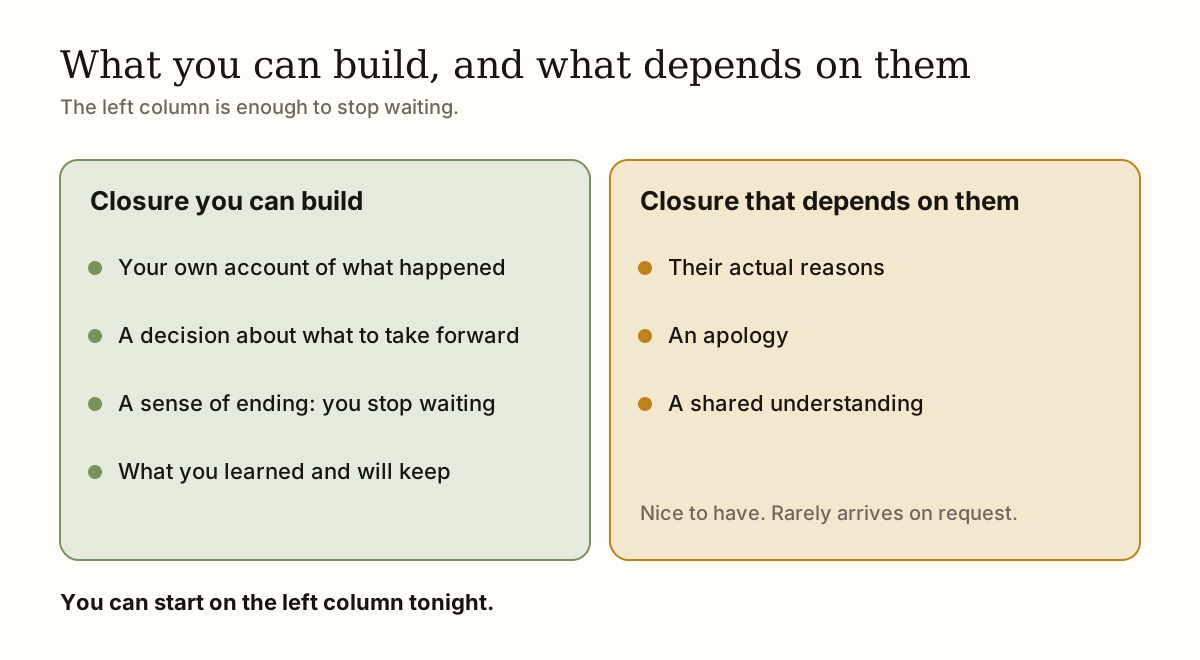
The table is a decision tool. For each thing you are waiting for, ask whether you can build it, whether it needs them, and whether asking is worth the risk. Most people find the “needs them” column is shorter than they feared.
| Closure element | Can I give it to myself? | Does it depend on them? | Is asking safe or worthwhile? |
|---|---|---|---|
| An explanation | Partly. You can write your own account from what you saw. | Their actual reasons are only theirs. | Low reward. Once at most, and only if there is no safety concern. |
| An apology | You can acknowledge the harm to yourself, but not receive an apology. | Entirely. | Asking for one usually produces a defence. Not recommended. |
| Understanding what happened | Largely. Timeline, patterns, your part, what you will do differently. | A shared understanding needs them. | You don’t need to ask to understand your own experience. |
| A decision about what to take forward | Yes, fully. | No. | Nothing to ask. |
| A sense of ending | Yes. It is a decision to stop waiting. | No. Contact tends to reopen it. | Nothing to ask. |
How do you move on without closure, or when an ex ghosted you?
You move on without closure by deciding what you know, what you can’t know, and what you will do with the gap. You don’t need their reasons to leave a relationship. You need yours.
Being ghosted makes this feel impossible, because there is no ending to hold. It helps to separate what you actually have from what you wish you had. What you have: they chose not to explain. What you don’t have: the reason, and no message can make them give it. It tells you something about how they handled the ending. It tells you nothing about whether you were worth an explanation.
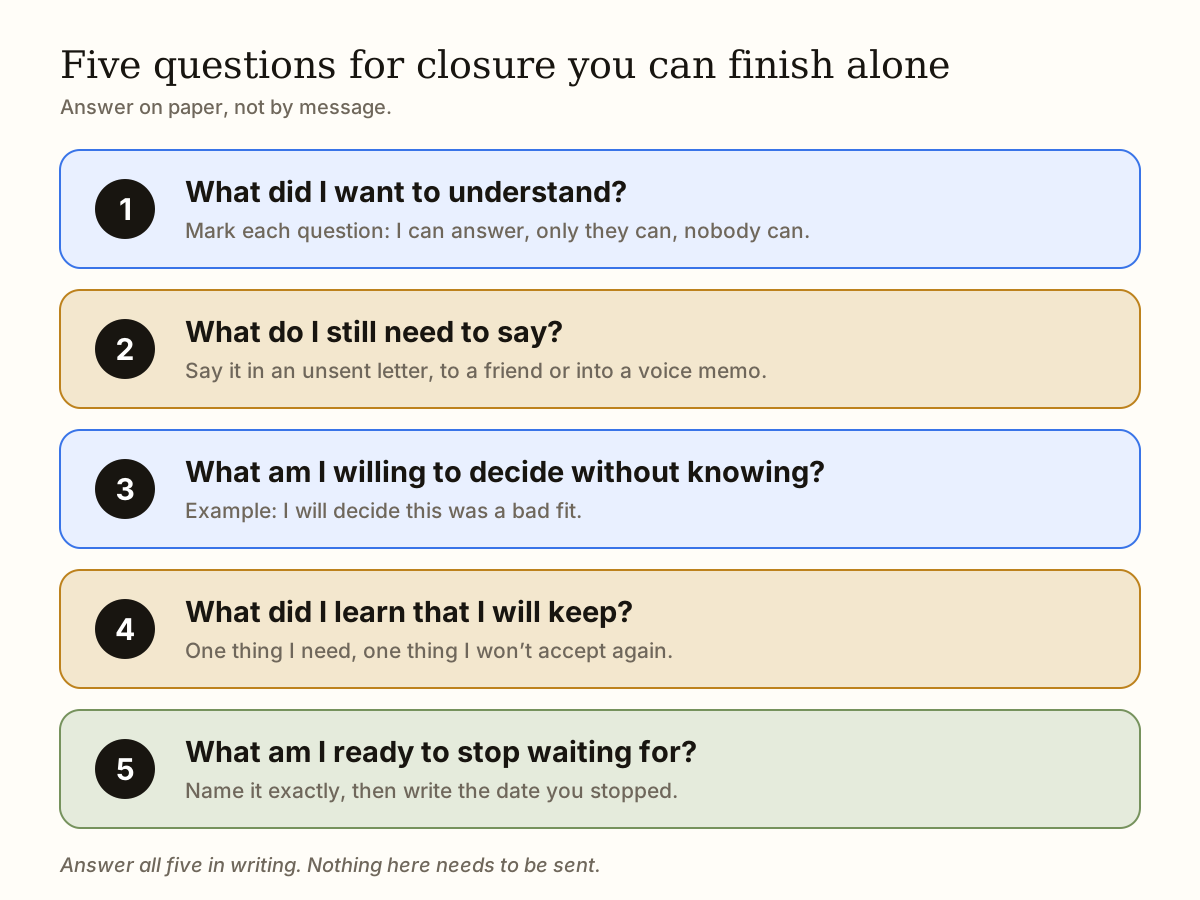
Work through these five questions, in writing. Give each a paragraph, no more. They are the same questions a good therapist would ask you, put in a form you can finish in an evening.
- What did I want to understand? List every question, then mark each one: I can answer this, only they can, or nobody can.
- What do I still need to say? Say it in an unsent letter, to a friend, or into a voice memo you delete.
- What am I willing to decide without knowing? For example: “I’ll decide this was a bad fit, even though I don’t know why they left.”
- What did I learn that I will keep? One thing about what you need, one thing about what you won’t accept again.
- What am I ready to stop waiting for? Name it exactly: a text, an apology, a chance meeting. Then write the date you stopped.
Why can asking for closure keep you stuck in a loop?
Asking for closure can keep you stuck because the reply, or the silence, becomes new material for the waiting. You asked to finish something and opened a fresh thread.
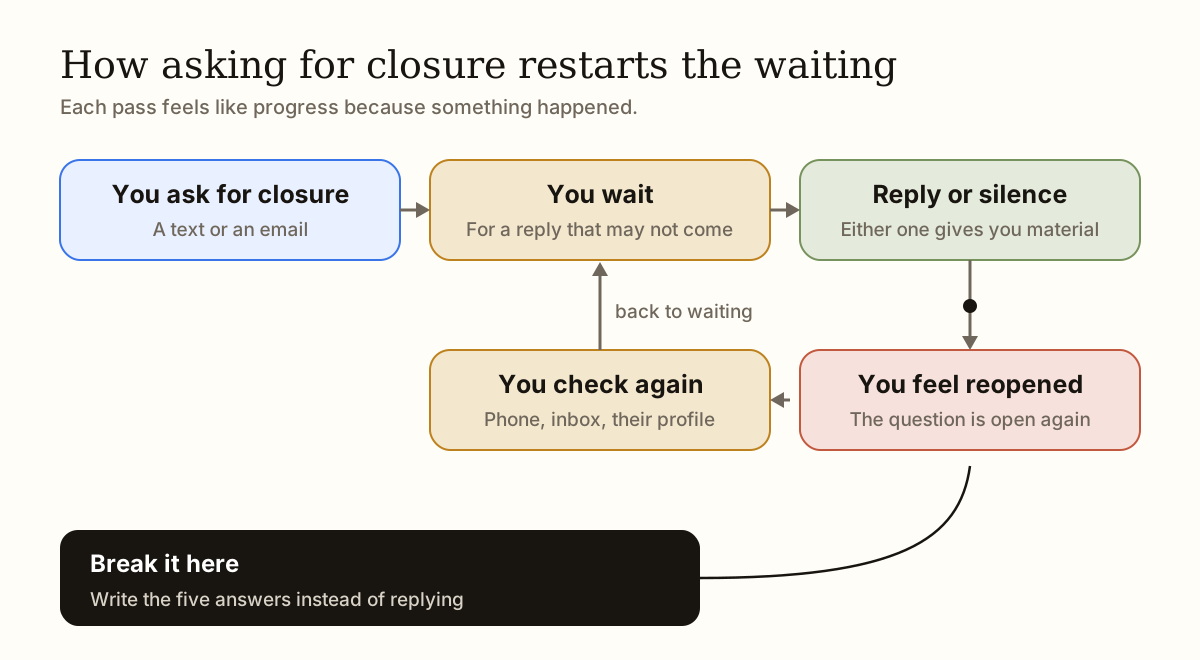
The loop looks like this: you ask, you wait, you get a reply or silence, you feel reopened, and you check again. Each pass feels like progress because something happened. The loop breaks at the gap between receiving the reply and acting on it, which is why the if-then plan matters.
On contact itself, the evidence is cautious. In a study of 122 recently separated adults, more in-person contact with an ex predicted more separation-related distress two months later, though the same-time link wasn’t reliable and the effect appeared only in people without children (O’Hara et al., 2020). It measured in-person contact after marital separation, not a text asking why, so treat it as a caution, not a verdict.
Example: three weeks after a partner stops replying, you send “Can we talk? I just need to know what I did.” Two days of nothing. On day three: “Not really a good time. I think it just ran its course.” You now hold an answer that is true, not new and not enough, plus a new thread to analyze. Why “ran its course”? Why not a good time? The alternate route costs one evening: the five questions above, one friend told “it ended and I’m not getting an explanation”, and the message left in your drafts.
If you have already sent one and are spiralling, what to do if you break no contact is the next page. If the urge is to send a second, how to stop texting your ex is built for that minute.
Does getting closure mean ending no contact?
No. Closure and the no-contact rule work on the same side of the line. The boundary protects the space you do the closure work in, and closure does not require a single message across it.
The practical difference is where the work happens. Closure on the contact side asks for an answer. Closure on your side writes the answer and keeps the question. If you share a lease, belongings or children, keep every message to logistics and read modified no contact. If seeing their name keeps reopening the question, blocking, muting or restricting is not a punishment, it is furniture moved out of your path.
Closure also does not need a day count. Some people feel the waiting stop in a week, others notice it months later, usually on a day they forget to check. There is no schedule to be late for.
When unanswered questions point to something unsafe
If the relationship involved threats, stalking, harassment, control over money, movement or your phone, or violence, closure from the other person is not the goal. Your safety is. Don’t message them for an explanation, and don’t go to their home, workplace or family to get answers. Leaving an unsafe relationship can raise the risk, so safety planning comes before any plan about contact.
In the US, the National Domestic Violence Hotline is 1-800-799-7233, or text START to 88788 (thehotline.org). Other countries have local services, and our safety page lists more. In immediate danger, call your local emergency number. If you miss someone who treated you badly and it confuses you, why do I miss my abusive ex is written for that.
Unanswered questions can also become heavy on their own. If you are not sleeping or eating, can’t work, or have thoughts of not wanting to be here, tell someone today. In the US, call or text 988. In the UK and Ireland, Samaritans is 116 123. In India, Tele-MANAS is 14416. Grieving a breakup covers what ordinary heaviness looks like and when it needs more than time.
You do not have to solve the whole relationship tonight. Take one private step that creates space between the feeling and the action.
Build your closure letter →Common questions
Do I need closure to move on?
No. You need a sense that you can stop waiting, and you can reach that without your ex’s explanation. Many people never get one and still move on. What helps is your own account of what happened, a decision about what to keep, and a clear point where you stop asking the question.
Is asking for closure a bad idea?
Often, yes. It usually restarts the waiting, and the reply tends to be shorter or less satisfying than you imagined. If it is safe and you still want to ask, send one short message that doesn’t need an answer, after waiting 48 hours. If the ending involved fear or control, don’t ask at all.
What is a closure conversation?
It is a conversation between exes meant to explain how or why the relationship ended and let both people feel finished. They can help some people and reopen things for others. If you have one, keep it brief and in a public place or by phone, with a time limit and a plan for afterwards, and skip it entirely if you feel unsafe.
How do I know I have closure?
There is no test, but there are signs. You can think about the ending without the urge to fix it, you stop drafting messages, and the unanswered questions are still there but no longer demand an answer. Having closure doesn’t mean you feel nothing. It means you aren’t waiting.
Can an unsent letter give me closure?
It can give you a large part of it. Writing the letter puts your account on paper and lets you say what you needed to say, which research on expressive writing links with better outcomes. It doesn’t give you their reasons or an apology, and it works best alongside the five questions above.
What if they say they will give me closure but keep delaying?
Treat the delay as the answer you have, and don’t schedule your recovery around it. A promised conversation that keeps slipping holds you in the waiting. Tell them once that you no longer need it, or say nothing, and do the five questions without it. If their delays feel like control, see the safety section above.
How do I get closure when my ex ghosted me?
Build it without their help. Write what you think happened and what you will never know, name what you are willing to decide without their reasons, and say out loud to one person that it ended without an explanation. Ghosting is painful because it withholds an ending, so the work is to supply one yourself.
Is it possible to move on without closure from my ex?
Yes. Closure is something you can mostly build, and people leave unfinished relationships every day. The unanswered questions may surface on birthdays or at night, and that is normal. They tend to lose their grip once you have written them down, decided what you can’t know, and stopped checking for a reply.
If contact involves threats, stalking, coercion, shared children, housing or immediate safety, a general no-contact rule may not fit. Read the safety guidance and seek qualified local help where appropriate.
Sources and further help
- Roe D, Farber BA, Yaniv H & Anderson N (2026), What’s left after a romantic breakup? The vicissitudes of closure, Counselling Psychology Quarterly
- O’Hara KM, Grinberg AM, Tackman AM, Mehl MR & Sbarra DA (2020), Contact with an ex-partner is associated with psychological distress after marital separation, Clinical Psychological Science
- Larson GM & Sbarra DA (2015), Participating in research on romantic breakups promotes emotional recovery via changes in self-concept clarity, Social Psychological and Personality Science
- Pennebaker JW (1997), Writing about emotional experiences as a therapeutic process, Psychological Science
- Gollwitzer PM (1999), Implementation intentions: strong effects of simple plans, American Psychologist
- Berns N (2011), Closure: The Rush to End Grief and What It Costs Us, Temple University Press
- The National Domestic Violence Hotline, Plan for safety
- 988 Suicide & Crisis Lifeline
Research is cited to explain general patterns, not to diagnose or predict any individual outcome. Sources do not endorse UnLink. Read our editorial principles.
Keep this support one tap away.
UnLink is a free, private no-contact tracker for iPhone: count your days, get through urges and restart without losing your history.