How to Stop Texting Your Ex
How to stop texting your ex: a 90-second urge protocol, if-then rules, copy-and-paste scripts, iPhone friction and a 7-day plan for the 11 p.m. moment.
 By the UnLink Editorial Team · General educational guidance, not therapy
To stop texting your ex, make the text harder to send before the urge arrives, then run a 90-second pause when it hits: phone down, slow exhales, name the feeling, pick one small task. Write the message in a private note instead. The urge comes in waves, and you only have to get across each one.
- Stopping the text is easier when you prepare before the urge arrives: add friction to your phone, write your reasons down and save scripts in advance.
- A 90-second pause gives the first wave of the urge time to peak and fall without forcing a decision about the text.
- An if-then plan, such as “If it is after 10 p.m. and I miss them, then the phone goes on the charger in another room,” makes the next step automatic.
- Writing the message in a private note lets the need behind it be heard without sending anything to your ex.
- A study of urge surfing in smokers suggests you do not need the urge to vanish, only to not act on it. Logging triggers shows where your plan needs support.
Why is it so hard to stop texting your ex?
Because the urge behaves like a craving, not like a decision. If your thumb is over the thread before you have thought anything through, that is a normal brain doing a normal thing after a rejection. Researchers who scanned people recently rejected by a partner found that viewing a photo of that person activated regions linked to reward, motivation and craving, the same kinds of systems associated with addiction (Fisher et al., 2010).
It hurts in a literal sense, too: recalling an intense recent rejection engaged brain regions that also respond to physical pain (Kross et al., 2011). A text promises to switch that off for a few seconds. It rarely does, and the reply, or the silence, feeds the next urge.
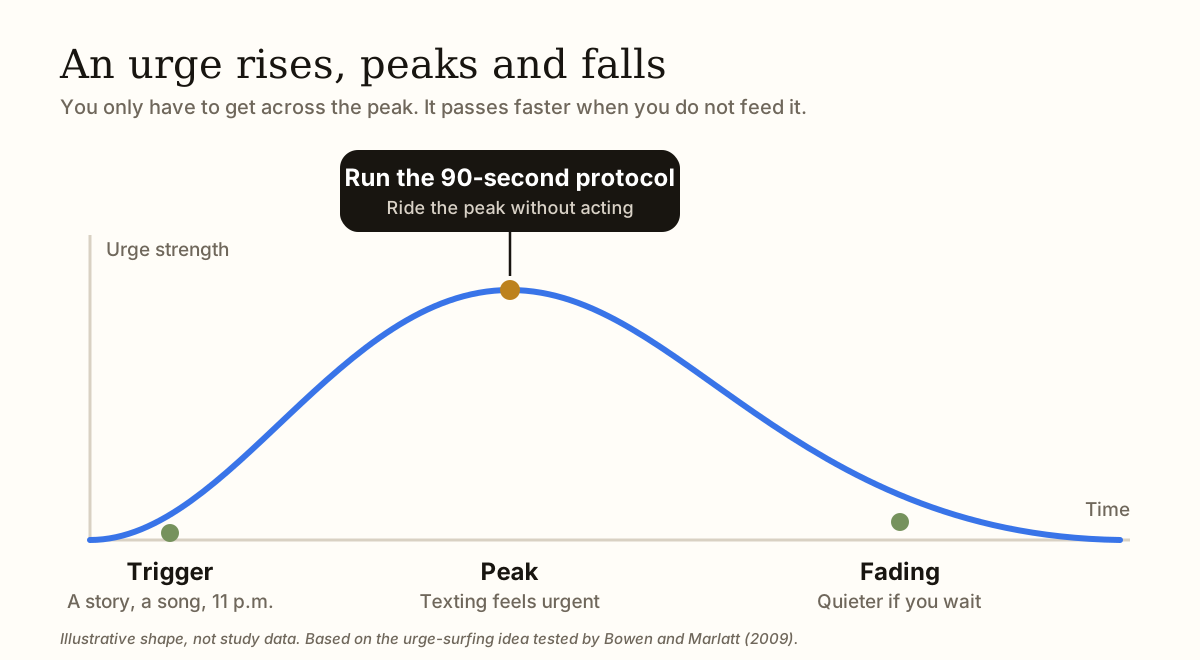
You cannot out-argue a craving at 11:40 p.m., so the plan below does not try. It makes the text harder to send and treats each urge as a wave to get across. A study in smokers shows why that can work. In 2009, Bowen and Marlatt taught 123 undergraduate smokers “urge surfing”: noticing an urge rise and pass without acting on it. Their reported urges did not drop, but they smoked fewer cigarettes over the next week. Smoking is not heartbreak, but the lesson carries. The urge does not have to vanish before you can leave it unacted on.
What should I do in the next 90 seconds?
Use this when the urge is already here. Run the steps in order and decide nothing about the text until the end. Ninety seconds is a short, workable window, not a law of physiology, so if the urge is still loud when the timer ends, run another round. You can do it in the kitchen, in the car or in a bathroom with the door shut.
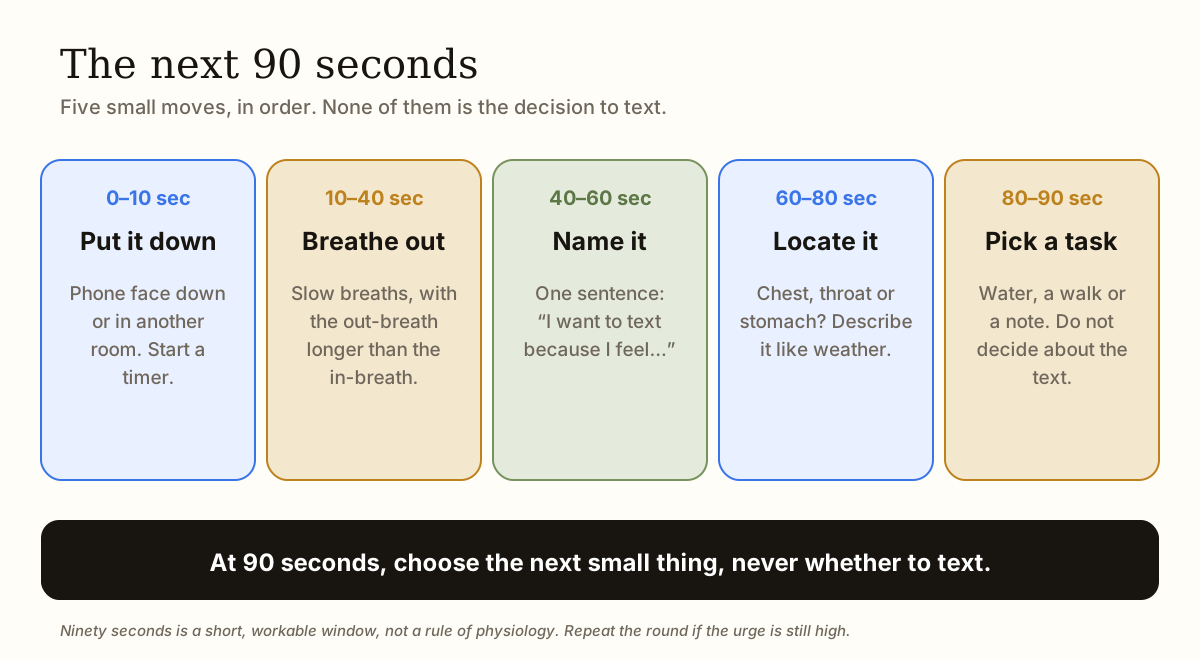
- 0 to 10 seconds: put it down. Phone face down, or in another room, and start a 90-second timer. The 90-second urge reset runs the whole sequence on screen if you would rather be guided.
- 10 to 40 seconds: breathe out. Make the exhale longer than the inhale. Four or five slow rounds is plenty.
- 40 to 60 seconds: name it. One sentence: “I want to text them because I feel lonely,” or “because I want to be reassured,” or “because I am angry.” In a brain-imaging study, putting a feeling into words dampened the amygdala’s response to negative images (Lieberman et al., 2007), which is a plausible reason naming helps.
- 60 to 80 seconds: locate it. Chest, throat, stomach? Describe it without judging it, as if you were reporting the weather.
- 80 to 90 seconds: pick one small task. Drink a glass of water, step outside, open your reasons note. Do not decide whether to text.
How do I write an if-then plan for not texting my ex?
An if-then plan, also called an implementation intention, is one sentence that links a situation to an action: “If X happens, then I will do Y.” In research on goal pursuit, specific plans of this kind helped people follow through on what they intended (Gollwitzer, 1999). The point is to take the decision out of the moment your judgment is weakest.
Write yours today, while you still remember how the bad moments feel. Choose three to five, not twenty, short enough to read on a lock screen. The “then” should take under a minute and no willpower, such as moving the phone.
| If… | Then I will… | Backup if that fails |
|---|---|---|
| It is after 10 p.m. and I miss them | Put my phone on the charger in another room and read my reasons note | Send the accountability script to a friend |
| I open their profile or story by accident | Close the app, mute them and write one line about what I felt | Stand up and drink a glass of water before touching the phone again |
| I catch myself rehearsing what to say | Write it in a private note and leave it there for 24 hours | Read the note aloud tomorrow, then keep it or delete it |
| I have had a drink | Put the phone in a bag or drawer, then water, food, bed | Ask whoever is with me to hold it |
| A song or a friend’s story reminds me of them | Name it (“that is a memory, not a message”) and message someone else | Mute that friend’s stories for a week |
| It is a weekend afternoon and I am alone | Go to a planned activity before the phone comes out | Call someone while I walk |
| They text me first | Not reply tonight, then use the reply script below or the they texted me tool | Show it to a friend before answering |
What should I text instead of texting my ex?
Scripts remove the invention from a hard moment. Save these in Notes today and edit them to sound like you. The aim is to route the need to someone who can meet it, not to stop talking to everyone. Pick a friend who answers briefly and does not need the whole backstory. If nobody fits, try the longer list in what to do instead of texting your ex.
| Situation | Script |
|---|---|
| You need a person right now | “I am about to text my ex and I do not want to. Can you talk for ten minutes, or just reply to me until this passes?” |
| You want someone to hold the line | “If I text you ‘pause’ after 10 p.m., please reply ‘not tonight’ and nothing else. No debate, even if I argue.” |
| You want to say it all to them | Private note: “What I want to say: … What I actually need: … What I will do in the next hour: …” Then close the note. |
| They text you first and you are not ready | No reply tonight. If you choose to answer later: “Thanks for your message. I am taking some space, so I will not be replying for now. I hope you are well.” More in what to do when your ex texts you. |
| You must talk about kids, a lease or work | “Pickup is Saturday at 10. Please confirm.” One practical subject, no feelings, no extra questions. See modified no contact. |
| You already sent something | To yourself: “I texted. It happened. I will not send a second message to fix it. Next: water, then sleep.” |
Write the message, then don’t send it
Most texts to an ex carry a need under the words: reassurance, recognition, closure, relief from anger, a wish to feel chosen. Sending it asks someone else to meet that need. Writing it privately lets you see the need and meet part of it yourself.
Expressive writing about emotional experiences has been linked with health benefits across many studies (Pennebaker, 1997). Open a private note and answer three prompts: What did I want to say? What do I actually need right now? What will I do in the next hour instead?
Keep the note and reread it in a week. If a phone note feels exposed, use a paper notebook or the Vault in UnLink’s Premium plan. Our guide to writing an unsent letter shows how to structure one so it does not turn into a message to your ex.
Can you block yourself from texting someone?
Not with one switch. iPhone has no setting that stops only your outgoing texts to one person, so the working answer to how to stop yourself from texting someone is friction, stacked in layers. Willpower fails when you are tired, lonely or drinking. Friction does not care how you feel.
Blocking is a different tool: it stops their messages reaching you, not yours reaching them. The full walkthrough is in how to block yourself from texting someone, and should you block your ex compares blocking with muting and archiving.
The closest built-in option is Screen Time. Go to Settings, Screen Time, Communication Limits, During Screen Time, and choose Contacts Only. If you try to message someone the limit blocks, their name appears in red in your recent messages and the message will not go through until you change the setting. Apple notes this needs Contacts turned on in iCloud, and a Screen Time passcode can lock the setting. If a friend will hold the passcode, set it up with them while you are calm.
Seeing their life feeds the urge too. In a 2012 study of 464 people, Facebook surveillance of an ex was associated with more distress, more longing and lower personal growth (Marshall, 2012). If the pull starts with a profile, see how to stop checking your ex’s social media covers that side.
| Level | What you do | Time to undo | Use it when… |
|---|---|---|---|
| Light | Mute the thread, turn off its notifications, move Messages off your home screen | Seconds | A name or banner on your lock screen sets off the urge |
| Medium | Archive the thread, rename the contact to a warning, unfollow or mute them online | A minute | You keep rereading old messages or opening their profile |
| Strong | Delete the number and set Screen Time Communication Limits to Contacts Only | A few minutes | You have slipped through light and medium friction |
| Locked | A friend sets your Screen Time passcode or holds your phone overnight | Needs another person | Nothing else has held through a bad night |
What does a 7-day plan to stop texting your ex look like?
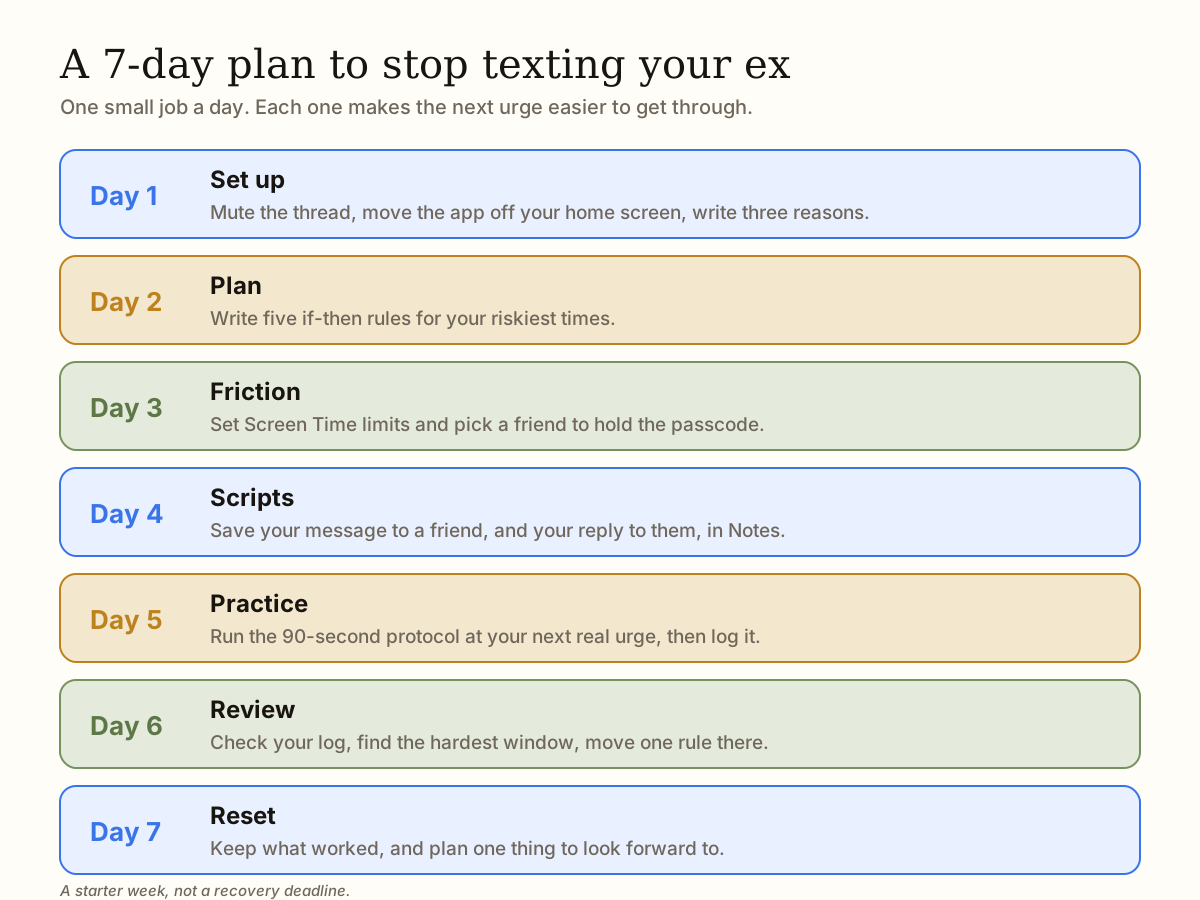
It looks like building the system first and testing it second. This is a starter week, not a recovery deadline. Seven days will not end the urge, but the next one will meet a plan. For the longer arc, see the first 30 days of no contact and what the no contact rule is.
| Day | Focus | Do this |
|---|---|---|
| Day 1 | Set up | Mute the thread, move the app off your home screen, write three honest reasons and pin them somewhere you will see them. |
| Day 2 | Plan | Write five if-then rules for your riskiest times. Read them once out loud. |
| Day 3 | Friction | Set Screen Time limits. Ask one friend to hold the passcode or the phone overnight. |
| Day 4 | Scripts | Save your message to a friend and your reply to them in Notes. Pick your replacement task now. |
| Day 5 | Practice | Run the 90-second protocol at your next real urge. Afterwards, log the time, the trigger and what helped. |
| Day 6 | Review | Read your log. Which window was hardest? Move one if-then rule to that window. |
| Day 7 | Reset | Keep what worked, drop what did not, and plan one thing for next weekend to look forward to. The no contact plan generator can turn the week into a longer plan. |
Why does the urge come at night, and how long does it last?
Many people find the urge clusters in late evenings, the hour after a drink, Sunday afternoons and the first minutes after waking. Those windows tend to combine tiredness, fewer distractions and more time alone with your thoughts. Notice when yours arrives and move your plan there: charge the phone outside the bedroom and keep a paper reasons note by the bed. More in why you want to text your ex at night.
How long does it last? A single wave tends to pass in minutes if you do not feed it by checking or replying. The period in which waves keep coming is weeks to months, and nobody can give you your number. Watch the trend instead: urges that come less often or less sharply over a few weeks are progress, even when tonight is bad. If empty evenings are the problem, read loneliness after a breakup, and why do I miss my ex explains what the missing is doing.
What if I already texted them?
Do not treat it as the end of the plan. Stop, note what happened just before you sent it, and resist a second message that tries to explain or fix the first. A follow-up usually extends the contact. Go back to your boundary, take the next step you would have chosen anyway (water, the reasons note, one task), and log the trigger, because that is the moment your plan was missing. Our guide on what to do if you break no contact walks through how to restart without spiraling.
When the urge is tied to fear or danger
Sometimes the urge to contact an ex comes from fear that they will hurt you or show up, or the relationship involved threats, control or coercion. Then this plan is not enough, and it is no substitute for advice from someone who knows your situation. Leaving or going silent can raise risk in some relationships, so safety planning comes before any contact strategy. Our safety page lists support, and the National Domestic Violence Hotline offers safety planning at thehotline.org.
If you are in the US, you can call 1-800-799-7233 or text START to 88788 for the Hotline, and call or text 988 in a crisis. In the UK and Ireland, Samaritans is on 116 123. In India, Tele-MANAS is 14416. If you are in immediate danger, call your local emergency number.
UnLink is a private tracking and support tool, not therapy, and it cannot judge your safety. Use it to log urges and patterns, and reach out to people who can help you directly if things feel unsafe. If you miss someone who treated you badly, why do I miss my abusive ex explains the pull.
Step-by-step plan
- Write your reasons before the urge arrives
In a calm moment, write three honest reasons for not texting your ex and keep the note where you can find it fast, such as your lock screen.
- Remove the easy route
Mute or archive the thread, move the messaging app off your home screen and turn off its notifications. For more friction, set Screen Time Communication Limits.
- Write your if-then plans
Write three to five sentences in the form “If X happens, then I will do Y” for your riskiest times, such as late evenings or after drinking.
- Save your scripts
Put a message to a friend, an accountability request and a reply for when your ex texts first into Notes.
- Run the 90-second pause when the urge hits
Phone down, slow exhales, name the feeling, find it in your body, then pick one small task. Decide nothing about texting until the timer ends.
- Write the message without sending it
In a private note, answer three prompts: what you wanted to say, what you need now and what you will do in the next hour.
- Log the urge and review weekly
Note the time, trigger and what helped. Each week, move one if-then rule to the moments that keep returning.
You do not have to solve the whole relationship tonight. Take one private step that creates space between the feeling and the action.
Try the 90-second urge reset →Common questions
How do I stop texting my ex when I miss them?
Missing someone is a feeling, not an instruction. Run the 90-second pause, name the feeling in one sentence, write what you wanted to say in a private note and do one prepared task. Repeat it each time, and add phone friction so the text is harder to send.
How do I stop myself from texting my ex at night?
Plan for the time of day you struggle most. Charge your phone outside the bedroom, keep a reasons note nearby and set an if-then rule such as “If it is after 10 p.m., then the phone goes in another room.” Pair it with a calming activity you can start at once.
How do I stop texting my ex when I’ve been drinking?
Decide before the first drink, not after. Leave the phone at home or in a bag, or ask a friend to hold it. Alcohol makes impulses easier to act on, so if the pull comes anyway, drink water, eat something and decide nothing until the next day.
Can you block yourself from texting someone?
Not directly. iPhone has no setting that stops only your outgoing texts to one person. You can add friction instead: mute or archive the thread, delete the contact and set Screen Time Communication Limits to Contacts Only, ideally with a friend holding the passcode. The full steps are in our guide to blocking yourself from texting someone.
Is it okay to block my ex so I stop texting them?
Blocking can be useful friction when easy access keeps restarting the cycle, and it is a personal choice. It works best alongside a plan for the urge. Some people mute or archive the thread first and block only if the urge keeps winning.
Why do I keep wanting to text my ex even though it made things worse?
Research on rejection has linked recent heartbreak to brain systems involved in reward and craving, and to regions that respond to physical pain. The urge can feel strong even when you know a message would not help.
How long does the urge to text your ex last?
There is no fixed timeline. A single wave often passes within minutes if you do not feed it, and the waves tend to get less frequent or less intense over weeks to months, especially when you do not act on them. Tracking your urges shows what is changing for you.
What if my ex texts me first?
You do not have to reply. Pause before answering, use your reasons note and your if-then plan, and treat the message as news, not as a reason to drop your boundary. If you decide to respond, keep it brief and practical. Our guide to when your ex texts you has more.
Is it okay to text my ex once for closure?
It is your decision, but a closure text rarely delivers what you hope for, because you cannot control the reply or its tone. Write the unsent version first, wait a few days, then check if you still want to send it. How to find closure without them covers the alternatives.
If contact involves threats, stalking, coercion, shared children, housing or immediate safety, a general no-contact rule may not fit. Read the safety guidance and seek qualified local help where appropriate.
Sources and further help
- Fisher et al. (2010), “Reward, addiction, and emotion regulation systems associated with rejection in love”, Journal of Neurophysiology
- Kross et al. (2011), “Social rejection shares somatosensory representations with physical pain”, PNAS
- Bowen and Marlatt (2009), “Surfing the urge: brief mindfulness-based intervention for college student smokers”, Psychology of Addictive Behaviors
- Lieberman et al. (2007), “Putting feelings into words: affect labeling disrupts amygdala activity in response to affective stimuli”, Psychological Science
- Gollwitzer (1999), “Implementation intentions: strong effects of simple plans”, American Psychologist
- Pennebaker (1997), “Writing about emotional experiences as a therapeutic process”, Psychological Science
- Marshall (2012), “Facebook surveillance of former romantic partners: associations with postbreakup recovery and personal growth”, Cyberpsychology, Behavior, and Social Networking
- Apple Support: Choose who you can communicate with at certain times with Screen Time on iPhone
- The National Domestic Violence Hotline: Plan for safety
- 988 Suicide & Crisis Lifeline — US crisis support
Research is cited to explain general patterns, not to diagnose or predict any individual outcome. Sources do not endorse UnLink. Read our editorial principles.
Keep this support one tap away.
UnLink is a free, private no-contact tracker for iPhone: count your days, get through urges and restart without losing your history.