Why Is No Contact So Hard? What’s Going On and What Actually Helps
Why is no contact so hard? Five pulls keep the urge alive: craving, replaying, empty hours, a shaken sense of self and hope. What each one needs.
 By the UnLink Editorial Team · General educational guidance, not therapy
No contact is hard because it removes the one thing that calms the urge to reach out, while five other things keep that urge going: a reward system that reacts to rejection, a mind that replays them, empty hours, a shaken sense of self, and hope. Hard doesn’t mean you’re failing, and it doesn’t prove it’s working.
- Five separate pulls make no contact hard, and each needs a different fix, so naming yours matters more than trying harder.
- Studies of recently rejected people found brain activity linked to reward, craving and physical pain. That explains the intensity. It does not show that a breakup is literally an addiction.
- Forcing thoughts of them away tends to backfire. Naming the feeling and giving the thought somewhere to go works better.
- Hard is not a score. A bad week doesn’t mean you’re failing, and pain doesn’t prove no contact is working.
- If you can’t eat, sleep or function for two weeks, or you’re frightened of your ex, this has stopped being “hard” and become a reason to get support.
Why is no contact so hard?
It’s Sunday night and you’re fine, mostly. The dishes are done. You’ve answered two messages from friends. Then a song comes on, or a notification lights up the wrong name, and the thing you’ve been holding steady for nine days suddenly weighs a hundred pounds.
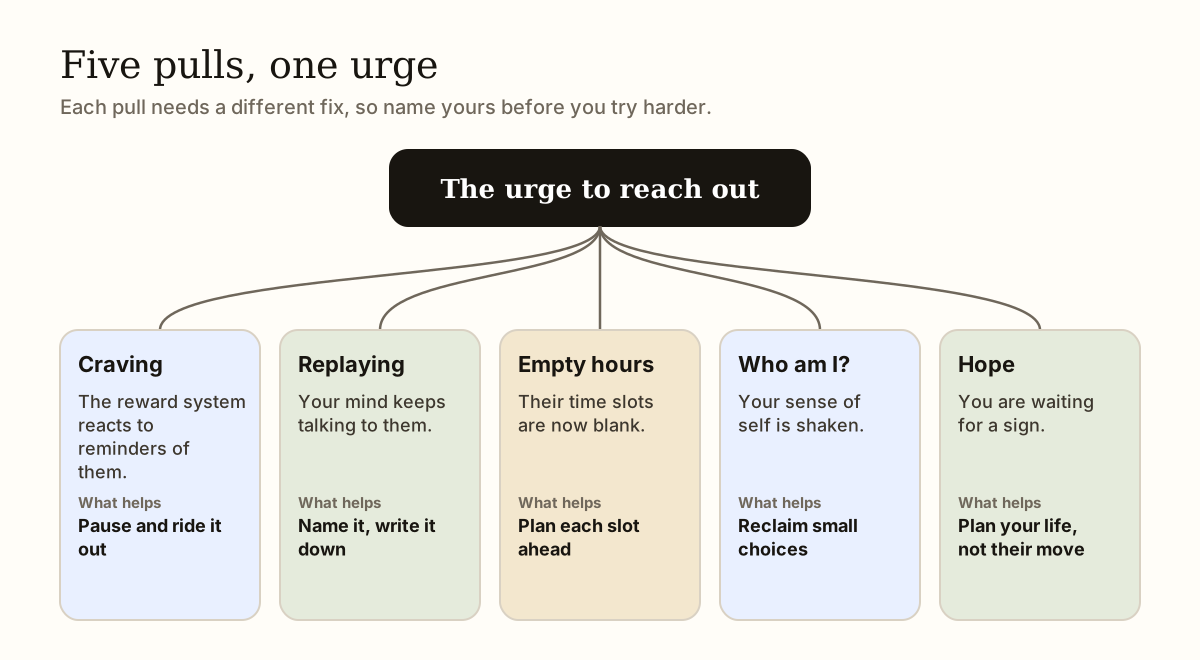
If that’s where you are, you’re not weak and you’re not doing it wrong. No contact is hard because it pulls on five different things at once, and most advice treats it as one. You get told to be strong, as if willpower were the whole job. It isn’t. Here are the five pulls, so you can see which ones are working on you. The rest of this page takes them one at a time, and if you only want the plan for the worst moments you can jump to what helps when it’s at its hardest.
- Craving. Your brain’s reward system reacts to rejection and to reminders of the person. Reaching out is the fastest way to quiet it, and no contact takes that option away.
- Replaying. You can stop texting and still be talking to them in your head all day. Your mind doesn’t honor the boundary on its own.
- Empty hours. They used to fill certain parts of your day. Those parts are now blank, and blank is loud.
- Who am I now? A relationship holds up a lot of your sense of yourself. When it ends, that wobbles too.
- Hope. While you’re waiting for a sign, every quiet day feels like a verdict.
Is no contact supposed to feel this bad?
It’s supposed to feel like something. Losing someone you were close to is a real loss, and your body treats it as one. If you felt nothing, that would be the surprising result.
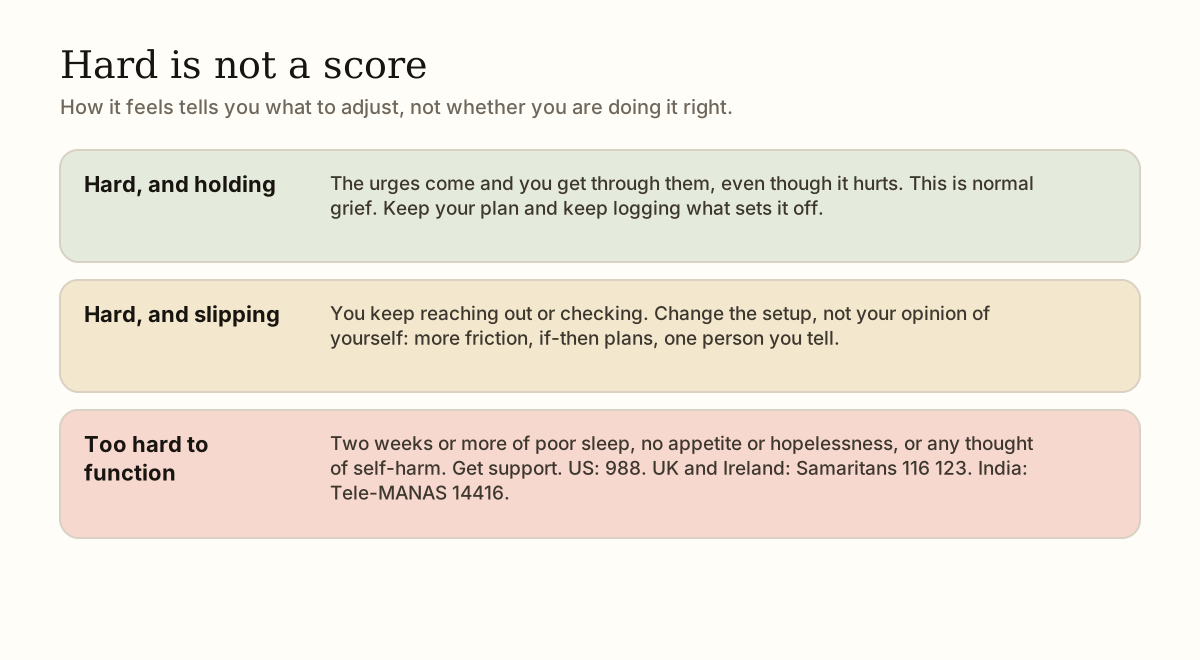
There’s a trap here, though, and a lot of advice online walks you straight into it. You’ll read that if no contact feels like hell, it’s working, and if it doesn’t, you’re doing it wrong. Nothing supports that. Pain tells you that you cared. It doesn’t tell you how well you’re doing, and it doesn’t predict how things will turn out for you or for them.
What the research does offer is a small piece of good news. In a study that followed people before and after breakups, those who went through one had predicted far more distress than they ended up feeling, and their distress faded faster than they’d forecast (Eastwick et al., 2008). It won’t feel true on day nine. Hold it loosely anyway. Right now you’re a worse judge of your future self than you’ll be in a month.
Why does no contact feel like withdrawal?
Because in some ways your brain is treating it like one. When researchers scanned people who had recently been rejected in love and showed them a photo of the person who had left, regions linked to reward, motivation and craving became active, including areas that are also involved in addiction (Fisher et al., 2010). In another study, when people recalled an intense recent rejection, brain regions that also respond to physical pain became active (Kross et al., 2011). That fits what many people say: it hurts in the chest, and it comes in waves.
Read those findings with care, though. They were small studies of a handful of people, scanned while looking at a photo or recalling a memory. They show that the craving and the pain are physical and real. They don’t show that a breakup is an addiction, and you’ll see pages that claim exactly that. Be wary of any page that says your brain is “identical to cocaine withdrawal” or hands you a neat 90-day brain chemistry timetable. Nobody has measured that.
In practice it comes down to something simpler. The pull you feel is a craving, and cravings rise and fall. In one small trial of smokers, people taught to notice an urge and ride it out without acting on it smoked fewer cigarettes afterward, even though the urges they reported didn’t get smaller (Bowen & Marlatt, 2009). Different habit, same idea. You don’t have to make the urge disappear. You have to get through the next while without feeding it, and the 90-second reset is built for exactly that.
Why can’t I stop thinking about them when we’re not even in touch?
Because no contact stops the messages. It doesn’t stop the thoughts, and much of the exhaustion people describe comes from this second job, the one nobody sees. You’re not texting, but you’re rehearsing what you’d say, rereading old conversations in your memory, wondering what they’re doing, composing the reply to a message that hasn’t come.
Trying to shove those thoughts out usually makes them louder. In a classic experiment, people told not to think about a white bear thought about it more than people who were allowed to, and the thought came back stronger once the rule was lifted (Wegner et al., 1987). Telling yourself “stop thinking about them” sets the same trap.
Two things work better. The first is to name what you’re feeling in plain words. In brain imaging work, putting a feeling into words calmed the part of the brain that reacts to threat (Lieberman et al., 2007). “I’m lonely and I want reassurance” is a smaller thing than an unnamed ache. The second is to give the thought a place to go that isn’t them: a note, a voice memo, a letter you never send. Here’s how to write one, and here’s a fuller guide to the looping.
One more thing belongs here, because it’s the easiest way to make everything harder. Checking their profile counts as contact for your brain, even if they never know. In a study of Facebook use after breakups, more monitoring of an ex was linked to more distress, more longing and less personal growth (Marshall, 2012). It was a correlation, so it doesn’t prove the checking causes the pain, but it’s a good reason to mute first and decide later. If checking has become a habit, this guide takes it apart.
Why do the empty hours hurt the most?
Walk through a normal day and notice where they used to be. The morning text. The ten minutes after work when you’d call. Sunday afternoons. The last thing you did before sleep. Those weren’t only moments with them. They were the structure of your day, and when the structure goes, you feel it first in the gaps.
That’s why the hardest times tend to be predictable: evenings, weekends, late at night, and anywhere a certain song or street or smell lives. It’s also why “just stay busy” helps less than it sounds. Busyness spreads thinly across a whole day, and the pull arrives in particular slots.
So work with the slots. Write down the three times your pull is strongest this week. Next to each, put one specific, slightly dull thing you’ll do in that exact window: a walk that starts at 6:30, a standing call with a friend on Sundays, a class on Thursday nights. It doesn’t have to be fun. It has to be decided already, because the version of you at 10:40 p.m. isn’t going to plan well.
If the loneliness under all this is the part that’s got you, there’s a guide for that. If you’re trying to work out whether you miss them or just the company, this one separates the two.
Why do I feel like I don’t know who I am without them?
Because for a while you may have been partly defined by the two of you. Your plans, your jokes, what you did on Saturdays and who you told about your day were built around another person. When that comes out, some of the support beams of how you see yourself come out with it.
Research on breakups backs this up. In a set of studies, people who went through a breakup described a less clear, less certain sense of who they were, and that loss of clarity was linked to feeling worse (Slotter et al., 2010). It’s one more reason the first weeks can feel unmoored, as if you’ve forgotten how to be you.
The practical side is almost boring. Take back small decisions that used to be shared: what you eat, what you watch, what you play when you’re alone in the car. Spend an hour on something that was only ever yours. Write down three things you knew about yourself before them. It’s slow, and it works the way strength works, by repetition. If the relationship was a long one, this guide goes further.
Why does hope make no contact harder?
This one is hard to say out loud. A lot of people who go no contact are quietly waiting. Not for closure, exactly. For a sign. A text, a like, a name on the screen. Every day without one can feel like an answer, and it’s exhausting to live inside a question.
No contact isn’t a waiting room, and it isn’t a method for making someone come back. Some people reach out after weeks of silence and plenty never do, and what they choose says more about them than about you. If you’re holding the boundary mainly to get a result, every quiet day will feel like failing. If you’re holding it to give yourself room to recover, a quiet day is just a quiet day. We’ve written about what it can honestly do.
Try a small experiment. Finish this sentence in your notes: “If I never hear from them again, the next thing I’ll do for myself is…” It isn’t giving up. It moves some of your weight off something you can’t control. And if they do reach out, here’s how to handle it, and this decision flow will walk you through the first reply, or the decision not to send one.
Which kind of hard is yours?
Most people have a main pull and a supporting one. Find yours in the table, then start with the fix in the last column. Using more than one is fine.
| What you’re feeling | What’s likely behind it | Start with this |
|---|---|---|
| A sudden spike, usually at night: “I’ll just send one text” | Craving. Your reward system reacting to a reminder | The 90-second pause and a message you write but don’t send. Try the reset |
| Your head won’t go quiet even when your phone does | Replaying, and thought suppression backfiring | Name the feeling, move the thought to paper, mute the reminders |
| Evenings and weekends feel unbearable | Empty hours where they used to be | Decide one dull plan for each slot before you’re in it |
| “I don’t know who I am without them” | A shaken sense of self | Take back one small shared decision a day |
| Every quiet day feels like a verdict | Hope, and waiting for a sign | The “if I never hear from them” sentence, and a plan for your week that doesn’t depend on them |
| Stomach in knots, can’t sleep, can’t eat | Your body’s stress response | Basics first: food, water, daylight, a walk. See can’t sleep after a breakup |
What helps when no contact is at its hardest?
When the pull is at its worst, you don’t need insight. You need a short list you can follow with a shaky head. Keep this one on your phone.
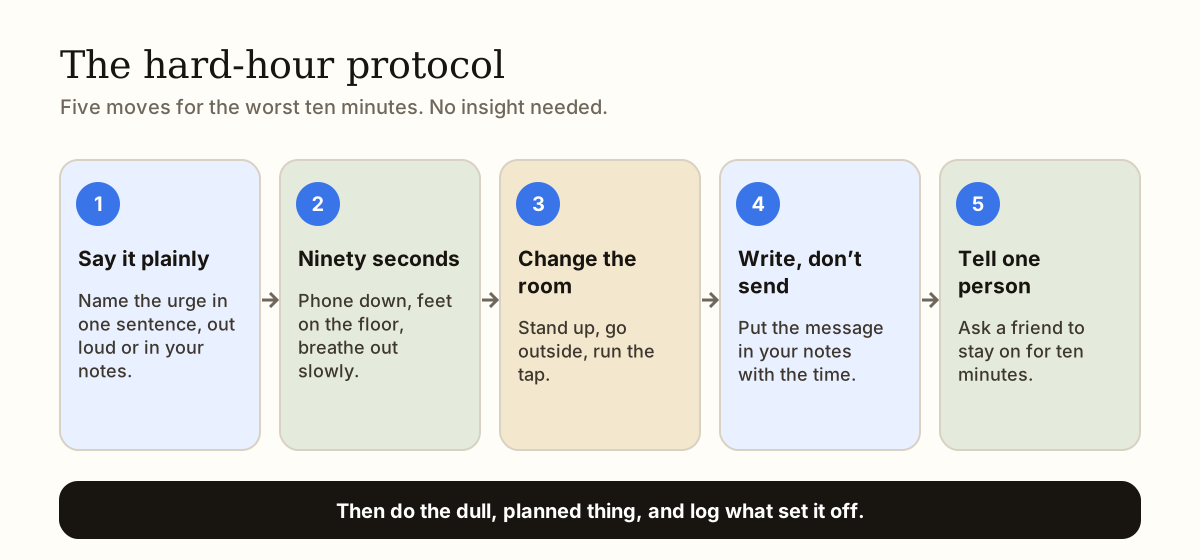
- Say it plainly. “I’m having an urge to contact them.” Out loud, or in your notes. Naming it takes some of its force.
- Set a 90-second timer. Phone down, feet on the floor, breathe out more slowly than you breathe in. You’re not deciding anything yet.
- Change the room. Stand up, go outside, run the tap. Anything that changes what your body senses.
- Write the message and don’t send it. Put it in your notes with the time. Most of the pressure leaves once the words are out.
- Tell one person. A text to a friend: “bad moment, can you stay on with me for ten minutes?”
- Do the dull, planned thing. The walk, the shower, the call. Then write down what set it off.
How do you make it easier before the next bad night?
The research behind planning ahead is better than the research behind most tips. People who make an if-then plan in advance (“if it’s late and I miss them, then I’ll put the phone in the kitchen and text my sister”) follow through more than people who simply intend to (Gollwitzer, 1999). Write two of them now, while you’re calm. One for the night pull, one for the “they might have posted” pull.
Then add friction, because the version of you at midnight is not the one making the rules. Take their thread off your home screen. Mute them. Archive the conversation rather than deleting it if you might need it later for something practical. On an iPhone you can also limit who you can message at all, which this guide walks through step by step. The full set of options for the urge itself is in how to stop texting your ex.
And if you slip, one message doesn’t erase the weeks before it. It’s information about which hour or which trigger got you. Here’s what to do if you break no contact, including whether to reset your count.
Does no contact get easier, and when?
Usually, yes. Not in a straight line and not on a date anyone can honestly give you. If a page promises that day 21 or day 60 is when it clicks, it’s guessing. What people describe, and what fits the research on how recovery tends to go, is more like weather. The bad stretches get shorter and further apart, and a good week can be followed by a rotten Tuesday for no reason you can find.
A rough patch is not a reset. If you’re in one, the stages guide explains why this comes in waves, and how long should no contact last deals with the day-count question honestly. And here are signs it’s easing, so you know what to look for:
- You go a few hours, then most of a day, without thinking of them.
- The urge still comes, but you notice it as an urge and not an instruction.
- You catch yourself in the middle of something and realize you forgot for a while.
- The bad moments hit about as hard, but you recover from them faster.
- You can think of a good memory without it flattening your evening.
When is no contact too hard to do alone?
Hard is normal. Some things aren’t, and they deserve more than a better routine. Get support if any of these are true:
- You haven’t been able to eat properly, sleep or do your work for two weeks or more.
- You feel hopeless, worthless or numb most of the day, most days.
- You’re thinking about hurting yourself, or about not wanting to be here.
- Drinking or other substances have crept up to get you through the evenings.
- You’re frightened of your ex, or contact with them has included threats, following you or controlling behavior.
Who can you contact for help?
If the first few apply, talk to a doctor or a therapist. It isn’t overreacting, it’s exactly what they’re there for, and this guide explains how to tell grief from depression. If you’re thinking about harming yourself, call or text 988 in the US, call Samaritans on 116 123 in the UK and Ireland, call Tele-MANAS on 14416 in India, or call your local emergency number now.
If the last one is true, you’re in a different situation. “No contact is hard” stops being the question and your safety becomes it. The US National Domestic Violence Hotline is 1-800-799-7233 (text START to 88788), and our safety page is a good first read. Leaving can be the riskiest time, so talk to an advocate before you change how you contact them. If you share children or a workplace with your ex, modified no contact is the version to read.
If nothing else from this page sticks, take one thing. Write down the two or three hardest times this week and decide, now, what you’ll do in each. Then eat something and go to bed on time.
You do not have to solve the whole relationship tonight. Take one private step that creates space between the feeling and the action.
Try the 90-second urge reset →More free tools: My ex texted me: what do I do? · Does this break no contact?
Common questions
Why is no contact so hard?
Because it takes away the quick relief of reaching out while several other things keep the pull alive: a reward system that reacts to rejection and reminders, a mind that keeps replaying them, empty hours where they used to be, a shaken sense of who you are, and hope for a sign. Each needs a different fix, which is why willpower alone often isn’t enough.
Is no contact supposed to be this hard?
It’s supposed to feel like something, because you’re grieving a real loss. How hard it is varies with how long you were together, how it ended and what else is happening in your life. Hard isn’t a sign you’re failing, and it isn’t proof the approach is working.
Why does no contact feel like withdrawal?
Brain imaging studies of recently rejected people found activity in reward and craving regions that are also involved in addiction, so the comparison isn’t baseless. The studies were small, though, and they don’t show a breakup is literally an addiction. The practical point is that cravings rise and fall, and you don’t have to act on them.
Does no contact get easier?
For most people it does, gradually and unevenly. Good days and bad days mix for a while, and a rough week doesn’t mean you’re back at the start. Nobody can give you an accurate date, so watch for signs instead: shorter urges, faster recovery, and moments when you realize you forgot.
How long does it take for no contact to stop hurting?
There’s no reliable number. Studies suggest people tend to predict more distress after a breakup than they end up feeling, which is some comfort, but the pace varies with the relationship and your circumstances. Treat day counts as checkpoints. The breakup recovery time guide covers what lengthens and shortens it.
Why do I feel worse the longer no contact goes on?
Early on, adrenaline and the sheer busyness of a breakup can carry you. Later the shock wears off and the gaps, the loneliness and the loss come into focus, so many people describe a dip some weeks in. It’s part of grieving, not evidence that no contact is harming you. If the low mood sticks for two weeks or more, talk to a doctor.
Does it mean no contact is working if it hurts?
No. Pain shows that you cared, not how well the boundary is going. Some people hold no contact steadily and feel awful, while others feel relief and find it easy. Judge progress by what’s changing in your days, such as fewer checks, faster recovery and more of your own life, not by how much it hurts.
Why do I miss my ex more during no contact?
Without contact, the mind fills the gaps with memories, usually the good ones, and the loneliness has nowhere to go but toward them. Missing someone can also mean missing company, routine or who you were with them. The do I miss my ex quiz can help you tell which.
Why do I keep thinking about them even though we’re not in contact?
No contact stops messages, not thoughts. Trying to force thoughts away tends to bring them back stronger, so it works better to name the feeling, write the thought down and give your attention somewhere definite. Muting their accounts removes many of the reminders.
What if I can’t do no contact?
Change the setup, not your opinion of yourself. Add friction (mute, archive, a Screen Time limit), write if-then plans for your worst times and tell one person what you’re doing. If you slipped, restart without punishing yourself. If you must stay in touch about children or work, use modified no contact.
Is it normal to cry every day during no contact?
In the first weeks, often yes. Crying is a normal part of grief and doesn’t mean you’re doing no contact wrong. If it’s constant, you’re not eating or sleeping, or you feel hopeless for two weeks or more, talk to a doctor or therapist. If you ever think about harming yourself, use the crisis lines on this page.
If contact involves threats, stalking, coercion, shared children, housing or immediate safety, a general no-contact rule may not fit. Read the safety guidance and seek qualified local help where appropriate.
Sources and further help
- Fisher et al. (2010): Reward, addiction, and emotion regulation systems associated with rejection in love, Journal of Neurophysiology
- Kross et al. (2011): Social rejection shares somatosensory representations with physical pain, PNAS
- Eastwick et al. (2008): Mispredicting distress following romantic breakup, Journal of Experimental Social Psychology
- Wegner et al. (1987): Paradoxical effects of thought suppression, Journal of Personality and Social Psychology
- Lieberman et al. (2007): Putting feelings into words, Psychological Science
- Marshall (2012): Facebook surveillance of former romantic partners, Cyberpsychology, Behavior, and Social Networking
- Slotter, Gardner & Finkel (2010): Who am I without you? The influence of romantic breakup on the self-concept, Personality and Social Psychology Bulletin
- Bowen & Marlatt (2009): Surfing the urge, Psychology of Addictive Behaviors
- Gollwitzer (1999): Implementation intentions, American Psychologist
- National Domestic Violence Hotline: plan for safety
- 988 Suicide & Crisis Lifeline (US)
Research is cited to explain general patterns, not to diagnose or predict any individual outcome. Sources do not endorse UnLink. Read our editorial principles.
Keep this support one tap away.
UnLink is a free, private no-contact tracker for iPhone: count your days, get through urges and restart without losing your history.