Can’t Sleep After a Breakup? A Night Plan for Tonight
Can’t sleep after a breakup? Use this three-phase night plan: the last hour, the first 20 minutes awake and a 3 a.m. reset, plus when insomnia needs a doctor.
 By the UnLink Editorial Team · General educational guidance, not therapy
Stress from the breakup keeps your body on alert, which is why you can’t sleep after a breakup. Tonight: cut caffeine and alcohol hours before bed, put the phone out of reach, and if you are still awake after 15 to 20 minutes, get up, do something dull in dim light and go back when sleepy.
- Poor sleep right after a breakup is a stress response, not a flaw. The NHS lists stress, anxiety and depression among the common causes of insomnia.
- The plan has three phases: a protected last hour, a 15 to 20 minute limit on lying awake in bed, and a short reset for 3 a.m. Each has one job, so you are not deciding anything at the worst hour.
- Writing a specific list for tomorrow for five minutes helped healthy young adults fall asleep faster in a lab study (Scullin et al., 2018). Park worries on paper, then close the notebook.
- Alcohol is not a sleep aid. The NHS says it can make you drowsy at first but disrupts sleep later in the night.
- See a doctor if habits have not helped, trouble sleeping has gone on for months, or you cannot cope with daily life. Don’t wait that long if it comes with low mood, panic or thoughts of self-harm.
Why can’t I sleep after a breakup?
Because your body is treating the breakup as a problem it has to stay awake for. Stress keeps the alarm system switched on, and an alarm that is on does not hand you over to sleep.
The NHS names stress, anxiety and depression among the common causes of insomnia, and it lists sleeping much more or much less than usual among the behaviours that go with stress. So yes, stress from a breakup can cause insomnia. That is the ordinary course of things, not a sign that something is wrong with you.
Then the bedroom adds its own damage. Lights out removes every distraction, and the replay starts: the last conversation, the line you should have said, whether they are awake too. A few nights of that and a second problem joins the first. You begin to dread the bed, and you try hard to fall asleep, which is a reliable way to stay awake.
Most of what helps is dull and within your control. None of it cures heartbreak. It stops the heartbreak from costing you the night as well, and it fits into the wider plan in how to get over a breakup.
Can’t sleep after a breakup? A night plan for tonight
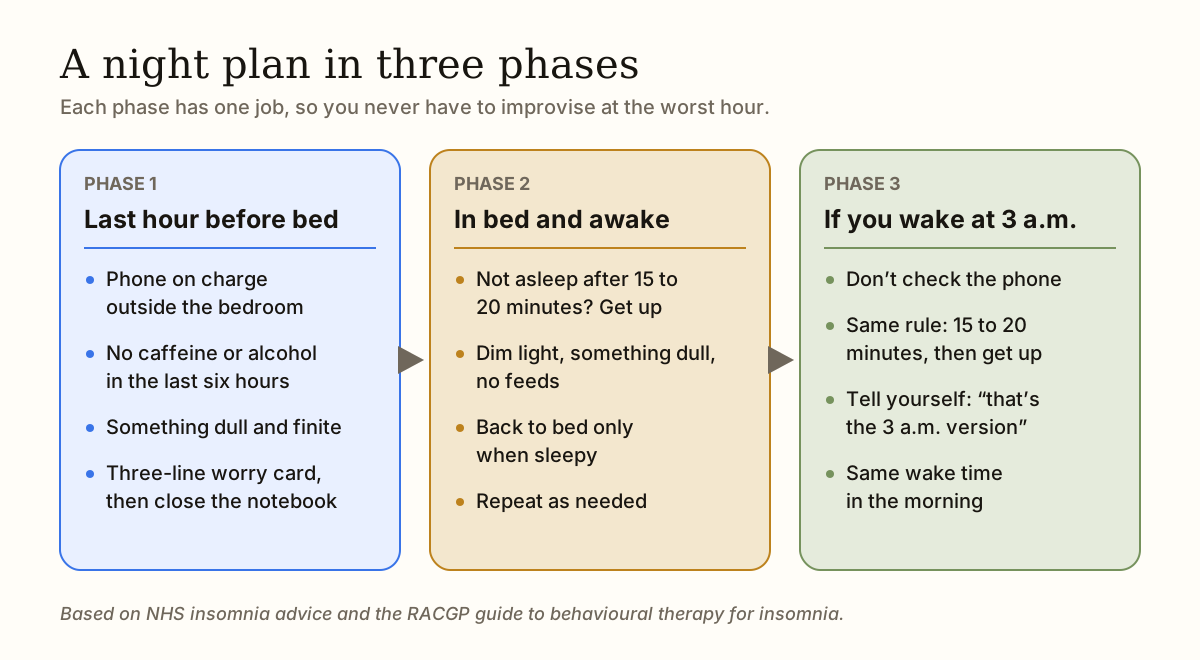
Run the night in three phases: the last hour before bed, the first 20 minutes you are awake in bed, and a short reset if you wake at 3 a.m. Each phase has one job, which means you never have to improvise at the hour when your judgment is worst.
If what keeps you awake is the urge to text them, this page won’t duplicate that. Why you want to text your ex at night covers the urge and its scripts. Here the subject is sleep itself.
What should I do in the hour before bed?
Make the last hour as dull as you can stand. The NHS advises relaxing for at least an hour before bed, with no smoking, alcohol, tea or coffee in the last six hours and no exercise in the last four. It also lists TV and devices right before bed among the things to avoid, and the CDC suggests switching devices off at least 30 minutes before you sleep.
Alcohol deserves its own sentence, because after a breakup it is the obvious fix. The NHS says it may make you drowsy at first but disrupts your sleep later in the night, so the 3 a.m. wake-up gets more likely. A drink that ends in a text to your ex is a separate problem, with its own plan in the night-time guide.
What fills the hour instead? Something finite and low-stakes: a shower, a podcast you have already heard, folding laundry, a paper book. Skip anything with a feed, a cliffhanger or a shared history. The show you watched together counts as all three.
Finish with the worry-parking routine below, then put the phone on charge where you can’t reach it from the pillow. A cheap alarm clock solves the alarm problem.
What do I do when I am in bed and still awake?
Give it 15 to 20 minutes, then get up. This is the core rule of the behavioural treatment for insomnia, which the RACGP, Australia’s GP college, lays out in its guide to behavioural therapy for insomnia: if you cannot fall asleep after about 15 to 20 minutes in bed, leave the bedroom, do something calming in low light, and return only when you feel sleepy. Repeat as often as you need.
Lying there awake teaches your brain that this bed is where you think, and getting up breaks the link. It feels like giving up. It isn’t.
You don’t have to watch a clock. A rough estimate is fine, and turning the clock away helps.
While you are up, keep it boring and dim. Read something you already know, fold something, listen to a low-volume audiobook with a sleep timer, or sit in the next room and stretch. No screens with feeds, no eating a full meal, no email, and no looking at their profile. If the thought arrives, say “not now” and carry on with the dull thing.
Keep the wake-up time the same in the morning, including after a terrible night. The NHS advice is the same: get up at the same time every day and don’t sleep in after a bad night. It hurts for a day or two, and then the next night improves.
If you wake at 3 a.m. thinking about your ex, run the same rule, not a debate. Example: you wake at 2:50 and the first thought is “they’re probably with someone”. You say “that’s the 3 a.m. version”, take two slow breaths and give it 20 minutes. If you are still awake, you get up. Stress and anxiety can make it hard to stay asleep as well as to fall asleep, and at that hour nothing else is competing for your attention. The thought is no more true than it was at 3 p.m. It is just unopposed.
If you catch yourself drafting a message, write the words on paper, tell yourself you can reread them in daylight, and use the 90-second urge reset before you decide anything. The unsent box clears when you leave the page.
How do I stop my mind racing at night?
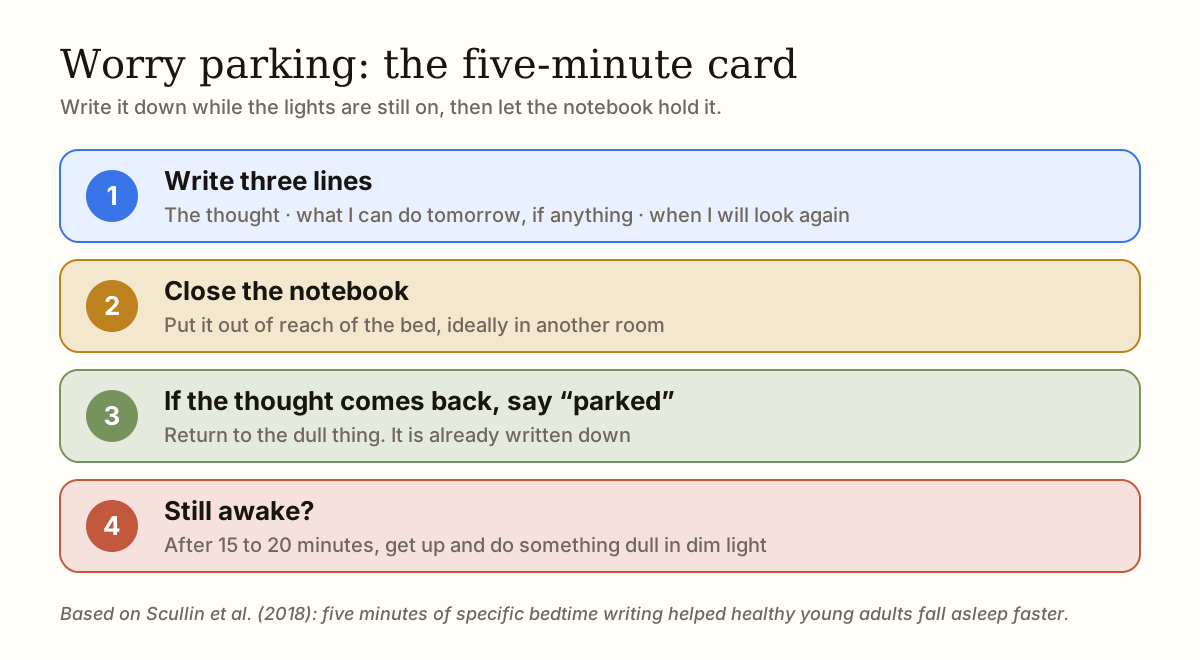
Park the worries on paper before bed, with a specific list for tomorrow. Scullin and colleagues (2018) had 57 healthy young adults write for five minutes before sleeping in a lab. Those who wrote a to-do list of things to remember over the next few days fell asleep significantly faster than those who listed what they had already done, and the more specific the list, the faster they fell asleep.
Keep the limits in view. The study was small, it used healthy 18 to 30 year olds, and the lists were about tasks, not heartbreak. Treat it as a reason to try this, not a promise.
The version for a breakup is three lines, written about 30 to 60 minutes before bed. If the loop runs all day too, how to stop thinking about your ex has the daytime techniques.
- Line 1: the thought that keeps coming back, in one plain sentence. (“I keep wondering whether they’re seeing someone.”)
- Line 2: what I can actually do about it tomorrow, if anything. (“Nothing. I will mute their stories.” or “Call the landlord about the lease.”)
- Line 3: when I will look at this again. (“Tomorrow at 6 p.m., for ten minutes.”)
How do I stop checking my phone at 3 a.m.?
Make checking physically slower than staying put. At 3 a.m. willpower is at its lowest and the phone is at its most convenient, so the rule has to be a location, not a promise.
Four rules, set up in daylight and with no moral tone attached:
- The phone charges outside the bedroom from a set time, with a cheap alarm clock on the nightstand.
- Use a Focus or Do Not Disturb schedule for the sleep window, so notifications from anyone, including them, can’t wake you.
- Mute or archive their account and the group chats where they appear. See how to stop checking your ex’s social media for the full mute-and-restrict setup.
- If you do check, you get up first. Having to leave the bed and walk to another room often lets the urge pass.
Which sleep basics help, and what can’t they fix?
They help with the mechanics of sleep, not with the feeling. The table is honest about both columns, because a tidy routine will not stop you missing someone, and expecting it to is how people decide the routine failed.
| Basic | What it helps with | What it cannot fix |
|---|---|---|
| Fixed wake time, every day | Gives sleep a steady anchor, so a bad night doesn’t reset the whole week (NHS advises it daily) | A night you have already lost. Keep the time anyway |
| Exercise during the day, not in the last four hours | Burns off restlessness and gives the day a shape (NHS) | Racing thoughts after lights out |
| Caffeine and alcohol cut-off of six hours | Removes two things that make sleep lighter or later (NHS) | The urge to drink because the evening is empty |
| Bed for sleep only | Stops the bed becoming the place where you think and scroll | A bedroom full of their things. Box them up, out of sight |
| Dim lights and no feed in the last 30 minutes | Fewer prompts that restart the replay (CDC suggests devices off 30 minutes before sleep) | Grief itself. This only stops the screen adding to it |
| Get up after 15 to 20 minutes awake | Breaks the link between bed and wakefulness (RACGP) | Anxiety that needs its own plan. See anxiety after a breakup |
Is it normal to sleep too much after a breakup?
Yes, in the first days. The NHS lists sleeping much more than usual alongside sleeping much less as a behaviour change with stress, and a body in shock often asks for rest.
It becomes a problem when it is most days, when you are sleeping to avoid the day, or when the wake time has gone. The fix is the same as for insomnia: one fixed wake time, daylight and one thing to get up for. If you can’t get out of bed on most days and nothing interests you, read depression after a breakup and consider talking to a doctor.
For the wider routine, including food and movement, see self-care after a breakup.
How long does it last, and when does insomnia need a doctor?
Nobody can give you a number, but bad sleep usually eases as the shock does. The NHS calls insomnia that lasts under three months short-term, and a few nights to a few weeks of poor sleep after a breakup is common. The physical-symptoms guide covers sleep alongside appetite and energy.
The NHS says to see a GP if changing your sleep habits hasn’t helped, you have had trouble sleeping for months, or it is making it hard to cope with daily life. We would not wait months if the sleep trouble comes with any of the following:
- Low mood or loss of interest on most days.
- Panic, chest tightness or a racing heart that you can’t settle. Chest pain, trouble breathing or fainting means calling your emergency number, not a GP appointment.
- Falling asleep at the wheel, or being too tired to drive or work safely.
- Thoughts of harming yourself or not wanting to be alive. Contact someone now, not in the morning: in the US call or text 988, in the UK and Ireland call Samaritans on 116 123, in India call Tele-MANAS on 14416, or call your local emergency number if you are in danger. More options are on our safety page.
Should I take sleeping pills or melatonin after a breakup?
Talk to a doctor or pharmacist first, and treat tablets as a last step, not a first one. The NHS says GPs rarely prescribe sleeping pills because of serious side effects and the risk of dependence, and only for a few days or weeks at most when insomnia is very severe and other treatments haven’t worked. Pharmacy sleep aids, it adds, may help for about one to two weeks and can cause drowsiness the next day, so check with a doctor first.
The American College of Physicians guideline (Qaseem et al., 2016) recommends cognitive behavioural therapy for insomnia (CBT-I) as the first treatment for chronic insomnia disorder in adults, with short-term medication discussed only if CBT-I alone does not work. CBT-I is the structured version of much of this page: the 15 to 20 minute rule, a fixed wake time and a plan for the worries. In England the NHS offers CBT, including online programmes, through your GP.
Don’t use alcohol as the pill. It feels like the same thing and it behaves like the opposite. If you are drinking most nights to sleep, tell a doctor, because that is worth knowing about too.
Step-by-step plan
- Set the last hour (60 minutes before bed)
No caffeine or alcohol in the last six hours. Do something dull and finite. Write the three-line worry card, close the notebook, and put the phone on charge outside the bedroom.
- Go to bed when you feel sleepy, not just tired
Lights low, phone out of reach. If you notice you are checking the time, turn the clock away.
- Give being awake 15 to 20 minutes
Estimate the time. Don’t try to force sleep, and don’t solve anything. Keep your eyes closed and your attention on the dull thing.
- Get up if you are still awake
Leave the bedroom and do something calm in dim light: read something familiar, fold laundry, listen to a low-volume audiobook. No feeds, no email, no profile checking.
- Return only when sleepy, and repeat
Go back to bed when your eyes get heavy. If you are awake again after 15 to 20 minutes, get up again. It is normal to repeat this several times on the first nights.
- Keep the same wake time
Get up at your usual time, even after a bad night, and get daylight early. This is what makes tomorrow night easier.
You do not have to solve the whole relationship tonight. Take one private step that creates space between the feeling and the action.
90-second urge reset →Common questions
Why can’t I sleep after a breakup?
A breakup is a major stressor, and stress keeps the body alert at the hour it should be winding down. The NHS lists stress, anxiety and depression among the common causes of insomnia. Add a quiet bedroom, a replaying mind and a phone within reach, and sleep gets harder still.
How long does insomnia last after a breakup?
It varies, and nobody can promise a number. The NHS calls insomnia lasting under three months short-term, and poor sleep after a breakup commonly eases as the shock does. See a doctor if habits haven’t helped, trouble sleeping has gone on for months, or you can’t cope with daily life. Seek help sooner if you also have low mood or panic.
Should I take sleep medication after a breakup?
Speak to a doctor or pharmacist first rather than self-prescribing. The NHS says sleeping pills are rarely prescribed, and only briefly, because of side effects and dependence. The American College of Physicians recommends CBT-I as the first treatment for chronic insomnia, with short-term medication considered only if it does not work.
Should I drink alcohol to sleep after a breakup?
No. The NHS says alcohol may make you drowsy at first but disrupts sleep later in the night, so you are more likely to wake at 3 a.m. It also lowers your guard on the urge to text. If you are using it most nights to get to sleep, mention it to a doctor.
Can stress from a breakup cause insomnia?
Yes. The NHS names stress, anxiety and depression among the common causes of insomnia, and it lists sleeping much more or much less than usual among the behaviours that come with stress. Insomnia from a breakup is usually short-term and responds to a steady routine, but it can last, so see a doctor if it doesn’t ease.
Why do I wake up in the middle of the night thinking about my ex?
Stress and anxiety can make it hard to stay asleep, and at that hour nothing else is competing for your attention. The thought isn’t more accurate at 3 a.m., only less challenged. Use the same rule as bedtime: after 15 to 20 minutes awake, get up and do something dull in dim light.
Is it normal to lie awake for hours after a breakup?
It’s common, especially in the first weeks, and it is also worth interrupting. Lying awake for long stretches teaches your brain that bed is for thinking. Get up after 15 to 20 minutes, return when sleepy, and keep the same wake time in the morning. If it carries on for months or makes daily life hard, see a doctor.
Can not sleeping after a breakup make me feel worse the next day?
It can. Poor sleep can make tiredness, low mood and tension harder to carry, so a bad night can make the breakup feel heavier. Go easy on decisions, especially messages to your ex, and keep the wake time. A short walk in daylight and a regular meal help more than a long nap.
What helps with sleep when you’re heartbroken?
A fixed wake time, a dull last hour, no caffeine or alcohol in the last six hours, the phone out of reach, and a rule to get up after 15 to 20 minutes awake. Writing a specific list of worries for tomorrow before bed may help too, based on one small lab study. None of it removes the grief, but it can protect your sleep.
If contact involves threats, stalking, coercion, shared children, housing or immediate safety, a general no-contact rule may not fit. Read the safety guidance and seek qualified local help where appropriate.
Sources and further help
- NHS: Insomnia (causes, short-term vs long-term, self-help, treatment, when to see a GP)
- NHS Every Mind Matters: Sleep (alcohol, caffeine, exercise timing, devices)
- NHS: Stress, symptoms and when to get help
- CDC: About sleep (devices off 30 minutes before bed)
- RACGP: GP guide to behavioural therapy for insomnia (stimulus control, 15 to 20 minute rule)
- Scullin et al. (2018): The effects of bedtime writing on difficulty falling asleep
- Qaseem et al. (2016): Management of chronic insomnia disorder in adults, American College of Physicians guideline
- 988 Suicide & Crisis Lifeline
- Samaritans (UK and Ireland)
- National Domestic Violence Hotline — safety planning
Research is cited to explain general patterns, not to diagnose or predict any individual outcome. Sources do not endorse UnLink. Read our editorial principles.
Keep this support one tap away.
UnLink is a free, private no-contact tracker for iPhone: count your days, get through urges and restart without losing your history.