Physical Symptoms of Heartbreak: What Is Normal and When to Get Help
Physical symptoms of heartbreak, from sleep and appetite changes to chest tightness: what is normal, what needs emergency care, and what to tell a doctor.
 By the UnLink Editorial Team · General educational guidance, not therapy
The physical symptoms of heartbreak include poor sleep, appetite changes, fatigue, headaches, stomach upset, muscle tension and sometimes chest tightness. Most ease as the emotional shock does. Chest pain, pressure, trouble breathing or fainting is different: call your emergency number (911 in the US, 999 in the UK) instead of assuming it is stress.
- If you have chest pain or pressure, trouble breathing, or you faint, call your emergency number now (911 in the US, 999 in the UK). Do not wait to see whether it passes.
- Sleep trouble, appetite changes, tiredness, headaches, stomach upset and muscle tension are common after a breakup, and they usually ease as the emotional shock does.
- The aches are not imagined. Brain imaging research found that recalling a romantic rejection engages regions that also respond to physical pain (Kross et al., 2011).
- Broken heart syndrome (takotsubo) is a real heart condition, but it is uncommon and only a doctor can tell it apart from a heart attack. Having a breakup does not mean you have it.
- A three-week log of sleep, food, energy and chest tightness gives a doctor something concrete. See someone if a symptom is new, lasting or getting worse.
What are the physical symptoms of heartbreak?
If you have chest pain or pressure, trouble breathing, or you faint, stop reading and call your emergency number now: 911 in the US, 999 in the UK. Everything else on this page can wait.
For everyone else, the usual physical symptoms of heartbreak are sleep that falls apart, a stomach that will not take food (or will not stop wanting it), a tiredness that a night in bed does not fix, headaches, a clenched jaw and sore shoulders, a churning gut, and a heart that seems to pound at 2 a.m. The NHS lists headaches or dizziness, muscle tension or pain, stomach problems and a faster heartbeat among the physical symptoms of stress, and puts sleeping or eating too much or too little in the same group.
A breakup is a textbook stressor, so this is your body doing what bodies do under stress. It is not weakness, and you are not making it up. The table is the quick version, and the sections after it explain each row.
| Symptom | Common after a breakup? | What to do | Get help now if… |
|---|---|---|---|
| Sleep trouble | Very common: slow to fall asleep, waking at 3 a.m., or sleeping far more than usual | Fixed wake time, daylight, no caffeine late, phone out of the bedroom. See can’t sleep after a breakup | Poor sleep has gone on for several months, or it is making daily life or driving unsafe |
| Appetite change | Very common, in either direction: no appetite, or eating more than you want to | Small, regular, easy meals and plenty of fluids; no rules about what counts as a proper meal | You are losing weight without meaning to, cannot keep food or fluids down, or are barely eating for days |
| Fatigue | Common. Grief and broken sleep are tiring | Daylight, a short walk, an earlier night, fewer demands this week | It is severe, keeps getting worse, or comes with breathlessness or fainting |
| Headaches and muscle tension | Common, often with a clenched jaw, poor sleep or skipped meals | Water, regular meals, a break from screens, gentle stretching | The headache is sudden and severe, or comes with weakness, confusion or trouble speaking |
| Chest tightness or a racing heart | Can happen with stress and anxiety, but worth getting checked the first time | Slow breathing, tell someone, mention it to a doctor | It is crushing or squeezing, spreads to the arm, neck or jaw, or comes with breathlessness, sweating or nausea |
| Chest pain or trouble breathing | Do not put this down to heartbreak | Call your emergency number | Always. Now. Do not drive yourself and do not wait to see if it passes |
Can heartbreak cause chest pain? When to call emergency services
Heartbreak can come with chest tightness, but you cannot decide from the sofa whether yours is stress or something that needs treatment, so the rule is simple: chest pain or pressure, trouble breathing, or fainting means you call.
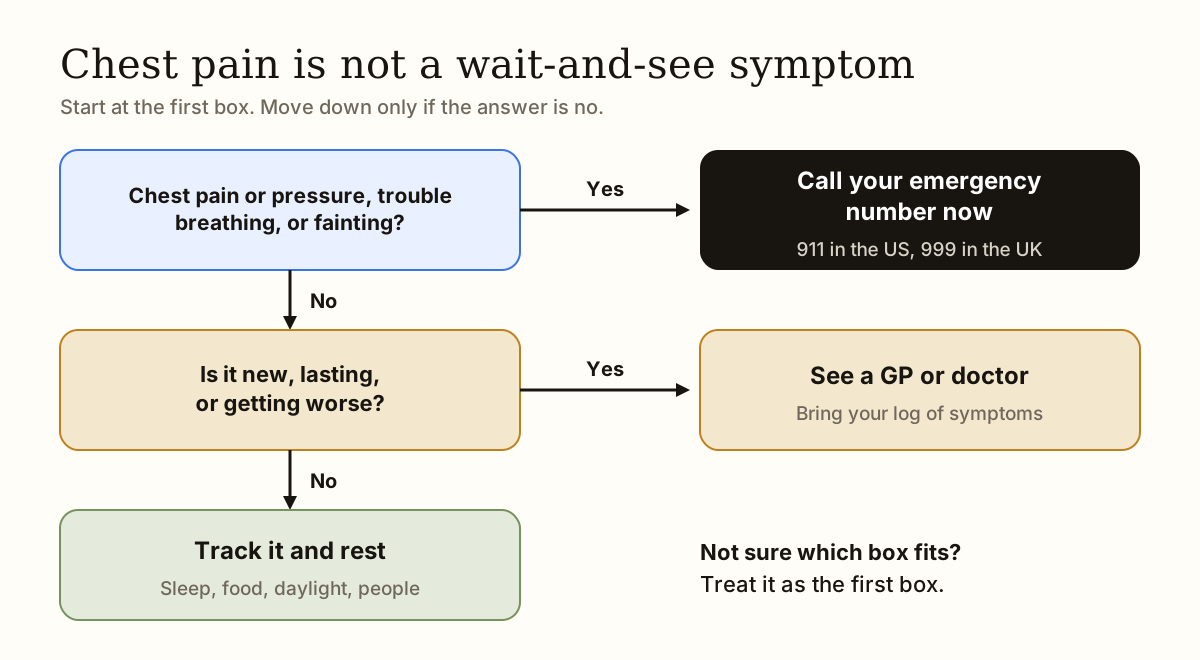
Call 911 in the US or 999 in the UK (other countries have their own number) if you have any of those. The CDC says not to wait to see whether symptoms pass, and the NHS says not to drive yourself to hospital. Sit down, unlock the door if you are alone, and follow what the call handler tells you.
The warning signs the NHS and CDC list are chest pain that feels crushing, squeezing, tight or heavy; pain that spreads to the arm, neck, jaw, shoulder or back; chest discomfort that lasts several minutes or comes and goes; breathlessness; sweating; nausea; lightheadedness; and pale, grey or blue skin. The CDC notes that unusual tiredness and nausea are more common in women, so a heart attack does not always look like the film version.
A false alarm costs you an afternoon. A real one cannot be treated from home. Anxiety can also produce a pounding heart and a tight chest, and the first time it happens it is genuinely impossible to tell from the inside. Let someone with equipment make that call.
If it is milder but new, comes with a racing or irregular heartbeat, or leaves you more breathless than usual, get same-day advice: NHS 111 in the UK, or your doctor or a nurse advice line in the US.
Why does heartbreak affect the body?
Your brain treats a breakup as a serious threat, and a threat switches on the body’s alarm system.
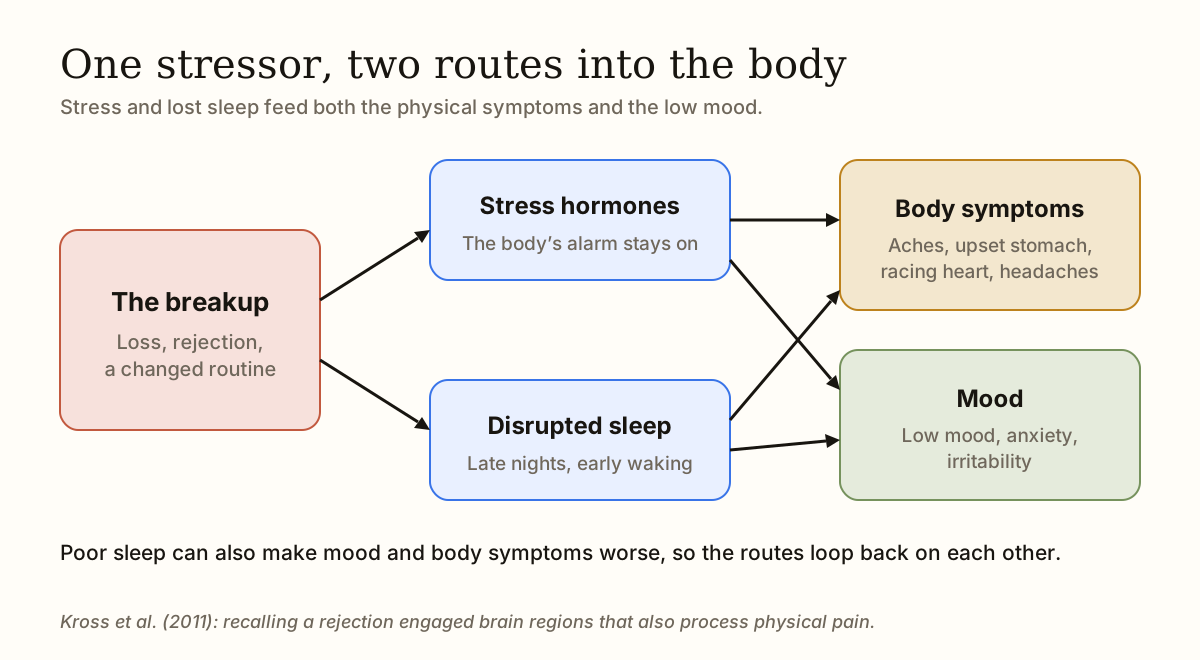
Kross and colleagues (2011) scanned people who had recently been through an unwanted breakup. Looking at a photo of the ex and recalling the rejection engaged brain regions that also respond to physical pain. That study is about the brain’s pain-related regions, not the heart, and it does not show that heartbreak damages anything. What it supports is the plain experience: the ache is registered as an ache.
The alarm system then does what it always does. Heart rate rises, muscles tighten, the gut stalls. That fits the stress symptoms the NHS lists: headaches, muscle pain, stomach problems, a faster heartbeat. Sleep is the second route in. The NHS names stress, anxiety and depression as common triggers of insomnia, and a week of bad nights makes mood lower and tension higher. The two routes feed each other.
Every fresh hit of your ex restarts this. A 2012 study found that monitoring an ex-partner on Facebook was associated with more distress and less personal growth (Marshall, 2012). If you are checking their stories at 1 a.m., see how to stop checking your ex’s social media, because a body that is trying to calm down cannot do it while you keep pressing the alarm.
Why can’t I sleep or eat after a breakup?
Because sleep and appetite both run on the stress response: a body on alert does not rest well and does not want food.
It can go the other way, too. Sleeping fourteen hours or eating through a whole packet of biscuits is just as common as lying awake, and it is just as much a stress response. Neither is a character flaw.
For sleep, the NHS advice for short-term insomnia (under three months) is plain and worth following in full. It is also the kind of advice that gets ignored because it sounds too simple, so pick two and start tonight:
- Get up at the same time every morning, including after a bad night. Do not sleep in to make up for it, and avoid daytime naps.
- Wind down for about an hour before bed with something dull: a bath, a book, a podcast you have already heard.
- Keep caffeine, alcohol and cigarettes out of the last six hours before bed. Alcohol feels like a sleep aid and works against sleep.
- Exercise during the day, but not in the four hours before bed.
- Charge your phone outside the bedroom. The urge to text peaks late, and why you want to text your ex at night explains why.
What is broken heart syndrome, and can you die of a broken heart?
Broken heart syndrome, medically called takotsubo syndrome, is a real condition in which the heart muscle temporarily weakens, usually after severe emotional or physical stress. It is uncommon, most people recover, and it is not what most people mean by heartbreak.
The British Heart Foundation (BHF) says it is more common in women, in people over 50 and in people with anxiety or depression, and that it affects up to 5,000 people a year in the UK. Triggers can be emotional or physical: bereavement, illness, surgery, mental trauma, financial stress. It does not have to be a sad event. The exact cause is unknown, and the working theory is a surge of stress hormones that strains the heart.
The reason it matters on this page is the symptoms. The BHF lists sudden, intense chest pain, chest pressure or heaviness and shortness of breath as the most common, and says it can feel like a heart attack. You cannot tell the two apart at home, and neither can anyone else without checking. That is the whole case for the emergency rule above.
Can you die of a broken heart? It is a heart condition and needs hospital assessment, so it is not trivial. But the BHF says most people recover, usually within weeks, and that about 1 in 10 people who have had it get it again, so long-term medication such as beta blockers is often recommended.
None of this means you have it. A breakup is a stress, and stress is on the BHF’s list of triggers, but the page cannot tell you that, and a breakup does not mean you have it. Chest symptoms after one do not rule it out either. Get checked.
When should I see a doctor after a breakup, and what should I bring?
See a doctor if a symptom is new, lasting or getting worse, if it stops you doing ordinary things, or if it worries you enough that you keep checking it. You do not need a better reason than that.
Tell them about the breakup. It is relevant context, not an excuse, and it changes what they look for. The NHS says to see a GP if you are struggling to cope or your own efforts are not helping, and for sleep specifically, if changing your habits has not worked, if trouble sleeping has gone on for several months, or if it is hard to get through your day.
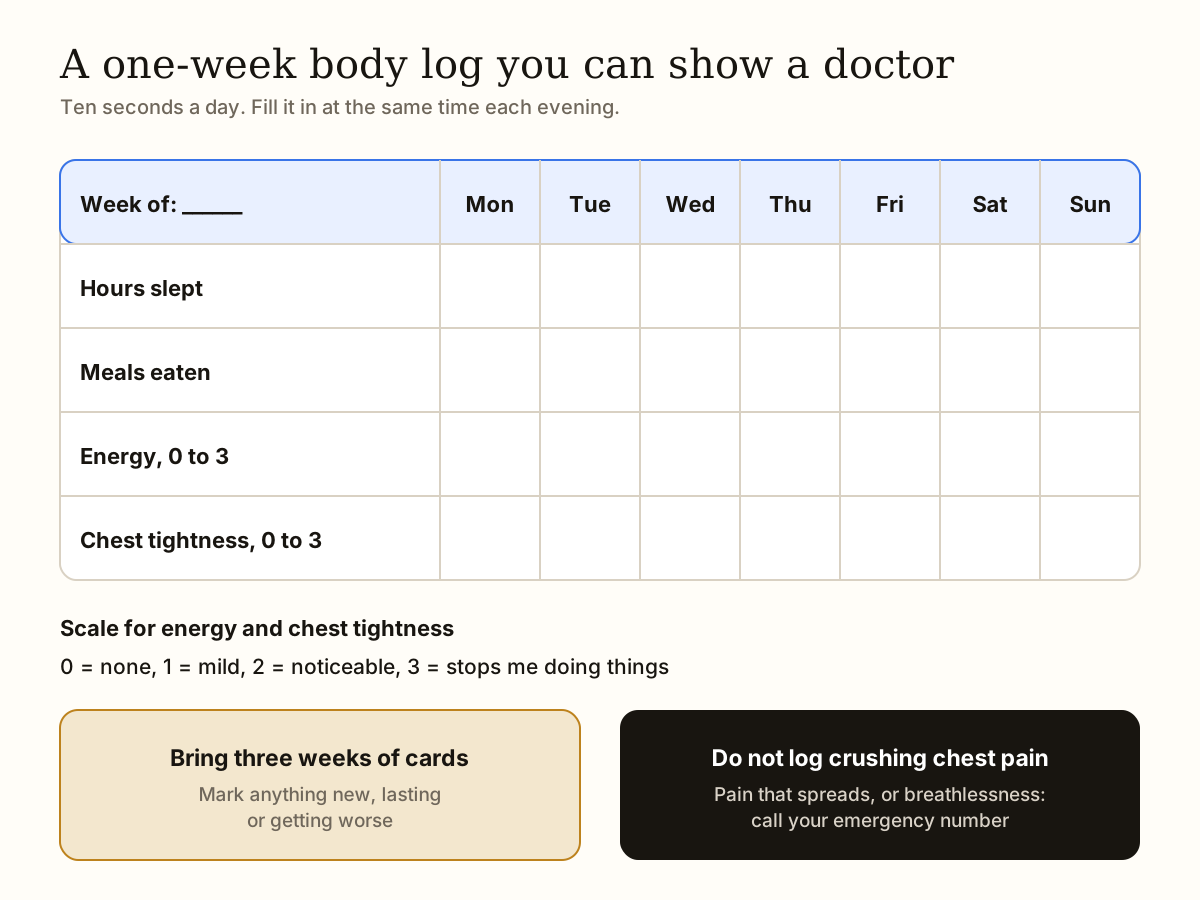
A log beats memory. Doctors work from patterns, and at a bad week you will remember the worst night and forget the three better ones. The card below takes ten seconds a day, and the steps further down explain how to keep it.
Example: three weeks of a log, summarised weekly. Weeks one and two improve a little, which is the usual wave. Week three is the one to show someone: chest tightness that is new and happens at rest, and eating has dropped again. This is an illustration of what to note, not a diagnosis of anyone.
Questions worth bringing to the appointment:
- Could anything physical be behind this, such as an overactive thyroid or a heart rhythm problem, that is worth ruling out?
- Does my chest tightness need a heart check, and what should make me come back sooner?
- Could a medicine, caffeine or alcohol be making my sleep or my heartbeat worse?
- What should I try first for sleep, and when would you want to review it?
- Could this be anxiety or low mood, and what support is available near me?
- If I lose more weight or stop sleeping altogether, who do I call, and how fast?
| Example week | Sleep | Eating | Energy, 0 to 3 | Chest tightness, 0 to 3 | What stands out |
|---|---|---|---|---|---|
| Week 1 | About 4 to 5 hours, awake at 3 a.m. | 1 to 2 small meals a day | 1 | 2 on three evenings | A hard first week; keep logging |
| Week 2 | About 5 to 6 hours | 2 meals most days | 1 to 2 | 1, mostly evenings | Slowly better on sleep and eating |
| Week 3 | About 4 hours again after a bad weekend | 1 meal, some days none | 0 to 1 | 2, including once at rest in the afternoon | Chest tightness at rest is new and eating has dropped: book a visit now and bring this |
What can I do for my body in the first weeks?
Do the dull basics at the same times every day, because they are the part of recovery your body cannot skip. This is the short, body-only version. The wider plan is in how to get over a breakup, and self-care after a breakup goes deeper on routines.
Eat something at set times even if you are not hungry. A banana and peanut butter counts, and so does soup. Drink water. Step outside once a day, because daylight helps your sleep clock and a ten-minute walk costs nothing. Ask one person to check on you, specifically: “Can you text me at nine tonight?”
Cut what you can control. Fewer hits of your ex means fewer alarm surges, and a clear boundary is the quickest way to get them. The first 30 days of no contact is a day-by-day plan for that. If you want a rough sense of how recovery tends to run, the breakup recovery time estimator gives a range, and how long it takes to get over a breakup explains why nobody can give you a date.
Expect waves. The body symptoms tend to track the emotional wave, so a bad Sunday after a decent week is normal. A downward trend over several weeks is not. If sleep, eating or energy have not started to improve after a couple of weeks, or they are getting worse, book the appointment.
When is it more than heartbreak?
It is more than heartbreak when the symptoms stop easing and your mood, not just your body, is flattening out: weeks of barely eating or sleeping, no interest in anything, hopelessness, or not being able to work or look after yourself.
That pattern can be depression or anxiety, and both are treatable. Our guides to depression after a breakup and anxiety after a breakup cover the difference between a hard stretch and something to get help for. The NHS says to see a GP if you are struggling to cope, and in England you can usually refer yourself to NHS talking therapies without one.
If you have any thoughts of harming yourself, get help now. In the US, call or text 988 (Suicide & Crisis Lifeline). In the UK and Ireland, call Samaritans on 116 123. In India, call Tele-MANAS on 14416. Elsewhere, call your local emergency number. If your ex has hurt you or you are afraid of them, in the US call the National Domestic Violence Hotline on 1-800-799-7233 (or text START to 88788). More resources are on our safety page.
Step-by-step plan
- Pick one time each day
Evening works for most people. Put it next to something you already do, like brushing your teeth, so it takes no willpower.
- Write four numbers
Hours slept (roughly), meals eaten, energy from 0 to 3, and chest tightness from 0 to 3. Do not round up to look better. A doctor wants the honest version.
- Add a line for anything new
A racing heart at rest, a new type of headache, a day you could not eat. One line is enough.
- Keep it going for three weeks
A missed day does not matter. Three weeks is long enough to see whether things are easing, flat or getting worse.
- Take it with you, or act sooner
Bring the log to your appointment. If anything on it matches the chest pain, breathing or fainting warning signs, do not wait for the three weeks: call your emergency number.
You do not have to solve the whole relationship tonight. Take one private step that creates space between the feeling and the action.
Estimate your recovery range →Common questions
Can a breakup make you physically sick?
It can make you feel ill: nausea, an upset stomach, headaches, shakiness and exhaustion are all common stress responses. These come from the stress and lost sleep, not from an infection. If you also have a fever, vomiting that will not stop, or you cannot keep fluids down, see a doctor rather than putting it down to the breakup.
How long do physical symptoms of heartbreak last?
There is no reliable number, but body symptoms generally follow the emotional wave and ease as the shock settles. The NHS calls insomnia that lasts under three months short-term, and says to see a GP if trouble sleeping has gone on for several months. If sleep, eating or energy have not started to improve after a couple of weeks, or they are getting worse, get checked. See how long it takes to get over a breakup for the wider picture.
Is heartbreak dangerous?
For most people, the physical symptoms are uncomfortable but not dangerous. The exceptions are chest pain, trouble breathing and fainting, which need emergency care whatever the cause, and symptoms that do not ease, which need a doctor. Heartbreak can also lower mood to the point where support matters, so watch your mood as well as your body.
Does heartbreak cause weight loss?
It can, because many people eat much less for a few weeks, and some people gain weight instead. Either direction is a common stress response. Tell a doctor if you are losing weight without meaning to, or if you are barely eating for days. Small, regular, easy meals are a better aim than proper ones.
Can a breakup actually cause chest pain?
Chest tightness and a racing heart can happen with stress and anxiety, and the NHS lists both among the physical symptoms of stress. Chest pain can also be a heart problem, and from the inside you cannot tell the difference. If it is crushing, squeezing, spreads to the arm, neck or jaw, or comes with breathlessness, call 911 or 999 now.
Is it normal to feel nauseous or physically sick after a breakup?
Yes. A churning stomach and nausea are common when your body is under stress, and eating little makes it worse. Eat small, bland things at set times, drink water, and see a doctor if it lasts for more than a couple of weeks, if you are losing weight without trying, or if you cannot keep food or fluids down.
Can you die of a broken heart?
Broken heart syndrome (takotsubo) is a real heart condition that usually follows severe stress, and it is serious enough to need hospital care. Most people recover, usually within weeks, according to the British Heart Foundation. It is uncommon, and heartbreak alone does not mean you have it, but chest pain after a breakup still needs an emergency call.
Should I tell my doctor about a breakup?
Yes. It is useful context that changes what they ask and look for, and it helps them judge whether the sleep, appetite or chest symptoms might be stress, anxiety or low mood. You do not have to give details. “My relationship ended three weeks ago and I have not been sleeping” is enough.
When is a racing heart after a breakup an emergency?
Call your emergency number if a racing heart comes with chest pain or pressure, trouble breathing, fainting or nearly fainting, or pain spreading to the arm, neck or jaw. If it is milder but new, lasts, or keeps coming back, get same-day advice or see a doctor. A pounding heart that eases when you slow your breathing and sit down is more likely to be stress, but have it checked at least once.
Is it normal to have headaches and fatigue after a breakup?
Yes. Headaches and tiredness are common stress symptoms, made worse by poor sleep, skipped meals and a clenched jaw. Water, regular food, daylight and an earlier night help. See a doctor if a headache is sudden and severe, or comes with weakness, confusion or trouble speaking, or if the fatigue keeps getting worse.
If contact involves threats, stalking, coercion, shared children, housing or immediate safety, a general no-contact rule may not fit. Read the safety guidance and seek qualified local help where appropriate.
Sources and further help
- British Heart Foundation: Takotsubo cardiomyopathy (broken heart syndrome)
- NHS: Heart attack, symptoms and when to call 999
- CDC: About heart attack, warning signs and calling 911
- NHS: Insomnia, causes, short-term vs long-term, and when to see a GP
- NHS: Stress, physical symptoms and when to get help
- Kross et al. (2011) — Social rejection shares somatosensory representations with physical pain
- Marshall (2012) — Facebook surveillance of former romantic partners
- National Domestic Violence Hotline: Plan for safety
- 988 Suicide & Crisis Lifeline — US crisis support
Research is cited to explain general patterns, not to diagnose or predict any individual outcome. Sources do not endorse UnLink. Read our editorial principles.
Keep this support one tap away.
UnLink is a free, private no-contact tracker for iPhone: count your days, get through urges and restart without losing your history.