Valentine’s Day After a Breakup: A Plan for the Day and the Weeks Around It
Valentine’s Day after a breakup: an hour-by-hour plan with a fallback for the urge, social media rules, scripts for friends, and a check before you text.
 By the UnLink Editorial Team · General educational guidance, not therapy
Get through Valentine’s Day after a breakup by deciding the whole day before it arrives: where you will be, who you will talk to, what you will mute, and what you will do if the urge to text your ex hits. Write the plan while you are calm, tell one friend, and follow it on the day.
- Plan the day in blocks (morning, midday, afternoon, evening, bedtime) and give each one a fallback, so the 9 p.m. decision is made by a calmer version of you.
- Mute before 14 February, not during it. Monitoring an ex’s social media after a breakup has been linked to more distress and less personal growth (Marshall, 2012).
- The date is the weakest reason to text your ex. Wait 24 hours, write the message in Notes, and check it against a few plain questions first.
- The weeks around the date matter as much as the day: the build-up starts in late January, and the 15th can feel flat.
- If the day leaves you hopeless, or you have thoughts of harming yourself, get help now. In the US, call or text 988.
How do you get through Valentine’s Day after a breakup?
Decide the day in advance. Most of what makes 14 February hard is not the date itself but the open hours, the phone in your hand and one decision you would rather not make at 9 p.m., so you write the plan while you are calm and follow it when you are not.
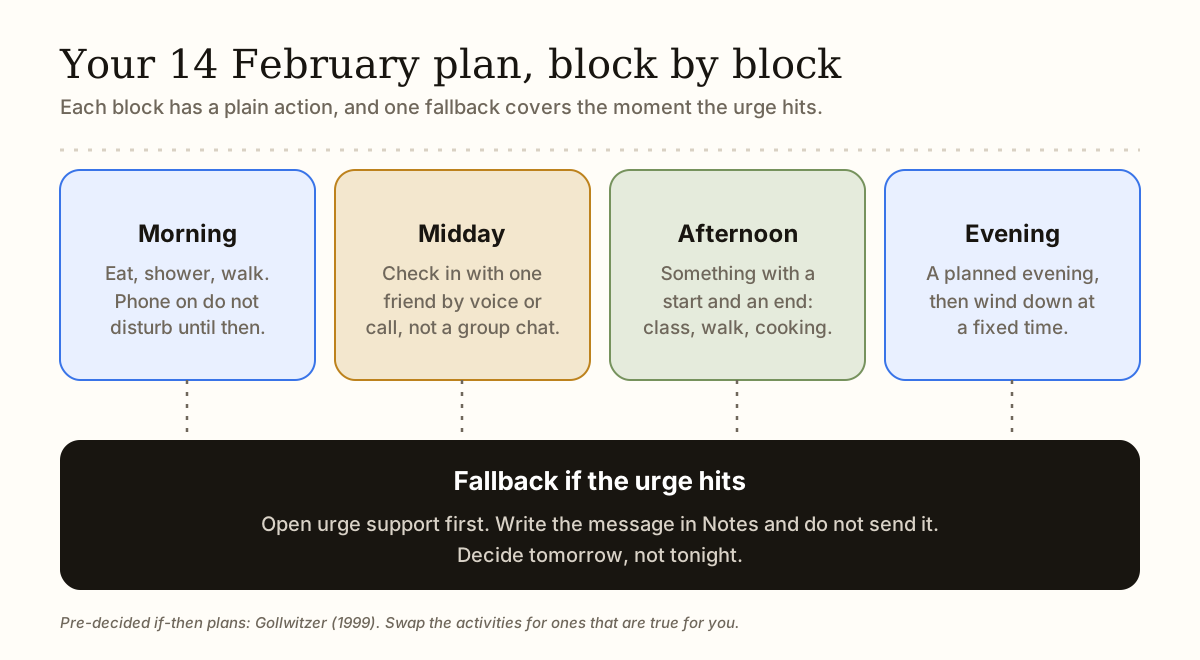
Planning beats willpower for a simple reason. In a 1999 paper, Gollwitzer reviewed research on “implementation intentions”, plans in the form “if X happens, then I will do Y”, and reported strong effects on whether people follow through on a goal. Here the “if” is the urge, the lonely hour or the couples post, and each block of the day gets a “then”.
Treat the table as a template and swap in your own details. A short plan you will follow beats an ambitious one you won’t.
| Block | Plan | If the dread or the urge hits |
|---|---|---|
| Morning | Get up at your usual time and eat something. Keep the phone on do not disturb until you have showered and walked. | Text one friend: “Rough day to wake up to. Can I check in at lunch?” |
| Midday | Call or voice-note one person. A voice is harder to hide behind than a thumbs-up emoji. | Step outside for ten minutes with the phone in your pocket. |
| Afternoon | Do something with a start and an end: a class, a gym session, a long walk, a recipe that takes two hours. | Run the 90-second reset before you open Messages. |
| Evening | Be somewhere on purpose after dark: dinner at a friend’s, a cinema, a call you booked in advance. | Write the message in Notes. Do not send it. Read it tomorrow. |
| Bedtime | Charge the phone outside the bedroom and wind down at a fixed time. | If you are awake and spiralling, get up for twenty minutes and go back when you are tired. |
How do you plan for Valentine’s Day before it arrives?
Start two or three weeks ahead, on a calm evening, and give it fifteen minutes. A plan written at midnight on 13 February is a worry list. A plan written in late January is a plan.
The seven-step checklist further down covers the plan itself. A few of its items are logistics that people forget until the day: cancel the table you booked for two, switch off the flower or chocolate subscription that still has their address on it, and turn off the “On this day” photo memories, which will hand you last year’s 14 February without warning.
Tell one friend what you are dreading and what you have planned. It takes one text, and it turns a private dread into something another person can check on.
Planning will not promise a good day. It promises that you will not be making decisions alone, tired and sad, with a phone in your hand.
What should you do about social media on Valentine’s Day?
Mute before the day, not during it. On 14 February your feed fills with proposals, flowers delivered to desks and couples photos, and your ex’s account is one thumb away if you can still see it.
The research leans one way. In a 2012 study of people after a breakup, Marshall found that monitoring an ex-partner’s Facebook was associated with more distress and less personal growth. It was a correlation and it was about Facebook, so it cannot prove that looking causes the distress. It does match what most people say afterwards: they didn’t feel better for looking.
The post you are tempted to make is a form of checking too. A pointed “single and thriving” photo means you will spend the evening watching to see whether they saw it. If you are drafting captions with them in mind, that is the signal to put the phone down. More setup steps are in how to stop checking your ex’s social media.
Friends can’t follow a rule you haven’t told them about, so send one: “I’m staying off Instagram until the 15th. If you want to show me something, text it to me.”
| Option | What it does | Works best when |
|---|---|---|
| Mute their account and their close family | They stay followed, so there is no visible gesture, but you stop seeing them. | You share friends or a workplace and don’t want to make a point. |
| Mute words like “Valentine’s” and “anniversary” | Thins out couples content in apps that let you mute keywords. | You can’t stay off the app for the whole day. |
| Sign out of the apps or move them off your home screen for 48 hours | Adds friction, so opening an app becomes a decision. | You check without noticing you are doing it. |
| A “no posts this week” rule | Stops you posting something aimed at an audience of one. | You have caught yourself writing captions for them. |
| Block | Removes access completely. | Checking is already a habit and nothing shared requires contact. See should you block your ex. |
Should you text your ex on Valentine’s Day?
Usually not, and 14 February is the weakest reason to do it. If you are in no contact, the date doesn’t suspend it. If you aren’t, the question is the same: what do you want to happen after you press send?
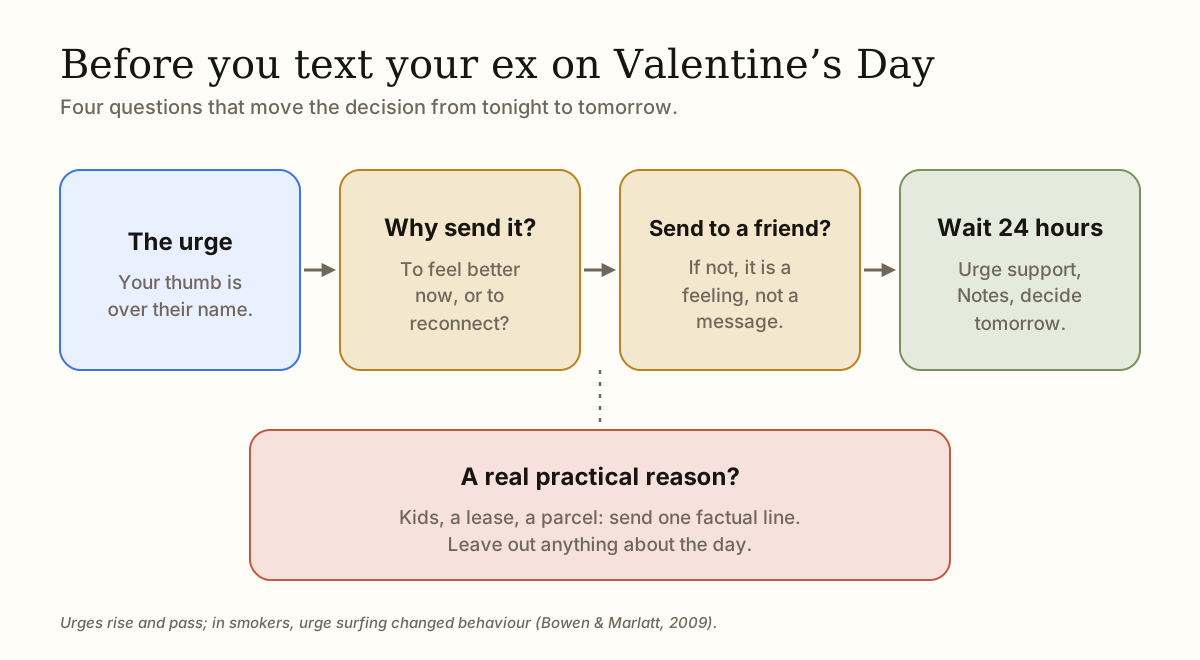
The pull is real. Fisher and colleagues (2010) scanned people who had recently been rejected and found that looking at their ex activated reward and craving areas of the brain. Cravings rise, peak and pass, and the useful skill is not acting while one is peaking. In a 2009 study of college students who smoked, Bowen and Marlatt taught “urge surfing”, which means noticing an urge without acting on it. The students smoked fewer cigarettes over the following week, even though their urges were no weaker. You don’t have to make the urge disappear. You have to not obey it for a while.
If any answer below points toward “wait”, wait 24 hours, open urge support and keep the draft in Notes. If you are still sure tomorrow, you will have chosen it rather than reacted to it. The Should I text my ex? tool runs a longer version, and what to do instead of texting your ex has alternatives for the minute itself.
If they text you first, the same wait applies. What to do when your ex texts you during no contact has replies you can adapt. The questions to ask yourself before any message of your own:
- What do I want to happen next? A reply, an apology, ten minutes of feeling less alone? If it is the last one, a message is an unreliable way to get it.
- Would I send this on 3 March? If it only makes sense on 14 February, the date is doing the talking.
- Would I send this to a friend? If the tone, length or hope in it would be odd to send anyone else, it is a feeling, not a message.
- How will I feel if they don’t reply, or reply coldly? Silence is a real possibility, and you will be alone with it.
- Am I tired, or have I been drinking? Both lower your guard at the hour when urges tend to peak.
- Is there a practical reason? Kids, a lease, a parcel, a shared pet: send one factual line about that and nothing about the day.
Who should you spend Valentine’s Day with when you are single?
People who make the day easier, in a setting that has an end. That is usually one or two friends, a relative, or you with a plan, not a crowded bar on the biggest couples night of the year.
Galentine’s Day is a name from the TV comedy Parks and Recreation for a day celebrating friends, usually on 13 February. After a breakup it works when it stays low-key: brunch, pizza and a bad film at someone’s flat. It works badly when it becomes a night designed to prove you are fine, or a hunt for a rebound.
Staying in is a legitimate plan, as long as it is a plan. Cook something that takes effort, watch something that isn’t a romance, and speak to one person by voice. If a whole evening alone sounds like a bad idea, believe that and book the friend. Go easy on alcohol, which lowers impulse control at the exact hour the urge peaks.
The awkward part is usually saying no, or asking for what you need. Scripts help, so adapt these.
| Situation | What you could say |
|---|---|
| A friend invites you to a couples dinner | “Thanks for thinking of me. A couples night isn’t for me this year. Can we do a walk on Saturday instead?” |
| A friend keeps talking about plans with their partner | “I’m glad it’s going well. Today it’s hard to hear the details. Can we talk about something else for a bit?” |
| A relative asks if you are seeing anyone | “Not right now, and I’d rather talk about something else. How’s the move going?” |
| A friend asks what you need | “Can you text me at 7 and again at 9? I don’t need you to fix anything.” |
| You want a quiet day | “I’m having a quiet one. I’ll call you on Monday.” |
| The urge hits and nobody is around | To yourself: “I can want to text them and not text them. I’ll check again in twenty minutes.” |
How do you handle the weeks around Valentine’s Day?
Plan for the whole stretch, not only the day. The build-up starts in late January, when shop displays, restaurant promotions and couples posts arrive, and the 15th can land flat or low, which catches people who spent all their effort on the 14th.
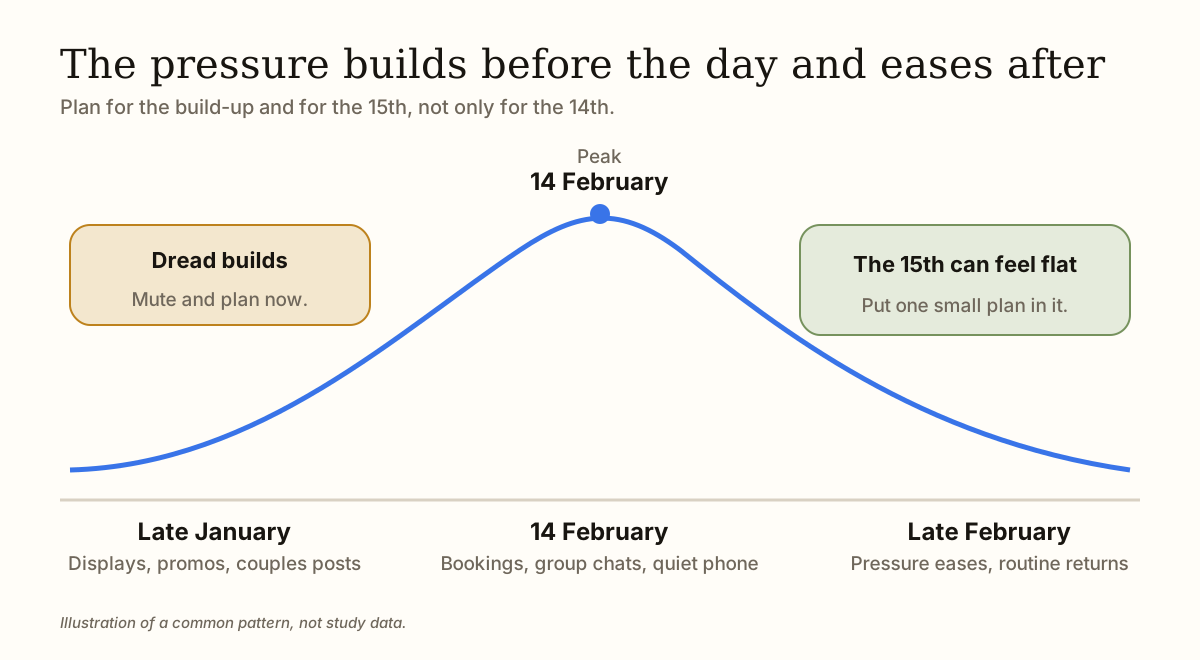
Is it normal to feel worse the week before? Yes, and it is often the anticipation more than the day. We don’t know of good data on Valentine’s Day specifically, so read that as a common pattern, not a statistic. Dread tends to run ahead of the event, and plenty of people find the day itself more bearable than the week leading up to it.
A few small moves help across the whole stretch. Mute early. Keep your usual sleep. Put something small on the 15th, such as a gym session, a call or a dinner you have been meaning to cook, and something on the weekend after. If the 14th goes well, the 15th still has a plan. If it goes badly, the plan is already waiting.
How do you stop the day from ruining the week after? Don’t review it. Don’t rate the day at midnight, and don’t text your ex because it is over. Write three lines (what went well, what was hard, what you would change) and go to bed.
What if Valentine’s Day goes badly?
Then it was a hard day, and it ends at midnight. You can cry, abandon the plan, watch their story or send the text, and none of that cancels the weeks you have already put in.
Crying at a memory is not weakness. Kross and colleagues (2011) found that recalling a painful rejection by a partner engaged brain regions that also process physical pain, so a day like this hurts in a way the body treats as real.
If you did text or check, treat it as information. Note the time, what happened in the hour before, and what you would change. Then restart the count: what to do if you break no contact covers the steps.
Writing helps with the rest. In a 1997 review, Pennebaker described research on expressive writing, where people write about emotional experiences for about fifteen to twenty minutes over several days, and linked it to better health and wellbeing. A Notes page you never send is one version of that, and the unsent letter guide shows how. If loneliness is the hardest part, read loneliness after a breakup.
When should you get more support?
Get support if the low mood doesn’t lift after the day, if you can’t sleep or eat for around two weeks, or if the day tips from sadness into hopelessness. A doctor, a therapist or a counselling service can help, and you don’t need to be in crisis to ask.
If you have any thoughts of harming yourself, get help now. In the US, call or text 988 (Suicide & Crisis Lifeline). In the UK and Ireland, call Samaritans on 116 123. In India, call Tele-MANAS on 14416. The safety page has more.
If your ex was controlling, threatening or frightening, a day like this can bring contact you did not ask for, and leaving can raise the risk. In the US, the National Domestic Violence Hotline is 1-800-799-7233 (text START to 88788), and its safety planning guide is a good first read. Safety planning comes before any contact strategy. For the wider recovery plan, see how to get over a breakup, and for the holiday season more generally, no contact during the holidays.
Step-by-step plan
- Write the plan for the day
Fill in morning, midday, afternoon, evening and bedtime, each with a fallback. Do it on a calm evening, in your Notes app.
- Mute or archive
Mute your ex, their close friends and Valentine’s keywords where the app allows it, and decide whether to sign out of the apps for 48 hours.
- Tell one friend
Send one text with the day, the plan and one request, such as “Can you check on me at 7?”
- Choose your fallback for the urge
Decide what you will open instead of Messages and who you will call. The 90-second reset works in the moment.
- Pick a safe place to be
Decide where you will physically be after dark, ideally with someone, and where the phone sleeps overnight.
- Set a text-check rule
Write it down: any message to your ex waits 24 hours and goes through the questions first.
- Note one thing you are proud of
Write one thing you have done since the breakup that you are proud of, however small, and put it where you will see it on the day.
You do not have to solve the whole relationship tonight. Take one private step that creates space between the feeling and the action.
Run the 90-second reset before you text →Common questions
What should I do on Valentine’s Day after a breakup?
Plan it in blocks and give each one a fallback: something that gets you moving in the morning, a call at midday, an activity with a start and an end in the afternoon, and a planned evening. Mute your ex and couples content before the day, and tell one friend what you are dreading. The details are in the plan above.
Is it okay to text my ex on Valentine’s Day if we’re not together?
You can, but the date is a weak reason, and a message sent to feel better tonight often leaves you feeling worse tomorrow. Wait 24 hours, write it in Notes, and check it against the questions above. If you are in no contact, the date doesn’t suspend it.
Does no contact still apply on Valentine’s Day?
Yes. No contact is a boundary for your recovery, and a holiday doesn’t change what it is protecting. If you share children, a lease or a workplace, practical messages are still fine, kept short and about the practical matter only. See modified no contact.
What if my ex sends a Valentine’s message?
You don’t have to reply, and you don’t have to reply today. Wait at least 24 hours and ask whether answering helps your recovery or restarts the wait. If you decide to respond, keep it short and neutral. The guide on when your ex texts you during no contact has scripts.
Is it normal to feel worse the week before Valentine’s Day?
Yes, and it is common. The shop displays, ads and couples posts start weeks ahead, and the dread can run ahead of the day. Plan early, mute early and put something small on the 15th as well.
How do I handle friends who keep talking about their partners?
Tell them once, kindly, and give them something to do instead: “I’m glad it’s going well. Today it’s hard to hear the details. Can we talk about something else?” Most friends want a rule they can follow. If one keeps going, spend the day with someone else.
Should I plan something for myself or stay home?
Plan something either way. Staying in works if it is a plan with a start and an end, such as cooking something that takes effort and a call with a friend. If the thought of a whole evening alone feels bad, trust that and book company for the first few hours after dark.
What is Galentine’s Day, and is it a good option after a breakup?
Galentine’s Day comes from the TV comedy Parks and Recreation and means a day to celebrate friends, usually on 13 February. It can be a gentle option after a breakup if it stays low-key, such as brunch or a film at someone’s flat. It is a poor fit if it turns into a night out meant to prove you are over them.
Is it okay to skip Valentine’s Day altogether after a breakup?
Yes. You can treat it as a Saturday or a Tuesday, and many people do. The only thing worth doing is the unglamorous prep: mute the couples content, move the phone away from your bed and have a fallback ready in case the urge hits.
Is it weird to feel jealous of couples on Valentine’s Day?
No. Jealousy on a day built around couples is one of the most ordinary reactions there is, and it doesn’t mean you want your ex back or that you are failing. Keep what you see to a minimum, and talk to a friend if the feeling lingers.
If contact involves threats, stalking, coercion, shared children, housing or immediate safety, a general no-contact rule may not fit. Read the safety guidance and seek qualified local help where appropriate.
Sources and further help
- Gollwitzer (1999) — Implementation intentions: strong effects of simple plans
- Marshall (2012) — Facebook surveillance of former romantic partners: associations with postbreakup recovery and personal growth
- Fisher et al. (2010) — Reward, addiction, and emotion regulation systems associated with rejection in love
- Bowen & Marlatt (2009) — Surfing the urge: brief mindfulness-based intervention for college student smokers
- Kross et al. (2011) — Social rejection shares somatosensory representations with physical pain
- Pennebaker (1997) — Writing about emotional experiences as a therapeutic process
- 988 Suicide & Crisis Lifeline
- National Domestic Violence Hotline — safety planning
Research is cited to explain general patterns, not to diagnose or predict any individual outcome. Sources do not endorse UnLink. Read our editorial principles.
Keep this support one tap away.
UnLink is a free, private no-contact tracker for iPhone: count your days, get through urges and restart without losing your history.