What Should You Do Instead of Texting Your Ex?
What to do instead of texting your ex: 40+ ideas matched to what you feel (lonely, angry, awake at 1 a.m., wanting closure), plus a plan for the first minute.
 By the UnLink Editorial Team · General educational guidance, not therapy
Instead of texting your ex, change your state first and decide later. Put the phone in another room, move your body for a few minutes, then contact a friend who is not your ex or write the message in a private note. Pick the option that fits what you feel, and revisit the decision once the urge has eased.
- Texting an ex is usually a response to a feeling, so the first move is to deal with the feeling rather than the phone.
- Choosing two or three alternatives in advance makes them far easier to use at the moment the urge peaks.
- Writing the message somewhere private gets the words out without sending them to the person who caused the pain.
- Wanting closure or wanting to feel chosen are normal needs, and a reply from your ex rarely meets them for long.
- You are not deciding whether to text forever. You are deciding to wait, and waiting is a decision you can repeat.
Why you need a plan before the urge hits
The urge to text an ex usually arrives as a state rather than a considered thought. Loneliness, anger, tiredness or a sudden memory can make a message feel urgent, and urgent messages are hard to take back. A prepared alternative gives your mind something to do while the feeling passes, which works better than telling yourself not to think about them.
Researchers who study rejection found that, in people recently rejected by a partner, viewing that person’s photo activated brain regions linked to reward, motivation and craving (Fisher et al., 2010). That is one reason the pull can feel almost physical. You do not need to argue with the urge. You need a next move small enough to do while you are upset.
Research on implementation intentions, which are simple if-then plans, suggests that specific plans help people follow through on goals (Gollwitzer, 1999). Write one sentence now: “If I feel the pull to text, then I will put the phone face down and walk to the kitchen.” Keep it where you will see it. The more concrete the plan, the easier it is to run when you are upset.
Pick two or three options from the lists below that work in a bathroom, a car or a kitchen. You are not looking for the perfect distraction. You are trying to interrupt the sequence long enough to make a choice you will still agree with tomorrow. The 90-second urge reset gives you a private box for the message you were about to send.
What to do in the next 60 seconds
When the urge is at its strongest you need actions that take almost no thought. Pick one from this list and do it before you open the message app again.
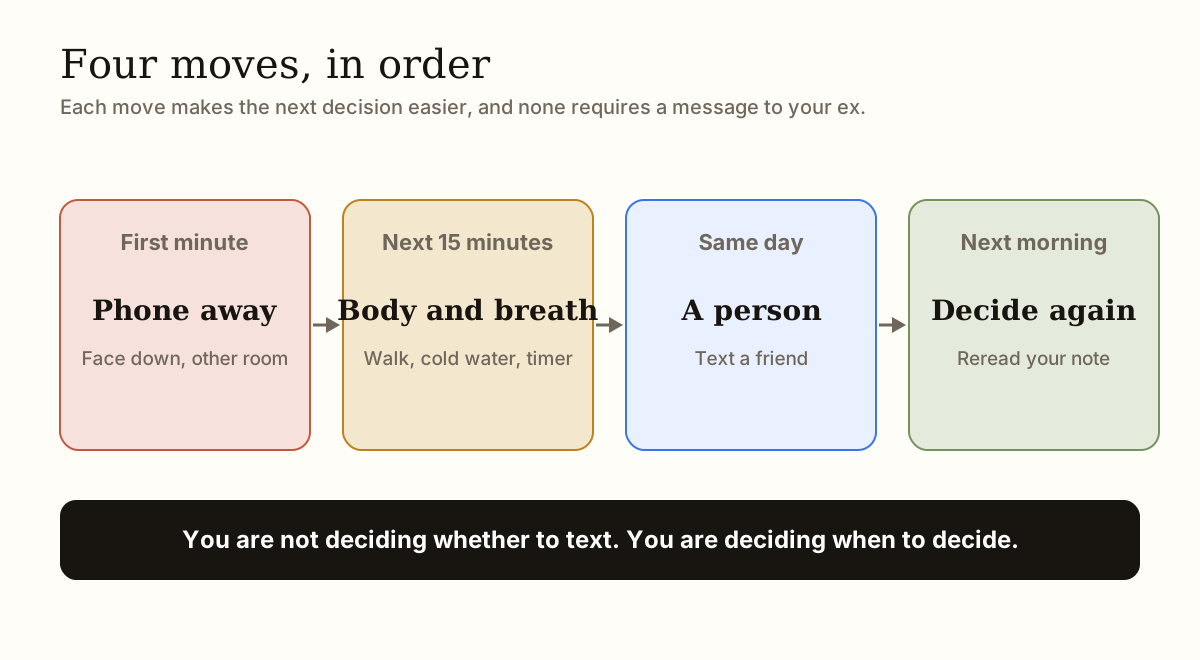
The order matters more than the item. Distance from the phone comes first, because every other option is easier when the screen is not in your hand.
- Put the phone face down, then move it to another room.
- Stand up, walk to a window and name five things you can see.
- Run cold water over your wrists for a minute.
- Take ten slow breaths, making each exhale longer than the inhale.
- Say the urge out loud: “I want to text them because I feel scared right now.”
- Open a note, type the first sentence of the message, then stop there.
- Set a 15-minute timer and tell yourself you can decide when it rings.
How long does the urge to text your ex last?
Usually minutes, not hours, when you do not feed it, but nobody can promise a number. The timer is a tool for making the decision later, not a prediction that the feeling will be gone when it rings.
Urge surfing is a useful idea here: you watch the urge rise and fall like a wave instead of obeying it. In a study of smokers, Bowen and Marlatt (2009) found that urge-surfing instructions did not lower how strong the urges felt, but participants smoked fewer cigarettes in the following week. The study was in smokers, not people missing an ex, so treat it as a model of the skill. The takeaway is that you can feel the urge fully and still not act on it.
If the urge is still loud when the timer ends, restart the timer. Two or three rounds is normal in the first weeks. If it is loud every night at the same time, that is a pattern worth planning for, and the guide to night-time urges covers it in detail.
What to do when you are lonely
Loneliness often makes the ex feel like the only familiar name on the screen. Aim at someone or something that can meet the need, even in a small way. A short message to a friend usually helps more than a long internal argument, and loneliness after a breakup has a fuller plan for rebuilding your time.
- Text a friend who is not your ex and ask for something specific, such as a walk on Saturday.
- Message a friend with: “Are you free for a coffee this week? I’d like to see you.”
- Call a family member just to hear about their week.
- Go somewhere with other people in it, like a library, a café or a class, even if you do not speak to anyone.
- Watch a comedy or a familiar show rather than a playlist built around heartbreak.
- Sign up for a one-off volunteer shift, which gives you company and a sense of purpose at once.
- Book something for next month so you have a future point to look forward to.
- Write down three people who showed up for you before the breakup, and send one of them a thank-you message.
What to do when you are angry
Anger wants to be heard, and a text feels like the fastest way to be heard. The problem is that the message gets written at the peak of the feeling, when you are least able to choose your words. Discharge the energy first, then decide whether anything needs saying at all.
If you do want to say something, write the full version in a private place. Then notice whether you still want to send it an hour later. Many first drafts are written more for you than for the person reading them.
- Go for a fast walk or run until you are out of breath, then come home.
- Do ten squats and ten push-ups, or hit a punching bag, until the heat drops.
- Write the angry message in full, then save it in a private note and close the app.
- Tear up a sheet of paper with the words you want to say.
- Clean something demanding, such as the shower, the oven or the skirting boards.
- Write down what you actually need from them, then notice that it cannot come from a text.
- Play one loud song and sing it all the way through.
- Set a 20-minute timer and work on a task you have been avoiding.
What to do late at night
Late at night the house is quiet, your defences are lower and the day is over. These options give a tired brain a simple job so the decision waits until morning. For a fuller breakdown of why night is so hard, read why the urge to text an ex at night feels so strong, and if sleep itself is the problem, see what to do when you cannot sleep after a breakup.
- Charge your phone in another room, ideally with a separate alarm clock.
- Turn on a Focus before bed so that only the people you choose can reach you.
- Keep a glass of water and a notebook beside the bed.
- Listen to an audiobook or a podcast at low volume, with a sleep timer.
- Have a warm shower, put on warm socks, or do a short stretch routine.
- Keep a note in your notes app titled “Read this at 1am” and write it now, while you are calm.
- Log the urge in a mood journal so you can spot the pattern over the next few weeks.
What to do when you want closure
Closure is one of the most common reasons people give for texting an ex. You want to know why it ended, whether they regret it, whether you will ever feel settled. A text is unlikely to deliver all the answers you want, and the replies you do get tend to raise new questions. The work you can do yourself is more reliable.
In one study, structured reflection on a breakup was associated with improved self-concept clarity, which in turn related to less emotional distress (Larson & Sbarra, 2015). Writing carefully about what happened can help you understand your own part of the story, which is the part you control. Closure after a breakup explains what it can and cannot look like without them.
- Write the questions you want answered, then accept that you may never get all of them.
- Write an unsent letter, using the prompts in this guide to unsent letters.
- Write the closing paragraph you wish you had been given, then keep it somewhere private.
- Ask yourself: what would closure look like if they never replied?
- Reread the reasons you chose no contact, from your own notes or earlier journal entries.
- List what you are grieving, such as routines, shared jokes and the future you pictured.
- Talk the question through with a trusted friend, a counselor or a support group.
- Write one sentence that starts with “This relationship taught me…” and stop there.
What to do when you want to feel chosen
Wanting to feel chosen is one of the hardest urges to name. Texting can feel like the only way to find out whether you still matter to them. But even a warm reply would not settle that question for long, and waiting for the next one can keep you attached. Look at who is already choosing you, then decide whether a text would add anything.
Feeling chosen usually comes from consistent, ordinary care from people who are present and reliable. It builds slowly, through choices you make for yourself as well as the ones other people make for you.
- Write down what being chosen would look like in your daily life: who shows up, and who you choose to spend time with.
- Cook a recipe you have never tried, or finish one small project you have been putting off.
- Accept an invitation from someone who is kind and available, without needing a particular result.
- Plan a date with yourself, such as a meal out or a film, where you pick everything.
- Write a list of the ways friends, family or colleagues have chosen you over the past year.
- Join a class or a club where the goal is the activity, not the outcome.
- Tell one person what you have been going through, and let them support you.
How to choose the right alternative for you
You do not need to try everything on this list. Name the feeling under the urge, then pick the move that speaks to it. If two feelings are tangled together, which is common at night, start with the body (water, a walk, the phone in another room) and move to the person or the page afterwards.
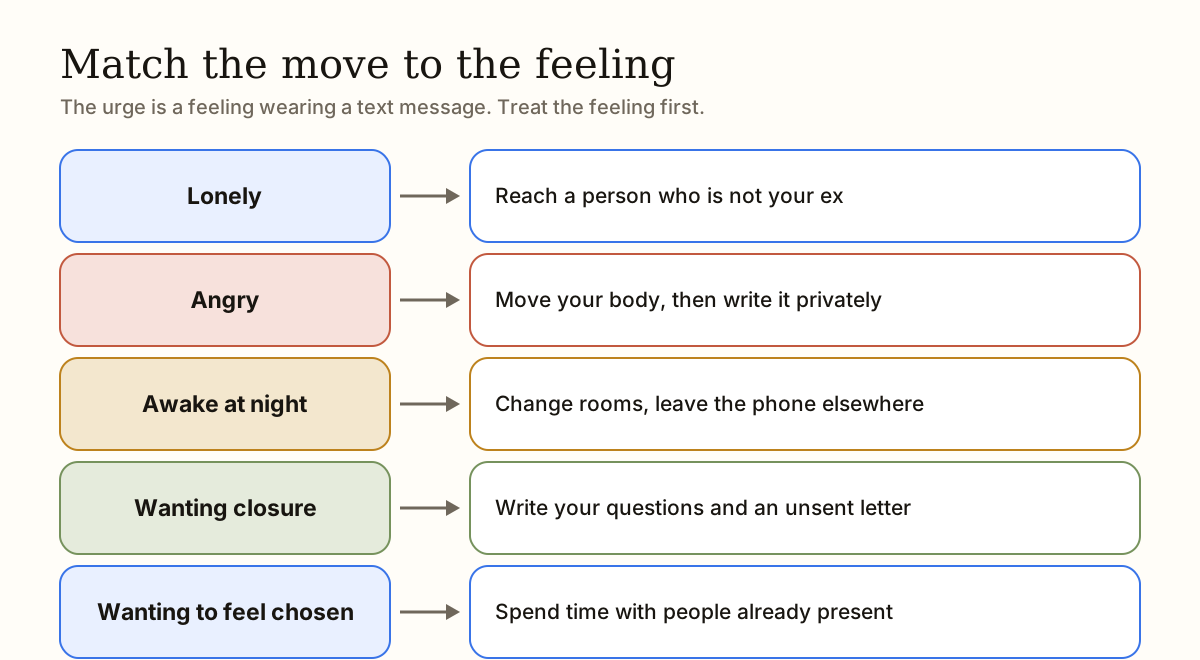
The table below is a one-glance version. The right-hand column matters as much as the middle one: each feeling has a tempting move that feeds the urge instead of settling it.
| What you feel | Try first | Skip, because it feeds the urge |
|---|---|---|
| Lonely | A call or a plan with a friend, a place with people in it | Rereading old messages or scrolling their tagged photos |
| Angry | Fast movement, then a private written draft | A “final” text sent at the peak of the feeling |
| Awake at night | Phone in another room, warm shower, audio at low volume | Lying in bed with the thread open |
| Wanting closure | Your questions on paper, an unsent letter, a trusted listener | Asking “can we talk?” hoping it answers everything |
| Wanting to feel chosen | Ordinary time with people who are already present | A test message to see how fast they reply |
What if you texted anyway, or they text first?
If you texted anyway, that is information rather than failure. Note what happened, what you felt and which option you skipped. What to do after a slip covers how to restart without shame, and you can restart your count without erasing the days you protected.
If they text you first, you do not owe an instant answer. What to do when your ex texts you during no contact walks through the options, and the private decision tool can help you think it through before you act.
If willpower is not enough on a given night, add friction: how to block yourself from texting someone shows how to set it up on your phone, and should you block your ex weighs the bigger step. The broader plan lives in how to stop texting your ex.
One last point about what you are protecting. A boundary that stops you texting your ex is not a tactic to make them respond. It is a way of protecting your recovery. If you are in danger, or thinking of harming yourself, skip the self-help: see our safety page, call or text 988 in the US, call Samaritans on 116 123 in the UK and Ireland, or call Tele-MANAS on 14416 in India.
You do not have to solve the whole relationship tonight. Take one private step that creates space between the feeling and the action.
Try the 90-second urge reset →Common questions
What should I do instead of texting my ex?
Start by changing your state rather than making a decision. Move away from the phone, do something physical, or contact a friend who is not your ex. If you still need to get the words out, write them in a private note and decide again once the urge has eased.
What can I do when I really want to text my ex right now?
Put the phone in another room, set a 15-minute timer, and do one physical task such as a walk or cold water on your wrists. Urges often rise and then ease when you do not act on them. Use the timer to make the decision later, with a calmer mind.
How do I distract myself from texting my ex?
Choose activities that involve your body or other people, such as a walk, a class, a call with a friend or a volunteer shift. Passive distractions like scrolling keep you close to your ex’s name. Pick something with a clear start and end.
Is it okay to write to my ex and not send it?
Yes. Writing about emotional experiences without sending the words is a common way to get feelings out of your head. Pennebaker’s 1997 paper on expressive writing describes benefits across a range of studies, although it is not a replacement for professional support.
Why do I feel like I need to text my ex to feel better?
Missing someone can activate reward and craving systems, which makes contact feel like relief. That relief is often short, and it can keep the cycle going. Looking for a different source of comfort, such as a friend or a routine, usually works better over time.
Is it normal to want to text my ex after a breakup?
Yes. Wanting contact is a common response to losing someone. Kross and colleagues (2011) found that recalling an intense romantic rejection engaged brain regions that also respond to physical pain. The urge does not mean you are weak, and it does not mean you should act on it.
What should I do if I already texted my ex?
Stop at one message and do not send a follow-up that explains the first. Write down what you were feeling, then use the next hour for something physical or social. A single slip does not erase your progress, and you can restart your count the same day.
Should I block my ex so I cannot text them?
It can help if you keep reaching for the phone, because it adds friction at the exact moment you need it. Some people prefer to mute and archive instead. The right choice depends on whether you share children, housing or money, and whether you feel safe.
If contact involves threats, stalking, coercion, shared children, housing or immediate safety, a general no-contact rule may not fit. Read the safety guidance and seek qualified local help where appropriate.
Sources and further help
- Fisher HE et al. (2010), Reward, addiction, and emotion regulation systems associated with rejection in love, Journal of Neurophysiology
- Kross E et al. (2011), Social rejection shares somatosensory representations with physical pain, PNAS
- Gollwitzer PM (1999), Implementation intentions: strong effects of simple plans, American Psychologist
- Bowen S & Marlatt A (2009), Surfing the urge: brief mindfulness-based intervention for college student smokers, Psychology of Addictive Behaviors
- Larson GM & Sbarra DA (2015), Participating in research on romantic breakups promotes emotional recovery via changes in self-concept clarity
- Pennebaker JW (1997), Writing about emotional experiences as a therapeutic process, Psychological Science
- National Domestic Violence Hotline — safety planning
- 988 Suicide & Crisis Lifeline — US crisis support
Research is cited to explain general patterns, not to diagnose or predict any individual outcome. Sources do not endorse UnLink. Read our editorial principles.
Keep this support one tap away.
UnLink is a free, private no-contact tracker for iPhone: count your days, get through urges and restart without losing your history.