What Is the No Contact Rule?
The no contact rule is a boundary you set yourself: no direct or indirect contact with an ex for a chosen period. Definition, what counts, and common myths.
 By the UnLink Editorial Team · General educational guidance, not therapy
The no contact rule is a boundary you set for yourself: you stop all direct and indirect communication with an ex, including texts, calls, social media checking and updates through friends, for a period you choose in advance, so you can recover without their replies pulling you back. It is not a tactic to make anyone react.
- The no contact rule is a boundary you set for your own recovery, not a method for making someone miss you or come back.
- Contact includes direct messages and calls, but also indirect routes such as checking profiles, asking mutual friends for updates and sending messages through someone else.
- No contact is different from limited contact, which allows narrow, practical communication such as arrangements about shared children, property or work, and from blocking, which is only a tool.
- A personal no contact rule has no legal force. A court no-contact order does, so follow its exact terms if you have one.
- Day counts are checkpoints for reviewing how you are doing, not deadlines. The rule needs to change when safety, coercion, stalking or shared responsibilities are involved.
What is the no contact rule?
The no contact rule is a boundary you set for yourself in which you stop all direct and indirect communication with a former partner for a period you choose in advance, so that you can recover without their replies, their updates or your own checking pulling you back. It is a pause in the connection, not a verdict on the other person’s worth or your own.
You will also see it called a no contact policy, a no-contact period or just “no contact”. After a breakup they all mean the same thing: a rule you make for yourself, with no authority behind it except your own decision. The phrase is informal. It is common in breakup and recovery writing, and it is not a clinical term with an official definition, so the details are yours to set. If you came here looking for a legal or workplace meaning, the section on other meanings below covers it.
A workable rule has four parts. It names the person, lists what counts as contact, says how long you will hold it before reviewing, and says what you will do when the urge hits. Write those down in a calm moment, before an urge arrives. Our guide on stopping the urge to text covers the fourth part in detail.
What counts as contact, and what doesn’t?
Contact is anything that sends a message to them or through them, plus anything that keeps you watching them. Most people agree that texts, calls, direct messages and in-person conversations count. The less obvious items are the ones that tend to restart the cycle, so name them in your own rule before you are tempted to argue that a particular message is different.
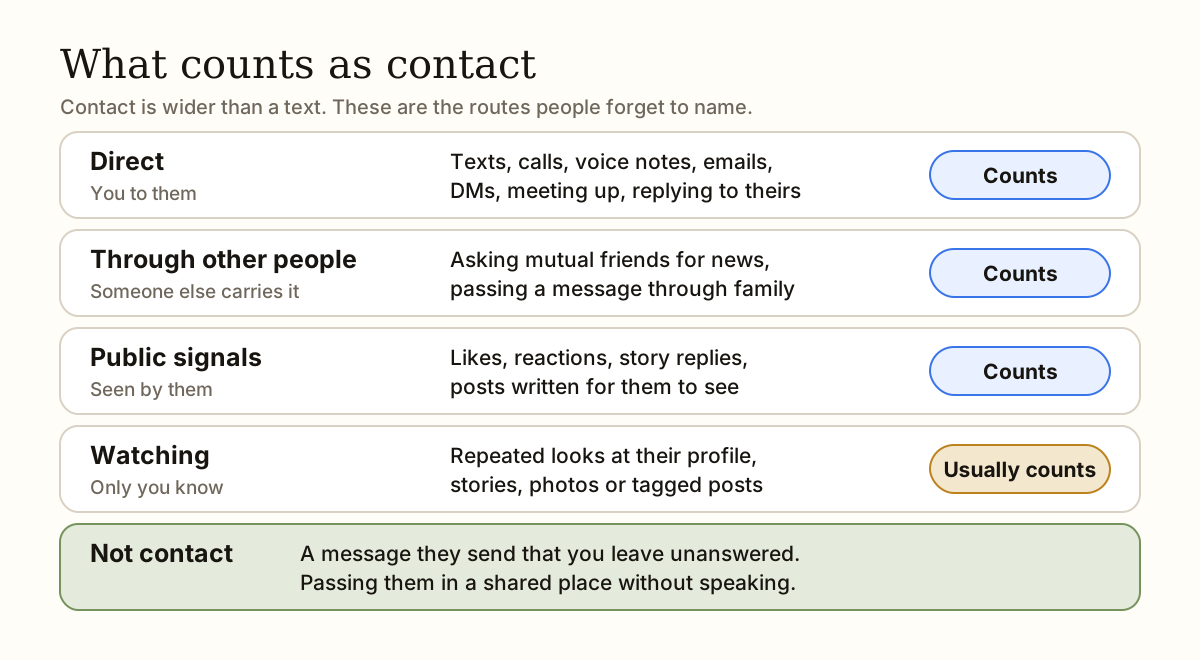
The table gives a ruling on the gray cases people ask about most. Adjust it to your situation, and be honest with yourself about which items keep you hooked.
| Situation | Counts as contact? | Why |
|---|---|---|
| They text you and you don’t reply | No | Choosing not to answer is part of the boundary. You can mute the thread so it doesn’t pull at you. |
| You reply “just this once” | Yes | A reply restarts the exchange, whoever began it. |
| Liking or reacting to their post | Yes | They see it, and you will spend the evening waiting for a response. |
| Replying to their story | Yes | It is a direct message with a thin disguise. |
| Asking a mutual friend how they are | Yes | You get the update, and your friend becomes a messenger. Ask friends to keep their news to themselves. |
| Looking at their profile or stories, even logged out or from a spare account | Usually yes | They never know, but the check feeds the same loop. If it leaves you worse, it belongs in your rule. |
| Sending something through a new number or account | Yes | Same contact, new door. |
| Seeing them in a shared place without speaking | No | Nod or leave if you need to. You did not reach out. |
| Both of you in the same group chat or friend group | Depends | Decide in advance whether to mute, leave or stay silent in the thread. Writing to them directly inside it counts. |
| Writing them a letter you never send | No | It stays with you. Writing can help as long as it stays unsent. |
| Returning belongings or settling a money or legal issue | Handle separately | Use one channel, keep to the task, or ask a third person. That is limited contact, covered next. |
No contact vs limited contact vs blocking: what’s the difference?
These three get mixed up constantly, and they do different jobs. No contact is a decision about your own behavior. Limited contact is a narrow arrangement for people who cannot avoid each other. Blocking is a technical tool that can support either one.
Parents who co-parent, people who share a lease and colleagues who cannot avoid each other usually need limited contact instead of a full stop. It allows one channel, a short list of practical topics and clear expectations about response times. The risk is that it quietly slides into a conversation about feelings, the past or the future. If that happens, most people benefit from returning to the narrower boundary, even if the other person objects. You can be kind and still be clear. Our guide to modified no contact explains how to set that boundary when you cannot avoid each other entirely.
Blocking removes the temptation to check at 11:40 p.m., and for many people that is the difference between a rule that holds and one that doesn’t. It is also optional, and some people feel it sends a message they don’t intend. We weigh that choice in should you block your ex.
| No contact | Limited contact | Blocking | |
|---|---|---|---|
| What it is | A personal rule: no communication in any channel | A narrow arrangement: one channel, practical topics only | A phone or app setting that stops their messages reaching you |
| Who it suits | Most people ending a romantic relationship with no shared obligations | Co-parents, shared leases, shared workplaces | Anyone, alongside either of the other two |
| What it asks of you | Not reaching out, and not checking | Keeping messages brief and factual, and steering away from feelings | Nothing once it is set up, which is why people like it |
| What it can’t do | Stop them contacting you | Settle feelings; it only manages logistics | Stop you looking from another account or change why you want to |
Is a “no contact policy” or a “no contact order” the same thing?
Not always. After a breakup, a no contact policy is just another name for the personal rule above. The same words mean something different in three other places, and it helps to know which one you are dealing with. The difference that matters most: your personal rule has no legal force, so nobody can punish you for breaking it and nobody can enforce it for you.
- No-contact order. A court order, often part of a protective or restraining order, that bars a named person from contacting someone else. It can be enforced in a way your personal rule cannot, and the details vary by place. If one applies to you, follow its exact terms and ask the court clerk or an advocate what it covers.
- Workplace or school directive. An employer, university or school may tell two people to avoid each other while a complaint is handled. That is an instruction from an institution, and the institution sets the consequences.
- The lawyers’ no contact rule. In legal ethics, a lawyer is generally barred from speaking directly about a case to someone they know is represented by another lawyer, unless that lawyer agrees. It has nothing to do with relationships.
Where does the no contact rule come from, and why do people use it?
Breakup advice has long recommended stepping back from an ex. The exact origin of the phrase is unclear, and it is not tied to a single study or author, so be careful about claims that present it as a proven treatment. What the research does offer is a set of findings about why breakups hurt and why distance can help.
Researchers have found that recalling an intense recent romantic rejection engaged brain regions that also respond to physical pain (Kross et al., 2011). In people recently rejected by a partner, looking at that person’s photo activated regions linked to reward and craving (Fisher et al., 2010). Those findings help explain why checking a profile can feel so compelling. A 2012 study of Facebook use after breakups found that more monitoring of an ex’s profile was associated with more distress and less personal growth (Marshall, 2012). That was a correlation, so it cannot show that checking causes distress, but it is a good reason to count watching as contact. Our guide to how to stop checking your ex’s social media goes into the practical side.
Other research on relationships that end is more hopeful. People who left lower-quality relationships often reported personal growth and positive emotions afterward (Lewandowski & Bizzoco, 2007). No contact is one way to create space for that kind of reflection. It does not guarantee it, and it is not the only route. For the whole picture, from the first 72 hours to month three, see how to get over a breakup.
People rarely choose no contact because the rule sounds appealing. They choose it because ordinary contact has started to cost them. You may recognize several of these, and that is a useful signal about what your boundary should protect.
- You notice that each message or check leaves you more anxious, angry or stuck than before.
- Your mood depends on whether they replied, and your day revolves around the phone.
- You keep rehearsing arguments, explanations or apologies that never reach a resolution.
- The relationship was on again and off again, and each return brought the same uncertainty back.
- You want to rebuild a sense of who you are outside the relationship, without the other person’s voice in your head.
How do I start, and do I have to tell them?
Start by writing the rule, not by telling the other person. The card takes five minutes and does most of the work, because it turns a vague intention into something you can check at 11 p.m.
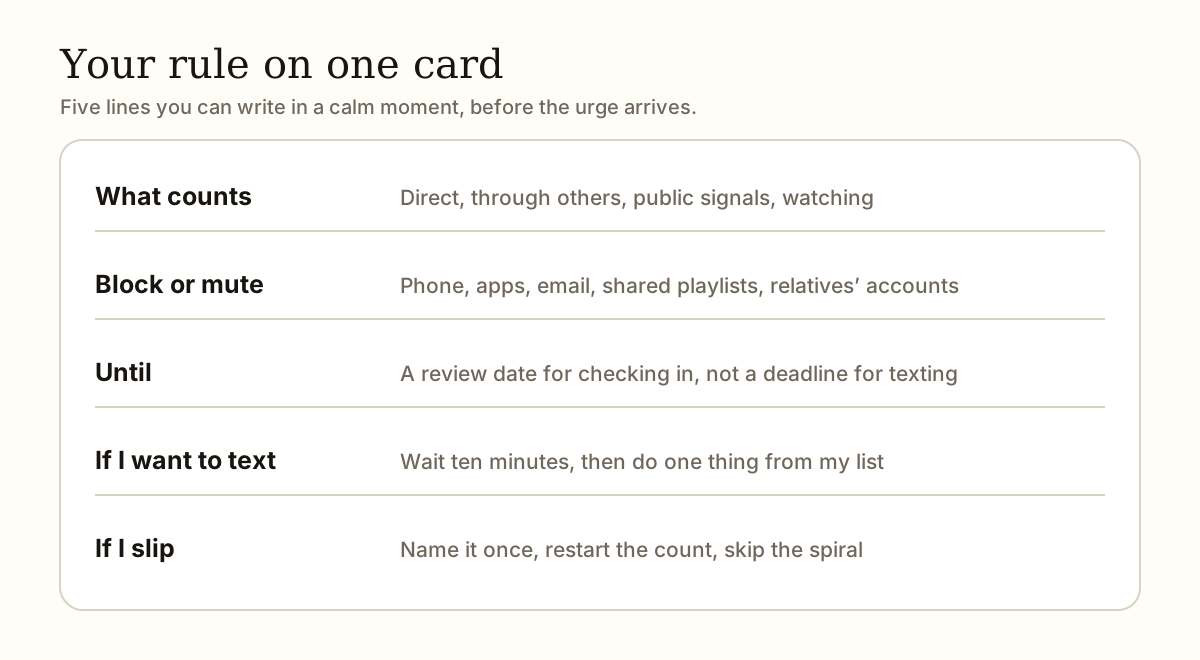
You do not owe anyone an announcement. Some people send one short message, once, so the silence does not read as a mystery. Example: “I need space to recover, so I won’t be in touch. I wish you well.” Use your own words, send it a single time and don’t invite a reply. If you have ever felt afraid of this person, or an announcement could provoke them, skip it and read the safety section below first.
Then handle the practical side. Mute or block, and archive threads instead of deleting them if you might need them for logistics or legal reasons. Tell one or two friends what you are doing so they stop passing on news.
Common myths about the no contact rule
Much of the confusion around no contact comes from myths that spread quickly online. Clearing them up early can stop you from using the rule in a way that hurts you.
| Myth | What is actually true |
|---|---|
| No contact is a game to make them miss you | It is a boundary for your recovery. You cannot control whether they miss you, and trying to engineer that feeling tends to keep you focused on them. |
| There is one correct length | Some people use checkpoints such as 30, 60 or 90 days. The right length depends on your situation, and how long no contact should last explains how to decide. |
| Feeling fine means you are finished | Feeling calm on one day does not settle every urge. Strong days and hard days can alternate. |
| Any message at all resets everything | A slip is information, not a permanent failure. You can name it and return to the boundary. What to do if you break no contact covers the restart. |
| No contact guarantees a reconciliation | There are no guarantees. The other person may respond in many ways, and some relationships do not continue. |
| No contact is just the silent treatment | The silent treatment withholds contact to punish or control someone who is still waiting to hear from you. No contact is a boundary for your own recovery, and it is not aimed at causing distress. |
Does no contact work the way people hope?
It depends what you hope it will do. No contact can give you distance, quieter days and a clearer view of what you actually want. It cannot make another person change, and it cannot promise a particular ending. If your hidden goal is to get a reaction, the rule will feel like a test you are failing every hour, which is exhausting.
A more useful question is whether your life is getting steadier. Are you sleeping better, focusing more easily, spending time on things you care about and feeling less pulled by notifications? Those signs matter more than whether a message arrives at a particular time. We go through the evidence in does no contact work.
When the no contact rule needs to change
Some situations call for a different plan. If the relationship involved threats, coercion, control, harassment or stalking, the safest option may be to limit contact to what is strictly necessary and to plan around your safety first. Leaving can raise risk, and safety planning comes before any contact strategy. The National Domestic Violence Hotline offers safety planning support that can help you think through the specifics, and our safety page lists more help.
Shared children, shared housing and shared workplaces also change the picture. In those cases, a full stop may not be realistic. Write a narrow boundary, use one channel and keep messages brief and factual. Revisit it when circumstances change, rather than treating it as a one-off decision. If they keep reaching out after you have set the boundary, see what to do when your ex texts you during no contact.
The same boundary is sometimes used with a family member. That is a different decision with different stakes, and we cover it in going no contact with a parent.
If you are in crisis or thinking about harming yourself: in the US call or text 988; in the UK and Ireland call Samaritans on 116 123; in India call Tele-MANAS on 14416. If you are in a relationship that frightens you, the US National Domestic Violence Hotline is 1-800-799-7233 (text START to 88788).
Step-by-step plan
- Write your rule
Fill in the five lines on the card: what counts, where you will block or mute, your review date, what you will do when you want to text, and what you will do if you slip.
- Remove the easy routes
Mute or block, unfollow, and turn off message previews. Archive threads rather than deleting anything you might need for logistics or legal reasons.
- Brief one or two people
Tell a friend what you are doing and ask them not to pass on news about your ex, good or bad.
- Plan for the urge
Pick one thing to do in the first ten minutes of an urge: walk around the block, call someone, or write the message in a notes app and leave it unsent.
- Set a review date
Choose a date to check how you are doing, such as the end of the first month. At the review, decide the next boundary on purpose. Reaching the date does not oblige you to contact anyone.
You do not have to solve the whole relationship tonight. Take one private step that creates space between the feeling and the action.
Check what counts as contact →Common questions
What does no contact mean?
No contact means you stop all communication with a person, direct or indirect, for a period you choose in advance. It includes calls, messages, social media interactions and asking friends for updates. Its purpose is to create distance so you can recover, not to pressure the other person.
What is a no contact policy?
After a breakup, a no contact policy is another name for the no contact rule: a personal boundary you set for yourself. It is different from a court no-contact order, which is legally enforceable, and from a workplace or school directive, which an institution enforces. If one of those applies to you, follow its exact terms.
Is no contact the same as blocking someone?
No. Blocking is a technical step that prevents calls and messages from reaching you, while no contact is a personal boundary you keep in your own behavior. You can practice no contact without blocking, and you can block someone while still checking their profile. Many people use both, along with a plan for the urge.
Does no contact mean I can never talk to my ex again?
Not necessarily. No contact is usually a defined period, not a permanent ban. After it, you can decide whether any contact would help or harm you. If you do talk again, it helps to set clear limits before the first conversation.
Should I tell my ex I’m going no contact?
You don’t have to. If you do, one short message sent once is enough, and it should not invite a reply. If you have ever felt afraid of the person, or a message could provoke them, skip it and get safety advice first.
Does no contact make my ex miss me?
There is no guarantee. Some people reach out after a period of distance, and others do not. Using no contact to produce a reaction tends to keep you focused on the other person, so it is more useful to treat the boundary as protection for your own recovery.
Can I look at my ex’s social media during no contact?
If looking reopens the same loop, include it in your boundary, even though the other person will not know. Researchers who studied Facebook monitoring after breakups described more distress and less personal growth among people who checked more often. That was a correlational finding, but it is a useful reason to take checking seriously.
What if we share kids, a home or a workplace?
A full no contact rule may not be workable. Limited contact is usually the better fit. Use one channel, keep messages brief and factual, and stick to practical topics. If the relationship involved safety concerns, prioritize a plan that protects you first.
Is no contact the same as the silent treatment?
No. The silent treatment withholds contact to punish or control someone who is still waiting to hear from you. No contact is a boundary you keep for your own recovery, and its purpose is distance for you, not distress for them.
If contact involves threats, stalking, coercion, shared children, housing or immediate safety, a general no-contact rule may not fit. Read the safety guidance and seek qualified local help where appropriate.
Sources and further help
- Kross et al. (2011), “Social rejection shares somatosensory representations with physical pain”, PNAS
- Fisher et al. (2010), “Reward, addiction, and emotion regulation systems associated with rejection in love”, Journal of Neurophysiology
- Lewandowski & Bizzoco (2007), “Addition through subtraction: growth following the dissolution of a low quality relationship”, Journal of Positive Psychology
- Marshall (2012), “Facebook surveillance of former romantic partners”, Cyberpsychology, Behavior, and Social Networking
- National Domestic Violence Hotline: Plan for safety
- 988 Suicide & Crisis Lifeline — US crisis support
Research is cited to explain general patterns, not to diagnose or predict any individual outcome. Sources do not endorse UnLink. Read our editorial principles.
Keep this support one tap away.
UnLink is a free, private no-contact tracker for iPhone: count your days, get through urges and restart without losing your history.