How Long Should No Contact Last?
How long should no contact last? No set number fits everyone. See what 30, 60 and 90 day checkpoints can and can’t tell you, and the signs you need more time.
 By the UnLink Editorial Team · General educational guidance, not therapy
No contact should last as long as it protects your recovery, and no set number of days applies to everyone. Many people use 30, 60 or 90 days as checkpoints to review how they are doing, not finish lines. Extend it while urges still drive your decisions, and let safety and shared responsibilities shape the plan.
- There is no universal number of no-contact days, so the right length depends on your safety, your urges and your situation.
- A 30-day checkpoint is best used to review your first patterns, not to decide whether to reach out.
- Needing more time is a normal signal, especially if you are rehearsing messages, checking profiles or hoping one conversation will settle everything.
- Day counts are checkpoints for reflection, and reaching one never creates an obligation to contact anyone.
- Safety concerns, coercion or shared responsibilities can change the plan, so an individual approach matters more than a generic timeline.
Is there a correct number of days for no contact?
No. No official rule or study we found sets a day count that tells everyone when no contact is complete, and nothing says the person who ended the relationship, or the person who was left, must wait a particular period.
The popular guides we read on 15 October 2026 give figures that run from 21 days to a year, with three to six months common for harder breakups. None of them ties its number to evidence, which is why they disagree. The marks of 30, 60 and 90 days are useful because they are easy to remember. They are not magic thresholds. They are reference points you can use to look at your life and ask an honest question.
A better way to think about the length is to start with what you are trying to protect. If the relationship keeps taking over your sleep, your work and your sense of self, you may need a longer boundary. If you can get through a difficult week without contact and your urges are becoming less frequent, you may be ready to review the plan sooner. Either way, the decision belongs to you, and you can change it.
If what you really want to know is how long the hurt will last, that is a different question. The breakup recovery time calculator gives a rough planning range, and how long it takes to get over a breakup covers what tends to speed it up or slow it down.
30, 60 and 90 days of no contact: what each checkpoint can and can’t do
Each checkpoint is a chance to look at the evidence from your own experience. The table describes what each one is useful for, and what it cannot tell you. Read it before you decide what the number means.
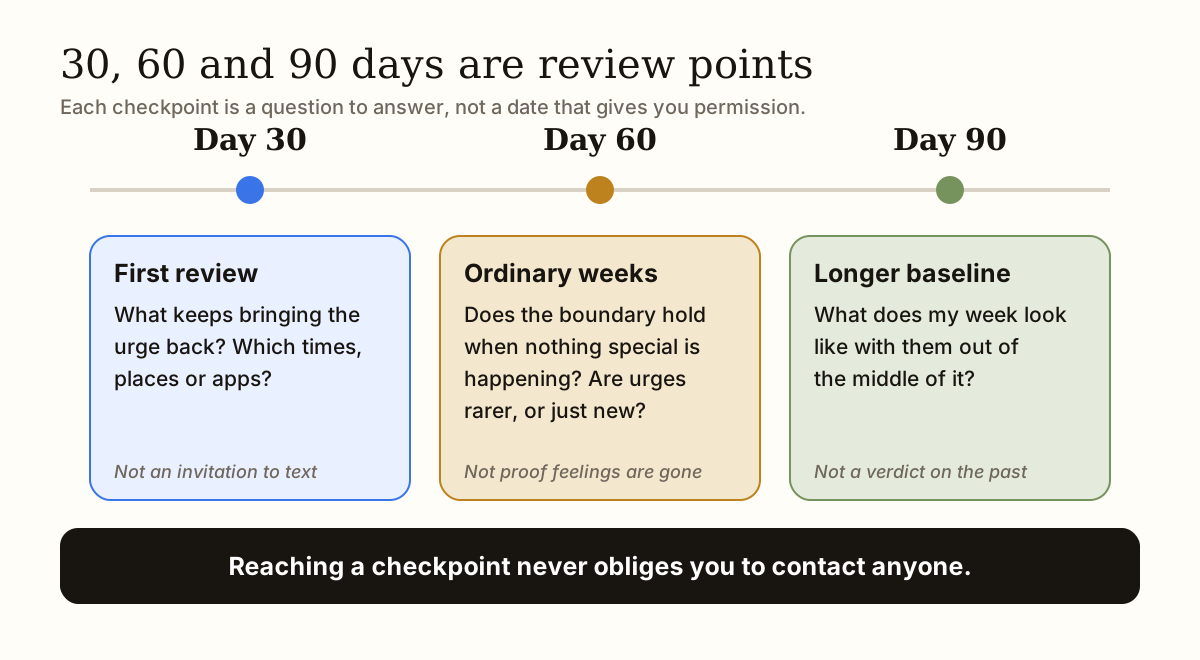
The first 30 days often feel the most intense, which is why many people treat day 30 as a first review rather than a finish line. Our guide to the first 30 days of no contact covers what to expect week by week, and the stages of no contact maps the common phases beyond it.
| Checkpoint | What it can show you | What it can’t tell you | A question to ask yourself |
|---|---|---|---|
| Day 30 | That you got through the first, most acute stretch, and which times, places or triggers keep bringing the urge back. | That the relationship is resolved, or that you are ready to talk. It is a review point, not an invitation. | Which trigger keeps pulling me back? |
| Day 60 | Whether the boundary holds through ordinary weeks, not just the first rush of distance, and whether urges are rarer or just arriving in new forms. | That the feelings are gone, or whether the other person has changed. | Are the urges fewer, or are they showing up somewhere new? |
| Day 90 | A longer baseline: your routines, friendships and interests when the relationship is not the center of them. | Whether the relationship was right or wrong. It does not oblige you to contact anyone. | What does an ordinary week look like now, and do I like it? |
What changes how long you need?
The same number of days can mean very different things depending on what you are separating from. This table lists what tends to lengthen or shorten the time, and what to look at when you review. None of it is a formula.
| Situation | What tends to change the time | What to review |
|---|---|---|
| A few dates or a short relationship | Fewer shared routines, friends and places to untangle. Length of the relationship is a poor guide to how strong the urge is, so go by the urge. | Whether you still rehearse messages or check their profile. |
| Years together, or a shared home and friends | More routines, places and people to separate, so the first checkpoints may need more room. | Whether you have built a day that does not revolve around them. |
| On again, off again | Research on these relationships found they were associated with more uncertainty and lower relationship quality than other dating relationships (Dailey et al., 2009). Each return can bring the old uncertainty back. | Whether the pattern is clearer to you now, not just this latest ending. |
| A situationship or unclear status | Less closure and more “what was that?” questions. See no contact after a situationship. | Whether you are still waiting for them to define it. |
| You were the one who ended it | Guilt and second thoughts can pull as hard as being left. Ending it does not shorten the urge to check or explain. | Whether a message would soothe your guilt rather than do anything practical. |
| Shared kids, home or workplace | A full stop may not be possible, so the checkpoint applies to the narrower boundary. See modified no contact. | Whether messages stay brief, factual and on one channel. |
| Fear, control, threats or stalking | This is not a day-count question. Safety planning comes first. See our safety page. | Whether to talk to a hotline or advocate before any contact. |
What are the signs I need more time?
Some signals suggest the boundary still needs protecting. None of them mean you have failed. They are information about how strong the pull still is, and they can help you decide whether to extend your no-contact period before you reach a checkpoint. Holidays, birthdays and anniversaries tend to bring these signs on early, and our plan for no contact during the holidays covers those dates.
- You are rehearsing the perfect message, or a series of explanations, and feel relief only when you imagine sending them.
- You check their profile, stories or mutual friends’ posts, and the checking leaves you more anxious than before.
- You believe one conversation will remove all uncertainty, and you keep waiting for the right moment.
- You are making decisions mainly from loneliness, boredom or the anniversary of something that happened.
- You have slipped more than once in a short period, and the same trigger keeps coming back.
What are the signs contact might be a clearer decision?
Some people do reach a point where they are considering contact. That can be a clear, thoughtful choice rather than a relapse, but the bar should be high. Three questions cover most of it: whether you have a specific, practical purpose, whether you feel calm when you imagine the conversation, and whether you can accept a short answer or no answer at all.
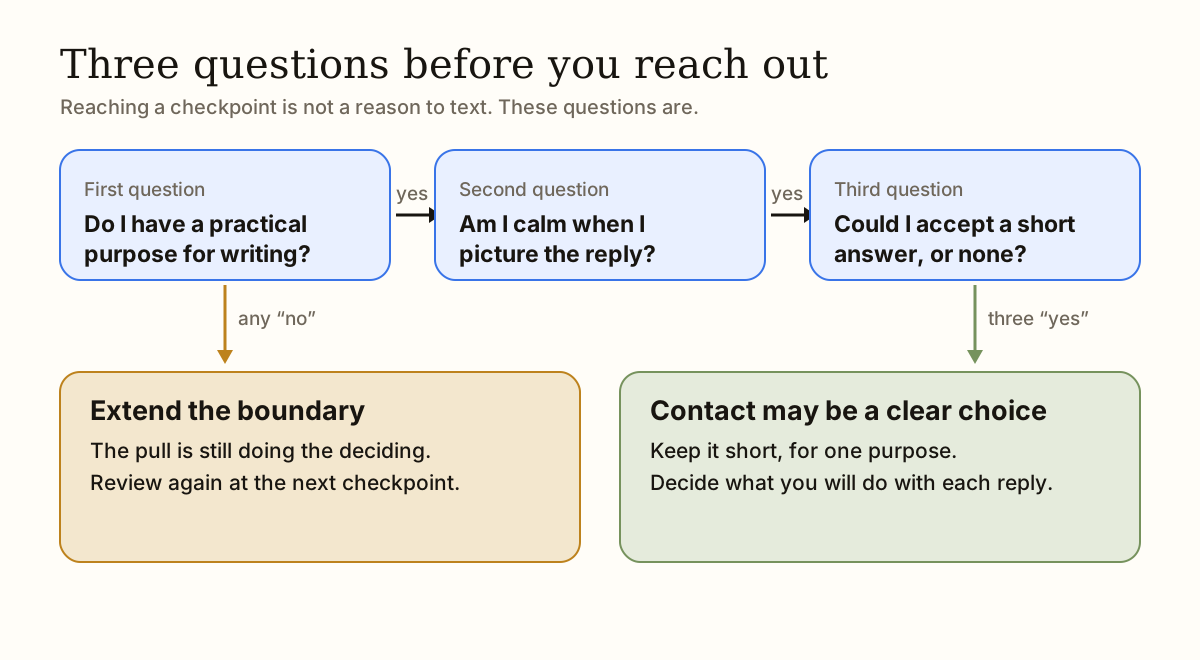
Be honest if the answers feel shaky. A reconciliation is not guaranteed by time, and contact made to get a particular reaction usually brings the same loop back. If you are unsure, our private decision tool can help you slow the thinking down and write out what you actually want from a message. If they contact you first, that is a separate decision, covered in what to do when your ex texts you during no contact.
Why day counts are checkpoints, not deadlines
A deadline turns a boundary into a test. If you count down to day 30 expecting a reward, you are back to hoping for a reaction, and a missed day can feel like a failure. A checkpoint works differently. It is a scheduled pause to look at how your life is going and to choose the next step deliberately.
Research on breakups has linked structured reflection with emotional recovery. In one study, structured reflection on a romantic breakup was associated with improved self-concept clarity, meaning a clearer sense of who you are, and that clarity was related to less emotional distress (Larson & Sbarra, 2015). Reflection takes time, and it can happen during a no-contact period as well as after it.
Habit research offers a second frame for the urge to check. In a study of 96 volunteers who repeated an eating, drinking or exercise behavior every day for 12 weeks, the time to reach 95% of each person’s own plateau of automaticity ranged from 18 to 254 days, and missing a single opportunity did not materially affect the process (Lally et al., 2010). Those were everyday habits, not breakups, so the numbers can’t tell you how long your urges will last. Two ideas still carry over: people vary enormously, and one slip does not erase your progress.
Can no contact last too long?
Some coaching sites warn that going past roughly 50 or 60 days will make an ex forget you or damage a reconciliation. We found no evidence behind that claim, and it treats your recovery as a tactic for someone else’s reaction. If the goal is your own steadiness, there is no day count after which no contact turns harmful. Some people, particularly after abuse, decide to keep it permanently, and that is a legitimate choice to review from time to time.
The real risk of a long boundary is different: it can turn into avoidance. If you are dropping friends, places or whole parts of your life to stay clear of one person, or you feel dread at the thought of ever seeing them, the boundary may be protecting you from a feeling rather than from contact. In that case loosen the parts that shrink your life, such as a shared friend group, before you loosen the rule itself. A therapist can help you sort out which is which.
How do I count days without letting the number run my life?
Counting can be encouraging, but it can also become another source of pressure. Keep the count simple, and let it support the things that matter, such as your sleep, your focus and your sense of control. Pair it with a short note on what made the day easier or harder.
If you slip, decide whether to restart the count or keep it running. Either choice can be honest, as long as you do not use the slip as a reason to contact the person again. Our guide on what to do if you break no contact explains how to restart without spiraling.
What if contact is unavoidable?
Some people cannot stop all contact for 30, 60 or 90 days. Shared children, a shared home or a shared workplace can make a full stop unrealistic. In those cases, the checkpoint can apply to the narrower boundary you set instead. Use one channel, stick to practical topics and decide in advance what you will do if a message goes beyond them. For a fuller plan, read our guide on modified no contact.
If the relationship involved threats, coercion, stalking or fear for your safety, do not rely on a generic timeline. Leaving can raise risk, and safety planning comes before any contact strategy. The National Domestic Violence Hotline offers safety planning support, and a conversation with a professional who knows your situation can help you set boundaries that protect you. In the US the hotline is 1-800-799-7233 (text START to 88788). If you are in crisis, call or text 988 in the US, call Samaritans on 116 123 in the UK and Ireland, or call Tele-MANAS on 14416 in India. More help is on our safety page.
You do not have to solve the whole relationship tonight. Take one private step that creates space between the feeling and the action.
Calculate your no-contact day →Common questions
Is 30 days of no contact enough?
Thirty days can be a useful first review point, but it is not a verdict or a finish line. Whether it is enough depends on how strong your urges still are, whether you are safe and whether your life is steadier. If the urges are still driving your decisions, extending the boundary is a reasonable choice.
Is 21 days of no contact enough?
Some sites quote 21 days as a minimum, but none of the ones we read backs the number with evidence. Three weeks can be enough to break the first habit of checking, and it can also be too soon to judge. Use it as an early check on your urges, not as a finish line.
Is 60 days of no contact enough to get over someone?
There is no guarantee that any number of days will make you stop caring. Sixty days can show you whether the boundary holds through more ordinary weeks and whether urges are becoming less frequent. Use that information to decide your next step rather than expecting a particular feeling.
What happens after 90 days of no contact?
Nothing is required of you. Ninety days can give you a longer baseline for reflection, and it may show clearer patterns in your routines and relationships. You can continue the boundary, change it or review whether any contact would be helpful. Make that choice deliberately rather than by default.
How long should no contact last if we were together for years?
There is no official rule that links length of relationship to a specific number of days. A long relationship often has more shared routines, friends and habits, so you may need more time to rebuild a separate daily life. A longer first checkpoint can make sense in that situation, reviewed honestly.
How long should no contact last if I was the one who ended it?
The same rules apply: go by your urges, not by who ended it. Guilt, doubt and the pull to check in or explain can last as long for the person who ended things as for the person who was left. A review at each checkpoint will show whether the pull is easing.
Can I text my ex after 30 days of no contact?
Reaching 30 days does not oblige you to contact anyone. Before deciding, ask whether you have a clear, practical purpose, whether you feel calm about the conversation and whether you can accept a short answer or none. If the urge to text is mainly about needing a reaction, it is usually better to wait.
Can no contact last too long?
There is no day count after which no contact becomes harmful, and some people keep it permanently. The thing to watch is avoidance: if you are giving up friends, places or parts of your life to stay clear of one person, loosen those parts first and talk to a therapist if it feels stuck.
How many days of no contact will make my ex miss me?
No number of days guarantees that. No contact is best understood as a boundary for your own recovery, not a technique to create a response. Trying to engineer missing you tends to keep your attention on the other person, so it is more useful to focus on your own steadiness.
If contact involves threats, stalking, coercion, shared children, housing or immediate safety, a general no-contact rule may not fit. Read the safety guidance and seek qualified local help where appropriate.
Sources and further help
- Larson & Sbarra (2015), “Participating in research on romantic breakups promotes emotional recovery via changes in self-concept clarity”, Social Psychological and Personality Science
- Dailey et al. (2009), “On-again/off-again dating relationships: how are they different from other dating relationships?”, Personal Relationships
- Lally et al. (2010), “How are habits formed: Modelling habit formation in the real world”, European Journal of Social Psychology
- National Domestic Violence Hotline: Plan for safety
- 988 Suicide & Crisis Lifeline — US crisis support
Research is cited to explain general patterns, not to diagnose or predict any individual outcome. Sources do not endorse UnLink. Read our editorial principles.
Keep this support one tap away.
UnLink is a free, private no-contact tracker for iPhone: count your days, get through urges and restart without losing your history.