The First 30 Days of No Contact, Day by Day
The first 30 days of no contact, day by day: a day-1 checklist, what week 1 feels like, how each stretch changes and a day-30 review to decide what next.
 By the UnLink Editorial Team · General educational guidance, not therapy
The first 30 days of no contact are for creating enough distance to think clearly. Set up the boundary on day 1, expect the sharpest urges in the first week, rebuild simple routines through the middle weeks and use day 30 to review, not to reach out. Intensity rises and falls, and a hard evening is not a step backward.
- The first 30 days are mainly about reducing easy access and preparing for predictable urges.
- Intense days are normal, and a hard evening does not mean you are going backward.
- Day 30 is a review checkpoint, not a deadline to contact anyone.
- Writing down your reasons and your triggers gives you something steady to return to.
- If you slip, you restart with a guardrail. The month is not ruined.
What happens in the first 30 days of no contact?
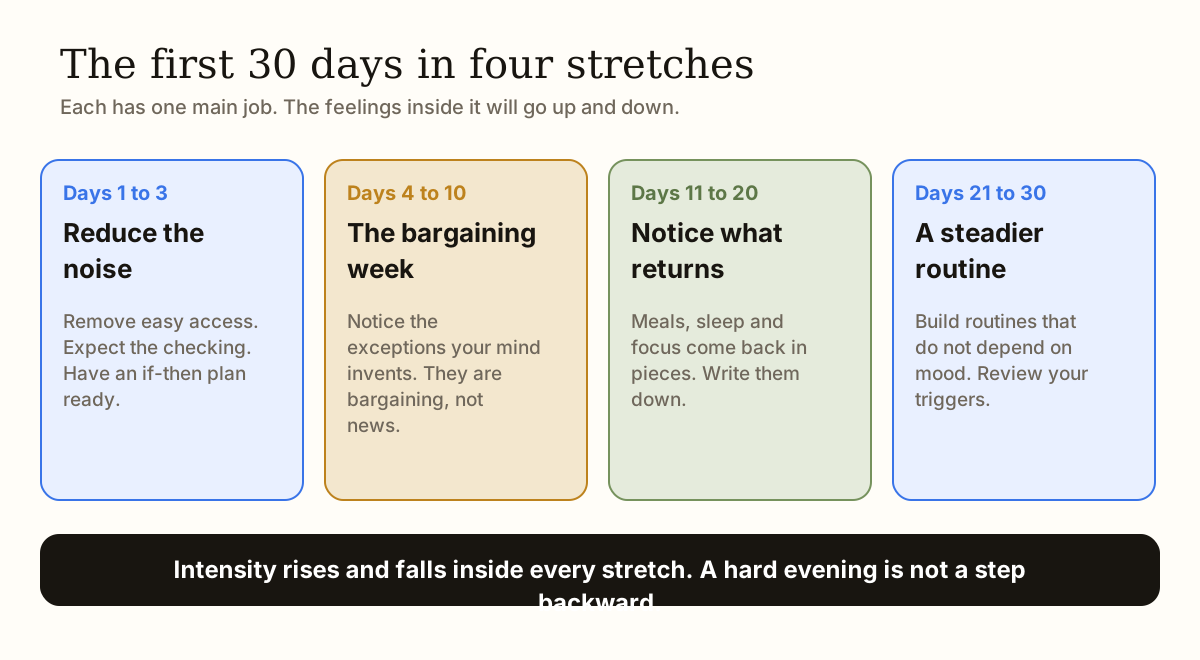
The first month usually runs in four stretches: setting up, a very noisy first week, a bargaining stretch, and a slow return of ordinary life. Nobody’s month follows a script, and the day ranges in the table are checkpoints, not promises. The point of knowing them is to meet each stretch with the right job instead of fighting the wrong battle.
There is a reason the early days feel so physical. In a 2010 brain-imaging study of people recently rejected by a partner, Fisher and colleagues found that looking at the ex’s photo activated areas tied to reward, motivation and craving. A 2011 study by Kross and colleagues, in people who had recently been through an unwanted break-up, found that viewing an ex-partner’s photo while thinking about the rejection activated regions that support the sensory side of physical pain. Both are small laboratory studies, but they match what many people describe: a pull that feels like a craving and an ache that feels like a bruise.
One caution about everything you read online: nobody can tell you what your ex is feeling during these 30 days. Pages that describe the other person’s “stages” are guessing. This guide is about your side, because that is the only side you can work on.
| Days | What is common | Your main job | Common trap |
|---|---|---|---|
| 1 to 3 | Constant checking, shock, trouble sleeping, sharp urges at routine times | Cut easy access and have an if-then plan for each routine | Rereading old messages “just once” |
| 4 to 10 | Bargaining: exceptions that sound reasonable, sudden doubt about the decision | Name the bargaining and keep your written reasons nearby | A “harmless” check on their profile |
| 11 to 20 | Small returns: a decent night’s sleep, a meal you enjoy, a longer stretch of focus; also flat days | Notice and record what comes back | Reading a good day as proof you can relax the boundary |
| 21 to 30 | More structure, more trigger awareness; anniversaries or events may still hit | Build routines that do not depend on mood, then run the day-30 review | Treating day 30 as a deadline to contact |
No contact day 1: the setup checklist
Day one is about structure, not feelings. Decide what your boundary covers before the first difficult evening, then make it easy to follow. Work through this list while you are still calm. If you want it turned into a schedule, the no contact plan generator builds one around your triggers, and what the no contact rule actually is explains the definition behind it:
- Write your boundary in one sentence, including what counts as contact: texts, calls, social media, and asking friends for updates.
- Mute the conversation and move it out of your main messages list.
- Remove the person from your favorites and quick-dial, and hide any shortcut that leads straight to their thread.
- Move shared photos, playlists and saved posts out of your daily view. Archive them somewhere you will not see first thing in the morning.
- If late-night messages are the problem, look at Screen Time Communication Limits under Settings, which can restrict who you can message during set times.
- Write down three honest reasons for the boundary while your thinking is clear.
- Choose one trusted person to tell about the plan, and ask for one specific kind of help, such as “please don’t let me read her profile to you.”
- Plan one if-then response for the first late evening, such as “If I want to text after dinner, then I will go for a walk and open my unsent note.”
- Check whether the relationship involved threats, coercion or stalking. If it did, make a safety plan first (see the last section).
Days 1 to 3: reduce the noise
The first three days often involve the most checking. Your attention may keep drifting to the phone, the thread or the places you shared. Rather than arguing with yourself, lower the number of opportunities. Turn off notifications from shared apps, keep the phone out of reach at night if you can, and avoid opening old photos while you are tired.
Expect the sharpest urges around routines: waking up, the commute, dinner and the last hour before bed. Those are the moments to have a plan ready. The guide on how to stop texting your ex lists practical alternatives, and what to do instead of texting your ex gives you ten-minute swaps. Gollwitzer’s 1999 review of implementation intentions found that specific if-then plans help people follow through on goals, so decide in advance what you will do at each of these times.
Sleep is usually the first thing to go. If the nights are the worst part, what to do when you can’t sleep after a breakup has a night plan. And when the pull is strongest, the 90-second urge reset gives you a pause before any decision.
Logging helps too. A short note on your mood, the time and the trigger each time you feel the pull shows you patterns that will matter by the second week. A paper notebook works as well as any app.
No contact week 1 and the bargaining stretch (days 4 to 10)
By the end of the first week, many people notice the mind getting more creative. You may invent exceptions: one final question, one check to be sure they are okay, one harmless reaction to a post. These thoughts can feel reasonable because they are wrapped in good intentions. Notice them as bargaining rather than as new information.
Prepare a sentence to say to yourself, such as “I can want contact and still choose space.” Keep it in a note on your phone so you do not have to remember it under pressure.
Be wary of profile checking. A 2012 correlational study by Marshall found that more monitoring of an ex’s Facebook was associated with more distress, more desire for the ex and less personal growth. It cannot show cause and effect, but it suggests that looking tends to make recovery harder. The guide to stopping social media checking has practical swaps for this week, and whether to block your ex covers the bigger step.
Urge surfing can help here. Bowen and Marlatt (2009) described brief instruction in observing an urge rise and fall without acting on it. That study involved smokers rather than people after a breakup, and the urges did not shrink; participants simply smoked less. So treat it as a technique to try, not a proven method for heartbreak. Name the urge, notice where you feel it in your body and watch it crest and fall.
If the missing itself is what is eating you, why you miss your ex explains what the missing is made of.
Days 11 to 20: noticing what returns
Around the middle of the month, small things often start to come back: a meal you enjoy, a longer night of sleep, a book you can focus on, or a plan you make without first checking whether they might be free. These returns are easy to dismiss, so write them down.
Look for evidence in your everyday life rather than in your feelings alone. Did you finish something you had been avoiding? Did you spend money on something you chose? Did you spend an evening with someone who matters to you? Those details show the boundary doing its job.
Structured reflection seems to help too. In a 2015 study of 210 recently separated young adults, Larson and Sbarra found that those who completed repeated reflective assessments over nine weeks reported larger drops in self-concept disturbance than those assessed only at the start and end. It was a research setting, not a self-help method, but it supports the idea that writing about who you are now is worth the ten minutes. The unsent letter is one way to do it.
Not every day will feel better than the one before. A hard Tuesday after a good weekend is common, and it does not erase progress. Lewandowski and Bizzoco (2007) reported that people who left lower-quality relationships often described personal growth and positive emotions afterward. That was a specific group, so it describes a possibility rather than a promise for your experience. If the grief itself is the weight, grieving a breakup explains how that works.
Days 21 to 30: building a steadier routine
The last stretch of the month is a good time to build routines that do not depend on a single emotional state. Schedule two things each day that involve other people or movement, plus one small task you can finish. Keep the routines simple enough that you will still do them on a bad day. The 14-day checklist for after a breakup has the practical items if you have not done them yet.
Review your triggers too. Which times, places or messages come up most often? Adjust your plan for those. If checking social media has been pulling you back in, decide whether to mute, unfollow or archive, and write down what you will do instead of reaching for the phone.
If you need to keep limited, practical contact, for example around shared responsibilities, the modified no-contact guide explains how to keep that channel narrow and clear.
Rereading your notes is useful. You may find that the reasons you wrote on day one still feel true, or that a new reason has appeared. Either outcome gives you information you can use. For the longer arc, the stages of no contact maps what usually comes after the first month.
What if you slip, or they get in touch?
A slip in the first month is common enough to plan for. Put the phone down, send nothing else, write down what led to it and restart with one guardrail. What to do if you break no contact has the full steps, including whether to reset your count.
If they reach out, you are not required to reply. You can wait, answer briefly about logistics only, or not answer at all. What to do when your ex texts you during no contact has scripts for each case. Their message tells you they wrote. It does not tell you what you should do.
Day 30 of no contact: a review, not a deadline
Day 30 is a checkpoint, not a finish line. Nothing requires you to contact someone, and reaching the number does not give you permission to send a message. Use the day to decide what protects you next.
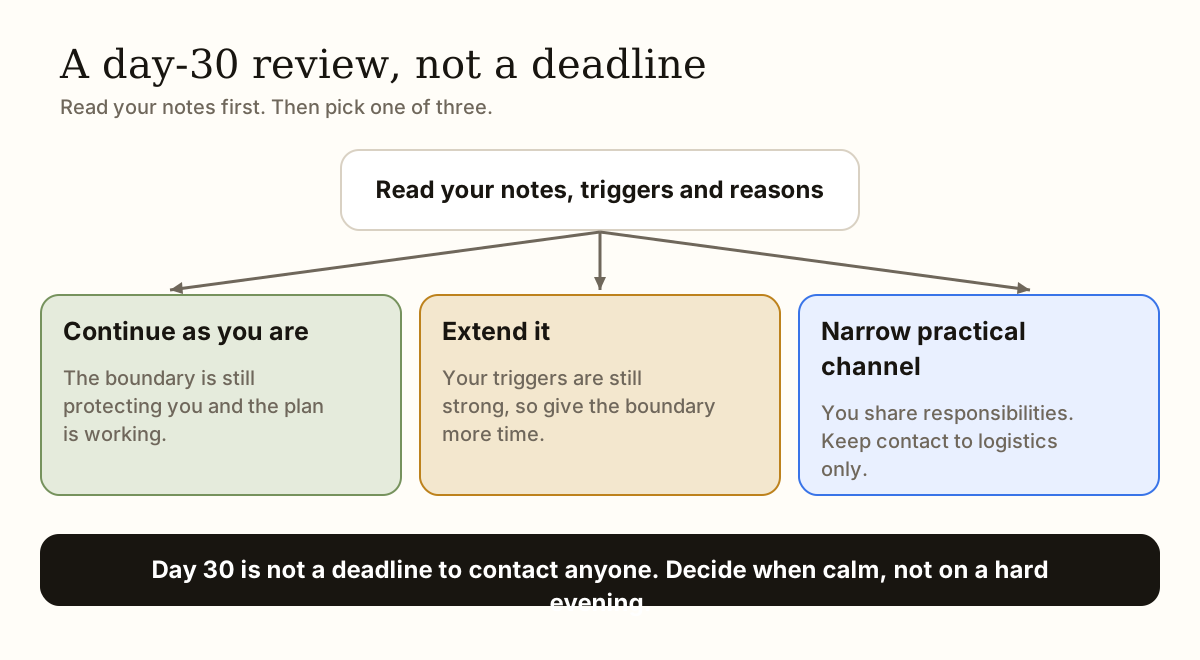
Some people continue the same boundary. Some extend it, and the guide on how long no contact should last explains why there is no magic number. Some choose carefully limited contact for practical reasons. Each choice can be made honestly, but it is best made when you are calm rather than in response to a hard evening. The steps below give you a short review you can complete in one sitting.
After the first month, the work shifts from holding the boundary to rebuilding your life. Our guide on how to get over a breakup maps out the weeks that follow.
When the first 30 days are not the right plan
If the relationship involved threats, pressure, stalking or fear, safety comes before any contact strategy, because leaving can raise risk. In the US, the National Domestic Violence Hotline is 1-800-799-7233, or text START to 88788. Our safety page lists more.
If your sleep, appetite or mood stay low for weeks, or you have thoughts of harming yourself, talk to a doctor or a crisis line. In the US call or text 988. In the UK and Ireland, Samaritans is 116 123, and in India Tele-MANAS is 14416. Getting help does not break any rule.
Step-by-step plan
- Read your notes from days 1 to 30
Skim your trigger log, your reasons and any unsent letters. Note the three patterns that repeat most often.
- Describe the month honestly
Write one sentence each about sleep, focus, money, time with people and urges, comparing the first week with the last.
- Name the next boundary
Decide whether to continue as you are, extend the boundary, or define a narrow, practical channel for necessary contact.
- Write your guardrails
Add one guardrail for your most common trigger and one reason you will return to on a bad night.
- Set your next check-in
Choose a date to review the plan again and let one trusted person know when that is.
You do not have to solve the whole relationship tonight. Take one private step that creates space between the feeling and the action.
See your current day and next milestone →Common questions
What happens in the first 30 days of no contact?
Most people experience changing intensity: some calm days, some sharp urges and some surprising moments of clarity. The month is usually about reducing access, handling predictable triggers and noticing what gradually returns to your life. It is not a test you pass by feeling a particular way.
What should no contact day 1 look like?
Day one is about setup. Define what counts as contact, reduce easy access to the person and tell one trusted person about your plan. Expect the urge to check or reach out, and have an if-then response ready before the evening. Feeling terrible on day one is common and does not mean the boundary is wrong.
Is no contact week 1 the hardest?
For many people the first week includes the most checking and bargaining, but difficulty can return later, especially around anniversaries, holidays or a lonely evening. Plan for the whole month rather than assuming the first week is the only hard part.
Should I track no contact day by day?
Tracking can make progress visible, and a daily record can reveal patterns in your triggers and mood. If the count starts to feel like pressure, focus on today’s boundary and the broader signs of recovery instead. UnLink’s no-contact day counter is one option, and a simple calendar works too.
What if I break no contact in the first 30 days?
A slip in the first month is common enough to plan for, and it does not mean the whole plan has failed. Pause before any follow-up, review what triggered the contact and restart with one guardrail. The guide on what to do if you break no contact covers the steps in more detail.
What should I do on day 30 of no contact?
Review your notes, identify the patterns that repeated and decide what protects you next. You do not have to contact anyone on day 30, and reaching the number does not create an obligation. Choose a review date and keep your boundary until you have made a deliberate decision.
Does no contact get easier after 30 days?
For many people the constant urgency eases, though anniversaries, news about the other person and lonely evenings can still bring it back. There is no guaranteed day when it ends. If it is not easing and your daily life is suffering, add support rather than adding pressure.
Is 30 days of no contact enough?
Thirty days is a common checkpoint, not a standard. Some people feel steadier by then, and some need longer or a modified version for practical reasons. Judge it by your sleep, focus and urges rather than the calendar, and see the guide on how long no contact should last.
If contact involves threats, stalking, coercion, shared children, housing or immediate safety, a general no-contact rule may not fit. Read the safety guidance and seek qualified local help where appropriate.
Sources and further help
- Fisher HE et al. (2010), Reward, addiction, and emotion regulation systems associated with rejection in love, Journal of Neurophysiology
- Kross E et al. (2011), Social rejection shares somatosensory representations with physical pain, PNAS
- Marshall TC (2012), Facebook surveillance of former romantic partners, Cyberpsychology, Behavior, and Social Networking
- Bowen S & Marlatt GA (2009), Surfing the urge: brief mindfulness-based intervention for college student smokers, Psychology of Addictive Behaviors
- Gollwitzer PM (1999), Implementation intentions: strong effects of simple plans, American Psychologist
- Larson GM & Sbarra DA (2015), Participating in research on romantic breakups promotes emotional recovery via changes in self-concept clarity, Social Psychological and Personality Science
- Lewandowski GW & Bizzoco NM (2007), Addition through subtraction: growth following the dissolution of a low quality relationship, Journal of Positive Psychology
- Apple Support: Choose who you can communicate with at certain times with Screen Time on iPhone
- National Domestic Violence Hotline: safety planning
- 988 Suicide & Crisis Lifeline (US)
Research is cited to explain general patterns, not to diagnose or predict any individual outcome. Sources do not endorse UnLink. Read our editorial principles.
Keep this support one tap away.
UnLink is a free, private no-contact tracker for iPhone: count your days, get through urges and restart without losing your history.