My Ex Moved On Like I Was Nothing: What a Fast Move-On Does and Doesn’t Mean
My ex moved on like I was nothing: why a fast move-on hurts, what it can and can’t mean, what research says about rebounds, and a 7-day plan to stop checking.
 By the UnLink Editorial Team · General educational guidance, not therapy
When an ex moves on fast, it tells you about their pace, not your worth. People start new relationships quickly for many reasons: they let go before the breakup, they cope by staying busy, or they met someone. None of those can be read from a post, and none of them means you were nothing.
- A fast move-on is a fact about someone’s pace, and you cannot tell from outside whether it reflects early detachment, avoidance, a good new connection or a performance for friends.
- Research on rebound relationships found that people who started something new quickly often reported more confidence and more resolution about the ex, so “it will fall apart” is a hope, not a finding.
- People grieve at different speeds, and the same breakup can feel finished to one person and unfinished to the other without either of them being wrong.
- Watching your ex’s life is linked to more distress and less personal growth, so the most useful thing you can change is how often you look.
- No contact still protects your recovery when your ex has a new partner, because it was never about them being single.
Why does it hurt this much when my ex moves on fast?
Because it feels like a verdict. You are still deciding who gets the good frying pan, and they are tagged at a rooftop bar with someone you have never heard of. The thought arrives fully formed: they moved on like I was nothing.
That sting is not vanity. A breakup already shakes your sense of who you are, and a fast replacement seems to answer a question you never asked: was I replaceable? The answer your mind supplies is usually the cruelest one available.
It also gets worse the more you look. In a 2012 study of 464 people after a breakup, those who kept checking their ex’s Facebook page reported more distress, more longing and less personal growth (Marshall, 2012). That was an association, not proof that the looking caused it, but it matches what most people describe: every glance gives the story another chapter.
Two things are true at once. Their pace is real, and your reading of it is a guess.
Why did my ex move on so fast?
There is no single reason, and from the outside you cannot tell which one applies. What follows are possibilities that fit many people, not a diagnosis of your ex. Notice the right-hand column: for every reason, there is something it does not tell you.
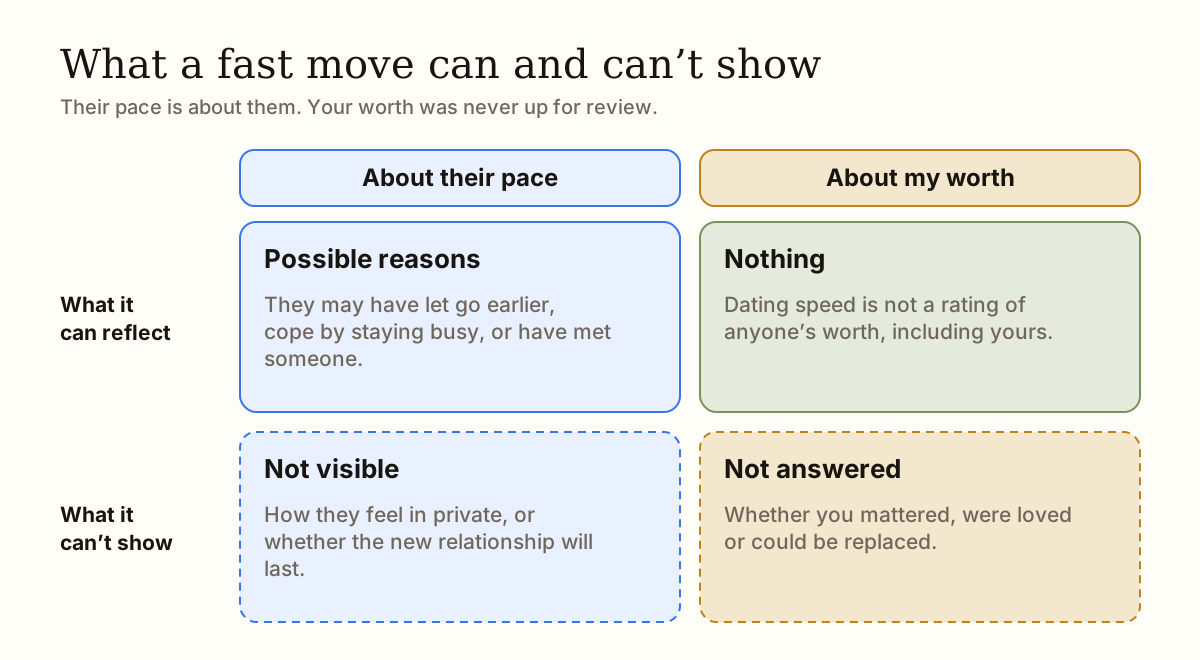
| Possibility | What it could mean | What it does not tell you |
|---|---|---|
| They are on a rebound | A new person can ease loneliness and fill the evenings. The pace may be about their discomfort with an empty flat. | What they felt for you, or whether the new relationship is shallow or lasting. |
| They had already decided before the breakup | The grieving may have happened while you still believed things were fine, so from your side it looks like no mourning at all. | That they did not care, or that you should have seen it coming. |
| They cope by doing | Some people process by staying busy: dating, working, travelling. Others process by sitting still. | That the busier person hurts less. |
| They are avoiding the feelings | Staying busy can postpone sadness. Sometimes it arrives later, and sometimes it does not. | A prediction. Some people avoid for a long time without any trouble, and you cannot know which this is. |
| They are showing a public face | Posts are edited. “Happy” may be for mutual friends, or for you. | How they feel at 2 a.m., or how serious the relationship is. |
| A connection was already forming | A friend, a colleague or an old acquaintance can become a partner faster than a stranger would. | When it began, or whether you were wronged. A profile cannot tell you the order of events. |
Do different people really grieve at different speeds?
Yes, and the research is consistent on this point even where it is thin on everything else. Sbarra and Emery (2005) followed 58 young adults who were in dating relationships, using diary entries for 28 days after a breakup. They found that attachment style and how much the breakup affected a person predicted both where their feelings started and how quickly they changed. That was a small sample of young adults, so treat it as a pattern and not a rule. It still says what you already suspect: two people can leave the same relationship on the same day and be in different places a month later.
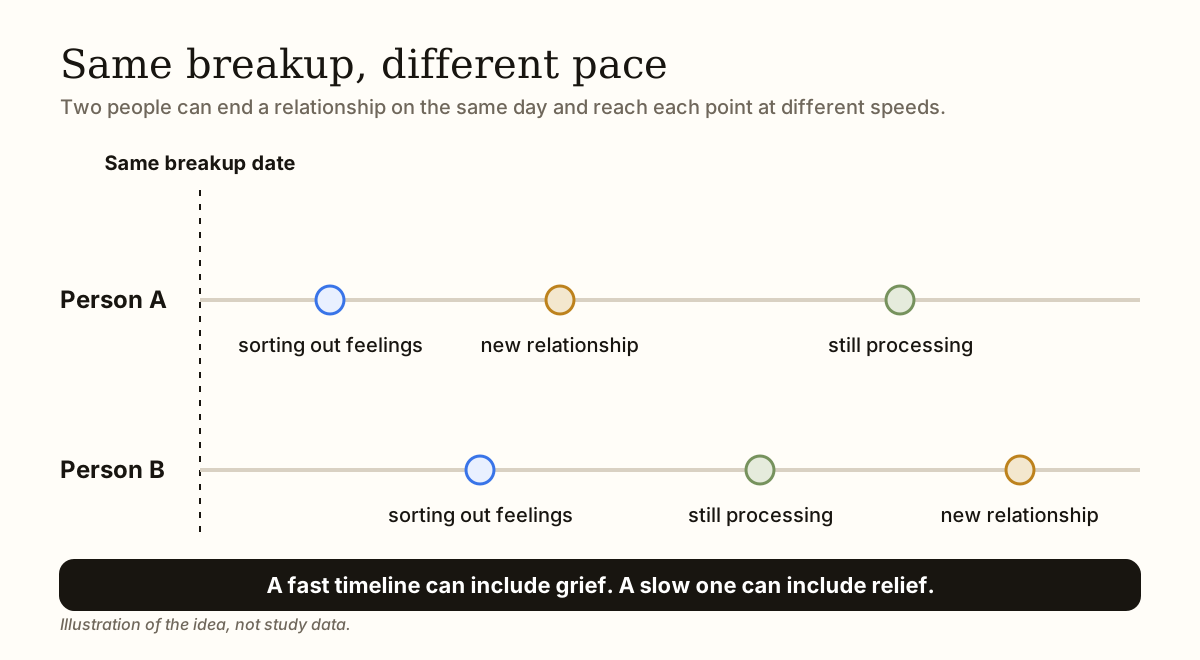
Here is how that can look. Example: two people end a four-year relationship on the same Friday. Person A has been unhappy for a year, quietly grieving in small pieces, and starts seeing someone in week three. Person B was blindsided, spends six weeks barely leaving the flat, and starts seeing someone in month five. From the outside, A looks cold and B looks devoted. Inside, A may be tired and relieved with some grief left, and B may be exhausted from a loss that was only a few days old when A’s was already old.
What would each have needed? A probably needed somewhere to say “I am not as fine as I look”. B needed someone to say “this is not a competition”. Neither needed to be told they were doing it wrong.
Does it mean they never loved me?
No. Speed is a poor measure of how much someone cared. A person can have loved you and left early. A person can have loved you and still need to be with someone by month two. A person can also have cared a little and moved on quickly, and the honest answer is that nobody reading a post can tell which.
What about the rebound? People assume that a quick new relationship is a sign of not caring, or a doomed one. The research does not say that. Brumbaugh and Fraley (2015) studied people after breakups in two studies. Those in new relationships were more confident in their desirability and had more resolution over their ex, and among them, starting the new relationship sooner was associated with better psychological and relational health. These were self-reports and correlations, and they describe averages, not your ex. Still, they cut against the comfort many people reach for.
We will not tell you the new relationship will end, and we will not tell you it will last. Both are predictions about strangers. Some relationships that start fast do last, and some that start slowly do not. If your recovery depends on a particular outcome for them, it stays hostage to them.
What can I know, and what can’t I know?
A short exercise will help here. The list on the left is the part of this story you can stand on. The right is where the mind does its worst work.
| What you can know | What you cannot know |
|---|---|
| They appear to be dating someone. | How they feel in private. |
| When they posted it. | When it started, or how serious it is. |
| How it makes you feel today. | Whether it will last, or fail. |
| You got through the worst weeks of the breakup. | Whether they miss you, regret it, or think about you at all. |
| What you do next. | What they mean by any of it. |
What does their new relationship change about my breakup?
It changes the view from your phone. It does not change why your relationship ended, what the two of you shared, or your ability to rebuild. Those facts were true the day before their post and are still true the day after.
It also does not make no contact pointless. No contact is a boundary for your recovery, and it was never about them being single. If anything, a new partner is a good reason to leave your ex’s life alone: there is now even more to see and nothing in it for you to act on. For the bigger picture, see does no contact work?
If your mind keeps asking why you miss them while they seem fine, why do I miss my ex? explains what the missing is usually made of.
How do I stop checking their life?
Checking feels like preparation: if you look first, the next blow will land softer. It does the opposite. Each look hands your mind new material, and the pain from the look brings the next urge a few hours later.
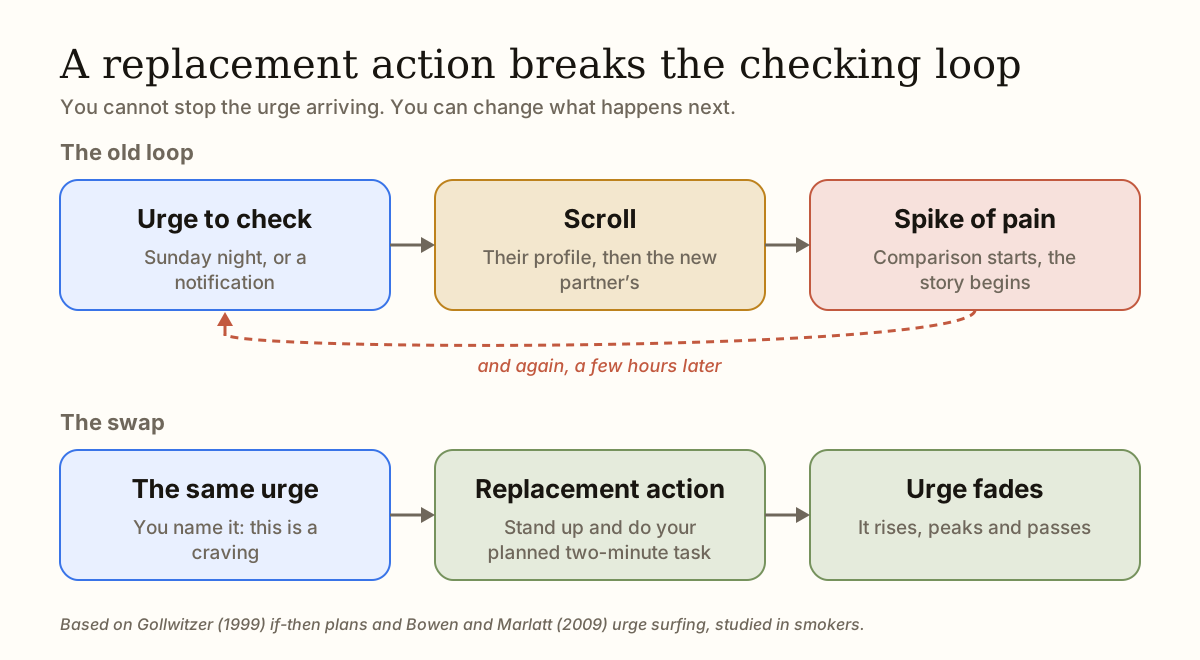
You can interrupt that loop without a perfect plan. You cannot stop the urge from arriving, but you can decide ahead of time what happens in the gap. The three-step, seven-day version is in the step-by-step plan below. For the full set of muting, blocking and friction options, use how to stop checking your ex’s social media.
The if-then idea underneath the plan comes from Gollwitzer (1999), who found that specific plans of the form “if this happens, then I will do that” help people follow through on their goals. The urge-surfing idea, that cravings rise, peak and pass if you do not act on them, has been tested in smokers (Bowen and Marlatt, 2009), so treat it as a promising technique and not a proven fix for breakups.
What do I do with the story my mind is writing?
Write it down, then split it. Take the sentence “they moved on like I was nothing” and put two columns underneath: what I know, and what I am guessing. Most of the sentence lands in the second column. The point is not to argue yourself out of the hurt. It is to stop treating a guess as a fact.
This is also the answer to comparing yourself with the new partner. You are putting your insides next to their edited outside, and you are treating a stranger’s photos as a ranking of you. Jealousy is a normal response to loss. It is not a sign that you are doing recovery wrong, and you do not have to pretend you do not feel it.
Another trap is trying to predict your own pain. In a study of Northwestern University students, people overestimated how distressed they would be after a breakup (Eastwick et al., 2008). This is a small student sample, but it is a reason to distrust the feeling that this will always be the worst it gets. For rumination techniques, see how to stop thinking about your ex, and for the longer arc of recovery, how long it takes to get over a breakup.
You may also be tempted to tell your ex, or their new partner, what you think. Before you do, run the specific message through Does this break no contact?, and ask what you want the message to change. Often the answer is your own feeling, and that can be written down instead.
When should I talk to someone?
Talk to a friend, a doctor or a therapist if the comparison is taking over your days, if you cannot sleep or work because of it, or if you are drinking more to cope. Those are signs the pain has got ahead of what you can carry alone, not signs of weakness. Our guide to anxiety after a breakup covers what to watch for.
If the comparison spirals into thoughts of harming yourself or feeling hopeless, reach out now. In the US, call or text 988. In the UK and Ireland, call Samaritans on 116 123. In India, call Tele-MANAS on 14416. If you are afraid of your ex, call the US National Domestic Violence Hotline on 1-800-799-7233 (or text START to 88788), and read our safety guidance. A plan for your safety comes before any plan about contact.
Step-by-step plan
- Days 1–2: make the trigger harder to reach
Mute your ex and their new partner on every app, remove both names from your search history and move the apps off your home screen. Then write down your two or three riskiest moments. For many people it is Sunday evening, after a drink, or the minute they wake up.
- Days 3–5: pair each trigger with a replacement
Write one if-then line for each risky moment: “If I reach for the app on Sunday evening, then I will stand up and fill the kettle, then text a friend.” Each time the urge hits, note the time and what set it off. After three days the pattern is usually plain.
- Days 6–7: review and keep what worked
Compare how often you looked on day 1 and day 7. Keep the replacement that worked and drop the one that did not. If you slipped, restart the plan from day 3, not day 1. Decide whether to unfollow or block, and do it in daylight, not at midnight.
You do not have to solve the whole relationship tonight. Take one private step that creates space between the feeling and the action.
Check whether a message or a look breaks no contact →Common questions
Why did my ex move on so fast?
There is no way to know from outside, but common possibilities include letting go before the breakup, coping by staying busy, avoiding the feelings, a connection that was already forming, or putting on a public face. None of these is a measure of your worth. See the table above for what each one does and does not tell you.
Does it mean they never loved me?
No. How fast someone moves on is a poor measure of how much they cared. A person can have loved you and left early, or loved you and needed company quickly. A post cannot tell you which.
My ex is dating someone new a month after we split. Is that normal?
It is common enough that researchers study it, and it is no sign of a hidden verdict on you. In two studies of people after breakups, those who started new relationships quickly often reported more confidence and more resolution over their ex (Brumbaugh and Fraley, 2015). It can still hurt a great deal, and both can be true.
Is a rebound relationship a sign they didn’t care?
Not on its own. Research on rebounds found that people who started something new soon after a breakup often did as well as or better than others on confidence and resolution. We cannot tell you whether a particular rebound will last or fail, and neither can anyone else.
Can a relationship that starts fast still last?
Yes, some do. Speed at the start does not decide how a relationship ends, and nobody can predict it for two people they have never met. Avoid building your recovery on the hope that it fails.
Why do I feel worse when I see them happy?
A fast replacement can feel like a verdict on your worth, and the sight of it reopens the loss. The distress is real, and checking tends to feed it: in a 2012 study, watching an ex’s Facebook page was linked to more distress and less personal growth (Marshall, 2012). Looking less is the part you can change.
Is it normal to feel jealous of their new partner?
Yes. Jealousy after a breakup is a common response to loss. You can feel it without acting on it. Notice it, write down what you are comparing, and ask whether you are comparing yourself to a real person or to a photo.
How do I stop comparing myself to my ex’s new partner?
Take the partner’s profile out of reach first: mute them, and remove the search shortcuts. Then, when the comparison starts, write it down in two columns, what I know and what I am guessing. Most of a comparison is guesswork about a stranger’s life.
How do I stop checking their social media?
Make looking harder than not looking: mute, clear search history and move the apps. Then pair each risky moment with a replacement action decided in advance, as in the seven-day plan above. For a fuller plan, read how to stop checking your ex’s social media.
Should I say something to my ex about their new partner?
Usually not. A message about their new partner rarely gets you what you want and almost always restarts the craving cycle. Write the message in a note instead, and if you are unsure whether something counts as contact, run it through Does this break no contact?
Does no contact still help if they are already with someone new?
Yes. No contact is a boundary that protects your recovery, and it does not depend on your ex being single. A new partner makes it more useful, because there is more to see and nothing for you to do about it.
Is it normal to feel humiliated when my ex moves on fast?
Yes. Humiliation is common when a relationship is replaced in public, because the loss feels witnessed. It tends to ease as you stop looking, as the story loses details to feed on, and as your own life gets more crowded.
Did my ex move on fast on purpose to hurt me?
You cannot know, and assuming it often keeps the pain alive. Some people do post to be seen, but many simply have a new relationship and a phone. A better question is what you need in the next hour, which is something you can answer.
Will my ex come back after moving on?
Nobody can tell you. Some exes get in touch later and many never do, and either outcome says little about you. A recovery plan that depends on them coming back keeps you waiting; one that does not keeps you moving.
If contact involves threats, stalking, coercion, shared children, housing or immediate safety, a general no-contact rule may not fit. Read the safety guidance and seek qualified local help where appropriate.
Sources and further help
- Marshall (2012) — Facebook surveillance of former romantic partners: associations with postbreakup recovery and personal growth
- Brumbaugh & Fraley (2015) — Too fast, too soon? An empirical investigation into rebound relationships
- Sbarra & Emery (2005) — The emotional sequelae of nonmarital relationship dissolution: analysis of change and intraindividual variability over time
- Eastwick et al. (2008) — Mispredicting distress following romantic breakup
- Gollwitzer (1999) — Implementation intentions: strong effects of simple plans
- Bowen & Marlatt (2009) — Surfing the urge: brief mindfulness-based intervention for college student smokers
- National Domestic Violence Hotline — Plan for safety
- 988 Suicide & Crisis Lifeline
Research is cited to explain general patterns, not to diagnose or predict any individual outcome. Sources do not endorse UnLink. Read our editorial principles.
Keep this support one tap away.
UnLink is a free, private no-contact tracker for iPhone: count your days, get through urges and restart without losing your history.