How Long Does It Take to Get Over a Breakup?
How long it takes to get over a breakup, what research says about recovery time, why the “half the relationship” rule is a myth, and what speeds it up.
 By the UnLink Editorial Team · General educational guidance, not therapy
There is no fixed number. For many people the worst of it, the constant thoughts, broken sleep and lost appetite, eases within a few weeks to two months, while fully rebuilding takes several months or longer. Research also shows people recover faster than they predict. Ongoing contact, a long or shared life, and a sudden ending tend to stretch the timeline out.
- No study gives a reliable average, and rules like “half the length of the relationship” have no evidence behind them.
- People consistently predict they will feel worse, for longer, than they actually do.
- Recovery comes in waves. A bad day in week six is part of the normal pattern, not proof you are back at the start.
- Accepting that it is over is linked to faster recovery from sadness. Continued love and anger are linked to slower recovery.
- The factors you control most, such as contact, social media checking, sleep and time with people, are also the ones that shift the timeline most.
- If things are getting worse rather than better after a couple of months, or you cannot function for more than two weeks, that is a reason to get support.
Why there is no honest single number
If you have searched this question at 2 a.m., you have probably seen confident answers: three months, eleven weeks, half the length of the relationship. They are appealing because they promise an end date. None of them hold up as a rule.
Breakup studies mostly follow young adults for weeks or months, measure different things (sadness, distress, love, life satisfaction) and stop before everyone has recovered. That makes them good at showing patterns and poor at producing a number you can circle on a calendar. The “half the relationship” formula comes from pop culture, not research. Plenty of people get over a five-year relationship faster than a six-month one, because what matters is how much of your life, identity and future was tied up in it, and how the ending happened.
So the honest answer comes in two parts. Here is what the research does show about timing, and here is what moves your timeline in either direction.
What research says about breakup recovery time
Four findings are worth knowing, because together they describe the shape of recovery better than any number.
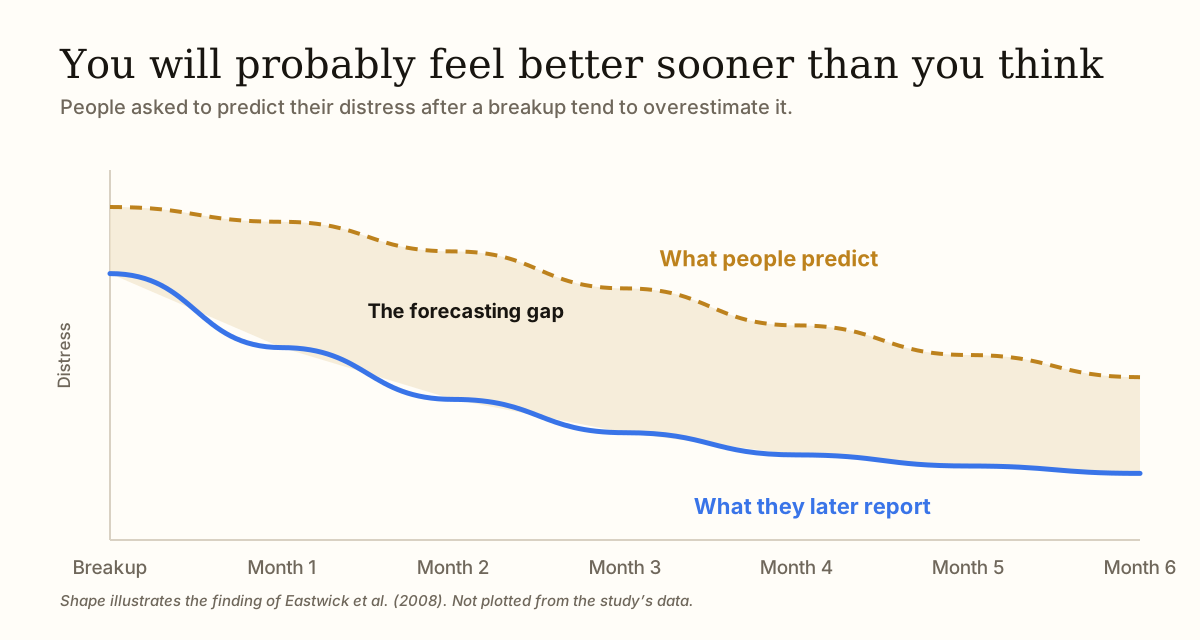
- You will probably recover faster than you expect. Eastwick and colleagues (2008) followed students in dating relationships and asked them how upset they would be if the relationship ended. Those who later broke up reported less distress than they had predicted, and it faded faster than they expected. Your current feeling is a poor forecast of how you will feel in two months.
- Day to day, recovery bounces. Sbarra and Emery (2005) had young adults keep daily emotion diaries for four weeks after a serious breakup. Sadness and anger generally fell over time, but they swung considerably from one day to the next. A good Tuesday and an awful Wednesday are both normal parts of the same recovery.
- Acceptance is the hinge. In a follow-up analysis, accepting that the relationship had ended explained why more securely attached people recovered from sadness sooner. Higher levels of continued love and anger, and a more preoccupied (anxious) attachment style, were linked to a lower chance of sadness lifting during the study (Sbarra, 2006).
- Bigger shared lives take a bigger hit. Among 1,295 unmarried young adults, a breakup was linked to more psychological distress and lower life satisfaction. The drop in life satisfaction was larger for people who had lived together or planned to marry, and smaller for those who had started dating someone new (Rhoades et al., 2011).
A rough timeline, without false precision
With that caveat in mind, this is a pattern many people recognise. Use it to orient yourself, not to judge yourself. For a week-by-week plan of what to actually do in each phase, see how to get over a breakup.
| When | What it often feels like | What tends to help |
|---|---|---|
| The first days | Shock, numbness or panic; disrupted sleep and appetite; a strong pull to make contact | Basics, two or three steady people, a 72-hour pause on all contact |
| Weeks 1–4 | Waves of sadness and anger; constant checking urges; bargaining thoughts | No contact, muting, a written reality list, a daily routine |
| Months 1–3 | Fewer bad days, but loneliness and boredom show up; spikes around anniversaries or news of them | Filling the empty time slots, new and old friendships, structured reflection |
| Months 3–6 | Thoughts of them are less frequent and less sharp; occasional strong days of missing them | Rebuilding identity, values and goals that are yours alone |
| Beyond six months | For many, the relationship has become part of your story rather than the whole of it | If pain is steady or worsening at this point, talking to a professional |
What makes it take longer, and what makes it faster
Some things that stretch recovery out are simply part of your situation: a long relationship, children, a home you shared, a betrayal you did not see coming. You cannot change those, and you should not blame yourself for them. Other factors are surprisingly controllable, and they are where your effort pays off most.
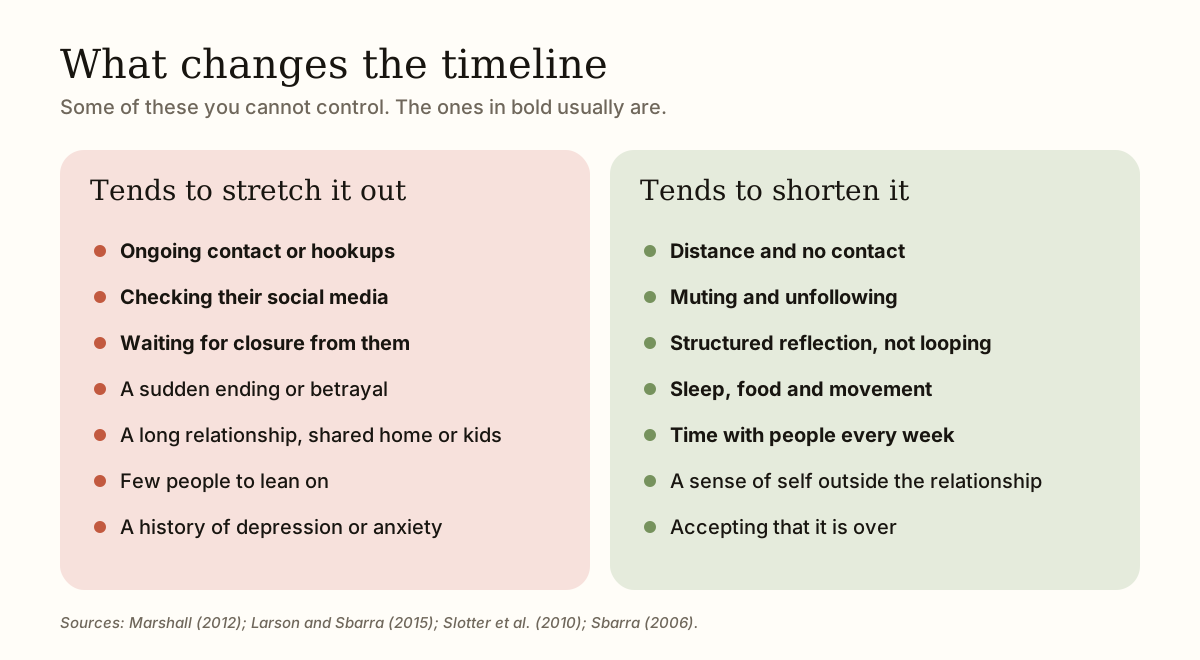
- Contact. Every conversation, hookup or “just checking in” reopens the craving loop that brain imaging studies associate with rejection (Fisher et al., 2010). This is the single biggest reason people feel stuck. If you cannot cut contact because of children or work, modified no contact keeps it practical.
- Watching them online. In a study of 464 people, monitoring an ex’s Facebook was linked to more distress, more longing and less personal growth, even after accounting for offline contact (Marshall, 2012). See how to stop checking your ex’s social media.
- Waiting for closure from them. If your recovery depends on them explaining themselves, apologising or admitting fault, your timeline is in their hands. Closure you build yourself, through writing and reflection, puts it back in yours.
- Who you are without them. People whose sense of self was more merged with their partner’s feel more lost after a breakup and more distressed (Slotter et al., 2010). In one study, structured reflection helped people rebuild self-concept clarity, which explained drops in loneliness and intrusive thoughts (Larson and Sbarra, 2015).
- Your body and your people. Sleep, food, movement and regular time with friends are not glamorous, but they set the floor your mood stands on. When they collapse, everything else takes longer.
Why it can feel worse at week three or month two
Many people are blindsided when the pain returns after a few better weeks. There are ordinary reasons for it. Early on, shock and adrenaline can hold feelings at a distance, so the grief often lands later, once life has gone quiet again. Friends check in less after the first fortnight. The novelty of being busy wears off, and the old routines, the Sunday morning or the drive home, are still there with a gap in them.
Missing someone more as time goes on is also common when you have started to forget the bad parts. Memory tends to soften over time and keep the highlights. That is why a written reality list, made in the first weeks while the reasons are fresh, is so useful in month two.
None of this means you are going backwards. Look at the trend across weeks rather than the last 48 hours. If the spikes are getting a little shorter or a little further apart, you are on track.
How long to get over a 1-year, 5-year or long-term relationship?
Length matters less than entanglement. A short relationship that was intense, secret or full of plans can hurt as much as a long one. A long relationship that had been fading for years may feel, once it ends, more like relief than grief. Ask yourself how much of your daily life, identity and imagined future ran through this person. That is a better guide than the number of anniversaries.
What usually does make long relationships harder is the practical layer: a shared home, money, pets, children, and a friend group you built together. Each one is a separate loss and a separate set of decisions. It is common for the practical untangling to take months on its own. Give yourself a longer runway, sort the logistics first, and consider talking to a therapist, especially after a marriage or a relationship that began when you were young.
Signs your recovery is on track
Progress is easy to miss from the inside, so it helps to know what to look for.
- You go hours, then whole days, without thinking about them.
- Seeing their name hurts, but it does not ruin the day.
- You can remember the good and the bad without rewriting either.
- The urge to check their profile comes less often and passes faster.
- You are making plans that have nothing to do with them, and you look forward to them.
- You are curious about the future rather than dreading it.
When the timeline is a reason to get help
Grief after a breakup is normal and does not need a diagnosis. But some patterns are worth taking to a doctor or therapist: for more than about two weeks you cannot sleep, eat or get through work or school; you feel hopeless or worthless most of the day; you are leaning on alcohol or drugs to cope; you are having panic attacks or cannot stop checking; or, several months on, things are getting steadily worse rather than slowly better.
If you have any thoughts of harming yourself, get help now. In the US, call or text 988. In the UK and Ireland, call Samaritans on 116 123. In India, call Tele-MANAS on 14416. Elsewhere, contact your local emergency number or visit findahelpline.com.
You do not have to solve the whole relationship tonight. Take one private step that creates space between the feeling and the action.
Estimate your recovery range →Common questions
Is the “half the length of the relationship” rule true?
No. It comes from pop culture, not research. How long recovery takes depends far more on how entangled your lives were, how the relationship ended and whether contact continues than on the number of months you were together.
Is it normal to still be sad about a breakup after 6 months?
It can be, especially after a long relationship, a shared home or a painful ending. What matters is the direction: are the hard days getting less frequent? If sadness has been steady or worsening for months, or it is affecting sleep, work or eating, talk to a professional.
Why do I miss my ex more as time goes on?
Early shock wears off, friends check in less, routines still have gaps in them, and memory softens the bad parts while keeping the highlights. A written list of the real reasons it ended, made while they are fresh, helps when this happens.
Does no contact make getting over someone faster?
It removes the biggest thing that slows recovery. Each contact restarts the craving loop, and monitoring an ex online is linked to more distress and longing. No contact does not make the feelings disappear, but it stops resetting them.
How long does it take to get over a breakup you did not want?
Often longer than one you chose, because rejection adds a hit to self-worth and leaves the “why” unanswered. Acceptance is what research links most closely to sadness lifting, so work on accepting that it ended rather than on understanding exactly why.
Does dating someone new help you get over an ex faster?
For some people. One study found that starting to date someone new was linked to a smaller drop in life satisfaction after a breakup. It helps most when you want that person for themselves, not as a way to avoid the loss or to make your ex jealous.
If contact involves threats, stalking, coercion, shared children, housing or immediate safety, a general no-contact rule may not fit. Read the safety guidance and seek qualified local help where appropriate.
Sources and further help
- Eastwick et al. (2008) — Mispredicting distress following romantic breakup
- Sbarra & Emery (2005) — The emotional sequelae of nonmarital relationship dissolution
- Sbarra (2006) — Predicting the onset of emotional recovery following nonmarital relationship dissolution
- Rhoades et al. (2011) — Breaking up is hard to do: the impact of unmarried relationship dissolution on mental health and life satisfaction
- Fisher et al. (2010) — Reward, addiction, and emotion regulation systems associated with rejection in love
- Marshall (2012) — Facebook surveillance of former romantic partners
- Slotter, Gardner & Finkel (2010) — Who am I without you?
- Larson & Sbarra (2015) — Participating in research on romantic breakups promotes emotional recovery via changes in self-concept clarity
- National Domestic Violence Hotline — safety planning
- 988 Suicide & Crisis Lifeline — US crisis support
Research is cited to explain general patterns, not to diagnose or predict any individual outcome. Sources do not endorse UnLink. Read our editorial principles.
Keep this support one tap away.
UnLink is a free, private no-contact tracker for iPhone: count your days, get through urges and restart without losing your history.