
The breakup recovery time estimator asks nine questions about your relationship, how it ended and how you are coping, and returns a rough planning range for the hardest part of the breakup to ease, plus the factors stretching your range most. It is a transparent estimate built from research patterns, not a prediction or diagnosis.
How the estimate works
Nobody can tell you when you will feel better, and this tool does not pretend to. What research can tell us is which things tend to make recovery slower or faster. The estimator starts from a base range of 4 to 10 weeks for the acute phase (constant thoughts, broken sleep, the strongest urges) and adds or subtracts weeks for each factor. The weights are shown below so you can see exactly how your number was built.
| Factor | Answer | Low end | High end |
|---|---|---|---|
| Length | Under 6 months / 2–5 years / 5+ years | −1 / +2 / +4 | −2 / +4 / +8 |
| Ending | I ended it / they ended it / sudden or cheating | −1 / +1 / +2 | 0 / +3 / +5 |
| Shared life | Lived together / share children | +2 / +3 | +4 / +6 |
| Contact now | Practical only / occasional / regular | +1 / +2 / +4 | +2 / +4 / +8 |
| Social media checking | Now and then / most days | +1 / +2 | +2 / +5 |
| Hoping to reunite | Not sure / yes | +1 / +2 | +2 / +4 |
| Support | One or two people / almost nobody | +1 / +2 | +1 / +4 |
| Sleep and appetite | Disrupted / badly affected 2+ weeks | +1 / +2 | +2 / +3 |
Why these factors
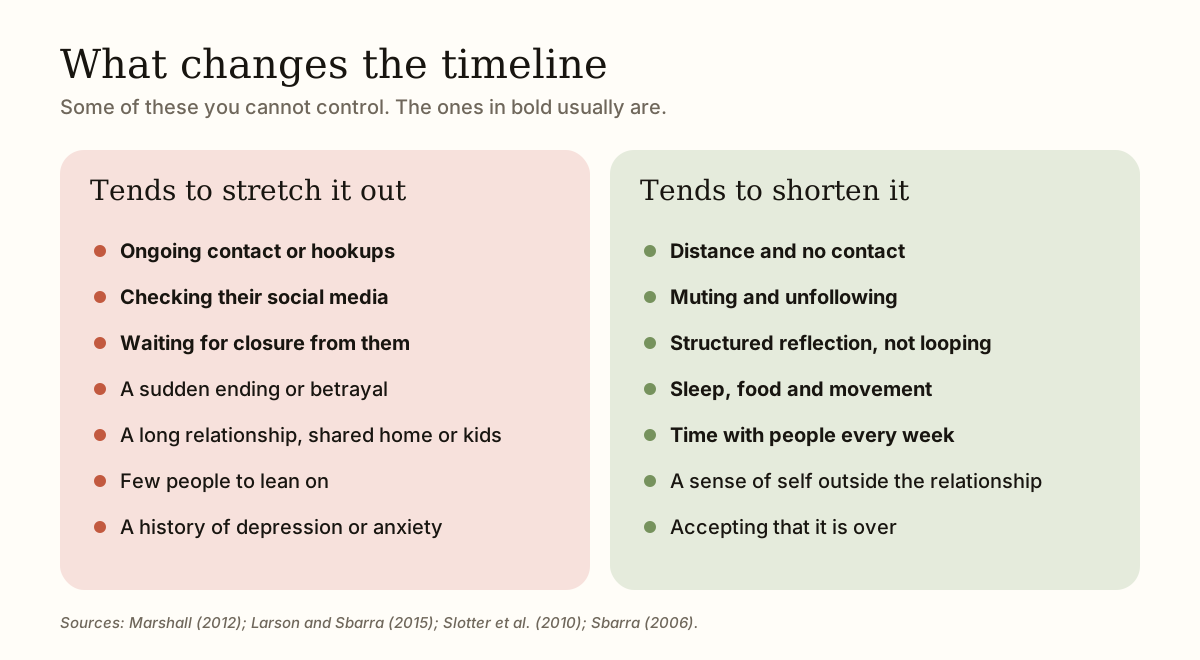
Each weight reflects a pattern in breakup research, not a measured effect size. People who later broke up predicted more distress than they felt, which is why the base range is shorter than most people expect (Eastwick et al., 2008). Accepting that the relationship had ended was linked to sadness lifting sooner, and continued love and anger to it lifting later (Sbarra, 2006). Monitoring an ex online was linked to more distress and longing (Marshall, 2012). Having lived together or planned to marry was linked to a bigger drop in life satisfaction (Rhoades et al., 2011).
Contact carries the heaviest weight because it is the factor people most often describe as keeping them stuck, and because each contact restarts the craving loop linked to rejection (Fisher et al., 2010).
How to read your result
Treat the range as a planning horizon, not a deadline. It covers the hardest stretch only; rebuilding your routines and identity usually takes longer. The tool also tells you where you are now relative to the range, and lists up to three factors stretching it, starting with the ones you can change.
If you are well past your range and things are not easing, or your sleep and appetite have been badly affected for more than two weeks, that is a reason to talk to a doctor or therapist, not a sign that you are doing recovery wrong. For the full picture, read how long it takes to get over a breakup.
Privacy
Your answers are scored in your browser and are not sent to us or saved. Refreshing the page clears them.
Common questions
Can a calculator really tell me how long it takes to get over a breakup?
No calculator can predict your recovery. This one shows a rough range based on factors research links to slower or faster recovery, so you can see which parts of your situation are stretching it and which you can change.
Why is my range so long?
Long relationships, shared homes or children, sudden endings, regular contact and frequent social media checking all add time. The result lists the biggest factors in your answers. Contact and checking are usually the easiest to change.
Does “recovered” mean I will not think about them anymore?
No. The range is for the hardest part to ease: constant thoughts, broken sleep and strong urges. Many people still think of an ex now and then long after they have moved on.
What if I am past my range and still hurting?
That happens, and it is not a failure. If the pain is slowly easing, keep going. If it is steady or getting worse, or affecting sleep, eating or work, talk to a professional.