The Stages of No Contact: Common Patterns, Not a Fixed Timeline
The stages of no contact people describe, from urgency and bargaining to steadying and rebuilding, with a stages table and an honest no contact timeline.
 By the UnLink Editorial Team · General educational guidance, not therapy
The stages of no contact people most often describe are shock and urgency, bargaining, anger, low mood and grief, steadying and rebuilding. They loop back instead of running in a straight line, and no research gives a fixed timeline for them. Treat them as a vocabulary for what you notice, and treat day counts as checkpoints.
- The stages of no contact are common patterns people describe, not a scientific sequence everyone must follow.
- Feelings often loop back, so moving into a new stage does not mean the earlier ones are finished.
- No reliable research gives a day count for when each stage starts or ends, and anyone who does is guessing.
- Intense emotions such as anger, sadness and craving are normal responses to a painful breakup.
- Structured reflection and steady routines can help you notice change, even when progress is uneven.
What are the stages of no contact?
People describe six overlapping patterns: shock and urgency, bargaining, anger, low mood and grief, steadying, and rebuilding. They are a vocabulary for what you may notice, not a map you must follow. They do not appear in the same order for everyone, they do not have fixed lengths, and nothing here predicts how long your experience will take.
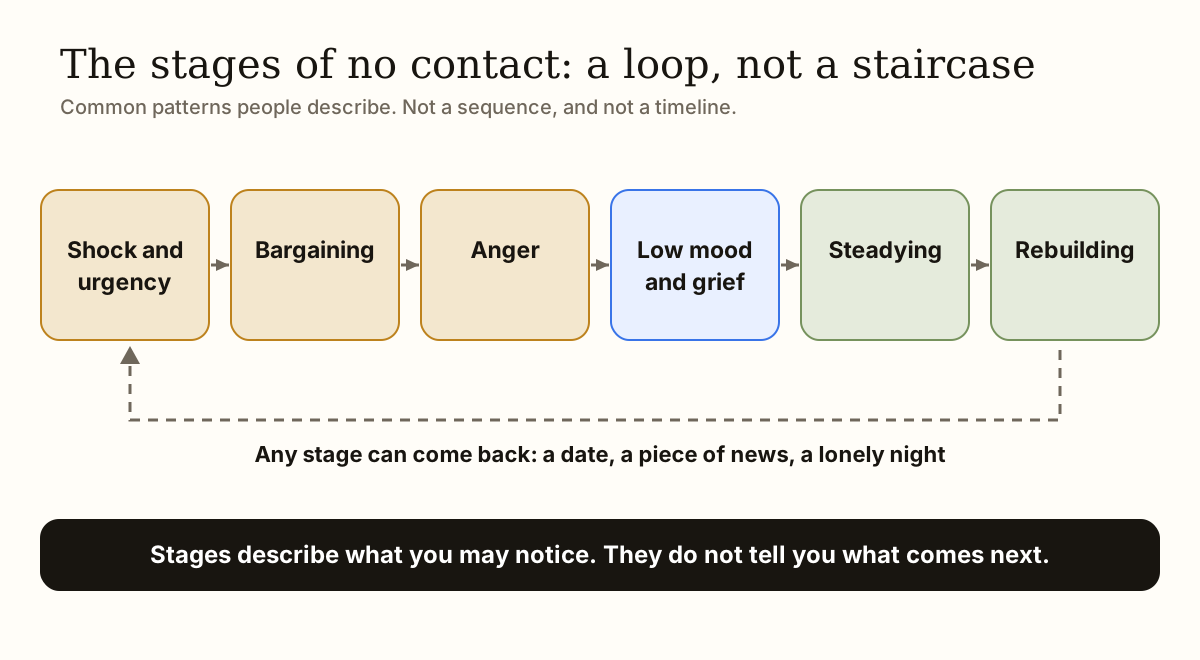
Most people’s experience is messier than any list. You may feel calm on Monday, furious on Wednesday and oddly tender on Sunday night. Those shifts are normal and do not mean you are failing. The table gives the quick version, and each stage has its own section below.
| Stage | What it can feel like | A thought you may hear | What tends to help |
|---|---|---|---|
| Shock and urgency | Numb or restless, tight chest, poor sleep, a need to fix things now | “I have to explain, or I can’t breathe.” | Slow down, cut easy access, use a pause before acting |
| Bargaining | The mind offers deals and exceptions | “One kind message won’t hurt.” | Name the deal, write down what you hope it would do |
| Anger | Energy, rehearsed arguments, a long list of their faults | “They owe me an apology.” | Write the full version privately, reread it tomorrow, do not send |
| Low mood and grief | Waves of sadness, missing small rituals | “What was the point of any of it?” | Keep basic routines, log triggers, tell someone, get care if it persists |
| Steadying | Quiet days, shorter urges | “I forgot to check today.” | Note those days so you can reread them |
| Rebuilding | Attention drifts back to your own life | “I want to try that class.” | Small repeatable choices, friends, goals |
Is there a no contact timeline?
No. There is no research-backed day count for when each stage begins or ends. Pages that give one, such as “day 3 is relief, week 4 is acceptance”, are repeating convention, and the numbers differ from page to page for that reason. A day count is useful as a checkpoint for reviewing your plan, not as a prediction.
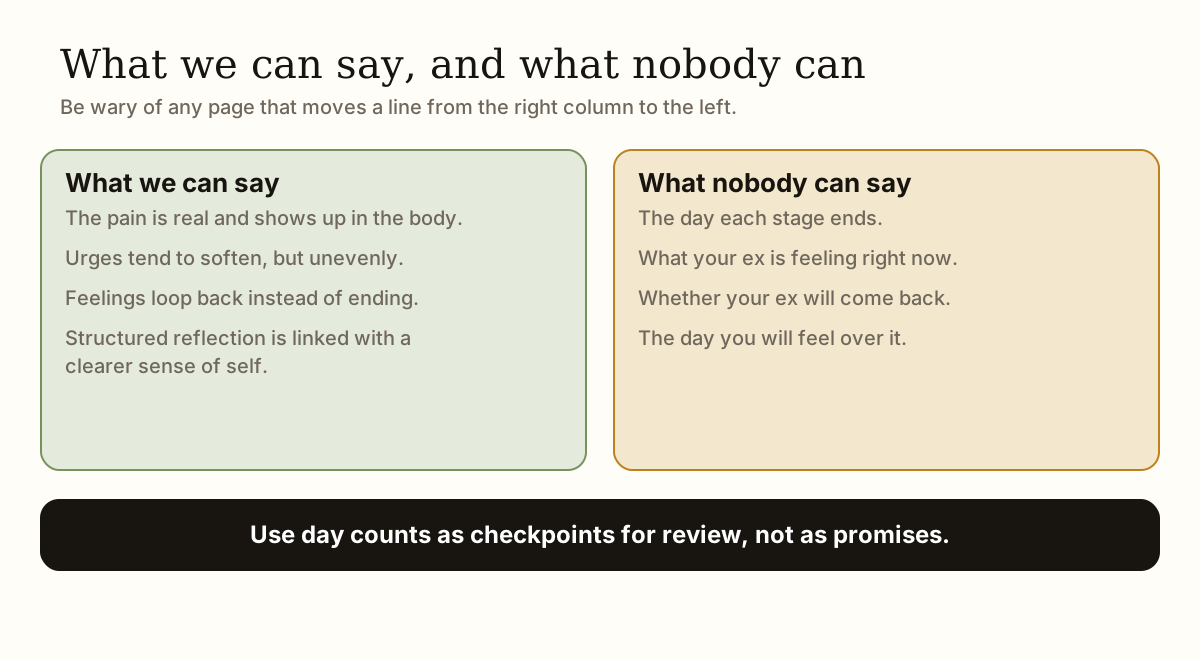
You will also see the five stages of grief applied to no contact. That model was written about dying and loss, not breakups, and a 2017 review by Stroebe, Schut and Boerner of the stage theory of grief in bereavement argued it lacks sound empirical support and can be harmful when people expect to pass through it in order. We borrow plain words like anger and sadness because they describe what people report, not because they come in sequence.
If you want ranges for how long recovery tends to take overall, how long it takes to get over a breakup covers what shortens and lengthens it, and how long no contact should last covers when to review the boundary.
| Claim | What is behind it | How to treat it |
|---|---|---|
| “No contact takes 30 days to work” | A convention. Thirty days is a common checkpoint, not a tested threshold. | Use it as a review date. See the first 30 days. |
| “Your ex will feel X by week Y” | Guesswork. Nobody can observe another person’s inner life from outside. | Ignore it. It keeps your attention on them. |
| “Each stage lasts a set number of days or months” | Stage lengths vary widely and the stages overlap. | Track your own signs: sleep, focus, urge strength. |
| “You are over it when the stages end” | Stages do not end cleanly. Steadiness is the target, and it returns and recedes. | Look for trend over weeks, not a finish line. |
Shock and urgency: the first days
Early on, many people feel a rush of urgency, and the steps for stopping the urge to text your ex can help you pause before acting. The urgency is a need to fix the situation, explain yourself, understand what happened or hear one final answer. Some feel numb or unreal. Others notice restlessness, a tight chest or trouble sleeping. Urgency is a signal to slow down, not an instruction to act.
Breakup pain can be intense. In a 2011 study, Kross and colleagues found that recalling an intense recent romantic rejection engaged brain regions that also respond to physical pain. That does not mean something is wrong with you. It means the hurt is real and deserves care. The day-by-day version of this stretch is in the first 30 days of no contact.
Bargaining: the “just one message” phase
Bargaining often arrives once the first shock settles. The mind offers deals: if I explain myself, they will understand; if I wait a week, I will feel ready; if I send one kind message, it will prove we are still connected. Each deal can sound reasonable, which is why it helps to name it.
A useful question is: “What am I hoping this message will do?” If the answer is reassurance, closure or a particular reaction, you are trying to control an outcome you cannot control. Write the hope down and address it directly with yourself or with a trusted friend. If the pull keeps returning late at night, the guide on why you want to text your ex at night explains those urges in more depth.
The pull can feel craving-like. In a 2010 study of people recently rejected by a partner, looking at that person’s photo activated brain regions linked to reward, motivation and craving. Knowing this may make the urge easier to observe rather than obey. If you do act on it, what to do if you break no contact shows how to restart without spiralling.
Anger and replaying the story
Anger is common after a breakup, and it often follows bargaining as the story starts to settle. You may rehearse arguments, list every flaw and wish for an apology. Anger can bring energy and clarity, but it can also keep you inside the most painful moments of the relationship.
Try writing the angry version in full in a private note, then reading it again the next day. Writing can be a useful outlet, and a draft is not a message to send. A guide to the unsent letter shows how.
Watch for anger that fuels checking, comparing or searching for proof that they were wrong. Those habits tend to keep the story active. If you notice them, step away from the screen and choose a different activity for ten minutes. The guide on how to stop thinking about your ex covers replaying and rumination in more detail.
Low mood and sadness: the grief stage
Sadness often becomes most visible once the other feelings have quieted. The small rituals of the relationship can be missed: a morning text, a shared show, a place you used to go. This is grief, and it can arrive in waves, especially at night or around dates that once mattered. Grieving a breakup explains why it counts as grief even though no one died.
Low mood deserves gentle attention. Keep basic routines such as meals, showers and a short walk, even when they feel pointless. If sadness lasts, becomes heavy or gets in the way of daily life, talk with a doctor or a counselor you trust. Depression after a breakup explains where normal grief ends and where to get help. This guide is educational and is not a substitute for professional care.
Mood and trigger logging can help you see whether low days cluster around certain times, people or places. A simple notebook works as well as any app.
Steadying: the quieter days
Steadying is the stage many people notice only in hindsight. A day passes without checking the phone. You make a plan and keep it. The urge still shows up, but it lasts a shorter time or loosens its grip. These moments are easy to miss precisely because they are quiet.
Steadiness is not the same as being over it. You may still feel tender about a memory or a song. The difference is that the feeling moves through your day without taking it over. Give those quiet days a short note so you can read them later. Signs you’re over your ex covers what else to look for.
Routine helps here. Regular sleep, meals, movement and time with people you trust create a base that does not depend on how you feel about the relationship on a given day. Keep your routines modest and repeatable.
Signs that steadying is starting may include:
- You checked the phone once and did not reopen the thread.
- You made a plan for the evening and kept most of it.
- A memory came up and passed without changing your whole day.
- You spent time on something that was yours, not a way of waiting for news.
Rebuilding: room for your own life
Rebuilding is the stage in which attention drifts back toward your own interests, friendships, goals and sense of self. It often starts with small choices: a class you signed up for, a friend you finally saw, or a hobby you let go of during the relationship.
Research on breakups gives some useful context. In a 2015 study of 210 recently separated young adults, Larson and Sbarra found that those who completed repeated reflective assessments over nine weeks reported larger decreases in self-concept disturbance, and that improved self-concept clarity was linked with less distress. It was a research setting rather than a self-help method, and it provides no recovery timeline, but it suggests reflection can be useful.
Lewandowski and Bizzoco (2007) reported that people who left lower-quality relationships often described personal growth and positive emotions afterward. That was not a study of every breakup, and growth is not guaranteed, but it suggests a painful ending can open space for change.
Some people find they feel grateful for parts of the relationship and clearer about what they want next time. For others, that gratitude comes much later. Both experiences are valid.
If you want a week-by-week plan for this stage, see how to get over a breakup.
What about the stages your ex goes through?
Many pages describe the other person’s stages: relief, then curiosity, then panic, then a wish to come back. Nobody can observe that from outside, and the pages that claim to are guessing, often to sell the idea that silence makes someone return. UnLink treats no contact as a boundary for your recovery, so we do not predict what a particular person will do.
If your attention keeps going to what they are feeling, take it as a sign of where your own stage is: probably bargaining or grief. When your ex moves on fast and why you miss your ex look at that pull directly. If they get in touch, what to do when your ex texts you during no contact has scripts.
When to ask for extra support
If the emotional stages feel stuck, overwhelming or unsafe, talk with someone who can assess your situation, such as a doctor, a counselor or a trusted person. You do not have to wait for a crisis before asking for help. Our safety page lists more options.
If you are thinking about harming yourself, or feel unable to keep yourself safe, contact emergency services or a crisis line right away. In the United States, you can call or text 988 at any time to reach the 988 Suicide & Crisis Lifeline. In the UK and Ireland, Samaritans is on 116 123, and in India Tele-MANAS is 14416.
If the breakup involved threats, coercion or fear for your safety, prioritize a safety plan over a general timeline. The US National Domestic Violence Hotline is 1-800-799-7233, or text START to 88788. Your stages matter, but your safety comes first.
You do not have to solve the whole relationship tonight. Take one private step that creates space between the feeling and the action.
Calculate your no-contact day →Common questions
What are the stages of no contact?
People often describe a mix of urgency, bargaining, anger, low mood, steadying and rebuilding. These are common patterns rather than a fixed scientific sequence. You may move through several at once, or return to an earlier stage after feeling better.
Is there a set no contact timeline?
No. There is no universal timeline that applies to everyone, and no fixed number of days when each stage ends. Use the stages to describe what you notice, and treat any day count as a checkpoint for review rather than a promise.
Why do I feel worse in the middle of no contact?
The middle can feel harder once the initial shock fades, the loss feels real and the new routine is still unfamiliar. Sadness and anger often surface then. Feeling worse does not necessarily mean the boundary is failing; it may mean emotions are finally getting room to be felt.
Does no contact get easier over time?
Many people notice the intensity of urges softening over time, though not evenly. Research on breakups has linked structured reflection with a clearer sense of self and less distress, which suggests that gaining clarity can help. Setbacks are part of the process and do not cancel progress.
Can I skip a stage?
You may not experience every stage, and some may feel very brief. There is no required order, and skipping one does not mean something is missing. Pay attention to what you actually feel and what you need.
What happens during no contact emotionally?
Many people experience intense urges, changing moods, replaying memories and moments of relief. The emotions often come in waves rather than a steady decline. Noticing and naming them, and keeping basic routines in place, can make them easier to carry.
What are the stages of no contact for the ex?
Nobody can reliably say. The “ex stages” described online are guesses, and the other person’s experience depends on who ended the relationship and many other things. Spend your attention on your own stage and your own plan.
How long does each stage of no contact last?
There is no reliable length for any stage. They overlap, repeat and vary from person to person. A better measure than the calendar is whether your sleep, focus and urge strength are changing over weeks.
If contact involves threats, stalking, coercion, shared children, housing or immediate safety, a general no-contact rule may not fit. Read the safety guidance and seek qualified local help where appropriate.
Sources and further help
- Kross E et al. (2011), Social rejection shares somatosensory representations with physical pain, PNAS
- Fisher HE et al. (2010), Reward, addiction, and emotion regulation systems associated with rejection in love, Journal of Neurophysiology
- Larson GM & Sbarra DA (2015), Participating in research on romantic breakups promotes emotional recovery via changes in self-concept clarity, Social Psychological and Personality Science
- Lewandowski GW & Bizzoco NM (2007), Addition through subtraction: growth following the dissolution of a low quality relationship, Journal of Positive Psychology
- Stroebe M, Schut H, Boerner K (2017), Cautioning health-care professionals: bereaved persons are misguided through the stages of grief, Omega: Journal of Death and Dying
- National Domestic Violence Hotline: safety planning
- 988 Suicide & Crisis Lifeline (US)
Research is cited to explain general patterns, not to diagnose or predict any individual outcome. Sources do not endorse UnLink. Read our editorial principles.
Keep this support one tap away.
UnLink is a free, private no-contact tracker for iPhone: count your days, get through urges and restart without losing your history.