How to Know You’re Over Your Ex: 10 Signs (and What If You’re Not Yet)
How to know you’re over your ex: ten signs grouped by thoughts, feelings, behavior and future, what neutral means, and what to do if you’re not there yet.
 By the UnLink Editorial Team · General educational guidance, not therapy
You know you’re over your ex when they take up less room, not when you stop thinking about them. Thoughts come less often and pass faster, news about them stings less, you stop checking, and your plans no longer revolve around them. It builds up over time, so expect a trend rather than a switch.
- Being over someone is a spectrum with a neutral middle, not a switch. “Not over yet” is a normal place to be and not a failure.
- Over does not mean you never think about them. It means the thoughts have lost their charge and no longer steer your choices.
- The most reliable signs are changes in behavior and in how your day runs: less checking, fewer drafts, plans that do not hinge on them.
- A new partner, or no thoughts for a week, is not proof either way. One bad night after a good month is a wobble, not a reset.
- If you are not moving forward and struggling to function, talk to a doctor or therapist. You do not need to wait for it to get worse.
How do you know you’re over your ex?
You can tell by what they cost you now. Over means your ex no longer takes up much of your attention, your mood or your decisions. It does not mean zero thoughts, zero feelings, or a day when you feel nothing and call it done.
Think of it as a trend line, not a switch. Early on, the thoughts are daily and loud. Later they come when something triggers them (a song, a street, a friend’s mention) and fade without a fight. Later still, they become part of your history rather than a live issue. Nobody can tell you the date this happens, and how long it takes to get over a breakup explains why.
Be wary of any page, including this one, that promises a yes or no. What follows is a set of signs to read against your own recent weeks. If you want a structured check first, the Am I over my ex check asks the same kinds of questions, and you can come back to the signs afterwards.
What is the difference between being over someone and being neutral?
Neutral is a midpoint: the pain has gone and nothing has replaced it yet. Over is further along, where the relationship sits in your past as one chapter among others. People often mistake neutral for a stall, and it is neither a stall nor a finish.
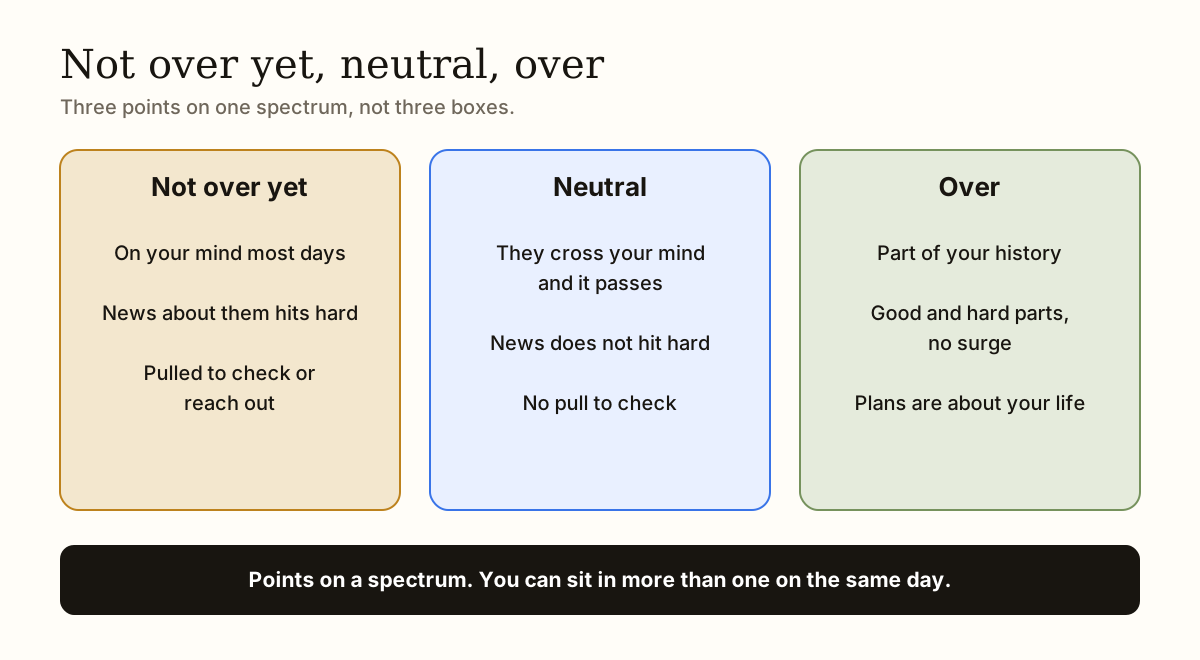
The table gives each state a sign and a warning about what that sign does not prove. Use it to place yourself roughly. You can be in different places on different days, and different parts of you can sit in different columns.
| State | What it looks like | What it does not mean |
|---|---|---|
| Not over yet | They are on your mind most days. News about them hits hard. You feel pulled to check, reread, or reach out. | You are weak, behind, or doing no contact wrong. It is where most people are for a stretch. |
| Neutral | They cross your mind and it passes. News stings less, or lands as information. The pull to check has mostly gone. | You are healed, or that you will not wobble. Neutral can feel flat, and flat is a normal stage. |
| Over (healed) | They are part of your history. You can recall the good and the hard parts without a surge. Your plans are about your life. | You feel nothing, wish them ill, or never think of them. You can still feel fondness or a pang. |
What are the signs you’re over someone?
Ten signs, grouped by where you notice them. You do not need all ten. Read them as a trend over the last few weeks, not as a test you pass today.
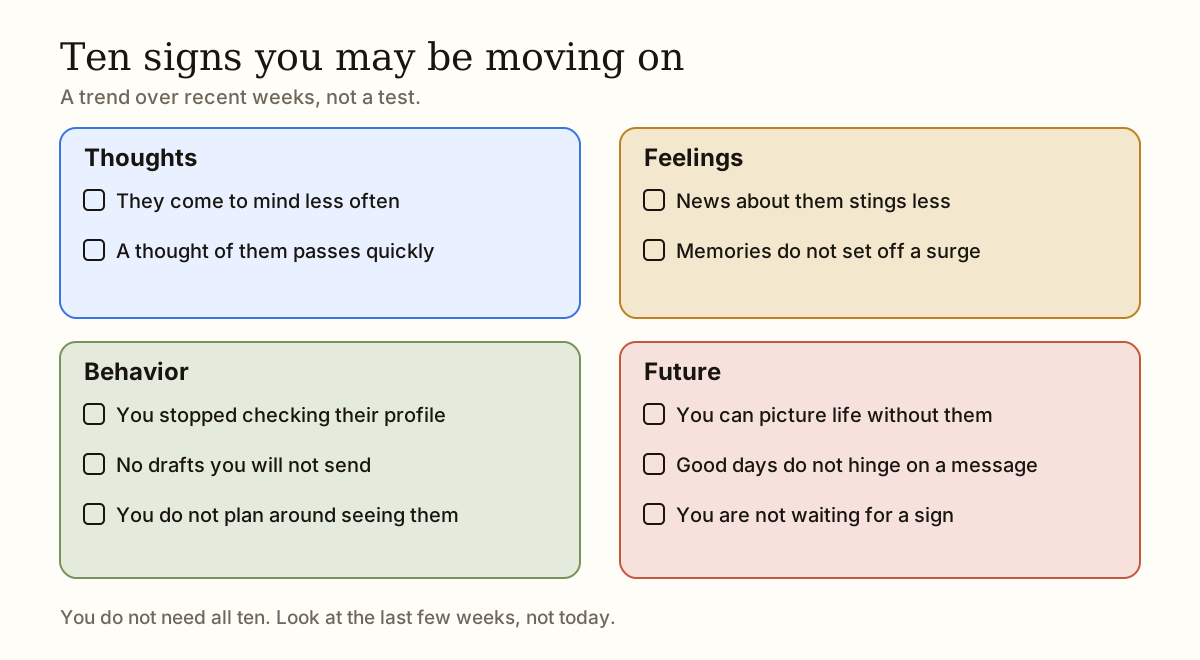
Behavior is the most trustworthy group, because feelings can lie in either direction. You may feel fine on a good week and bad on a tired one, but what you do on an ordinary evening is harder to fake.
- Thoughts: they come to mind less often than before, and a thought of them passes without you chasing it.
- Feelings: news about them stings less, and memories no longer set off a surge in your chest.
- Behavior: you have stopped checking their profile, you are not drafting messages you will not send, and you do not plan your week around possibly seeing them.
- Future: you can picture a future without them in it, your good days do not hinge on whether they reached out, and you are not waiting for a sign.
What are the signs you’re not over them yet?
The common ones are the mirror images: you check their profile “just once” several times a day, you reread old messages, you compare everyone you meet to them, you steer routes past their street, and a mention of their name raises your pulse. None of these is a character flaw. They are what attachment looks like while it is still working.
One sign deserves its own line: you still hope they will come back. Wanting them back is not shameful, and it is not a verdict. It means the story has not closed. It matters more as information than as judgment, and it is why people in this position often find how to stop loving someone useful.
Checking in particular is worth watching. A 2012 study of Facebook use after breakups found that monitoring an ex’s profile was associated with more distress and less personal growth (Marshall, 2012). It is correlational, so it does not prove that looking causes the distress, but it is a good reason to test whether you feel lighter when you stop. Our guide to stopping social media checking shows how.
Can you be over someone and still think about them?
Yes. Thoughts and charge are different things. You can think of an ex on a birthday, at a wedding, or when a song comes on, and feel a small tug, a half-smile, or nothing in particular. What changes is how long the thought lasts and whether you act on it.
The test is not whether they cross your mind. It is whether they steer you. After a thought, do you go on with your afternoon, or do you open their profile, open your messages, or lose an hour? If you go on with your afternoon, you are further along than the thought alone suggests.
This matters because people read a stray thought as a relapse and spiral, which makes the thought larger. Our guide to how to stop thinking about your ex is for the stretch where the thoughts are still frequent.
What if I’m still not over my ex after months?
Then you are in the large group of people who are not done yet, and months is not a deadline you have missed. There is no standard length. The question to ask is not “why am I still here?” but “am I trending?”
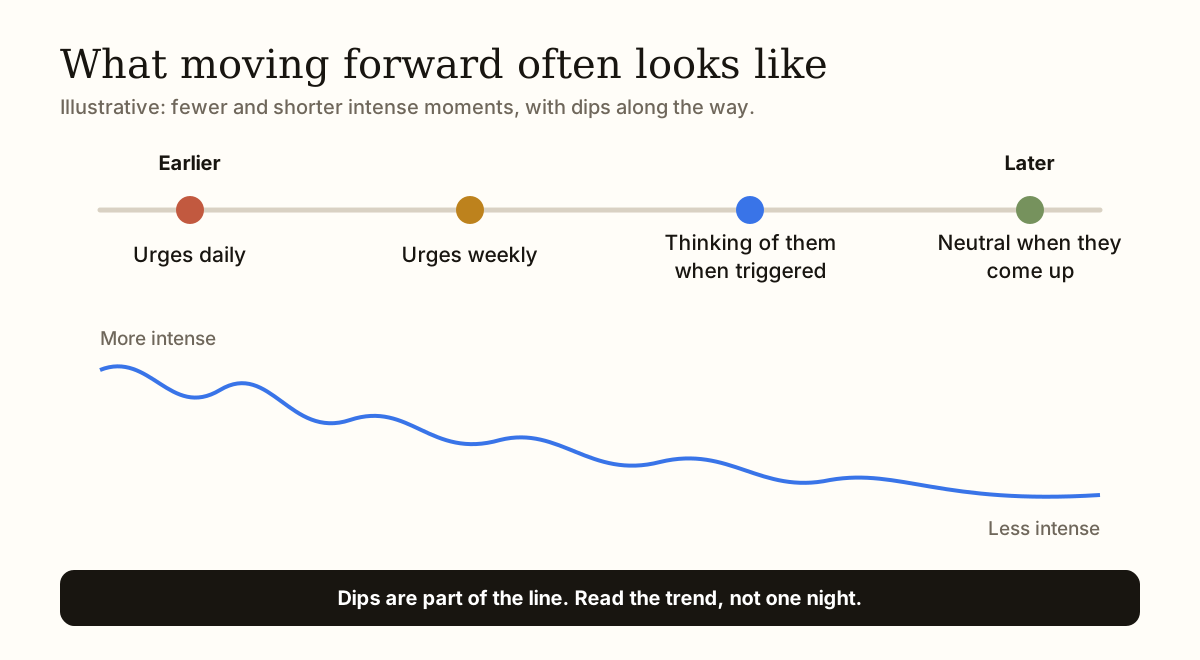
Progress tends to arrive as fewer intense moments, not as a single day when it ends. Predicting how you will feel is also unreliable. In a small study that followed college students for nine months through breakups, people’s predictions about their distress were off, with the error coming from misjudging how intense the distress would be at the start (Eastwick et al., 2008). It does not mean you will feel better by any date, but a forecast made on a bad night is weak evidence.
Example: three months in. It has been about twelve weeks. You no longer cry daily. You checked their profile once this week, down from every day. You have not drafted a message in ten days, but a friend mentioning their new job made your stomach drop. Is that going in circles? Probably not: fewer checks, longer gaps and a dip with a clear trigger is the trend. The dip is real, and the line is still heading the right way.
To tell the difference between moving forward and going in circles, compare weeks rather than days. Ask: are the intense moments less frequent, shorter, or easier to ride out than a month ago? If yes to any, you are moving. If every week looks the same, or worse, something in your routine is feeding it. That is often the checking, a shared account, contact that keeps restarting, or an on-off pattern that keeps resetting the clock. On-off couples report more uncertainty and lower relationship quality than other couples (Dailey et al., 2009).
How can I check in with myself?
Pick one day a week, answer the same few questions, and compare across weeks. The comparison is the point; a single week cannot tell you much.
Questions that work: How many times did I think about them this week, and for how long? Did I check them, and how many times? What happened the last time I felt a pang: did I act on it? How did I feel about news of them? What did I do with an empty evening?
Larson and Sbarra (2015) found that people who took part in a study that asked them structured questions about a breakup showed gains in self-concept clarity, which in turn was linked to less distress. You are not in that study, and a weekly check-in is not the same thing, but it suggests that looking at your recovery with some structure is worth the ten minutes. Our do I miss my ex quiz is a lighter version, and the Am I over my ex check asks about thoughts, feelings, behavior and future.
When should I get extra support?
Get support if you have been low most days for a few weeks, if sleep has fallen apart, if you have lost interest in things you usually enjoy, or if it is getting in the way of work or friendships. The NHS lists low mood, lost interest and disturbed sleep among the symptoms of depression and says to see a GP if they last most of the day, every day, for more than two weeks (NHS, clinical depression symptoms). Our guide to depression after a breakup explains the difference between grief and something more.
If you are in the US and thinking of harming yourself, call or text 988. In the UK and Ireland, Samaritans is on 116 123. In India, Tele-MANAS is 14416. If a past relationship involved fear, control or violence, in the US the National Domestic Violence Hotline is 1-800-799-7233 (text START to 88788), and the UnLink safety page lists more.
For the wider plan, the main guide is how to get over a breakup. Seeking help is not an admission that you are behind.
You do not have to solve the whole relationship tonight. Take one private step that creates space between the feeling and the action.
Take the Am I over my ex check →Common questions
Is there a test to see if you’re over your ex?
No test is definitive. A short check can help you notice patterns in your thoughts, feelings, behavior and plans, and it is more useful when you repeat it over several weeks. The Am I over my ex check on this site is built that way, and it is a prompt for reflection, not a verdict.
How long until I’m over my ex?
Nobody can give you a date, and any universal number is a guess. It depends on the relationship, how it ended, how much contact continues and what else is happening in your life. Track whether intense moments are getting fewer and shorter instead of counting days.
Does getting a new partner mean I’m over my ex?
Not necessarily. A new relationship can mean you are ready, or it can cover the feelings for a while. The better question is whether you are with the new person because you want to be, or to stop feeling the old pain.
Is it bad if I still want them back?
No. Wanting them back is common and does not mean you are failing. It is a sign the story is still open, and it is worth looking at what you miss: the person, the routine, or not being alone.
How do I know if I’m really over my ex or just pretending?
Look at behavior over a few weeks. If you are not checking, not drafting messages and not steering your plans around them, that is stronger evidence than how you say you feel. If you feel calm only when you stay busy and fall apart when things go quiet, you may be avoiding it, which is worth gentle attention rather than judgment.
What are the signs someone is over their ex?
You cannot reliably tell from outside. Posting, dating or silence all fit more than one explanation. This page is for reading your own signs, and chasing signs about another person tends to keep you attached.
Am I still in love with my ex or just missing them?
It can be both, and they are hard to tell apart. Missing usually points to a particular thing: company, routine, being known. Still being in love tends to show up as wanting this specific person even when you imagine them being hurtful or absent. Why do I miss my ex helps you sort it.
Should I tell my ex I’m over them?
Usually no. If you need to announce it, part of you is still talking to them. Being over someone rarely needs an audience. If there are practical matters, like shared money or children, handle those in a short, factual message.
Can I be over my ex but still not want to date?
Yes. Being over someone and being ready to date are separate. You can feel neutral about an ex and still want time alone, time with friends, or a break from romance. There is no rule that you must be over them before you date, or date once you are.
Is it normal to slip back into missing my ex after feeling over them?
Yes. Dips after a good stretch are common, often triggered by a date, a song or news. One bad night does not undo the weeks before it. Notice the trigger, wait it out, and look at the trend, not the dip.
If contact involves threats, stalking, coercion, shared children, housing or immediate safety, a general no-contact rule may not fit. Read the safety guidance and seek qualified local help where appropriate.
Sources and further help
- Eastwick et al. (2008) — Mispredicting distress following romantic breakup. Journal of Experimental Social Psychology
- Larson & Sbarra (2015) — Participating in research on romantic breakups promotes emotional recovery via changes in self-concept clarity. Social Psychological and Personality Science
- Marshall (2012) — Facebook surveillance of former romantic partners. Cyberpsychology, Behavior, and Social Networking
- Dailey et al. (2009) — On-again/off-again dating relationships: how are they different from other dating relationships? Personal Relationships
- NHS — Symptoms: clinical depression
- The National Domestic Violence Hotline — Plan for safety
- 988 Suicide & Crisis Lifeline
Research is cited to explain general patterns, not to diagnose or predict any individual outcome. Sources do not endorse UnLink. Read our editorial principles.
Keep this support one tap away.
UnLink is a free, private no-contact tracker for iPhone: count your days, get through urges and restart without losing your history.