Anxiety After a Breakup: A Calm-Down Plan and When to Get Help
Anxiety after a breakup is common. Use a three-step calm-down for the moment it spikes, learn panic vs worry, and see when to talk to a doctor.
 By the UnLink Editorial Team · General educational guidance, not therapy
To calm anxiety after a breakup, breathe out slowly for a few minutes, name five things you can see in the room, then put the fear into one sentence before you decide anything. Anxiety after a breakup is common and usually eases. Chest pain, fainting or thoughts of harming yourself need urgent help.
- Feeling on edge after a breakup is a common response to a big loss, not proof that something is wrong with you.
- A three-step reset works in the moment: slow breathing, five things you can see, and naming the thought before you act on it.
- Panic is body-led and usually passes within minutes. Worry is thought-led and about a specific future. They need different help.
- Checking your phone or your ex’s profile for relief tends to feed the anxiety. An if-then plan gives you something else to do.
- See a doctor if anxiety is affecting daily life or self-help is not working. Chest pain, fainting or thoughts of self-harm are emergencies.
Why does a breakup leave you feeling on edge all the time?
Because your alarm system has lost its main reference point. For months or years, one person was part of how you predicted your own days: who you would text, where you would be on Saturday, who would notice if you went quiet. When that goes, the brain keeps scanning for what comes next, and it scans in the body too. The racing heart in the supermarket queue, the stomach drop when your phone lights up, the 3 a.m. wake-up with a head full of “what if”.
There is also a pull toward the ex that behaves a lot like craving. Fisher and colleagues (2010) scanned people who had recently been rejected and were still in love. Looking at a photo of the ex lit up reward and motivation areas, the same system involved in wanting something you cannot have. That wanting can feel like anxiety from the inside: restless, urgent, unable to settle.
Anxiety on its own is not a disorder. The US National Institute of Mental Health describes feeling anxious as a normal part of life, and says an anxiety disorder is different because the anxiety does not go away, shows up across many situations and can get worse over time (NIMH). Most people reading this are somewhere on the normal side of that line, having a hard few weeks. The sections on getting help below tell you how to check.
If your main problem is a mind that will not stop replaying things, that is rumination, and how to stop thinking about your ex covers it. This guide is about the body and the spike. The wider plan is in the how to get over a breakup guide.
How do I calm down anxiety after a breakup?
Use three steps, in order, the moment the feeling spikes: slow your breathing, look around the room, then name the thought. It takes about five minutes and you can do it on a bus, in a bathroom or in bed with the lights off.
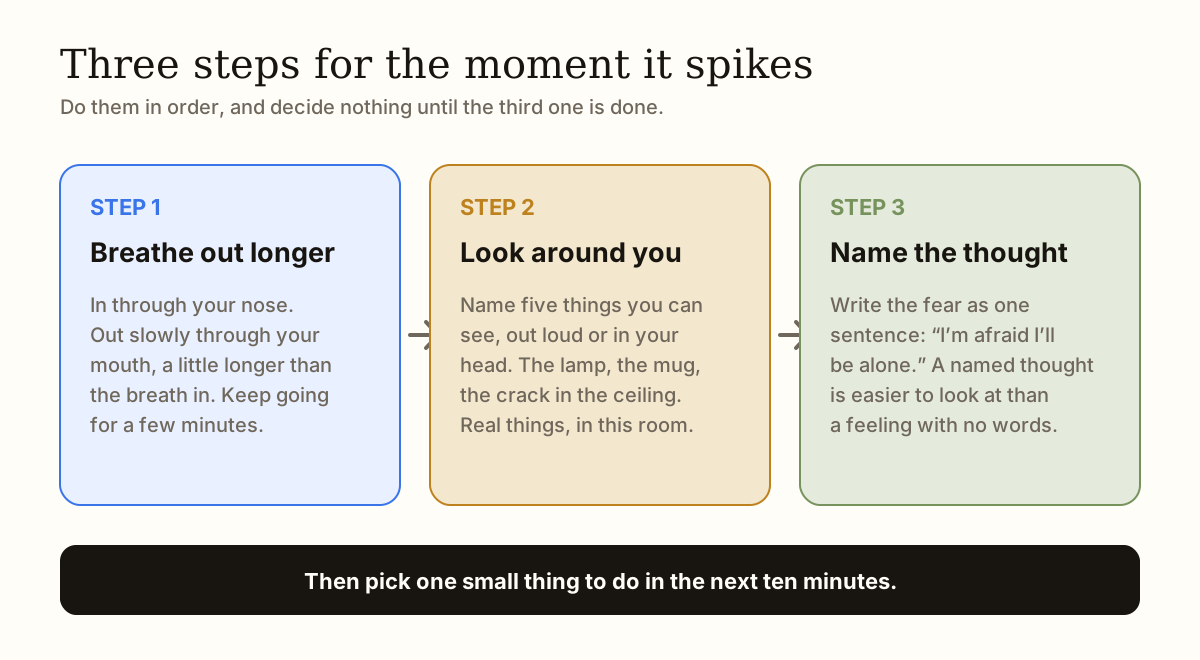
Do not decide anything while the spike is running. Not whether to text, not whether the relationship was a mistake, not whether you will ever be okay. Those questions are better answered once your body has come down a notch, and the steps below get you there.
- Breathe out longer than you breathe in. Breathe in through your nose and out slowly through your mouth, with the out-breath a little longer. If a longer exhale feels strange, the NHS version simply counts evenly, in for five and out for five, and suggests keeping it up for at least five minutes (NHS, breathing exercises for stress). Either works. What matters is slow and steady.
- Name five things you can see. The mug, the charger cable, the water stain on the ceiling, your own knees, a car outside. Say them out loud if you can. This is a grounding step: it pulls attention from the imagined future back to the room you are actually in.
- Name the thought. Finish the sentence “Right now I am afraid that…” in one line. “I’ll be alone forever.” “They’ve already replaced me.” “I made a mistake.” A fear in words can be examined. A fear with no words just spreads through the body.
- Pick one small thing for the next ten minutes. Drink a glass of water, step outside, text a friend who is not your ex, wash your face. Small and physical beats clever.
What is the difference between panic and worry after a breakup?
Panic is a sudden wave led by the body. Worry is a longer stretch led by thoughts about a particular future. After a breakup people often have both in the same evening, and telling them apart tells you which tool to reach for.
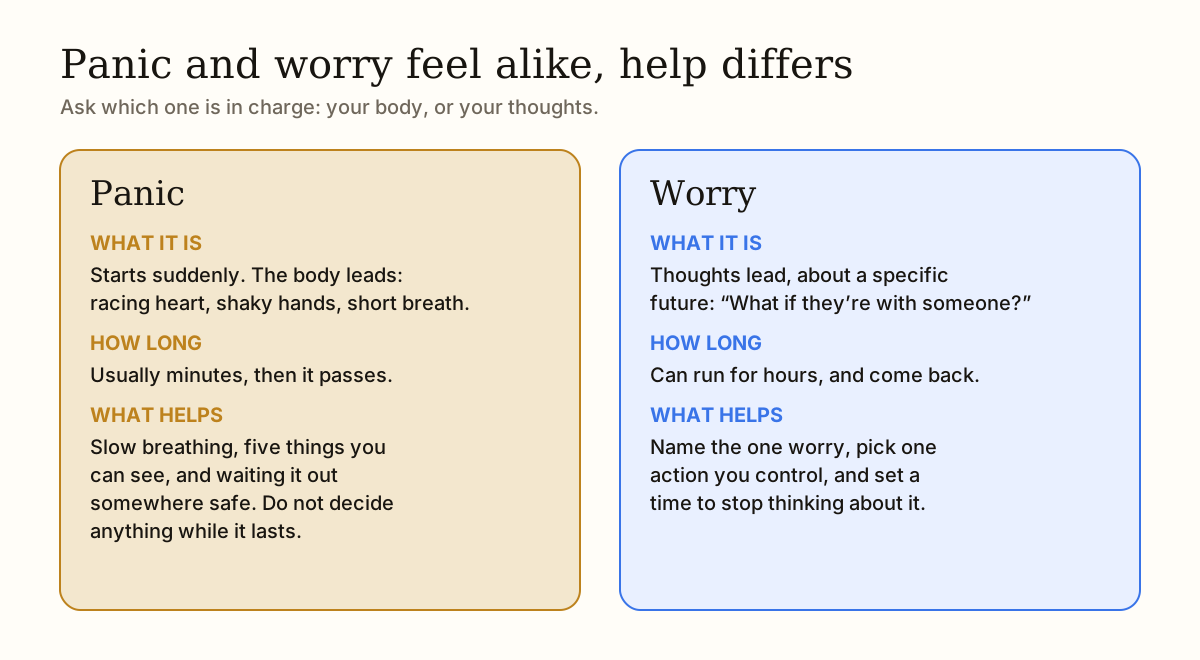
On panic, the NHS says that most panic attacks last between 5 and 20 minutes, and that although they are frightening they are not dangerous in themselves (NHS, panic disorder). That is worth holding onto in the middle of one. The feeling is real and awful, and it is also not a sign that something is physically failing.
Worry does not usually crest and fall like that. It circles. “What if they’re with someone already?” “What if I never feel normal?” It borrows trouble from a future that has not happened, and it often wants you to do something to feel safe: check, ask, text, search.
| Panic | Worry | |
|---|---|---|
| How it starts | Suddenly, often with no clear trigger | Gradually, usually after a trigger such as a notification, a song or a story |
| What you notice in your body | Racing heart, shaking, short breath, dizziness, a sense of dread | Tight shoulders, a knot in the stomach, restlessness, poor sleep |
| What your thoughts do | Go blank or catastrophic: “something is wrong with me” | Loop around a specific future: “what if they’re with someone?” |
| How long it lasts | Usually 5 to 20 minutes (NHS) | Hours, and it can return daily |
| What it wants you to do | Escape, get out, call someone, check you are okay | Check, ask, search, text for reassurance |
| What helps | Slow breathing, grounding, waiting it out somewhere safe | Naming the worry, one action, a set time to stop |
| When to get help | Attacks keep coming, you start avoiding places, or chest pain is new | It runs most days and affects work, sleep or relationships |
What should I do during a panic attack after a breakup?
Stay where you are if it is safe, slow your breathing and tell yourself the plain facts: this is a panic attack, it is horrible, and it will pass. You do not have to fight it. Trying to force the feeling away tends to add a second layer of fear on top of the first.
Sit down. Put your feet flat on the floor and notice the floor holding you up. Run the five-things step. If you are with someone, ask them to stay and say very little. If you are not, text a friend one line: “Having a panic moment, can you stay on text with me for ten minutes?” Not your ex, even if their name is the first one your thumb finds.
Afterwards you will feel wrung out, so drink water and go easy on the evening. If attacks keep coming, or you start avoiding places for fear of another, talk to a doctor. Nobody can promise panic stops by itself, and help works better than white-knuckling it.
If you have chest pain and you are not sure what it is, do not assume it is panic. The section on emergencies at the end says what to do.
How do I turn vague dread into one specific worry?
Use a short “what if” worksheet. Vague dread is exhausting because it has no edges, and you cannot act on something with no edges. The worksheet gives it some.
Example: it is Tuesday night and the feeling is “everything is going wrong”. You write the first line and keep going until the dread has a shape.
- The feeling: “I feel sick and I can’t stop going through it.”
- The specific what-if: “What if they’ve already started seeing someone and I find out from a mutual friend?”
- Is this happening now, or imagined? Imagined. Nothing has happened tonight.
- What is the part I control? Whether I see their name on my feed tomorrow. Whether I tell my friends I do not want updates.
- My one action: mute them, send my friend one line (“please don’t tell me anything about them for now”), then stop.
- When I will think about this again: Thursday, ten minutes, after work. Not tonight.
How do I stop checking my phone when I am anxious about my ex?
Checking feels like relief and works like fuel. You look at their profile to settle the dread, you get a few seconds of calm or a fresh sting, and the brain files “looking made me feel something” under things to repeat. Next time the dread spikes, the urge to look is stronger.
A 2012 study of Facebook use after breakups (Marshall) found that people who monitored an ex’s page reported more distress and less personal growth. It is an association, not proof of cause, but it matches what most people notice: the check never ends the worry. For a practical way out, see how to stop checking your ex’s social media.
Two tools help more than willpower. First, urge surfing: noticing the urge, naming it and letting it rise and fall without acting. In a 2009 study of smokers (Bowen and Marlatt), urges did not shrink, but people who practised surfing them smoked less. That is a different problem, so treat it as a hint, not a promise. Second, an if-then plan (Gollwitzer, 1999), which decides in advance what you will do when a trigger hits.
Example: “If my phone buzzes and it might be them, then I put it face down and do the five-things step before I look.” Or: “If I want to open their profile, then I stand up and fill a glass of water first.” Write two of your own. For ideas on the something-else part, see what to do instead of texting your ex, and if you keep reaching for the phone anyway, how to block yourself from texting someone adds friction.
If the urge is to reassure yourself by texting them, the free 90-second reset is built for that moment.
What daily habits lower background anxiety?
Boring ones, done every day, work better than clever ones done once. You are trying to lower the baseline so the spikes start from a lower place.
- Anchor your sleep. Get up at roughly the same time even after a bad night. If nights are the hardest part, can’t sleep after a breakup has a night-time plan.
- Move your body most days. A twenty-minute walk counts. Pick the route that does not pass their street.
- Watch what you add. If coffee or a few drinks in the evening leave you jittery the next morning, notice that and adjust. Alcohol can feel like relief and then make 3 a.m. worse for many people.
- Put one person in your day. A call, a coffee, a walk with a friend. You do not have to talk about the breakup.
- Keep a worry window. Ten minutes, same time daily, for the what-if worksheet. The rest of the day, a worry gets “Thursday at six”.
When should I talk to a doctor or therapist about breakup anxiety?
Talk to someone if anxiety is getting in the way of daily life, or if what you are doing on your own is not working. The NHS gives the same threshold: if anxiety affects your life and self-help is not working, see a GP, and adults in England can refer themselves to NHS talking therapies without one (NHS, anxiety, fear and panic). In the US, start with a primary care doctor or your insurer’s list of therapists. The NIMH page on anxiety disorders points to SAMHSA’s treatment locator.
You do not need to be sure it is “bad enough”. Wanting help is enough reason.
Whether it counts as a mental illness is for a clinician to judge, not a web page and not you at 2 a.m. They will ask about your symptoms, your history and how long this has gone on. “A reaction to a major loss” and “you would benefit from treatment” are both ordinary answers.
- It has been most days for several weeks and is not easing.
- You are missing work, class or sleep because of it.
- You are avoiding places, people or your phone out of fear.
- Panic attacks keep coming back, or you dread the next one.
- You are drinking more, or using something else, to get through the evening.
- You already had anxiety or low mood before the breakup and it has flared.
When is breakup anxiety an emergency?
Call emergency services for chest pain you cannot explain, trouble breathing, fainting, or if you think you may have harmed yourself. Panic can cause chest pain, but a panic attack and a heart problem can feel alike, so do not try to work out which it is on your own. In the US, call 911. In the UK, call 999.
If you are having thoughts of harming yourself or ending your life, reach out now. Call or text 988 in the US. In the UK and Ireland, Samaritans is free on 116 123. In India, Tele-MANAS is 14416. These lines are open to anyone, including people who are not sure they are “bad enough”. There is more on the UnLink safety page.
If your anxiety involves fear of your ex, because they have threatened you, follow you, or you do not feel safe, that is a safety question before it is an anxiety question. The US National Domestic Violence Hotline is 1-800-799-7233 (text START to 88788).
For the low mood that can travel with anxiety, see depression after a breakup. For the body side, physical symptoms of heartbreak. And if you come back to this at 1 a.m. because the dread is up again, start at the three steps and let the rest wait until morning.
Step-by-step plan
- Breathe out a little longer than you breathe in
In through your nose, out slowly through your mouth. Keep going for a few minutes.
- Name five things you can see
Look around the room and name them, out loud if you can. This brings your attention back to now.
- Name the thought
Finish the sentence “Right now I am afraid that…” in one line. Do not decide anything yet.
- Pick one small thing for the next ten minutes
Drink water, step outside, or text a friend who is not your ex.
You do not have to solve the whole relationship tonight. Take one private step that creates space between the feeling and the action.
Try the 90-second Don’t Text reset →Common questions
Is anxiety normal after a breakup?
Yes. A breakup removes a person, a routine and a future you were counting on, and feeling on edge is a common response. It becomes something to get help with when it is most days, lasts weeks and affects your sleep, work or relationships.
How long does breakup anxiety last?
There is no reliable number. For many people the sharpest anxiety eases over a few weeks, but long relationships, shared homes or children, a sudden ending and earlier anxiety can all stretch it out. If it is not easing, or it is getting in the way of daily life, talk to a doctor.
Why do I feel anxious all the time since my breakup?
Your daily structure, your support person and your picture of the future all changed at once, and the brain keeps scanning for what is next. Contact with the ex, checking their profile and poor sleep keep that alarm switched on. Calming the body and reducing checks usually lowers the baseline.
What is a good calm-down technique after a breakup?
Breathe out slowly for a few minutes, name five things you can see, then put the fear into one sentence. It is simple enough to do when you are overwhelmed, and it gives you a pause before you act. Afterwards, do one small physical thing, such as drinking water or stepping outside.
How do I stop my heart racing when I think about my ex?
Slow your breathing, with a long out-breath, and ground yourself by naming five things you can see. A racing heart is a normal part of the body’s alarm response and usually settles within minutes. If it comes with chest pain, fainting or trouble breathing, seek urgent medical help.
Can breakup stress cause physical symptoms?
Yes. Anxiety can cause a faster or irregular heartbeat, dizziness, headaches, sweating, breathlessness and shaking, according to the NHS. Breakups also disrupt sleep and appetite, which makes the body feel worse. New or unexplained chest pain should be checked, not assumed to be stress.
Is breakup anxiety a mental illness?
Not on its own. Feeling anxious after a major loss is a normal reaction. A clinician can tell you whether what you are experiencing has gone beyond that, which is usually judged by how long it lasts and how much it interferes with your life. This page cannot diagnose you.
Is it normal to feel anxious every time my phone buzzes?
Yes, and it is common after a breakup because a buzz used to mean the person you were close to. The brain still treats it as important. Muting notifications from their name, turning off previews, or keeping the phone out of reach in the evening can all turn the volume down.
Does breakup anxiety get worse at night?
Often, yes. At night there are fewer distractions, you are tired, and the brain replays the day. A wind-down routine, a worry window earlier in the evening and keeping the phone away from the bed help. The sleep guide on this site has a fuller plan.
When should I see a doctor about anxiety after a breakup?
See a doctor if anxiety affects your daily life, if panic attacks keep returning, or if self-help is not working. Chest pain, fainting or thoughts of harming yourself need urgent help. In the US, call or text 988.
If contact involves threats, stalking, coercion, shared children, housing or immediate safety, a general no-contact rule may not fit. Read the safety guidance and seek qualified local help where appropriate.
Sources and further help
- NHS: Panic disorder (panic attacks usually last 5 to 20 minutes and are not dangerous)
- NHS: Anxiety, fear and panic (physical symptoms; when to see a GP)
- NHS: Breathing exercises for stress
- NIMH: Anxiety disorders
- Fisher et al. (2010). Reward, addiction, and emotion regulation systems associated with rejection in love
- Marshall (2012). Facebook surveillance of former romantic partners
- Bowen & Marlatt (2009). Surfing the urge: brief mindfulness-based intervention for college student smokers
- Gollwitzer (1999). Implementation intentions: strong effects of simple plans
- 988 Suicide & Crisis Lifeline
- National Domestic Violence Hotline — safety planning
Research is cited to explain general patterns, not to diagnose or predict any individual outcome. Sources do not endorse UnLink. Read our editorial principles.
Keep this support one tap away.
UnLink is a free, private no-contact tracker for iPhone: count your days, get through urges and restart without losing your history.