How to Get Over Someone You Never Dated
How to get over someone you never dated: why it hurts, a facts-vs-fantasy table, a fantasy inventory, a one-month stop list and scripts for friends.
 By the UnLink Editorial Team · General educational guidance, not therapy
To get over someone you never dated, treat the loss as real, then stop feeding the story. Sort what actually happened from what you imagined, stop the checking and rehearsing for a month, and put your attention into plans of your own. You are grieving a hoped-for future, and that is allowed to hurt.
- The pain is real even though nothing officially ended. You are losing a future you pictured, and the brain does not check whether there was a relationship before it hurts.
- Most of the attachment is usually built from imagination filling gaps, so the fastest progress comes from separating what happened from what you made up.
- A one-month stop list (checking, rehearsing messages, asking mutual friends, replaying old moments) does the work a breakup would normally do for you.
- Confessing your feelings to get closure is a choice with a real cost. Make it for its own sake, not as a way to stop hurting.
- If the thoughts take over your days for months, or you feel pulled to turn up where they are, talk to a professional.
Why does it hurt so much when there was no relationship?
Because the part of you that attaches never needed a label. A few good conversations, a look across a room, a run of messages that made your day: that is enough for hope to move in, and hope is what you are now losing.
Two things make it sting more than people expect. First, uncertainty. When someone is warm on Tuesday and quiet until the following Sunday, you spend the gap guessing, and the guessing keeps them on your mind harder than steady contact would. Second, nobody gave you an ending. A breakup is a clear event that your friends recognize. Here there is no event, so there is no casserole, no "I’m sorry" text, and a lot of room for the story to keep running.
Rejection itself is a physical event for the brain. A small fMRI study of people who had been rejected in love found activity in reward and craving-related regions when they looked at photos of the person (Fisher et al., 2010). It was done with people who had been in relationships, so it does not map exactly onto a crush, but it explains why wanting someone who is out of reach can feel like withdrawal.
So the answer to "is this too much for someone I barely knew?" is no. What you feel is proportionate to what you invested, and you invested hope. The rest of this page is about getting that hope back.
How to get over someone you never dated, step by step
Do three things in this order: name what is true, stop supplying the story, then rebuild. The order matters because the stop list is much easier once you have seen how little of the picture is evidence.
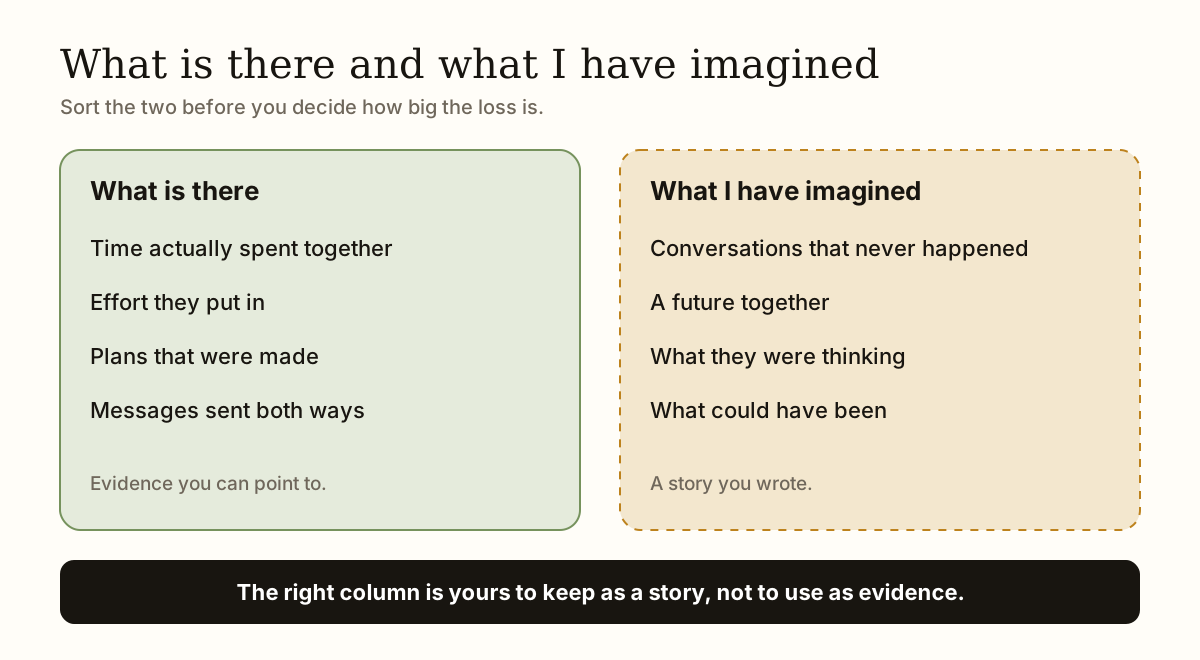
Start with the facts. The table below is a short audit. Answer each row for your own situation, then read the right-hand column for what it means for letting go.
| What to check | What the facts might show | What it means for letting go |
|---|---|---|
| Contact frequency | Daily messages for two weeks, or three conversations in six months, or one night out. | Steady contact leaves habits to unwind (the morning message, the shared jokes). Rare contact leaves a bigger imagined share. Both are real; they need different work. |
| Shared plans | Plans actually made and kept, versus “we should do that sometime.” | Kept plans are memories you can grieve. Vague plans are mostly hope, so the work is letting go of a future, not a past. |
| Reciprocal messaging | Who started conversations, who replied quickly, who asked questions. | Lopsided effort is information. It does not make you foolish, and it tells you which half of the story is yours. |
| Mutual interest you can confirm | Something they said or did that is hard to explain any other way, such as asking you out, or telling you they like you. | If it is clear and mutual, you have a loss to mourn. If it is one ambiguous moment, you are mourning what you hoped it meant. |
| What I have imagined | Their inner thoughts, a future, conversations that never happened. | This is the biggest share, and it is the part you can change by working on it directly. |
Why can’t I stop thinking about someone I only liked?
Usually because the thoughts are doing a job: they are keeping a door open. Each replay, each imagined reply, each "what if I had said" is a small bet that it is not over. The mind does not like to close a question when the answer is unknown.
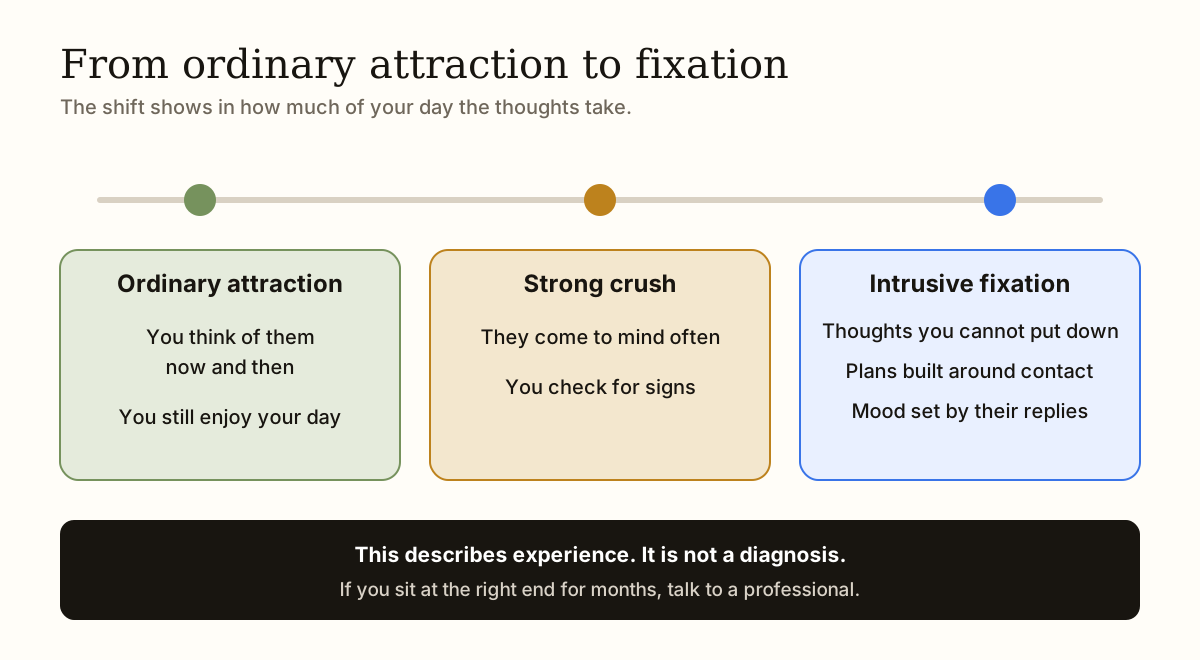
Sometimes it goes beyond ordinary attraction. Limerence is a descriptive term for an intense, often obsessive attachment to one person that depends on their response, coined by the psychologist Dorothy Tennov. It is not a diagnosis, and the research is young. A 2025 paper presented what it called the first published measure of limerence, tested with people who said they had experienced it (Marshall et al., 2025). One 2021 case report described a person with limerence whose rituals and unhelpful thoughts fell after a treatment adapted from OCD care (Wyant, 2021). That is one person, so it shows what a therapist might try, not that it works for everyone.
You do not need the label to use the idea. The shift from ordinary attraction to something more consuming is usually visible in how much of your day it takes. Our full comparison is in limerence vs love; here is the short version on a scale.
What should I do if I keep fantasizing about them?
Write the fantasy down, then sort it. Pulling it out of your head and onto a page makes it something you can look at, instead of something that plays on a loop at 11 p.m. Writing about emotional experiences has a long research record: in Pennebaker’s 1997 paper, people who wrote about upsetting experiences tended to show better health outcomes later. It is not a cure, but it is a reasonable first move.
The fantasy inventory takes about twenty minutes. List everything you have imagined: the date, the apartment, the version of them who finally says it, the apology, the argument you win. Then mark each line with one of three letters.
- W for wish. Something you want for your life, regardless of this person (to be chosen, to be known, to have someone to go to the market with).
- F for fear. Something you are bracing for (they will date someone else, you will never feel this again, you misread everything).
- S for story I made up. Something with no evidence behind it, such as what they thought when they looked at you.
| What I imagined | Letter | What to do with it |
|---|---|---|
| They finally say they have felt the same way for months. | S | Name it as a story. Nothing they have said supports a months-long feeling. |
| Nobody will ever make me feel this way again. | F | Notice the forecast. In a small study that followed college students through breakups, predictions of distress missed the mark (Eastwick et al., 2008), so a forecast made at your lowest is shaky evidence. |
| I want someone who notices when I’m quiet. | W | Keep it. This is yours, and it is a better guide to who to look for than this particular person. |
How do I stop checking their social media and cut back contact?
Run a one-month stop list, and treat it like a no-contact period even though there is no relationship to leave. There is no formal ending, so you have to write one yourself.
Checking is the habit that does the most damage. A 2012 study of Facebook use after breakups found that monitoring an ex was associated with more distress and less personal growth (Marshall, 2012). It was about exes and it is correlational, but the pattern fits crushes too: every look is a small hit of information and hope. Our guide to stopping social media checking covers mute versus block in detail, and it applies directly here.
For the urge to message ("just checking in", a meme, a reply to their story), how to stop texting someone covers it for people who were never exes.
If you cannot avoid them (a coworker, a flatmate, the same friend group), move to a lower-contact version: reply to work matters in one line, skip the optional drinks for now, do not volunteer personal updates, and keep your phone in a bag during shared meetings. The aim is to give the story less fuel, not to pretend they do not exist.
- Stop checking their profile, stories, last-seen status and tagged photos (mute them; do not stay logged in to look).
- Stop rehearsing messages you will never send. If the draft will not leave your head, put it in a note and close the note.
- Stop asking mutual friends about them, and ask friends not to volunteer news.
- Stop replaying old moments on demand. If one comes up, label it ("that’s the story again") and move your body: stand up, walk, wash a dish.
Should I tell them how I feel to get closure?
Only if you want to tell them for its own sake, and are ready for any answer including silence. Telling someone you like them is a legitimate thing to do. Telling them in order to stop hurting is a gamble with a bad payoff: if they say no, you have a new rejection to process, and if they say "maybe", you are back in the loop.
If you honestly want them to know, choose a single clear message, one time, in writing, with no demand for a reply. Example: "I’ve developed feelings for you and I wanted to be honest. I don’t expect anything back. I’m going to take some space." Then take the space. If they have already told you they are not interested, or asked you to stop contacting them, the answer is no, and the safety note below applies.
If you mainly want closure, you can build it without them. Write the message you would send in full, read it once, and put it away. Our guide to how to write an unsent letter shows how, and no contact after a situationship covers ending things on your own terms when nobody else will.
What do I say to a friend who thinks my feelings are silly?
Say one sentence, set the limit, and change the subject. You do not owe anyone a defense of your grief, and the argument "but you were never together" is one you will lose in your own head if you take it on.
Scripts you can use as written, for a friend or for yourself in the mirror:
- "I know we were never official. It still hurts, and I’d rather you just listen."
- "I’m not asking you to agree it makes sense. I’m asking you not to joke about it for a few weeks."
- "I’m taking a month off checking them. Can you help by not mentioning them unless I ask?"
- To yourself: "I’m allowed to be sad about a future I had pictured. It doesn’t have to be proportionate to be real."
When are the feelings a reason to talk to someone?
Talk to a professional if the thoughts keep taking over your days for months, if they get in the way of work, sleep or other relationships, or if you are low most days. Intrusive thoughts that return again and again and affect daily life are a reason to see a doctor or therapist; the NHS says this about obsessions in general, and it applies here whatever the cause. You do not have to have a diagnosis to ask.
There is one situation where this stops being about recovery and becomes about safety. If the person has told you to stop contacting them, or you feel pulled to show up at their home or workplace, do not go. Stop all contact and tell a friend or a professional about the urge today. Our safety page lists what to do.
If you are in the US and feeling hopeless or thinking of harming yourself, call or text 988. In the UK and Ireland, Samaritans is on 116 123. In India, Tele-MANAS is 14416. If your situation involves fear of someone, in the US the National Domestic Violence Hotline is 1-800-799-7233 (text START to 88788).
How do I rebuild my attention and plans?
Put dated plans where the daydreams were. Hours that used to go to checking and imagining need to be spoken for, or they refill with the same material.
Plans work better when they are specific and attached to a trigger, not a vague intention. Gollwitzer’s 1999 review reported that if-then plans help people follow through. Example: If it’s 9 p.m. and I reach for my phone to look at their profile, then I’ll text a friend a photo of whatever is in front of me.
Then widen the pool of people who matter to you. A crush on someone who did not reciprocate is partly a wish to be chosen, and that wish is better met by friends, family, a class, a team or a standing weekly thing than by waiting for one person. If you want to date again, you can, and the order is up to you: there is no rule that says the feelings must be fully gone first.
For the wider recovery plan, see how to get over a breakup. For the "will I ever stop?" question, how to stop loving someone sets out what tends to fade and what does not.
Step-by-step plan
- Name what is true
Fill in the facts audit: contact frequency, shared plans, who put in effort, anything mutual you can confirm. Write the rest down as imagined.
- Run a one-month stop list
Stop checking their profile, rehearsing messages, asking mutual friends about them and replaying old moments on demand. Mute rather than stay logged in to look.
- Sort the fantasy
Write down what you have imagined and mark each line as a wish, a fear or a story you made up. Keep the wishes for your own life.
- Replace the hours
Make dated plans with other people and write one if-then plan for your hardest time of day.
- Check in after a month
If the thoughts still take over most days, talk to a doctor or therapist. If someone has asked you to stop contacting them, do not contact them.
You do not have to solve the whole relationship tonight. Take one private step that creates space between the feeling and the action.
Take the limerence quiz →Common questions
Is it normal to grieve someone who was never my boyfriend or girlfriend?
Yes. Grief follows what you hoped for, not what you had on paper. You can mourn a future, a version of yourself, or the possibility. It is less recognized than a breakup, which is part of why it can feel lonelier.
How long does it take to get over a crush?
There is no reliable number. It depends on how much contact you had, how long the hope stayed alive and how much you keep feeding it. People tend to move faster once checking stops and the fantasy has been written down. If it has been months and it still takes over your days, consider talking to a professional.
Can you get over someone without any closure?
Yes. Closure is something you can build yourself, by deciding what happened, naming what you wanted, and writing the unsent version of the conversation. Waiting for them to supply it keeps the story open.
Is it weird to be this upset about someone I never dated?
No. How upset you are tracks how much hope you invested, not how many dates you had. Strong feelings after limited contact are common, especially when contact was warm but uncertain.
Is it okay to feel heartbroken over a crush who never knew how I felt?
Yes. Unspoken feelings can still hurt, sometimes more because there was nowhere to put them. Writing the message you would have sent, and not sending it, gives the feeling somewhere to go.
Can you get over a crush who is already dating someone else?
Yes, and having a clear no can make the stop list easier, because there is less uncertainty to feed on. Expect a dip when you hear the news. Mute them, keep your plans and give it time.
Is it normal to daydream about someone I barely know?
Yes. When there is little information, the mind fills the gaps with what it wants. The daydreams become a problem when they crowd out your day or you begin to treat them as evidence. The fantasy inventory above is built for that.
What is limerence, and does it apply to unrequited crushes?
Limerence is a descriptive term for an intense, often obsessive attachment to one person, coined by Dorothy Tennov. It can apply to unrequited crushes, and it is not a diagnosis. Use the word as a question about your experience, and see a professional if it takes over your life.
How do I know if it is a crush or limerence?
A crush tends to leave room for the rest of your life. Limerence tends not to: thoughts intrude, your mood depends on their replies, and you plan around possible contact. The line is blurry, and the quiz on this site can help you see where you sit.
If contact involves threats, stalking, coercion, shared children, housing or immediate safety, a general no-contact rule may not fit. Read the safety guidance and seek qualified local help where appropriate.
Sources and further help
- Fisher et al. (2010) — Reward, addiction, and emotion regulation systems associated with rejection in love. Journal of Neurophysiology
- Marshall et al. (2025) — Development and validation of the Limerence Questionnaire (LQ-11). Psychological Reports
- Wyant (2021) — Treatment of limerence using a cognitive behavioral approach: a case study. Journal of Patient Experience
- Marshall (2012) — Facebook surveillance of former romantic partners. Cyberpsychology, Behavior, and Social Networking
- Pennebaker (1997) — Writing about emotional experiences as a therapeutic process. Psychological Science
- Gollwitzer (1999) — Implementation intentions: strong effects of simple plans. American Psychologist
- Eastwick et al. (2008) — Mispredicting distress following romantic breakup. Journal of Experimental Social Psychology
- NHS — Obsessive compulsive disorder (OCD): overview
- The National Domestic Violence Hotline — Plan for safety
- 988 Suicide & Crisis Lifeline
Research is cited to explain general patterns, not to diagnose or predict any individual outcome. Sources do not endorse UnLink. Read our editorial principles.
Keep this support one tap away.
UnLink is a free, private no-contact tracker for iPhone: count your days, get through urges and restart without losing your history.