Self-Care After a Breakup: A Realistic Daily Plan
Self care after a breakup that works on bad days: a five-item minimum day, a four-week ladder, sleep and food basics, scripts for friends, and when to get help.
 By the UnLink Editorial Team · General educational guidance, not therapy
The best self care after a breakup is keeping five basics steady every day: a set sleep window, one meal with protein, ten minutes of movement, one contact with someone who is not your ex, and one small win. Each has a bad-day version that still counts. Treats are fine, but they do not replace the basics.
- Self-care after a breakup means keeping the basics steady, not treating yourself. Sleep, food, movement and people come first.
- A minimum day has five items, and each one has a bad-day version that still counts. The small version beats skipping the lot.
- Raise the floor slowly. Commit to two items in week one and add one a week, instead of rebuilding your life in your worst month.
- A treat turns into avoidance when it replaces the basics or becomes the only thing you do.
- If low mood, poor sleep or lost appetite fill most of every day for more than two weeks, see a doctor. If you have thoughts of not wanting to be alive, call or text 988 in the US.
What is self-care after a breakup, really?
Self-care after a breakup is keeping your basics steady while everything else is shaky: sleep, food, movement, people, and one small thing that moves your life forward. It is less glamorous than a bubble bath and works a lot better.
Friends mean well when they say “treat yourself”. But if you are lying in bed at 2 p.m. with a cold cup of tea, a face mask is not the missing piece. A realistic plan starts lower and asks what the least is that you can do today and still count it.
This page builds that floor, one week at a time. For the whole recovery arc, start with our guide to getting over a breakup. This is only the daily body-and-people layer underneath it.
Why do the basics slip first after a breakup?
Because a breakup hits your stress system and your routine in the same week. Recalling a painful rejection engages brain regions that also process physical pain (Kross and colleagues, 2011), and sleep and appetite are usually the first things to go when your system is overloaded. The NHS lists disturbed sleep and a change in appetite among the physical symptoms of depression, so both track your mood closely.
The relationship also held your schedule in place. The morning text, the dinner you cooked for two, the Sunday phone call. When those vanish and nothing replaces them, the day loses its edges. You did not stop caring about yourself. The scaffolding came down.
The basics also feed each other. Four hours of sleep and no breakfast make everything harder, including the 11 p.m. urge to look at their story.
Self care after a breakup: a daily plan that works on bad days
Aim for five things a day, and know the smaller version of each. Together they make a minimum day, the floor you stand on when nothing else works. If you only manage the bad-day versions, it was still a good-enough day.
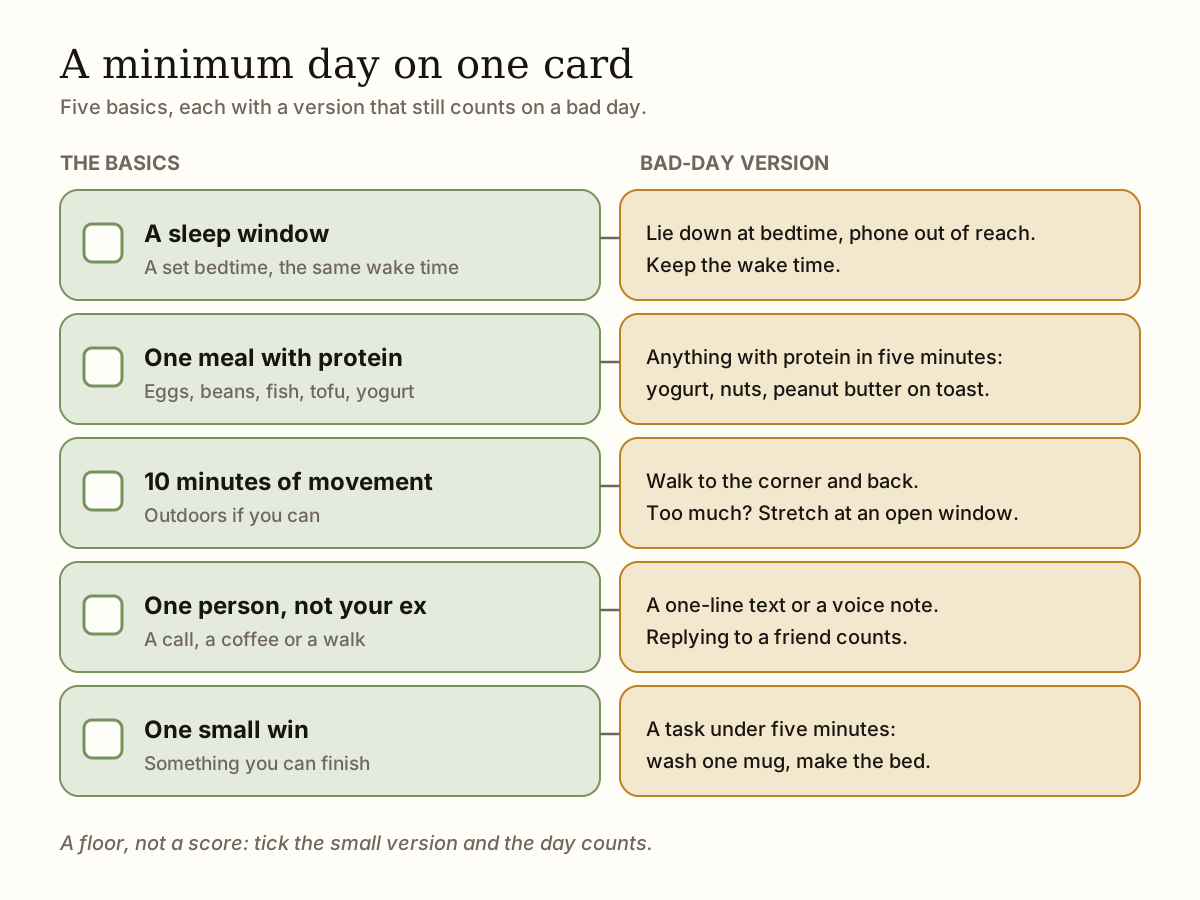
Attach each item to a cue, not to willpower. Gollwitzer’s 1999 review of if-then planning found that tying an action to a specific trigger helps people follow through. “If it’s 10:30 p.m., my phone charges in the hall.” “If I finish my coffee, I put on shoes.” On a day with no motivation, a cue still works.
The card is meant to be imperfect. Miss an item and nothing resets.
| Basic | Full version | Bad-day version |
|---|---|---|
| Sleep window | In bed at a set time, up at the same time every morning | Lie down at the set time with your phone out of reach, and still get up at the usual hour |
| One meal with protein | A proper meal: eggs, beans, fish, tofu, chicken or yogurt | Anything with protein you can eat in five minutes: yogurt, nuts, peanut butter on toast |
| 10 minutes of movement | A walk outdoors, or anything that gets you breathing faster | Walk to the corner and back, or stretch at an open window |
| One person who is not your ex | A call, a coffee or a walk | A one-line text or a voice note. Replying to a friend counts |
| One small win | A task you can finish and see: laundry, a bill, an email | A task under five minutes: wash one mug, make the bed |
What is a good daily routine after a breakup? A four-week ladder
Start with two items and add one a week. In week one, commit to the sleep window and one meal. Week two adds movement, week three adds a person, and week four adds a small win. By then the card is your whole floor, and you built it in steps instead of all at once.
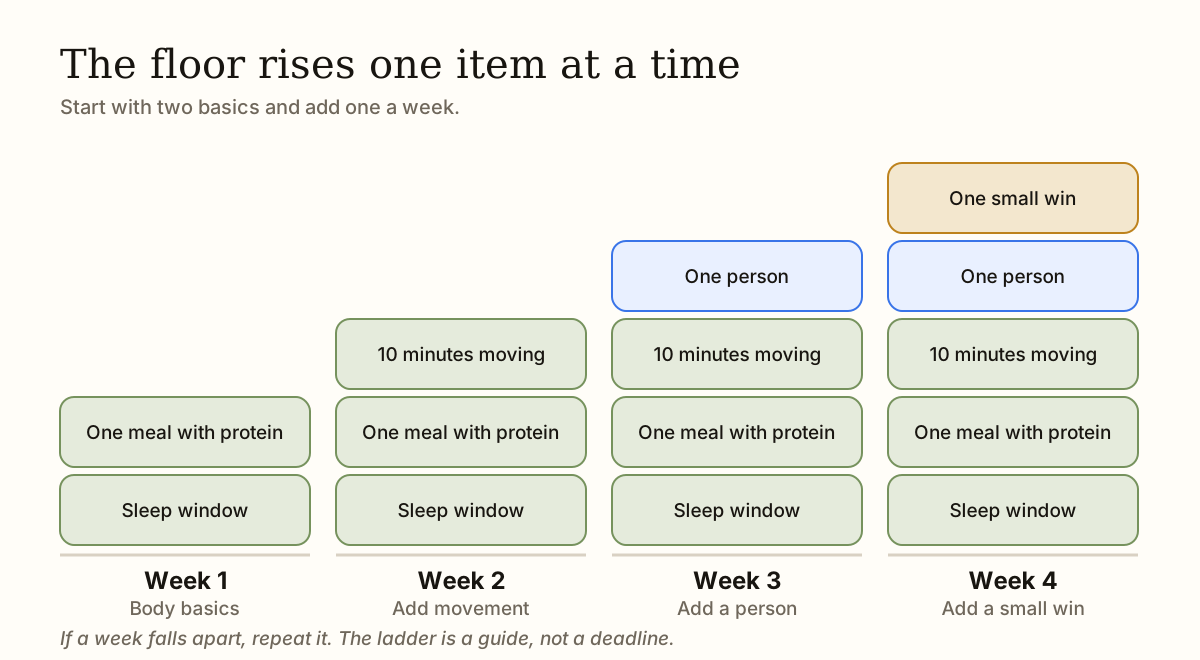
The body comes first because sleep and food are the two things you can do alone, without anybody else’s help. People and wins cost more energy, so they come later.
The ladder is a guide, not a deadline. If week two falls apart, repeat it. If the card starts to feel too easy, good. It is the floor, not the ceiling. The routine also sits underneath your contact boundary, so it pairs well with the first 30 days of no contact, and the practical side (accounts, belongings, money) is covered in what to do after a breakup.
How do I sleep when I can’t switch off?
Fix the wake time first. The NHS advises getting up at the same time every morning, winding down for at least an hour before bed, avoiding daytime naps, and skipping smoking, alcohol, tea and coffee for at least six hours before bed. Regular exercise helps, but not within four hours of bedtime.
After a breakup the hard part is the quiet. The thoughts arrive when the lights go off. Give them an earlier appointment: ten minutes of writing at 8 p.m., using the worry-window method in how to stop thinking about your ex. Then charge the phone outside the bedroom, because the bedroom is where checking their profile turns into 1 a.m. A 2012 study of Facebook use after breakups found that monitoring an ex was associated with more distress and less personal growth (Marshall, 2012).
A few days of heavy sleep right after the split are normal, and your body is asking for rest. If it has become most days, the same-wake-time rule is the quickest correction. For a full night plan, see what to do when you can’t sleep after a breakup.
What should I eat after a breakup if I have no appetite?
Eat small and often, and don’t wait to feel hungry. When appetite has gone, hunger is an unreliable signal, so tie food to the clock instead: something at the same times each day, even if it is only half a portion.
Choose food that needs no cooking and no decisions. Yogurt, eggs, toast with peanut butter, a banana, soup from a carton, a handful of nuts. Keep three of them in the house, and order a grocery delivery if the shop is too much. Drinking something with calories, like milk or a smoothie, is a fair swap when chewing feels impossible.
If you are eating crisps for dinner, don’t fight it with rules. Add one thing instead: the protein first, then the crisps. A list of forbidden foods only gives you something else to fail at while you already feel like you are failing.
If you are barely eating, or losing weight without meaning to, tell a doctor rather than waiting. The last section has the NHS timeline.
How do I make myself go out, and ask friends for support?
Go for a short, fixed time and give yourself permission to leave. “I’ll come for an hour” is far easier to say yes to than a whole evening, and one hour with a friend is enough to tick the person item on your card. If your circle has got thin, loneliness after a breakup covers rebuilding it.
Asking is harder than going, because needing something feels like being a burden. Specific requests are easier to say yes to than “I’m not doing great”, so say what you want and how long it will take. Most friends don’t know what to do and are relieved to be handed a job. Try these:
- “Can you text me at 9 tonight? I just need someone to say goodnight to.”
- “Would you walk with me on Saturday morning? You don’t have to talk about it.”
- “I’m not sleeping. Can I call you for ten minutes while I make dinner?”
- “I don’t want advice. Can I tell you what happened and have you say it’s awful?”
- “If I’m about to text them, can I text you first?”
Is it self-care or avoidance? Treats, trips and bubble baths
A treat is self-care when it sits on top of the basics, and avoidance when it replaces them. A bath after you have eaten and slept is a pleasure. A bath because you cannot face the phone call is a hiding place. Ask one question before you do it: what am I doing this for?
Should you take a holiday after a breakup? If you would have wanted the trip anyway and can afford it, a change of scene gives you a week of breathing room. Check that it wasn’t booked together, and that you are not planning to refresh their stories from a sunbed. The breakup travels with you.
| Activity | What it does | When it becomes avoidance |
|---|---|---|
| Bath or long shower | Warms you up and slows you down for twenty minutes | It is where you go every evening to skip a task or a call |
| Retail therapy | A small hit of novelty | The spending is hidden or large, or it replaces movement and people |
| Binge-watching | Quiet company and a break from your head | It runs past your sleep window, or it is all you do |
| A weekend away | A change of scene, and time with people | You are running from the feeling, or all routine stops while you are gone |
| Drinks with friends | Company | Alcohol is the plan, or you are drinking to stop thinking. It also disrupts sleep |
| Cleaning or redecorating | Gives your hands a job and a visible win | You stay busy so you never sit with the feeling at all |
| Sleeping in | Rest in the first few days | It is most days, and the wake time has gone |
What small things help when you feel awful?
The ones you can finish in five minutes and see finished. Any of these counts as your small win, and none needs a good mood:
- Make the bed, or just straighten the sheet.
- Shower and put on clean clothes, even if you are going nowhere.
- Open the curtains.
- Reply to one message.
- Put their things in one box, out of sight. You don’t have to throw anything away.
- Stand outside for two minutes.
When is self-care not enough?
When your basics have stopped for two weeks or more. The NHS advises seeing a GP if symptoms of depression, such as low mood, loss of interest, disturbed sleep or a change in appetite, last most of the day, every day, for more than two weeks. It also says low mood can improve after a short time, so that line is for symptoms that stay, not for every bad stretch. Our guide to depression after a breakup goes through the signs.
Get help sooner if you are having thoughts of not wanting to be alive. In the US, call or text 988. In the UK and Ireland, Samaritans is 116 123. In India, Tele-MANAS is 14416. If your breakup involved fear of your ex, the US National Domestic Violence Hotline is 1-800-799-7233 (text START to 88788). More options are on our safety page.
You do not have to reach crisis point to ask for help. A GP, a therapist or a campus counselor can work on sleep and appetite directly, and that is a normal use of them. Today, pick your first two items and write the bad-day version beside each.
Step-by-step plan
- Write the card
Copy the five basics onto paper or a note, with the bad-day version beside each. Put it where you will see it, such as the bathroom mirror or the lock screen.
- Pick your first two
Commit to the sleep window and one meal with protein. The rest are optional for now.
- Attach each item to a cue
Use if-then wording: “If I finish my coffee, I go for the walk.” “If it’s 10:30 p.m., my phone charges in the hall.”
- Tick, don’t grade
Tick an item when you did the bad-day version too. Don’t score the day or carry a miss into the next one.
- Review after two weeks
Check which items you did most, which keep slipping, and why. Add one basic, or repeat the week, and note whether sleep, mood or appetite changed.
You do not have to solve the whole relationship tonight. Take one private step that creates space between the feeling and the action.
No contact plan generator →Common questions
What is the best self care after a breakup?
The best self care is keeping your basics steady: a regular sleep window, one meal with protein, ten minutes of movement, contact with one person who is not your ex, and one small win. Treats like baths or a night out are fine on top of that. They work best once the basics are covered.
Is it normal to not take care of myself after a breakup?
Yes. Skipped meals, broken sleep and cancelled plans are very common in the first weeks, because the breakup removes your routine and loads your stress system at the same time. Start with the bad-day version of one item rather than trying to fix everything. If it lasts more than two weeks, speak to a doctor.
How long should self-care after a breakup last?
There is no end date, and it works best as a permanent baseline. Many people lean on the minimum-day card for the first month, then keep the habits that helped. Review it after two weeks and judge by trends, not single days.
How do I stop eating junk food after a breakup?
Don’t ban it. Eat the protein meal first and have the junk food after if you still want it. Keep three easy foods in the house, such as yogurt, eggs and peanut butter, so the easy choice is not always the crisps. Strict rules usually add one more thing to feel bad about.
How do I look after myself when I’m too sad to get out of bed?
Do the bad-day versions from where you are: drink a glass of water, open the curtains, text one person, and lie down at your sleep window. Shower or step outside once you can. If you have been in bed most of the day for more than two weeks, contact a doctor or a crisis line.
Is it okay to sleep all day after a breakup?
A few days of heavy sleep right after a split is normal, and your body may need the rest. If it becomes most days, fix your wake time, because the NHS advises getting up at the same time each morning and avoiding naps. Sleeping most of the day for weeks can be a sign of low mood worth discussing with a GP.
What is a simple self-care routine when I feel numb after a breakup?
Do the five items on the minimum-day card anyway. They are for your body and do not need a good mood or any motivation. Numbness is common after a breakup, and it often eases on its own. If it lasts for weeks or comes with hopelessness, talk to a doctor or counselor.
When should I see a doctor if I am not eating after a breakup?
See a GP if you are eating very little, losing weight without meaning to, or if the change in appetite lasts most days for more than two weeks. The NHS lists a change in appetite among depression symptoms and advises seeing a GP when symptoms last more than two weeks. Go sooner if you feel faint or unwell.
What self care is actually good after a breakup, not just bubble baths?
The kinds that protect sleep, food, movement and company. A set wake time, an easy protein meal, a short walk, a call with a friend and one finished chore all help more than a spa day. A bath is fine after those are covered.
If contact involves threats, stalking, coercion, shared children, housing or immediate safety, a general no-contact rule may not fit. Read the safety guidance and seek qualified local help where appropriate.
Sources and further help
- Kross E et al. (2011), Social rejection shares somatosensory representations with physical pain, PNAS
- Gollwitzer PM (1999), Implementation intentions: strong effects of simple plans, American Psychologist
- Marshall TC (2012), Facebook surveillance of former romantic partners: associations with postbreakup recovery and personal growth, Cyberpsychology, Behavior, and Social Networking
- NHS, Insomnia: self-help tips for sleep
- NHS, Symptoms of clinical depression
- 988 Suicide & Crisis Lifeline (US)
- National Domestic Violence Hotline: plan for safety
Research is cited to explain general patterns, not to diagnose or predict any individual outcome. Sources do not endorse UnLink. Read our editorial principles.
Keep this support one tap away.
UnLink is a free, private no-contact tracker for iPhone: count your days, get through urges and restart without losing your history.