How to Stop Thinking About Your Ex
Can’t stop thinking about your ex? Why the loop runs, why forcing it away backfires, and what helps: a worry window, urge surfing and a reality check.
 By the UnLink Editorial Team · General educational guidance, not therapy
To stop thinking about your ex, don’t fight the thoughts head-on, because suppression tends to backfire. Cut the inputs that restart them (checking, texting, replaying), give the thinking a fixed 20-minute window, and turn each loop into one specific question. The thoughts usually thin out over weeks, not days.
- Rumination is a loop of the same questions with no new answers, while reflection is a focused look that ends in a learning or a next step.
- Trying to force a thought out of your head tends to bring it back, so the working goal is to change what feeds the thought and how much room it gets.
- Obsessing over an ex is mostly made of habits (checking, replaying, rehearsing, asking friends), and each habit has a swap you can practice.
- Scheduling a short worry window and letting urges rise and fall without acting on them can shrink how much of the day the thoughts take up.
- Professional support is worth seeking when the thoughts disrupt sleep, work or safety, or when they have not eased after several weeks.
Why can’t I stop thinking about my ex?
After a breakup your brain is doing several jobs at once. It is grieving a future you expected, trying to make sense of what happened, and checking whether you are safe without the person who was close to you. Kross and colleagues (2011) found that recalling an intense romantic rejection engaged brain regions that also respond to physical pain. The ache is real, and the mind keeps returning to the source the way you press a bruise to see if it still hurts.
Fisher and colleagues (2010) found that people recently rejected by a partner showed reward and craving-related activity when they viewed that person’s photo. So the thinking can feel less like a choice and more like a pull. It also means that constant thinking in the first weeks is ordinary, not a sign that something is wrong with you. Nobody can give you an end date (how long it takes to get over a breakup covers what tends to shorten or lengthen it), but the thoughts usually come in waves rather than a steady stream, and the waves get further apart.
Why does trying not to think about them make it worse?
Because suppression keeps the thought on a watch list. In a classic 1987 experiment, Wegner and colleagues asked people not to think about a white bear. Afterward, people who had first suppressed the thought mentioned the bear more often than people who had been told to think about it from the start. It was a lab study with a neutral thought, not a heartbreak, so read it as a reason “just stop” fails rather than as a map of how breakups work.
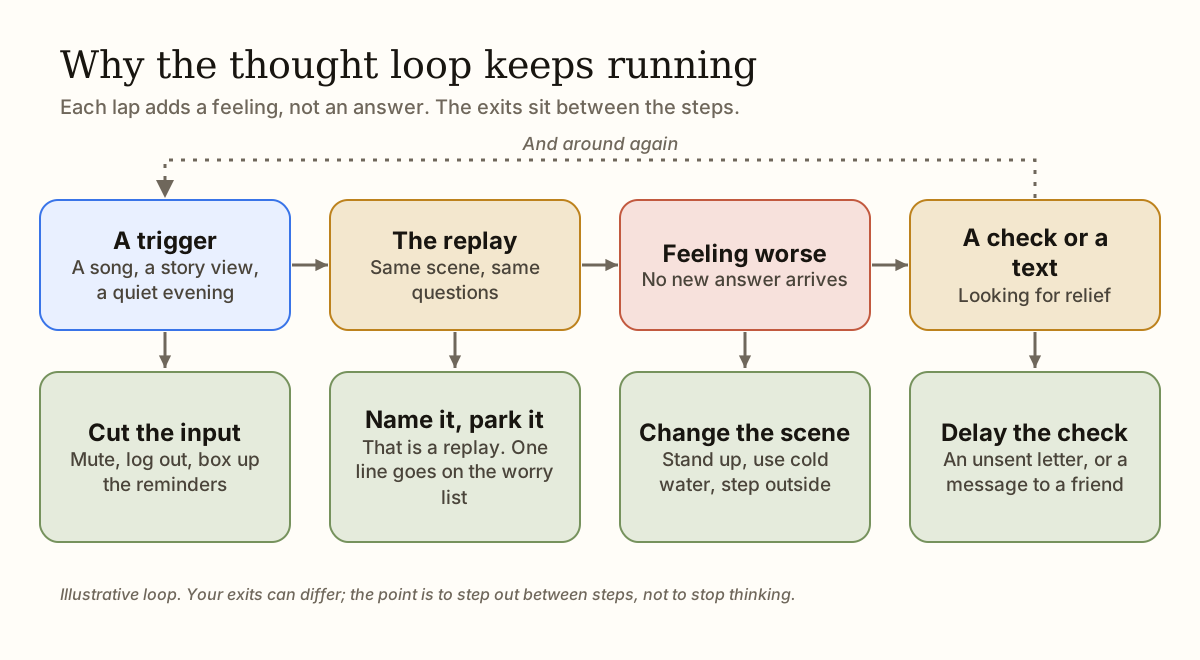
The practical lesson is to stop trying to delete the thought. Change where it goes, how much room it gets and what keeps feeding it. “I’m not allowed to think about them” is a rule you break every few minutes. “I’ll think about this at 7:30” is a rule you can keep. Everything below works that way.
Rumination vs reflection: what is the difference?
Rumination and reflection both involve thinking about the relationship, so they can look alike from the inside. The difference is what the thinking does. Nolen-Hoeksema, Wisco and Lyubomirsky (2008) review evidence that rumination, a repetitive and passive focus on distress and its causes, is associated with more depressive symptoms. Reflection asks a specific question, looks for a useful answer and ends with a learning or a small next step.
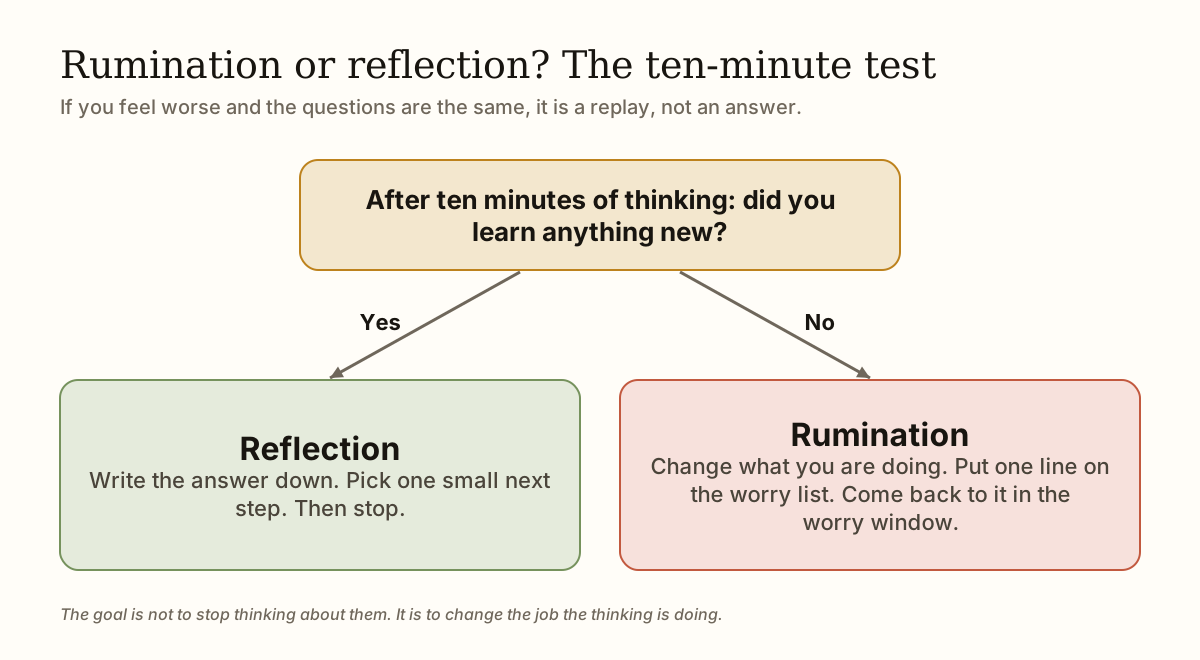
Here is a simple test. After ten minutes of thinking, do you know anything new, or do you just feel worse? If it is the second, you are ruminating. Turn it into a question that can have an answer: “What did I need that I did not get?” or “What do I want to do differently next time?” The aim is not to stop thinking. It is to change the job the thinking is doing.
| Rumination | Reflection | |
|---|---|---|
| The question | “Why did they do that?” asked again and again | “What do I need next time?” asked once |
| Where it ends | You are more upset and have no answer | A note, a decision or a small next step |
| How long it lasts | Until you are exhausted or distracted | About ten minutes, then you stop |
| What you do next | Check their profile or draft a message | Write it down and do something else |
How do I stop obsessing over my ex?
Obsessing over an ex is rarely one thought. It is usually a set of habits, and each one hands the thought fresh material: checking, replaying, rehearsing, imagining, asking around. Ordinary obsessing is part of grief. If it feels intrusive or frightening, read the last section.
Marshall (2012) found that people who monitored an ex’s Facebook more reported more distress and less personal growth, though the study is correlational and cannot show that the checking caused the distress. O’Hara and colleagues (2020) followed 122 recently separated married adults and found that more in-person contact with an ex predicted higher separation distress two months later, in people without children. The samples differ from yours, but the direction is consistent: less new input, fewer new loops.
Match each habit to a swap. The first row is covered in full in how to stop checking your ex’s social media.
- Name it: “That is a replay.”
- Change your input. Stand up, run cold water over your wrists or step outside.
- Do something that needs a little attention, such as the dishes, a puzzle or a call to a friend.
- Put one line on your worry list, so the thought has somewhere to wait.
- Check the clock. If it is inside your worry window, go. If not, go back to what you were doing.
| Habit | What it feeds | Swap |
|---|---|---|
| Checking their profile, “last seen” or location | New details to chew on for hours | Mute or log out of the app, and move it off your home screen |
| Replaying the last argument | A loop with no new facts | Write it once, then save the rest for the worry window |
| Rehearsing what you would say to them | The feeling of contact, which leads to texting | Say it in an unsent letter |
| Imagining their new life | A story where you are the audience | Say “imagining”, then do something with your hands |
| Asking mutual friends for updates | Second-hand checking | Ask them not to mention your ex, for now |
| Keeping reminders in sight | Cues that restart the thought | Box them up out of sight rather than throwing them away |
Can I schedule my worry time?
Yes, and it is one of the more practical options. Rather than fighting thoughts all day, you choose a fixed period, perhaps 20 minutes in the early evening, and let yourself think about the breakup then. Outside that time, you note the thought briefly and tell yourself it has an appointment. This works because it stops the thoughts from owning every moment while giving them a bounded place to go.
During the window, sit somewhere comfortable, write down what comes up and stop when the time is up. Try not to replay the same scene over and over; if you loop, return to the reflective question you wrote down. When a thought arrives outside the window, use a line like one of these:
- “That is a thought about them. I can think about it at 7:30, so I am writing it down.”
- “I do not need to solve this now. I can come back when I have time to think clearly.”
- “This feeling is real, and it does not need an answer right now.”
How do I surf an urge instead of acting on it?
Urge surfing comes from mindfulness-based work. In a 2009 study, Bowen and Marlatt tested a brief mindfulness intervention with college student smokers, which included watching an urge rise and fall without acting on it. In that study the urges themselves did not drop, but participants smoked fewer cigarettes. It was about smoking, not heartbreak, so treat it as a technique to try, not a proven method for getting over a relationship. Many people find the basic idea useful for the urge to text or check.
When the urge to contact your ex arrives, pause and notice where you feel it in your body, such as tightness in the chest or heat in the face. Name it silently: “This is the urge to message them.” Then watch it build and ease, without judging it and without acting on it. If it feels too big to sit with, combine surfing with a simple action. Put your phone in another room, step outside or take five slow breaths. The goal is to get through the wave without handing it your next move.
Do I miss them, or the version of them I’ve built?
Idealization is one of the most common engines of rumination. Over time the parts you miss can grow larger while the reasons it ended fade. A reality-check list brings the full picture back. Write it on a steadier day, not in the middle of a wave, and keep it where you can read it. You are not trying to make yourself angry. You are trying to make the memory accurate.
Use prompts like these, filling in your own specifics:
- The specific things that made me feel unsafe, ignored, lonely or disrespected were: ...
- The arguments we kept having, and how they usually ended, were: ...
- The version of this relationship I miss is missing these parts: ...
- When I was honest with myself at the end, I knew it was not working because: ...
- If a friend described this relationship to me, I would say: ...
| If your thoughts are mostly… | It may be… | Where to go next |
|---|---|---|
| Memories of specific, ordinary moments | Grief for a real person and a real routine | Why do I miss my ex? |
| Near-constant, intense and fantasy-heavy, even about someone who was inconsistent with you | A pattern called limerence, an involuntary romantic fixation | Limerence vs love and the limerence quiz |
| “I miss them, or I miss having someone?” | Missing the life you had together, not only the person | The do I miss my ex quiz |
How do I rebuild who I am without them?
Part of what keeps people thinking about an ex is that their sense of self got tangled up with the relationship. Who you were, what you did on weekends and what you hoped for may all have been shaped around another person. Larson and Sbarra (2015) reported that structured reflection on a romantic breakup was associated with a clearer sense of who you are (self-concept clarity), and that this related to less emotional distress. That was a study of people taking part in breakup research, but the idea is practical: getting clearer about yourself helps.
Start small. Write ten things you value, enjoy or want to be known for, without mentioning your ex. Pick one activity you stopped during the relationship and try it again, even briefly. Notice which decisions you now make only for yourself. Expressive writing can help too. Pennebaker’s work on writing about emotional experiences, first reported in 1997, linked this kind of writing with benefits across a range of studies. The guide on how to write an unsent letter shows one way to do it, and how to get over a breakup covers the wider recovery.
What helps on the worse days, and how long does this last?
Some days the thoughts will be louder. Have a plan simple enough to follow when you are tired: keep your routine steady, eat something regular, get some daylight, limit alcohol (it tends to intensify late-night thinking) and plan one thing with a person who is good for you, even if it is short. If the thinking is worst at night, can’t sleep after a breakup has a night plan, why do I keep dreaming about my ex covers the dreams, and why you want to text your ex at night explains the pull to message.
For more ways to fill the space where replaying used to go, see what to do instead of texting your ex, and the first 30 days of no contact if you are early in the process.
There is no fixed timeline. Some people find the thoughts less frequent within weeks, others over months. Progress shows up in the gaps: the afternoon you did not think about them until evening, or the night you chose sleep over scrolling. If thoughts return after a quiet stretch, something has probably triggered them, such as a date, a mutual friend or a song. Treat the return as information, not proof that you are going backward.
When should I get professional support?
Breakup thoughts are a normal part of grief, and most people find them easier over time with support and steady routines. Consider talking to a therapist, counselor or doctor if the thoughts keep you from sleeping, eating, working or caring for yourself, if you feel stuck for several weeks with no change, if the thoughts feel intrusive or frightening rather than sad, or if you are using alcohol or other substances to get away from them. This guide is education, not therapy, and it cannot replace individual care.
If you ever have thoughts of harming yourself or feel unable to keep yourself safe, contact emergency services or a crisis line straight away. In the US, call or text 988 (988 Suicide & Crisis Lifeline). In the UK and Ireland, Samaritans is 116 123. In India, Tele-MANAS is 14416. If your ex was controlling, threatening or abusive, or is still contacting or following you, read our safety page first. In the US you can call the National Domestic Violence Hotline on 1-800-799-7233 or text START to 88788.
You do not have to solve the whole relationship tonight. Take one private step that creates space between the feeling and the action.
90-second urge reset →Common questions
How do I stop thinking about my ex all the time?
Give the thoughts a set time and place, such as a 20-minute window in the evening, and write down thoughts that arrive at other times. Cut the inputs that restart them, like checking their profile, and let urges rise and fall without acting. A steady routine also leaves your mind less free time to replay the relationship.
Why can’t I stop thinking about my ex?
Breakup pain engages brain systems that overlap with craving and physical pain, so the thoughts can feel automatic. The mind also keeps trying to make sense of an ending that feels unfinished. Changing what the thinking is for usually works better than forcing it to stop.
How do I stop obsessing over my ex?
Find the habits that feed it, such as checking their profile, replaying the last argument, rehearsing what you would say or asking friends for updates. Swap each one for something else, and put the thinking in a worry window. If the obsessing feels intrusive or frightening, talk to a professional.
What is rumination after a breakup?
Rumination is repetitive thinking about the same questions, such as why it ended or what you did wrong, without reaching new answers. It tends to leave you more upset with each round. Reflection is different because it focuses on a specific question and ends with a learning or next step.
How long does it take to stop thinking about an ex?
There is no fixed timeline, and it varies a great deal between people and relationships. Many people notice the thoughts becoming less frequent over weeks or months, with setbacks along the way. Look for gradual changes, such as longer stretches without thinking about them, rather than a single finish line.
Is it normal to think about my ex constantly after a breakup?
Yes, it is very common, especially in the first weeks and around reminders like anniversaries or shared places. Breakup pain engages the same brain systems as physical pain, so the preoccupation is part of grief. If it stops you from functioning, talk to a professional.
How do I stop thinking about my ex at night?
Park the thoughts earlier: write them down in your worry window, then put the phone out of reach. If your mind starts replaying in bed, name it as a replay and focus on something physical, such as your breathing or the feel of the sheets. Our guide on not being able to sleep after a breakup has a full night plan.
What does urge surfing mean for getting over an ex?
Urge surfing means noticing a strong urge, such as the urge to message them, watching it without acting, and letting it rise and fall. It comes from a 2009 study of smokers that used brief mindfulness instruction, so it is a technique to try rather than a proven breakup method.
When should I see a therapist about my ex?
Consider a therapist or counselor if thoughts about your ex keep disrupting your sleep, work, relationships or self-care for several weeks, if they feel intrusive or frightening, or if you are drinking or using substances to get away from them. Seek emergency help straight away if you have thoughts of harming yourself.
If contact involves threats, stalking, coercion, shared children, housing or immediate safety, a general no-contact rule may not fit. Read the safety guidance and seek qualified local help where appropriate.
Sources and further help
- Kross E et al. (2011), Social rejection shares somatosensory representations with physical pain, PNAS
- Fisher HE et al. (2010), Reward, addiction, and emotion regulation systems associated with rejection in love, Journal of Neurophysiology
- Wegner DM et al. (1987), Paradoxical effects of thought suppression, Journal of Personality and Social Psychology
- Nolen-Hoeksema S, Wisco BE & Lyubomirsky S (2008), Rethinking rumination, Perspectives on Psychological Science
- Marshall TC (2012), Facebook surveillance of former romantic partners: associations with postbreakup recovery and personal growth, Cyberpsychology, Behavior, and Social Networking
- O’Hara KL et al. (2020), Contact with an ex-partner is associated with psychological distress after marital separation, Clinical Psychological Science
- Bowen S & Marlatt GA (2009), Surfing the urge: brief mindfulness-based intervention for college student smokers, Psychology of Addictive Behaviors
- Larson GM & Sbarra DA (2015), Participating in research on romantic breakups promotes emotional recovery via changes in self-concept clarity, Social Psychological and Personality Science
- Pennebaker JW (1997), Writing about emotional experiences as a therapeutic process, Psychological Science
- 988 Suicide & Crisis Lifeline (US)
- National Domestic Violence Hotline: safety planning
Research is cited to explain general patterns, not to diagnose or predict any individual outcome. Sources do not endorse UnLink. Read our editorial principles.
Keep this support one tap away.
UnLink is a free, private no-contact tracker for iPhone: count your days, get through urges and restart without losing your history.