How to Stop Checking Your Ex’s Social Media
How to stop checking your ex’s social media: a five-step friction ladder, in-the-moment scripts, and what to do when your ex views your stories.
 By the UnLink Editorial Team · General educational guidance, not therapy
To stop checking your ex’s social media, make it harder to reach, decide in advance what you will do when the urge hits, and stop reading their posts and story views as messages meant for you. Start by muting them, then clear your search history and shortcuts, and put an app limit on the apps you use most.
- Checking an ex’s profile is a habit loop, and the urge is usually strongest late at night, after a drink or when you feel lonely.
- A 2026 study found that actively searching for an ex online was linked to more distress that day and the next, while simply seeing them in your feed was linked to a worse mood that day.
- A story view tells you that an account opened your story. It says almost nothing about what your ex feels, thinks or intends.
- Friction works best when you set it up in advance: mute, clear the shortcuts, add an app limit, and decide what you will do instead.
- The side doors count too: mutual friends, a new partner’s account, shared albums, location sharing and memory reminders.
Why do I keep checking their profile?
It usually starts as something small and almost automatic. You open an app to check something else, your thumb drifts to their name, and ten minutes later you are scrolling through photos you have already seen. The habit is powerful because it pays you in tiny doses of information, even though that information never answers the question you actually have.
Part of the pull is biological. In a 2010 study, Fisher and colleagues found that people who had recently been rejected by a partner showed activity in reward, motivation and craving-related brain regions when they looked at a photo of that person. Kross and colleagues (2011) found that recalling a recent romantic rejection engaged regions that also respond to physical pain. So if you cannot resist looking, that is what you would expect from a brain that is still processing a loss. It is not a character flaw.
What does checking an ex’s social media actually cost you?
In a 2012 study of Facebook use after breakups, Marshall found that more surveillance of a former partner was associated with more distress, more negative feelings, a stronger desire for the ex and less personal growth. That study was correlational: it shows these things travel together, not that looking caused the distress. People who are struggling more may simply look more.
A 2026 paper by Marshall in Computers in Human Behavior was built to get closer to cause and effect. It combined a six-month follow-up, an experiment and two daily diary studies. Actively searching for an ex’s profile was linked to more distress on the same day and the next. An ex simply appearing in your feed was linked to a worse mood that day, with less of a hangover. The link between watching and distress was stronger in people high in attachment anxiety, the tendency to worry about being left. If that sounds like you, anxious attachment after a breakup explains why the early weeks hit so hard.
Most of that research used college students and Facebook-era platforms, so treat the details as a pattern rather than a prediction for you. The practical reading is simple: how often you go looking matters more than whether a post ever crosses your path.
Signs your checking has become a habit
Checking is not always a problem. The question is whether it is pulling you away from the recovery you want. These signs suggest the habit has taken over:
- You open their profile without deciding to, often while you are doing something else.
- You check after a bad day, a drink or a late-night scroll, even when you had planned not to.
- You look at the same photos or stories more than once, hoping for a different reading.
- You feel calmer for a few minutes after looking, then more restless and unsettled.
- You make up stories about what their posts or story views mean, then act on those stories.
Does it mean something when my ex views my story?
Almost never anything you can act on. On most apps the person who posted can see a list of viewers, and that list shows who opened the story, not why, not what they felt and not whether they will do anything about it. You have one data point and you are filling in the rest with hope or dread.
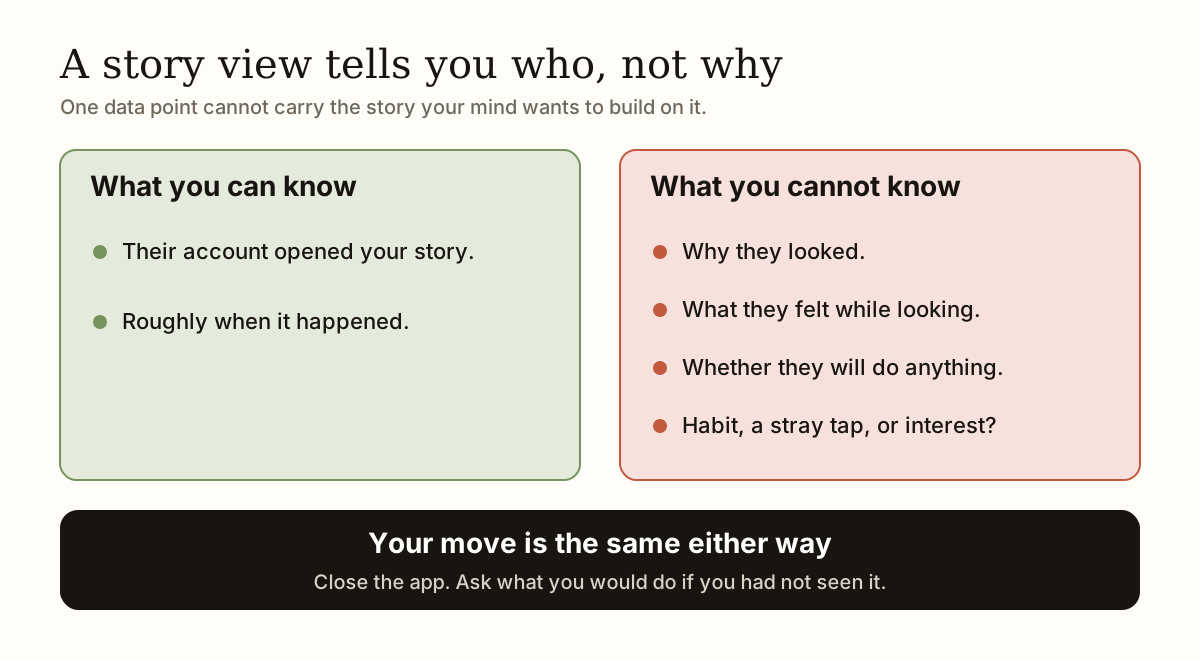
Sunday, 11:40 p.m.: their name sits at the top of your viewer list. A view could be a reflex tap, a glance to see how you are, a bad night of their own, or real interest. The table sets out what each could be and what none of them tells you.
Try a simple test. If you saw that view tomorrow, what would you do with it? If the honest answer is “spend an hour wondering what it means,” the view is not giving you information. It is giving the urge a reason to start. A useful reset is: “A view is just a view. I do not know what it means, and I do not need to know to look after myself.”
If their views bother you, you have options that do not involve guessing. You can share to Close Friends, hide your story from them, or block, depending on how firm you want to be. And if you find yourself posting so that they will see it, ask whether you would share it if you knew they would not look. Posting for an ex is another way of asking for a reaction, and it keeps the same loop running.
| What the view could be | What it still does not tell you |
|---|---|
| A reflex: they opened the app and tapped through everything | That they miss you, or think about you at all |
| Curiosity about how you are doing | That they want contact, or would welcome yours |
| A lonely or guilty moment on a bad night | That they feel the same way tomorrow |
| Real interest or nostalgia | That they will act on it, or that you want them to |
| Checking whether you have moved on | Anything good or bad about your worth |
How do I make it harder to check my ex’s social media?
Add friction, so that looking takes more effort than not looking. You do not need to delete your accounts or leave town. A few small barriers between you and the impulse are enough, and the ladder below runs from light to firm. Start at the lightest rung that actually stops you, and move up if it does not.
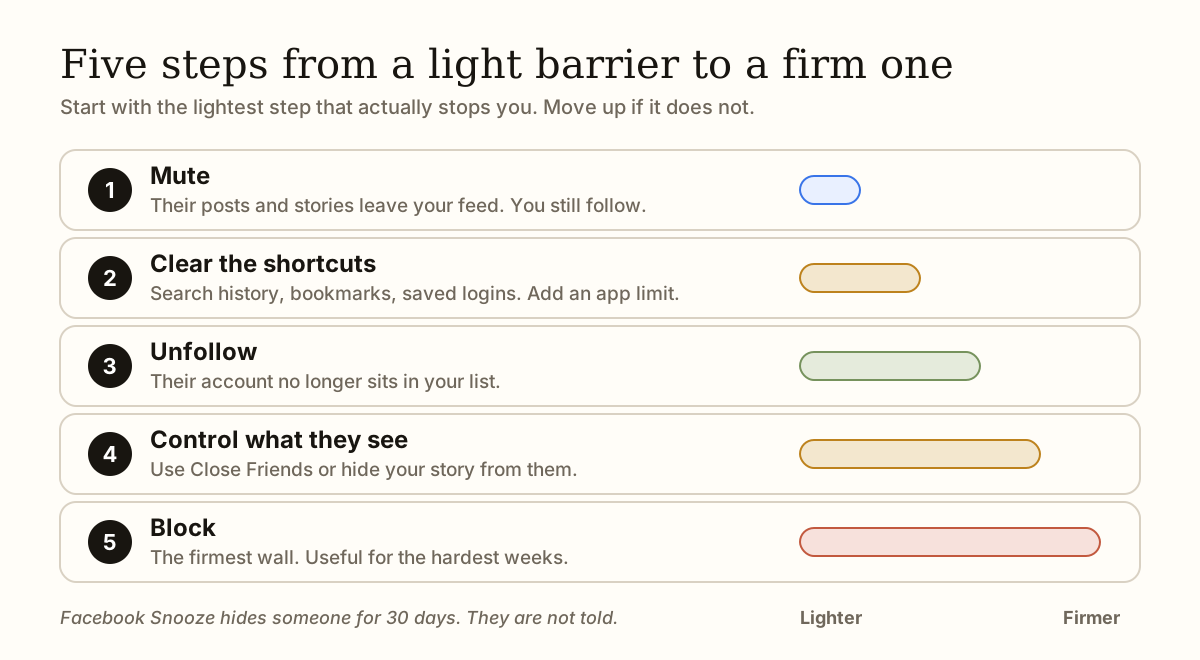
Friction is not punishment. It turns a three-second reflex into a decision you make on purpose. On an iPhone, Screen Time can set App Limits and Downtime for the apps you open most, and with a Screen Time passcode a friend can set it so you cannot override it at 1 a.m. Apple’s support pages walk through both. Facebook’s Snooze hides someone’s posts from your Feed for 30 days and, according to Meta, they are not told, which makes it a gentle first rung there.
For the pros and cons of each rung, see should you block your ex. If the urge to look comes with the urge to message, how to block yourself from texting someone applies the same idea to your messages.
What about mutual friends, their new partner and the other places they show up?
Closing the front door often leaves three side doors open. Checking an ex rarely stays on their profile: it moves to a friend’s tagged photo, a new partner’s account or a shared album. If you mute one place and start searching in another, the habit has just changed address.
One rule covers all of it: if you went looking, it counts as checking, whichever app you used. A second account, a friend asked to “just peek” and a search from a browser where you are logged out are all the same behavior. If seeing a new partner is the trigger, my ex moved on fast covers what that does and does not mean.
| Where they show up | What helps |
|---|---|
| Mutual friends’ posts and tags | Mute or snooze those friends for a few weeks. Tell the friend plainly: “Please don’t update me about them for now.” |
| A new partner’s account, or their friends | Do not follow or search. If you notice yourself searching, treat it exactly like checking their profile. |
| Shared albums, shared playlists, location sharing | Save anything you want or may need, then leave the album and switch off sharing. Keep records if there are legal or custody questions. |
| Memories and “on this day” reminders | Turn off or limit memory notifications in the app’s settings before the date arrives, not after the alert. |
| Second accounts and “just peek” requests | Name it as checking. Add the same limit you set for the main app. |
What do I do in the moment the urge hits?
Plans work better than willpower. In a 1999 paper, Gollwitzer described implementation intentions: specific if-then plans such as “If X happens, then I will do Y.” Research on them found they help people follow through on goals, because the situation itself becomes the cue. Deciding in advance means you are not negotiating with yourself at 11 p.m.
Pair the plan with a short wait. Urges often peak and fade within minutes, and a ten-minute delay with your phone in another room gives that a chance to happen. If you want a guided minute, the 90-second urge reset is built for it. For the wider set of urge plans, the hub guide how to stop texting your ex has them. Here are if-then plans you can adapt:
- If I open the app and their name is in my head, then I will close it and make a cup of tea.
- If I feel the pull after a drink, then I will put my phone in another room for the rest of the night.
- If I see a story view and start wondering what it means, then I will say, “I do not know, and I am not going to guess,” and do one small task.
- If I catch myself scrolling through old photos, then I will stop, name the feeling and open the urge reset tool.
- If I slip and look, then I will write down the time and the trigger, and nothing else, before I do anything next.
What can I do instead of checking?
Checking often fills a gap: boredom, loneliness, a need to know or a need to feel close to someone. Remove the habit without filling the gap and it tends to grow back, so decide what takes its place. Some people call a friend, walk around the block, cook, or start the show they have been saving. If you used to send memes or songs to your ex, pick one friend who gets those now.
Others write. Pennebaker’s work on expressive writing, first reported in 1997, linked writing about emotional experiences with benefits across a range of studies. Writing what you want to tell your ex, without sending it, gets the feeling out of your head and onto a page. How to write an unsent letter has a simple structure. If the checking is mostly the same questions on repeat, how to stop thinking about your ex covers that side of it.
For a longer list of alternatives, see what to do instead of texting your ex. You do not need one perfect replacement. You need two or three ready so the habit has somewhere else to go.
What if checking is connected to fear for my safety?
For most people, checking an ex’s profile is a painful habit, not a safety issue. Sometimes the urge to monitor comes from real fear, especially after abuse, threats, coercion or stalking. If that is part of your situation, the goal is not only to stop looking. It is to be safe, and to plan that with people trained to help. Leaving or cutting contact can raise risk in some situations, so safety planning comes before any contact strategy. The National Domestic Violence Hotline (1-800-799-7233 in the US) offers safety planning, and our safety page lists crisis lines for the US, the UK and Ireland, and India.
Be careful with advice to delete everything or block immediately. If an ex has threatened or harassed you, screenshots and message history can matter later, and blocking can change how they behave. Save evidence first and talk to an advocate before you decide. If you are the one being watched, or tracked through an account or a shared location, treat that as a safety question, not an etiquette one.
If you share children, a home or a workplace with your ex, you may need some contact for logistics. The guide on modified no contact explains how to keep it practical, and practical contact should not turn into checking their life.
What if I slip and look anyway?
Almost everyone slips. A slip does not erase your progress. It tells you what the trigger was and what you need next time. Notice what time it was and what you were feeling, write one line, and choose your next step. You are collecting information, not keeping score.
UnLink, a free no-contact tracker for iPhone, keeps your history when you restart, so a slip does not wipe out the days or patterns you built. If you have looked and are now spiraling, what to do if you break no contact offers a calm way to reset, and what the no contact rule is explains what actually counts as contact.
Step-by-step plan
- Mute their posts and stories
Mute the account so their posts and stories stop appearing in your feed. On Facebook you can also Snooze them for 30 days. Muting is private and a gentler first step than blocking or unfollowing.
- Clear the shortcuts
Delete their name from your recent searches, saved profiles and bookmarks, and log out of the social apps you use most so that logging back in is a deliberate choice.
- Set Screen Time limits on your iPhone
Use App Limits and Downtime in Screen Time for the apps you check most. Add a Screen Time passcode, or ask a friend to set it, so the limit takes a real decision to override.
- Close the side doors
Snooze mutual friends for a few weeks, turn off memory reminders, and leave shared albums and location sharing after saving anything you need.
- Unfollow or block when muting is not enough
If you still look even when they are muted, unfollow or block. Choose the moment deliberately instead of doing it in the middle of a bad night.
- Write an if-then plan for your highest-risk moments
Identify when you check most, such as late at night or after a drink, and write one specific if-then plan for each. Keep it where you can see it.
- Review after a week or two
Notice how often you opened their profile, what set it off and how you felt afterward. Adjust the plan rather than judging yourself for the slips.
You do not have to solve the whole relationship tonight. Take one private step that creates space between the feeling and the action.
90-second urge reset →Common questions
How do I stop checking my ex’s Instagram?
Mute their posts and stories so they stop appearing in your feed, then clear their name from your search history and log out of the app on your devices. Add an iPhone Screen Time limit if you check often. Write an if-then plan for the moments you usually look, such as late at night.
Does watching my ex’s story break no contact?
Many people define no contact as not messaging, calling or reaching out, and viewing a public story is usually not counted as contact under that definition. Your own agreement may be different, though. Even if it does not break the rule, repeated viewing keeps you emotionally tied to their life, and an ex can see that you viewed it.
What does it mean when my ex views my story?
On its own, it means their account opened your story. It could be a reflex, curiosity, a lonely moment or real interest, and you cannot tell which. Trying to decode it usually feeds the urge, so treat a view as neutral information and look after your evening instead.
Should I hide my story from my ex?
If their views pull you into guessing, yes, it is a fair boundary. You can post to Close Friends, hide your story from them or block, depending on how firm you want to be. None of these is a message to them, and you can change your mind later.
Why can’t I stop stalking my ex’s profile?
Looking at a former partner can activate reward and craving-related systems in the brain, especially soon after a rejection. Checking also gives you a short hit of relief or information, which reinforces the habit. Friction, if-then plans and a better use of that minute usually help more than telling yourself to stop.
Is it normal to check my ex’s social media after a breakup?
Yes, it is very common, and part of the attachment still settling. Research has linked more monitoring of an ex with more distress, so it is worth reducing even though it feels natural. Aim for less checking over time rather than perfection.
Should I unfollow or block my ex?
Muting is a private, gentle first step, unfollowing is a clearer boundary and blocking is the firmest. If you keep looking even when they are muted, move up a rung. Whether it is right for you also depends on shared children, work or safety, which the guide on whether to block your ex covers.
Is checking my ex’s profile the same as stalking?
Not usually. Looking at a public profile is a common, painful habit, and the aim here is to reduce it for your own sake. It crosses a line when you use fake accounts, track their location, show up where they are or contact them after being asked not to. If you are the one being watched, see the safety page.
How long until I stop wanting to check?
There is no fixed number of days. Many people notice the urge getting less frequent once the friction is in place, usually with a few slips along the way. Look for small changes: a day you forgot, or an urge that passed in a few minutes.
If contact involves threats, stalking, coercion, shared children, housing or immediate safety, a general no-contact rule may not fit. Read the safety guidance and seek qualified local help where appropriate.
Sources and further help
- Marshall TC (2012), Facebook surveillance of former romantic partners: associations with postbreakup recovery and personal growth, Cyberpsychology, Behavior, and Social Networking
- Marshall TC (2026), Social media observation of ex-partners is associated with greater breakup distress, negative affect, and jealousy, Computers in Human Behavior, 176
- Fisher HE et al. (2010), Reward, addiction, and emotion regulation systems associated with rejection in love, Journal of Neurophysiology
- Kross E et al. (2011), Social rejection shares somatosensory representations with physical pain, PNAS
- Gollwitzer PM (1999), Implementation intentions: strong effects of simple plans, American Psychologist
- Pennebaker JW (1997), Writing about emotional experiences as a therapeutic process, Psychological Science
- Meta: Well-being tools (Snooze, Mute)
- Apple Support: Set schedules with Screen Time on iPhone
- National Domestic Violence Hotline: safety planning
- 988 Suicide & Crisis Lifeline — US crisis support
Research is cited to explain general patterns, not to diagnose or predict any individual outcome. Sources do not endorse UnLink. Read our editorial principles.
Keep this support one tap away.
UnLink is a free, private no-contact tracker for iPhone: count your days, get through urges and restart without losing your history.