Anxious Attachment After a Breakup: Why the Stages Feel So Intense
Anxious attachment breakup stages explained as patterns, not a diagnosis: why you reach out, what it costs, an urge-peak script and a six-week example.
 By the UnLink Editorial Team · General educational guidance, not therapy
An anxious attachment breakup usually moves through shock, a strong urge to reconnect, replaying and checking, a crash, and uneven calm, though not in a fixed order. Attachment theory calls the reaching out protest. It is a lens for understanding your reactions, not a diagnosis, and no contact helps most by cutting the checking that keeps the alarm going.
- Anxious attachment breakup stages are overlapping patterns, not a fixed sequence. Bowlby’s three phases are a theory, and the six-to-eight-stage lists online come from blogs rather than from studies that followed people through them.
- Attachment is a lens, not a verdict. Researchers score attachment anxiety and avoidance as two dimensions, and the week after a breakup is a poor moment to measure either.
- In a survey of more than 5,000 people, higher attachment anxiety went with more preoccupation with the ex, more distress and more attempts to restore the relationship (Davis et al., 2003). That describes a tendency, not your destiny.
- Protest behaviors such as checking, texting, testing, waiting by the phone and reading into silence buy minutes of relief and cost hours. Each has a replacement you can decide on in advance.
- No contact helps with the urge. It does not change an attachment tendency by itself, which shifts slowly with time, other relationships and sometimes therapy.
What are the anxious attachment breakup stages?
There is no fixed list, but there is a recognizable shape. John Bowlby, the British psychiatrist behind attachment theory, described reactions to losing an attachment figure in three broad phases: protest (anger and attempts to get the person back), despair and sadness, and eventually reorganization (as described by Marshall, Bejanyan and Ferenczi, 2013, who present the model as theory rather than testing it). Breakup articles online stretch that into six or eight stages. Those come from therapists’ and coaches’ blogs, not from a study that tracked people through each one, and they differ from site to site.
So treat the stages as patterns that overlap and repeat, like the ones in the general stages of no contact. When the fear of being left runs high, people tend to describe something like this:
- Shock and alarm. The ending lands as a threat, not just a loss. Tight chest, no appetite, phone in hand.
- The pull to reconnect. Texting, calling, apologizing, reopening an old argument.
- Replaying and checking. Rereading the thread, studying their last-active time, hunting for the moment it went wrong.
- The crash. Reaching out stops working, or you stop. Sadness and exhaustion arrive, and it feels like going backwards. It is closer to the grief catching up.
- Uneven calm. A good Tuesday and a terrible Saturday. The urge is still there, but the gaps between spikes get longer.
- Turning back to your own life. They cross your mind without taking over the afternoon.
Am I anxiously attached, or is this a bad week?
Nobody can tell you from an article, and the weeks after a breakup are the worst time to measure it. Hazan and Shaver (1987) argued that adult romantic bonds work much like early attachment bonds. Researchers now mostly score attachment on two dimensions instead of sorting people into boxes: anxiety (worry about being left, wanting more closeness) and avoidance (discomfort with closeness, a preference for self-reliance). Davis, Shaver and Vernon (2003) used those two scales in their breakup survey.
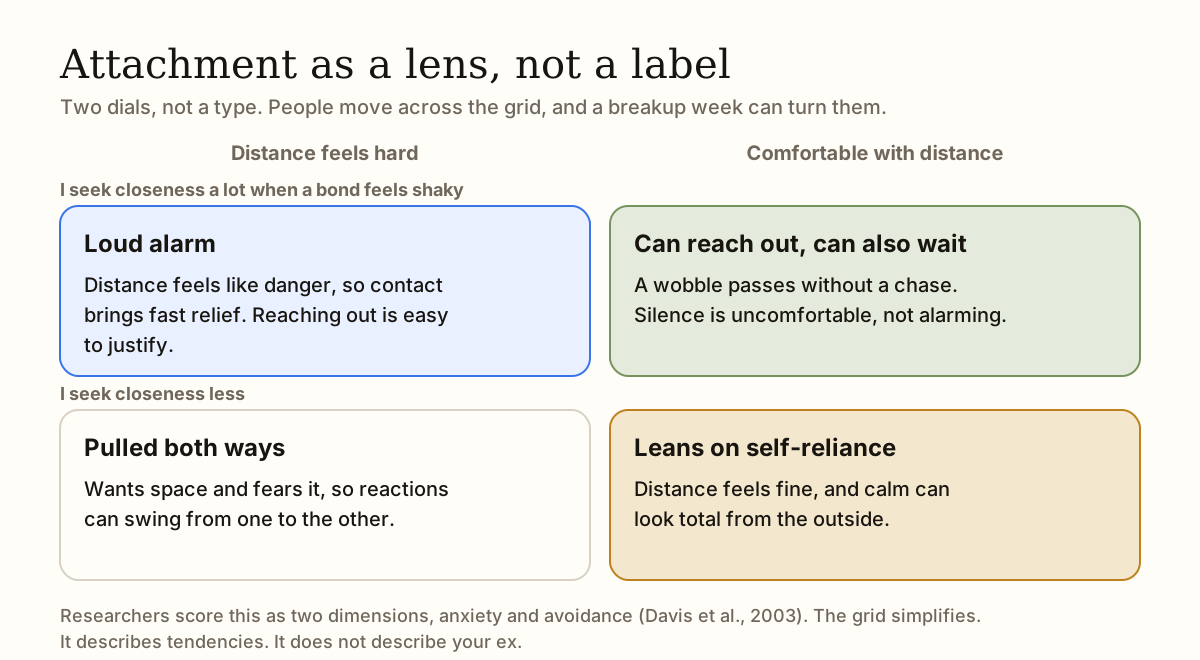
The grid below is a simplified version. People sit somewhere on it, and the spot moves.
- What the lens does say. It describes how you tend to react when a close bond feels threatened. It says nothing about your worth.
- What it does not say about you. Fraley and colleagues (2011) assessed 203 adults daily for 30 days and another 388 weekly for a year, and found a stable tendency underneath temporary swings. A week of being left is a temporary push on it.
- What it does not say about your ex. You cannot read their style from your side of the screen. Describe what they did, not what they are.
Why does the fear of being left feel so loud?
Because for the attachment system, losing the main bond registers as a threat, and in people with higher attachment anxiety the alarm tends to run hotter and longer. In Davis and colleagues’ survey of more than 5,000 people (2003), higher attachment anxiety was associated with more preoccupation with the lost partner, more perseveration over the loss (going over it again and again), more extreme physical and emotional distress, and more attempts to restore the relationship. A survey shows association, not cause.
There is a craving layer on top: Fisher and colleagues (2010) found that photos of the ex lit up reward and craving regions in people recently rejected but still in love. And Sbarra (2006) followed 58 young adults for four weeks after a serious breakup. Those with more love, anger and preoccupation with the ex were less likely to recover from sadness within that window. It is a small, short study, but the preoccupation does seem to be the sticky part.
The alarm is also a poor forecaster. Eastwick and colleagues (2008) found that people going through breakups overestimated how intense their distress would be. “I’m falling apart” describes tonight, not next month.
Why do I keep checking on my ex, and what does it cost?
Checking is a protest behavior. In attachment research, protest means the things people do to restore a bond that feels threatened: calling, messaging, turning up, monitoring, testing. Davis and colleagues (2003) linked attachment anxiety to exaggerated attempts to re-establish the relationship.
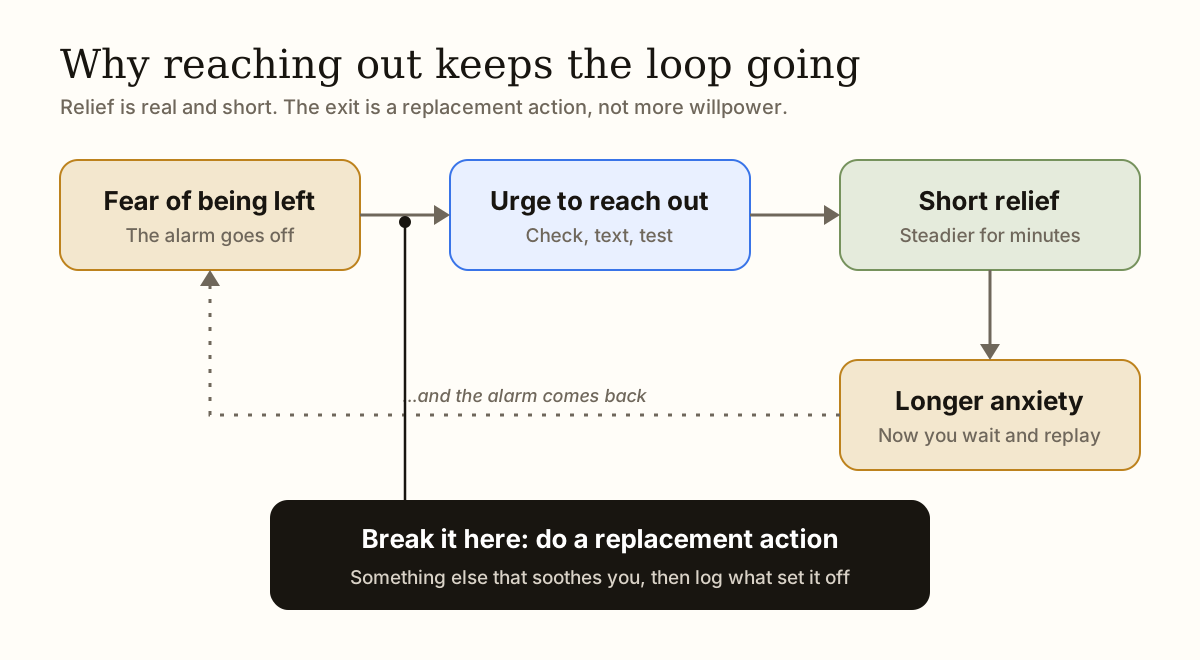
It makes sense from the inside. It also keeps the loop alive, because the relief is brief and the relief teaches the urge to return. A 2012 study of 464 people after a breakup found that monitoring an ex’s Facebook was associated with more distress and longing and less personal growth (Marshall, 2012). It is correlational, so it cannot say which caused which.
| Protest behavior | What it feels like | What it costs | Replacement |
|---|---|---|---|
| Checking their profile, last-seen time or who liked what | A drop in the stomach, then a brief settling, then the need to look again. | Every look produces a new question, and monitoring is associated with more distress (Marshall, 2012). | Mute or archive first, then wait ten minutes before any look. The social media setup covers how. |
| Texting “just to say” something | Relief while typing, a hot pulse right after sending. | You are now waiting for a reply, and the count starts over. | Write it in your notes or as an unsent letter. Send it to nobody. |
| Testing: posting a story for them to see, or a vague message to see if they react | Hope dressed up as indifference. | Their reaction, or their silence, becomes the measure of your worth that day. | Share it with someone who will answer, or leave it unposted and ask what you hoped they would do. |
| Waiting by the phone | Every buzz is them. The day turns into standby. | Hours of attention handed over, and a small drop each time it is not them. | Phone in another room for set hours. See what to do instead of texting your ex. |
| Reading into silence, a like or a typing bubble | Detective mode, with endless possible meanings. | None of it can be decoded, so you build a story out of nothing. | Write two columns: “what I know” and “the story I’m telling”. Close the note. |
What does an anxious avoidant breakup look like?
“Anxious avoidant” describes a mismatch of coping styles between two people, not two kinds of people. One reaches toward closeness when stressed, and the other moves toward space and self-reliance. In Davis and colleagues’ survey (2003), avoidance was weakly and negatively associated with most distress and proximity-seeking reactions and strongly associated with self-reliant coping. That is an average, not a window into your ex.
In the relationship, the mismatch often looks like one person asking for reassurance and the other needing room, each reading the other’s move as proof of what they feared. After the split, a smaller version continues: your urge to talk against their silence. A quiet ex is not proof they feel nothing, and not proof they feel something. You only see the outside.
If the relationship kept ending and restarting, the uncertainty is part of the pain. In studies of US college students, people in on-again, off-again relationships reported fewer positives and more negatives, such as communication problems and uncertainty, than people who had not broken up and renewed (Dailey et al., 2009). The waiting is where the alarm lives.
If you want to stop chasing someone who pulled away, change the sentence you tell yourself. “They pulled back when we talked about moving in” is a fact you can plan around. “They’re avoidant” is a label you cannot test, and it keeps you studying them. The chase loosens when the question moves from “what are they thinking?” to “what do I do with the next hour?”
How does no contact help if I’m anxiously attached?
It removes the inputs that keep the alarm running: their profile, their replies, and the cycle of reaching out and waiting. It does not change your attachment tendency, which moves slowly. No contact is for your recovery, and we do not offer it as a way to make anyone come back.
Willpower is a weak plan at the peak of an urge, so decide in advance. Gollwitzer (1999) reviewed research on if-then plans (“if X happens, I will do Y”) and found they help people follow through. Example: If I open the thread, then I write what I want to say in my notes and leave the phone in the kitchen for ten minutes.
If you share children, a home or a workplace, a modified no-contact plan keeps contact to logistics. If you slip, what to do if you break no contact covers the next hour, and how to stop texting your ex has the longer plan. If your ex is controlling or threatening, read the safety page first.
What does a six-week stretch look like?
Example: one reader’s six weeks. This is an illustration, not data. Real weeks run faster, slower or in loops.
| Week | What is happening | The urge | What helps |
|---|---|---|---|
| Week 1 | Shock. You barely sleep and keep rereading the thread. | Constant, with sharp spikes at night. | Tell two people. Mute their accounts. |
| Week 2 | You draft three messages, send none, then send a long one at 1 a.m. No reply. | High. The slip is followed by a dip. | Restart the count the next morning, no punishment. |
| Week 3 | The crash. Flat, tearful, tired, and it seems to be getting worse. | Lower, but sadness takes its place. | Treat it as grief catching up. Keep meals and sleep regular. |
| Week 4 | A good Tuesday. A hard Saturday after a mutual friend posts a photo. | Waves with gaps between them. | An if-then plan for photos. Log the trigger. |
| Week 5 | The urge arrives, you name it, and it passes within the hour. | Shorter peaks. | The urge-peak plan below, used early. |
| Week 6 | They still come to mind, with less pull. You plan their birthday weekend ahead. | Occasional, tied to dates and places. | A person to call. Keep logging. |
What helps the urge pass faster?
Treat the urge as a wave with a peak, and decide ahead of time what you do while it passes. Bowen and Marlatt (2009) tested “urge surfing”, noticing a craving rise and fall without acting on it, in 123 undergraduate smokers. Urge levels did not differ from the control group, but the mindfulness group smoked fewer cigarettes over the next seven days. The authors read that as a change in response to the urge, not its removal. It was a small study in smokers, so it is a clue.
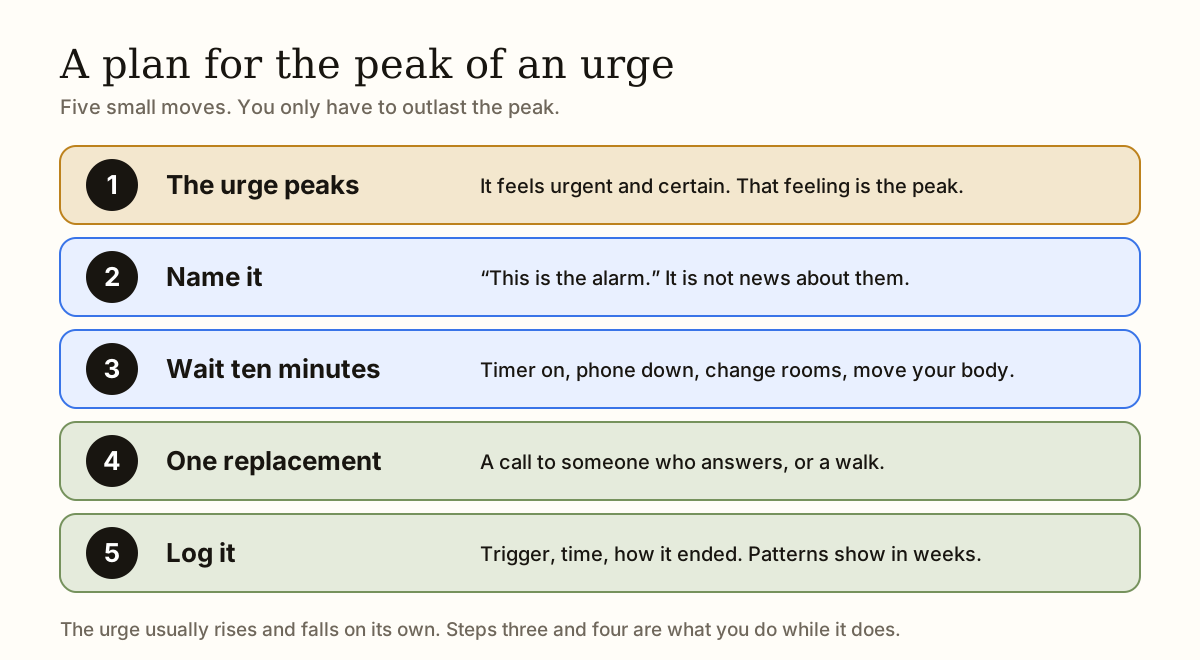
That is a fair goal here too. You may not shrink the urge, but you can change what you do with it. Use these lines at the peak, out loud if you are alone.
- “This is the alarm going off. It is not information about them.”
- “I can want to text and still not text.”
- “If I send this, I will be waiting for the reply for the next three hours.”
- “The urge rises and falls. I only have to get through the peak.”
- “I do not need to know how they feel to know what I will do tonight.”
- “Tomorrow-me has to live with whatever tonight-me sends.”
When should I get support, and can attachment change?
Get support if the alarm is stopping you from living. The NHS advises seeing a GP if you have symptoms of depression most of the day, every day, for more than two weeks (NHS, “Symptoms: clinical depression”). Other signals: you are barely sleeping or eating, you cannot work, panic keeps coming back, or you are drinking to get through the evening. Attachment insecurity, especially anxiety, was associated with using drugs and alcohol to cope (Davis et al., 2003).
On change: attachment tendencies move, slowly. A review of therapy studies found that attachment security tended to rise and attachment anxiety to fall after therapy, though the authors said more controlled trials were needed (Taylor et al., 2015). A meta-analysis of 36 studies (3,158 patients) found preliminary signs that people with lower attachment security may do better in therapy that focuses on close relationships (Levy et al., 2018). The NHS explains talking therapies.
If you have thoughts of harming yourself or of not wanting to be here, get help now. In the US, call or text 988. In the UK and Ireland, call Samaritans on 116 123. In India, call Tele-MANAS on 14416. Elsewhere, contact your local emergency number. If you are afraid of your ex, call the US National Domestic Violence Hotline on 1-800-799-7233 or text START to 88788. Leaving can raise risk, so safety planning comes before any contact plan. More options are on our safety page.
Step-by-step plan
- Name it
Say it plainly: “This is the alarm.” You are not agreeing to act on it.
- Wait ten minutes
Set a timer, put the phone down and change rooms. Notice the urge rise and fall.
- Do one replacement
Pick one from your list: a call to someone who answers, a walk, or the message in your notes, unsent.
- Log it
Write down the trigger, the time and how it ended. After a couple of weeks the pattern shows.
- Decide the next check-in
Choose a time, such as an hour from now, to check how you are doing. Then do the next small thing.
You do not have to solve the whole relationship tonight. Take one private step that creates space between the feeling and the action.
Take the “Do I miss my ex?” quiz →Common questions
Can attachment style change?
Usually in degree, not overnight. Longitudinal research finds a stable tendency with temporary swings around it (Fraley et al., 2011), a review found anxiety tended to fall after therapy (Taylor et al., 2015), and early experience does not fix adult outcomes (Fraley and Roisman, 2019).
Is an attachment test accurate?
Research questionnaires score anxiety and avoidance on two scales, while most online quizzes sort you into one of four labels, and the questions vary a lot. Your answers also reflect how you feel this week. Treat a result as a prompt for questions, not an answer.
Should I tell my ex I’m anxious about the relationship?
Not as a way back in. A message explaining your attachment pattern asks them to reassure you, which is protest in more articulate clothing. Write it as an unsent letter first, and take the insight to a friend or therapist.
Does anxious attachment mean I’m too needy?
No. Wanting closeness and reassurance is a normal human need, and attachment anxiety describes needing more of it when a bond feels threatened. The costs come from how the need gets met, such as chasing and checking, not from having it.
Is it normal to feel like I’m falling apart?
Yes. Rejection engages reward and pain-related brain regions (Fisher et al., 2010; Kross et al., 2011), and people tend to overestimate how bad they will feel (Eastwick et al., 2008). If you cannot eat, sleep or work for more than two weeks, or you have thoughts of harming yourself, get support. Our guide to anxiety after a breakup has a calm-down plan, and why you miss your ex covers the pull itself.
Why do I feel panicky when my ex stops replying?
An unanswered message is ambiguous, and an alarmed mind fills ambiguity with the worst version. Each message you send also extends the wait. If panic keeps returning, or comes with chest pain or trouble breathing, see a doctor.
Does anxious attachment go away with therapy?
It often eases rather than disappearing. A review found attachment anxiety tended to decrease after therapy, with the authors calling for more controlled trials (Taylor et al., 2015). Preliminary evidence suggests therapy that focuses on close relationships may suit people with lower attachment security (Levy et al., 2018).
How do I stop chasing an ex who pulled away?
Stop sending, and stop studying them. Replace labels with facts, such as what they did and said, use the urge-peak plan above, and give the hours you spent waiting to something else. If an on-off pattern keeps pulling you back in, a clear contact plan can hold the line.
If contact involves threats, stalking, coercion, shared children, housing or immediate safety, a general no-contact rule may not fit. Read the safety guidance and seek qualified local help where appropriate.
Sources and further help
- Davis, Shaver & Vernon (2003) — Physical, emotional, and behavioral reactions to breaking up: the roles of gender, age, emotional involvement, and attachment style
- Marshall, Bejanyan & Ferenczi (2013) — Attachment styles and personal growth following romantic breakups
- Hazan & Shaver (1987) — Romantic love conceptualized as an attachment process
- Fraley, Vicary, Brumbaugh & Roisman (2011) — Patterns of stability in adult attachment
- Fraley & Roisman (2019) — The development of adult attachment styles: four lessons
- Sbarra (2006) — Predicting the onset of emotional recovery following nonmarital relationship dissolution
- Fisher et al. (2010) — Reward, addiction, and emotion regulation systems associated with rejection in love
- Kross et al. (2011) — Social rejection shares somatosensory representations with physical pain
- Eastwick et al. (2008) — Mispredicting distress following romantic breakup
- Marshall (2012) — Facebook surveillance of former romantic partners
- Dailey et al. (2009) — On-again/off-again dating relationships: how are they different from other dating relationships?
- Gollwitzer (1999) — Implementation intentions: strong effects of simple plans
- Bowen & Marlatt (2009) — Surfing the urge: brief mindfulness-based intervention for college student smokers
- Taylor et al. (2015) — Changes in attachment representations during psychological therapy
- Levy et al. (2018) — Adult attachment as a predictor and moderator of psychotherapy outcome: a meta-analysis
- NHS — Symptoms: clinical depression
- NHS — Talking therapies and counselling
- The National Domestic Violence Hotline — Plan for safety
- 988 Suicide & Crisis Lifeline
Research is cited to explain general patterns, not to diagnose or predict any individual outcome. Sources do not endorse UnLink. Read our editorial principles.
Keep this support one tap away.
UnLink is a free, private no-contact tracker for iPhone: count your days, get through urges and restart without losing your history.