Going No Contact With a Parent: Options, Safety and Support
Going no contact with parents is a big decision. See the options between full contact and none, how to stay safe, what to say at holidays, and where to get help.
 By the UnLink Editorial Team · General educational guidance, not therapy
Going no contact with a parent means choosing not to communicate with them at all, usually to protect your safety or mental health. It sits at one end of a range that also includes scheduled, low and letters-only contact, and the decision is yours. If there is abuse or any threat, make a safety plan before you change anything.
- Going no contact with a parent is one option on a range: full contact, scheduled contact, low contact, letters or email only, and no contact. Lower-contact steps are easier to adjust later.
- If a parent has been violent, threatening or controlling, plan for safety before you change contact, because the weeks after a parent learns you are pulling away can be the tense ones.
- You do not have to explain, announce or win the argument. Silence, one short message and a full letter are all legitimate. What matters is deciding in advance what you will do when they respond.
- Grief and guilt are common even when the decision is right. Interviews with adult children who chose estrangement describe relief and a considerable sense of loss together (Agllias, 2018).
- No contact does not have to be permanent, and it does not have to be announced as permanent. “For now” is an honest answer.
What does going no contact with a parent mean?
Going no contact with a parent means deliberately ending all communication with them: no calls, texts, visits, or messages passed through other people. It is usually a boundary set for protection rather than punishment, after years of harm, control, criticism, neglect or limits that were crossed again and again.
It is also less of a switch than it sounds. In a grounded-theory study of 52 adult children in the middle of estrangement, Scharp (2019) described estrangement as a continuum with eight components, including how often you talk, how good the conversations are, how far apart you live, how you feel when you think of them, and whether you still want to be a family. You can move on some of those dials and not others.
This page is neutral on purpose. Plenty of people keep a difficult parent in their lives on strict terms, and plenty step away completely. Either can be right, and nobody outside your life can tell you which. What we can do is set out the options, put safety first and make the decision easier to think through. If you are asking about an ex-partner instead, start with what the no-contact rule is. If you share children with someone you need distance from, modified no contact is the better fit.
If there is abuse or danger, start here
If a parent has been physically violent, has threatened you, controls your money or movements, or has turned up uninvited after you asked them not to, safety planning comes before any decision about contact. Distance can lower risk. The period when someone realizes you are pulling away can also be when tension rises. That is not an argument for staying or for leaving. It is an argument for planning.
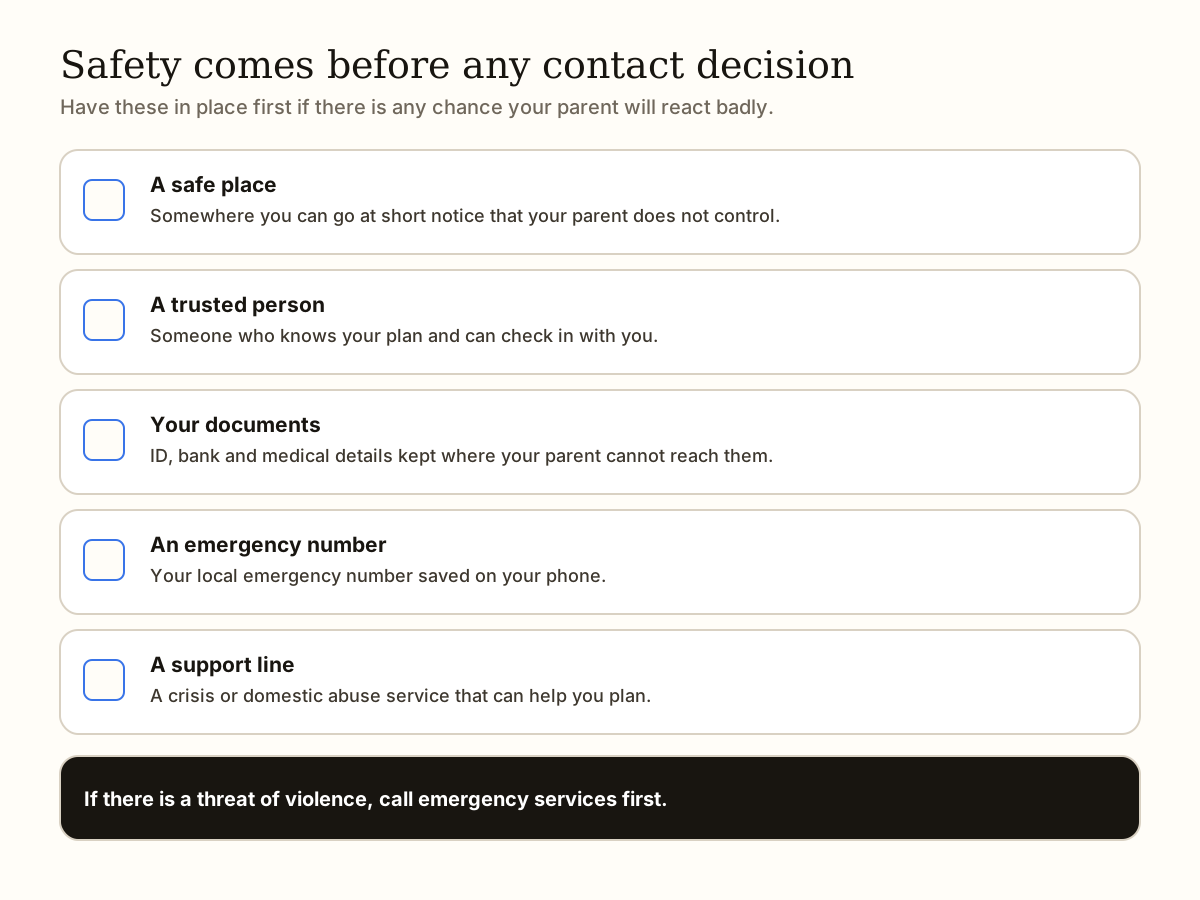
If you are in danger right now, call your local emergency number (911 in the US, 999 in the UK, 112 in Ireland). Skip the explanation and act on safety if they have threatened to hurt you, someone you love or a pet after you set a limit; turned up at your home or work after you asked them not to; used money, housing, immigration status or your children as leverage; or hurt or frightened you after you said no before. If a parent says they will harm themselves unless you respond, that is a reason to call emergency services or a crisis line for them, not a reason to reopen contact on their terms.
- Do not contact your parent to test their reaction. A trial message can start the very escalation you are trying to avoid.
- Tell one person you trust. Give them the plan and the date, and agree how you will check in.
- Keep a record. Screenshot threatening messages and note dates of calls and visits. Store copies somewhere your parent cannot reach, not on a shared cloud account or a family tablet.
- Check what they can see. Shared location, a family phone plan, joint bank accounts and shared streaming or cloud logins can all reveal where you are.
- Call a service that plans for safety. In the US, the National Domestic Violence Hotline is 1-800-799-7233 (text START to 88788) and has a safety planning page. Its material is written mainly around partner abuse, so for abuse by a parent in childhood, Childhelp (1-800-422-4453, or text GO to 800-422-4453) is open to anyone affected by child abuse. In the UK, the NHS says domestic abuse includes abuse between family members, and the National Domestic Abuse Helpline is free on 0808 2000 247.
- For distress rather than danger: in the US, call or text 988. In the UK and Ireland, Samaritans is 116 123. In India, Tele-MANAS is 14416. Our safety page lists more.
Going no contact with parents: is it the right step for you?
Only you can answer that, and “not yet” is as valid as yes. A more useful question than “is my parent a bad person?” is: what would have to change for contact to feel safe enough, and is that change likely?
It may help to know how others describe their reasons. In a qualitative study of 26 adults in Australia, who together described 40 estrangements, Agllias (2016) identified three core reasons: abuse, poor parenting and betrayal. Most described a long-standing sense of disconnection from the parent and the family rather than one blow-up. It was a small interview study, so it tells you what happened for those people, not how common any reason is.
The worksheet below is not a quiz with a score. Write your answers on paper and take several days. The last column says what each kind of answer usually points to. If you are still unsure, stepping down one rung gives you information without committing you to the end of the line. You do not need a therapist to decide, though one can help (more below).
| Area | Ask yourself | What an answer usually points to |
|---|---|---|
| Safety | Have I been physically or sexually harmed, threatened or controlled by this person? Do I feel afraid before I see or hear from them? | Yes means safety planning comes before any decision about contact. See the section above. |
| What contact costs | After a call or visit, how long until I feel like myself? What do I stop doing, eating or sleeping while in contact? | A cost tied to one pattern (comments, drop-ins, money) often responds to a lower rung and clearer limits. |
| What I have tried | Have I told them clearly what I need? Did anything change, even briefly? What happened the last time I enforced a limit? | Limits that were stated clearly and then ignored or punished are the strongest sign that a lower rung may not hold. |
| What I would lose | What do I get from this relationship that I would miss? Which relatives, places and traditions come attached? | Name the losses now. Plan for them (a sibling, a grandparent, a holiday) before you act, not after. |
| What I am grieving | What did I want from this parent that I may never get? Can I live with that being the final answer? | Grief is likely whichever way you go. Line up someone to talk to. |
| What would need to change | Which two or three changes would make contact feel safe? Has this person shown they can do them? | If the changes are things they have never shown they can do, weigh that honestly. If they have, a trial period at a lower rung may be worth it. |
What is low contact, and what sits between full contact and none?
Low contact means keeping the relationship but shrinking it and giving it rules: fewer calls, shorter visits, agreed topics, agreed times, often in a public place or with another person present. It is usually the first rung worth trying, because it is the easiest to adjust in either direction.
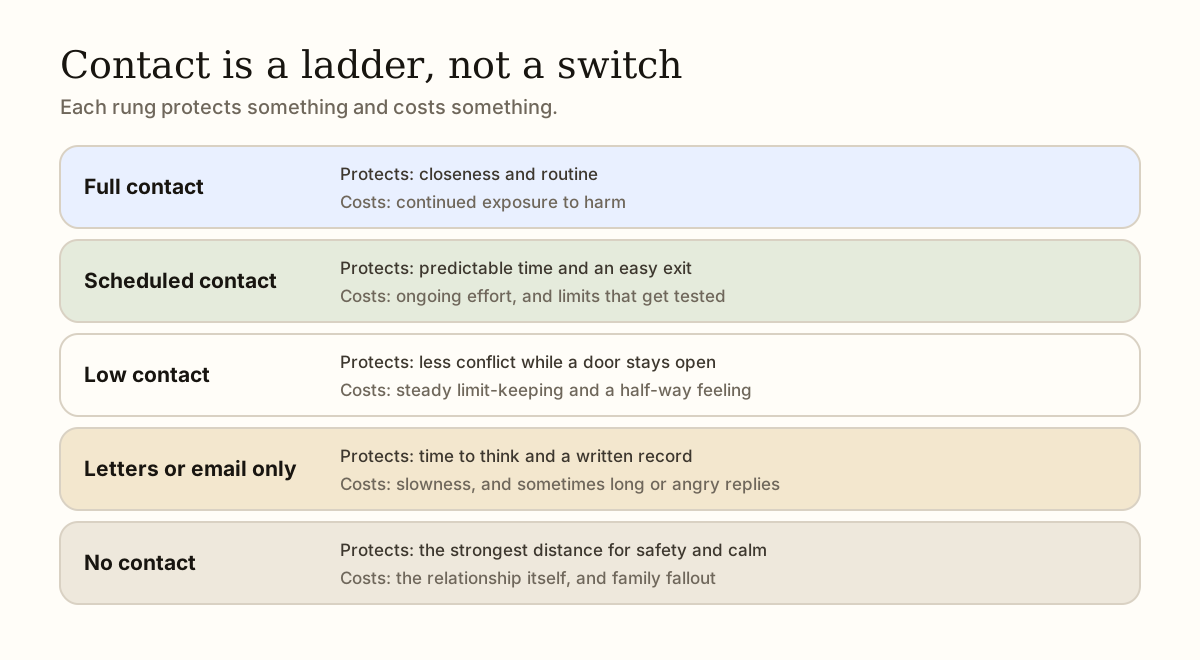
Choose limits you can actually enforce, say them once, and follow through the first time they are crossed. A limit you announce and never act on teaches the opposite of what you meant.
Examples of limits people use: a call on Sunday afternoons for a set time; meeting in a café, never at your home; no alcohol around; no discussion of your partner, weight or money; messages only, no calls. A script that works because it is boring: “I’m happy to talk about work and the garden. If it turns to my marriage, I’ll end the call and try again next week.” Then end the call.
Flat, brief replies are sometimes called grey rock, and our guide to the grey rock method covers when it helps. It can also provoke some people into escalating, so do not use it as a safety strategy. If you also need to block a number or social account, should you block your ex explains the trade-offs, and the channel logic is the same for a parent.
| Option | What it protects | What it costs | When it fits |
|---|---|---|---|
| Full contact | Closeness, shared routines, no explaining | Any ongoing harm continues | The relationship is mostly safe and good for you |
| Scheduled low contact | Your energy and your calendar; a built-in exit | Needs constant limit-keeping; limits get tested | The parent can respect limits, but unstructured contact wears you down |
| Letters or email only | Time to think before replying; a written record | Slow; replies can be long or angry | Phone calls and visits go badly, or you need a record |
| No contact | The strongest distance for safety and calm | Losing the relationship; family fallout; grief | Harm continues despite clear limits, or contact is not safe |
Do I have to explain, and should I tell my parent?
You do not have to explain, and you do not have to tell them. There are four ways to do it, and each buys something different.
- Say nothing and step back. The right choice when explaining could put you at risk. The cost is that they may keep trying and may tell others a version of events.
- Send one short message. It ends the guessing without opening a debate. For example: “I’m stepping back from contact for now. I’m not looking to argue about it. Please don’t come to my home or contact me through other people.”
- Write the full letter, and keep it. Putting everything on paper helps you even if it never leaves your phone or notebook. How to write an unsent letter shows how.
- Ask for a mediated conversation. A family therapist can host it. Only consider this if you feel safe and want to be heard rather than to argue.
How do I handle holidays, siblings and family pressure?
Decide your plan before the invitations arrive, because pressure peaks when a date is close. For each occasion, settle who needs to know, what you will say, and what you will do if the plan is tested.
You can usually stay close to a sibling while stepping back from a parent, but it depends on how that sibling handles being in the middle. Say it plainly: “I’m not asking you to take a side or cut them off. I’m asking you not to pass messages, and not to tell them where I live.” See your sibling one to one, and do not use them to check on the parent. A sibling may also remember the same parent differently, which does not make either memory wrong.
Pressure to reconcile tends to arrive as one of a few lines. Have an answer ready for each, and do not feel you must win the point.
- “You’ll regret this when they’re gone.” Try: “I’ve thought about that. It’s my decision to make.”
- “They’ve changed.” Try: “I hope that’s true. I’m not ready to find out.”
- “Just come for an hour.” Try: “No, thank you. I’ll let you know if that changes.”
- “After everything they’ve done for you.” Try: “I’m not going to argue about this. Can we talk about something else?”
- A relative who keeps pushing: “I’m going to stop talking about it now. If it comes up again, I’ll hang up.” Then hang up.
| Occasion | Who to tell | What to say | If they show up |
|---|---|---|---|
| Holiday meal | The host and one sibling or relative | “I won’t be there this year. I hope the day goes well.” | Leave calmly, or do not open the door. Leave the rest for later. |
| Birthday or Mother’s or Father’s Day | Only people who will ask | “I’m not in touch with them right now. I’d rather not talk about it today.” | Keep your phone muted and a plan for the day with someone else. |
| A sibling’s wedding or graduation | The sibling, early and in private | “I want to celebrate you. Can we find a way that works for both of us?” | Agree arrival and departure times, or a separate visit with the sibling. |
| Funeral or hospital emergency | Whoever organizes it | “I’d like to attend the service and leave after. Please keep seating separate.” | Bring a supportive friend and an exit plan. |
| Family group chat | Nobody needs to be told | Leave or mute it. No announcement needed. | Do not reply to messages sent through the chat. |
How do I grieve a parent who is still alive?
You grieve what you did not get: the parent you needed, the childhood that should have been, the future where it went differently. It is real grief, and it is often unrecognized. There is no leave from work, no card, and some people will tell you that you chose this.
In an interview study of 25 adult children who started or maintained estrangement from a parent, Agllias (2018) found that many said they did so to get relief and room to heal, and that they also experienced it as a considerable loss, missing the emotional, financial and practical support a family can bring. Relief and grief can arrive in the same hour. One does not cancel the other, and having both does not mean you made a mistake.
What helps is naming it, planning for the dates that hurt, and giving the grief somewhere to go. Mother’s Day, Father’s Day, your birthday and the week before Christmas are predictable, so book something for them. Put the unsayable on paper. Tell one person the whole story. Our guide to grief when the person is still alive is written about breakups, but the way it handles unfinished loss applies here too.
What if my parent is older or ill, or my children are involved?
Stepping back does not cancel practical realities, so think ahead. If your parent is frail, ill or in care, decide in advance whether you will take an emergency call as next of kin, who else can be contacted, and whether you will tell a sibling or the care home in writing. If you think an older adult is being neglected or abused by anyone, most areas have an adult protective services or adult safeguarding team that takes concerns, and in the US the Eldercare Locator (1-800-677-1116) can point you to local services for older adults. You can raise a concern without resuming contact. Questions about wills, power of attorney or medical decisions depend on where you live, so ask a lawyer.
If you have children, their safety is the deciding factor in any contact with their grandparent. You can choose supervised visits, none at all, or something in between, and you do not owe the grandparent access because of the relationship you had. Keep the explanation short and true for the child’s age: “We’re not seeing Grandma for now. It isn’t because of anything you did.” If a child is in immediate danger, call your emergency number. Childhelp at 1-800-422-4453 takes calls from anyone worried about child abuse. Grandparent access rules vary by place, so a family lawyer is the right person to ask.
Do I need a therapist, and how do I find a good one?
You can step back without a therapist, but support helps because the hardest part is often the aftermath rather than the decision. Look for a therapist who has worked with family estrangement, trauma or family systems, and ask at the first session: “How do you approach estrangement? Do you have a view on whether I should reconcile?” You want someone who helps you decide, not someone who decides for you. If a therapist pushes forgiveness or cutoff before you have said what you want, find another.
In England, you can refer yourself to NHS Talking Therapies for many problems such as anxiety and depression without seeing a GP first. In the US, start with your insurer’s directory or a psychologist locator. If you are in crisis, use the numbers in the safety section above.
Step-by-step plan
- Check safety first
If there has been violence, threats or control, make a safety plan and tell a trusted person before you change anything.
- Pick a rung and write the rule in one sentence
For example: “Phone calls on Sunday for up to 30 minutes, no discussion of my marriage,” or “No contact for now.”
- Audit shared accounts
Check the family phone plan, location sharing, cloud photos, streaming logins and shared passwords. Change passwords and sign out of old devices.
- Update documents and emergency contacts
Review your next-of-kin and emergency-contact listings with your employer, doctor, bank and school, and move important documents out of the family home if you can.
- Set up your channels
Mute, filter or block numbers and accounts, and route their emails to a folder you check on your schedule. Use a trusted address for post if needed.
- Tell the few people who need to know
Siblings, your partner, and anyone the parent might contact, such as a workplace. Keep it short and factual.
- Write your reasons down
Put your reasons on one page you can reread when guilt or pressure builds.
- Review on a schedule
Pick a date to reconsider, such as once a year, so the decision is not remade every holiday.
You do not have to solve the whole relationship tonight. Take one private step that creates space between the feeling and the action.
Build your no contact plan →Common questions
Is it normal to feel guilty about going no contact with my mum or dad?
Yes. Guilt often comes from loyalty, family rules and fear of being the “bad” one, and it can sit alongside relief. Guilt is a feeling, not a verdict on whether your decision was right. If it is heavy or lasts, a therapist can help you sort out what is guilt and what is grief.
Can I go no contact with a parent and still see my siblings?
Often yes, but it depends on how the sibling handles being in the middle. Tell them clearly what you need, for example that you are not asking them to take sides but that you do not want messages passed or your address shared. Meet one to one and avoid using them to check on your parent.
Is going no contact with a parent permanent?
It does not have to be, and you do not need to promise “forever” or announce an end date. “For now” is honest, and you can review it on a schedule you choose, such as once a year, rather than at every holiday. If you reopen contact, start on a lower rung than where you left off, with the limits you needed before.
Should I tell my parent I am going no contact?
You do not have to. If you feel safe, one short message can end the guessing, for example “I’m stepping back from contact for now.” If you do not feel safe, say nothing and put your safety plan first.
Do I have to explain why I am going no contact with my parent?
No. Explanations often turn into a debate, and a parent who disagrees with your reasons may argue each one. You can write the full reasons for yourself, in a letter you keep, and send little or nothing.
Can I go no contact with a parent without a therapist?
Yes. Therapy is not required, and the decision is yours as an adult. Many people find a therapist helpful for the guilt, grief and family pressure that follow, so it is worth considering, but it is not a gate you must pass first.
What are the signs I should go no contact with my parent?
No single sign settles it. Patterns that make people consider it include harm that continues after clear limits, threats or control, and contact that reliably leaves you unwell or unsafe for days. If your safety is at stake, make a safety plan first. If it is not, try lower rungs of contact before the last one.
What should I do if my parent threatens me after I step back?
Do not argue or negotiate. Save the message, tell your trusted person, and call your emergency number if you fear for your safety. A lawyer or local victim-support service can explain what protection orders exist where you live.
Can I get help for family abuse if I am not sure it counts?
Yes, you do not have to be sure. The NHS says domestic abuse includes abuse between family members, and in the UK the National Domestic Abuse Helpline is 0808 2000 247. In the US, the National Domestic Violence Hotline is focused on partner abuse, Childhelp (1-800-422-4453) covers child abuse, and 988 is there for distress. A therapist can also help you work out what happened.
Is it okay to stop talking to my parent if they never admitted what they did?
Yes. Whether to have contact depends on whether contact is safe and good for you now, not on whether they ever apologize. Some people decide to wait for an admission, and others decide the waiting is the harm. Both are your call.
If contact involves threats, stalking, coercion, shared children, housing or immediate safety, a general no-contact rule may not fit. Read the safety guidance and seek qualified local help where appropriate.
Sources and further help
- Scharp (2019) — “You’re Not Welcome Here”: A grounded theory of family distancing. Communication Research
- Agllias (2016) — Disconnection and decision-making: adult children explain their reasons for estranging from parents. Australian Social Work
- Agllias (2018) — Missing family: the adult child’s experience of parental estrangement. Journal of Social Work Practice
- National Domestic Violence Hotline — plan for safety
- Childhelp National Child Abuse Hotline
- NHS — getting help for domestic violence and abuse
- NHS Talking Therapies
- 988 Suicide & Crisis Lifeline
- Eldercare Locator (Administration for Community Living)
Research is cited to explain general patterns, not to diagnose or predict any individual outcome. Sources do not endorse UnLink. Read our editorial principles.
Keep this support one tap away.
UnLink is a free, private no-contact tracker for iPhone: count your days, get through urges and restart without losing your history.