No Contact With a Narcissist: Safety First, Then a Plan
No contact with a narcissist: check your safety first, then decide between full and modified no contact, expect hoovering, and keep records. No diagnosing.
 By the UnLink Editorial Team · General educational guidance, not therapy
Going no contact with a narcissist means ending contact with someone whose behavior harms you, but check your safety before you do anything else. If they have threatened, followed or hurt you, or use money or children as leverage, talk to a domestic violence service first. You cannot diagnose anyone from messages, so plan around what they do.
- Safety comes before tactics. If the other person has threatened, followed or harmed you, make a plan with a domestic violence service before you block, announce or move.
- You do not need to be sure anyone is a narcissist. You can act on behavior: what they do, what it costs you, and what you will do about it.
- Some people meet a surge after the boundary: repeated messages, messages through friends, charm, anger or stories about you. A surge is a pattern to plan for. A threat is a safety matter.
- If you share children, a home or a workplace, use modified no contact: practical topics only, one written channel, and records kept.
- Keep records of harassing contact without replying to it, and get support from people who are not the other person.
Should I go no contact with a narcissist? Start with safety.
Going no contact can be the right call when someone keeps belittling, controlling or draining you and does not accept your limits. It still comes after one question: is anyone at risk of harm? If the answer might be yes, read the next section first. Everything after it, including grey rock and blocking, assumes you are physically safe.
This page does not diagnose anyone. Narcissistic personality disorder is a clinical diagnosis, and MedlinePlus notes that personality disorders are diagnosed through a psychological evaluation by a health care provider. You cannot make that call from a breakup, a family argument or a stack of messages, and you do not have to. A label can even keep you stuck, because the question becomes “is he really one?” instead of “what do I need to do?”.
You are allowed to go no contact without being certain. “This hurts me, and they will not change how they treat me” is enough.
Is it safe to go no contact with a narcissist?
Usually, but not always, and the moment you pull away can be the moment risk rises. In an 11-city US study comparing 220 women killed by an intimate partner with 343 abused women who were not, Campbell and colleagues (2003) found that estrangement, especially from a controlling partner, was associated with higher risk of intimate partner femicide. Stalking and the abuser’s access to a gun were also linked to higher risk. Most people who end a relationship never face anything like this, but you cannot assume you are in that group, and a safety plan costs little.
Treat these as a safety situation, not a communication problem:
- Threats to hurt you, themselves, your pets or someone you love, or threats to take your children or report you falsely.
- Following you, turning up at your home, work or gym, or messaging from new numbers after you ask them to stop.
- Physical violence at any point, or contact that gets more frequent or more intense after you set a limit.
- Tracking your phone or location, or getting into your accounts.
- Control over your money, housing, documents or access to your children.
- You are afraid of what happens when you say no. That fear is information.
What should I do if it isn’t safe?
If you are in immediate danger, call your local emergency number (911 in the US, 999 in the UK and Ireland, 112 in India). Then talk to a trained advocate. In the US, the National Domestic Violence Hotline is 1-800-799-7233, or text START to 88788, or use the chat on thehotline.org. Advocates are available 24 hours a day and can help you build a plan that fits your situation. Other countries need a local equivalent: search for your country’s domestic abuse helpline or ask local police for one.
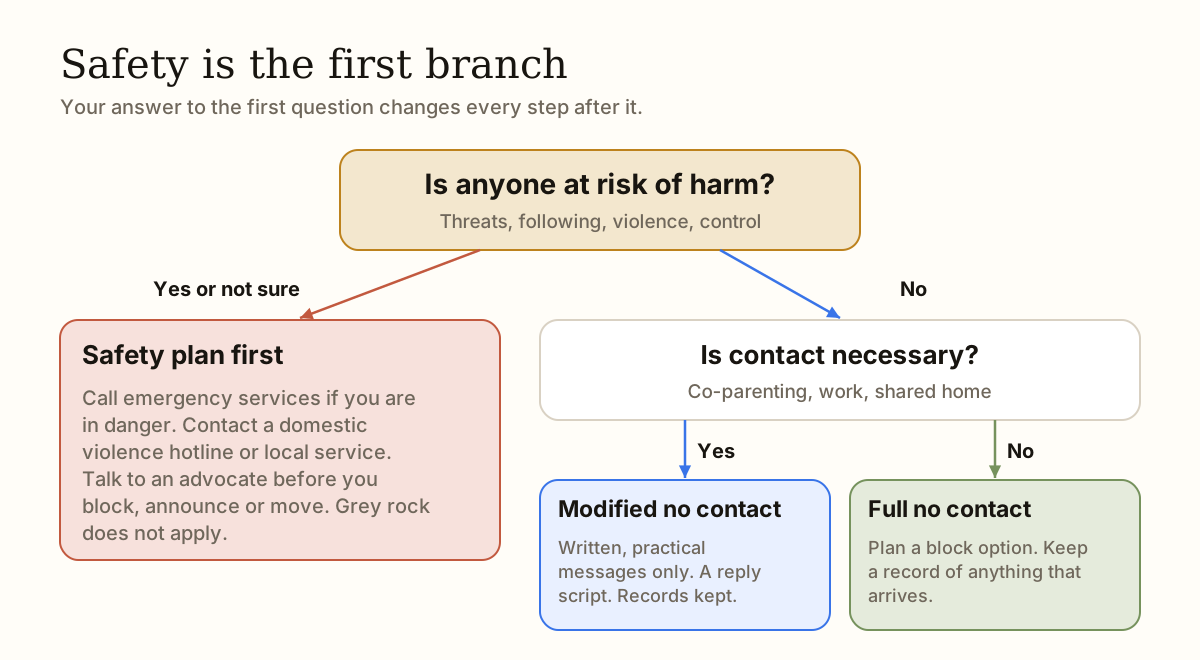
Before you block, announce a decision, move out or hand anything over, ask an advocate about timing. Unless they advise otherwise, skip the final message explaining yourself. It rarely changes the other person’s mind, and it tells them exactly when the door is closing.
Two pieces of advice on this page do not apply if any sign above is true: grey rock, and blocking everywhere at once. Someone who escalates can read grey rock as defiance, and a sudden block can remove your only warning. If children or money are used as leverage, your first step is legal and practical advice, not a cleverer reply.
Check your devices too. Apple’s Personal Safety User Guide shows how to review who can see your location, which accounts you share and which apps have access, and our safety page has more links. UnLink, a free no-contact tracker for iPhone, is not a safety tool and cannot protect you from another person.
If you are thinking of harming yourself: in the US call or text 988; in the UK and Ireland call Samaritans on 116 123; in India call Tele-MANAS on 14416.
Can I tell someone is a narcissist from their behavior?
Not reliably, and you do not need to. People use “narcissist” for everything from a self-absorbed ex to someone who is abusive, so the word alone tells you little about what is happening or how to protect yourself.
Behavior is a better guide because you can see it, date it and write it down. Reading your messages and checking your phone every night is a pattern. “He is a narcissist” is a guess about someone’s inner life. MedlinePlus also notes that people with personality disorders usually do not seek treatment on their own, because they see the traits as part of who they are. That is one reason change is not something you can count on or cause.
Judge the relationship by what it does to you. Do you get smaller, more anxious, more isolated, more afraid of the reaction? That is reason enough to limit contact, whatever the label turns out to be.
What do narcissists do when you go no contact? Patterns to plan for
Some people meet a surge after a boundary is set. Online it gets packaged as “7 things narcissists do”. We would rather describe patterns than traits. They appear whenever someone ends contact with a person who does not accept the limit, and they prove nothing about the sender.
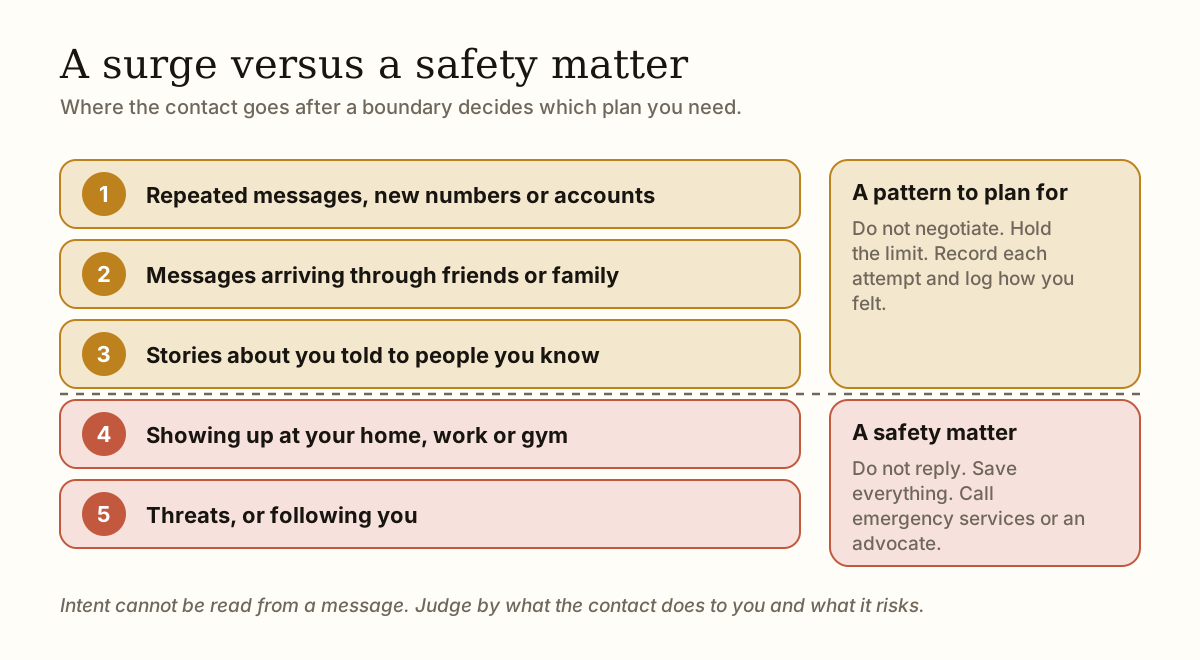
There is some behavioral science behind a surge. When behavior that used to be rewarded stops getting a reward, it sometimes spikes first, which researchers call an extinction burst. Lerman and Iwata (1995) analyzed 113 sets of extinction data from applied treatment research and found a burst in 24% of cases, less often than had been assumed. That research was not about exes, so treat it as an analogy, not a forecast. A surge is possible, it is not guaranteed, and the answer to a loud week is not to give in.
One term to know: hoovering is a popular word, not a clinical one, for attempts to pull someone back into contact after distance. It is named after the vacuum cleaner.
| Pattern | What it can look like | What it can be aiming for | Your options |
|---|---|---|---|
| Hoovering | A sudden apology, “I miss you”, a crisis only you can fix, a “thinking of you” on your birthday | A reply, which restarts the old routine | Don’t reply. If you must, answer only logistics. Log it |
| Smear attempts | Mutual friends hear a story about you; someone asks “what happened?” with an edge | Controlling the story, or getting you to defend yourself | One calm sentence to people you trust. Skip public rebuttals. Keep screenshots if it affects work or custody |
| Escalation | More messages, more channels, new numbers, calls to your family | Making the boundary costlier than giving in | Don’t negotiate. Block or filter where safe. Record each attempt. Threats go to the safety section |
| Testing | A small message: “can I just get my charger back?” | Finding out whether the boundary holds | Hold it quietly. Route belongings through a third party |
| Leverage | Money, shared accounts, the lease or the kids as a reason you must talk | Keeping a reason for contact open | Practical-only contact in writing. Get legal or financial advice, and a safety plan if control is involved |
Do I need no contact, or modified no contact?
Choose full no contact when nothing ties you together that you cannot end: no children, no shared lease, no job. Choose modified no contact when something does, which means contact limited to the practical, through one written channel, at set times. Our guide to modified no contact has the rules, and the no contact rule page covers the full version.
Co-parenting is the most common reason a clean break is not possible. Use a single written channel, keep every message about the child, and answer on your schedule, not theirs. At work, move conversations into email or shared documents and ask about a different reporting line if the behavior is affecting you. With family you can limit visits and topics and still be in the room at a wedding.
How do I respond when a narcissist hoovers, and when not to?
The default is not to reply. Even a “no” can tell the other person the channel still works. Keep replies for the narrow cases in the table.
Example: it has been three weeks since you went no contact, and at 11:40 p.m. this arrives: “I’ve been thinking about how I treated you. Can we talk? I’m not doing well.” Replying feels cruel and silence feels like abandoning someone in pain. You are not required to be their only support. If you answer at all, one line that does not engage with the content is the most you owe: “I hope you have support. I’m not able to talk.” Then stop. If you share a child or a lease and the message is about that, answer only that, once, in the agreed channel.
- The grey rock method guide covers the technique. It works when contact cannot be avoided and you are safe, and it is the wrong tool if any safety sign applies.
- The grey rock reply builder turns a message you received into a short, flat reply.
- If you cannot tell whether to answer a message, what to do when your ex texts you during no contact walks through the reply-or-not question.
| Message type | Reply? | What to do |
|---|---|---|
| Practical, about children, work or a shared bill | Yes, briefly, in the agreed channel | One short answer to the practical question. No history, no feelings |
| Apology, love-bombing or “I’ve changed” | No | Save it if you may need it. Let the urge pass and log it |
| Guilt, blame or accusations | No | Don’t defend yourself in writing. Talk to someone on your side |
| Messages via friends or family | No | Tell them you are not a go-between. Pass nothing back |
| Threats, following or turning up | No | Save everything and call emergency services or an advocate |
Should I block a narcissist, and how do I keep records?
If you are safe, blocking is usually the simplest way to stop a surge reaching you. If you need the messages for custody, work or legal reasons, filter or mute them and read them at set times, ideally with a friend. Our guide on whether to block your ex compares block, mute and restrict. If your problem is the urge to reach out yourself, how to block yourself from texting someone covers the reverse.
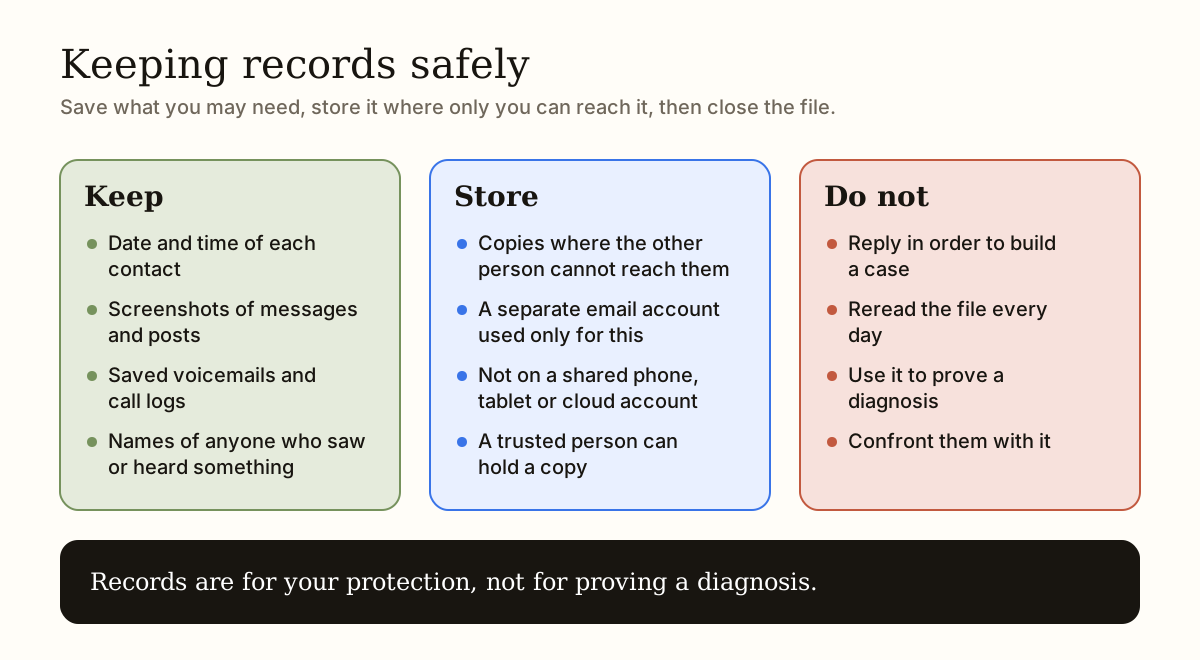
Keep records without engaging. The National Domestic Violence Hotline suggests keeping dated descriptions of incidents, printed emails or call logs, text messages, screenshots of social media posts and saved voicemails. It also suggests storing copies where the other person cannot reach them, such as a separate email account used only for this. Do not keep them on a phone or cloud account the other person can see.
Records are for your protection, in case you need a police report, a protective order, a custody hearing or an HR complaint. They are not for proving a diagnosis, and you do not need to reread them. Store them and close the file.
Is no contact with a narcissist different from no contact with an ex?
The rule is the same: no messages, calls or checking. What changes is the pressure around it: more third parties, more ties you cannot cut, and a stronger sense that you are being unfair. Self-doubt is usually the loudest part. If you keep wondering whether you imagined it, write down what happened in dated, plain sentences. That helps more than debating it in your head.
Checking their profile is the same trap here as anywhere. In a study of 464 people after a breakup, Marshall (2012) found that Facebook surveillance of an ex was associated with more distress, more longing and less personal growth. Mute the account, ask a friend to be your information filter, and use the urge guide when you want to look.
Who can support me while I do this?
You do not have to do this alone or be sure first. Useful help includes a therapist who understands coercive control (ask directly), a domestic violence advocate if any safety sign applies, and one or two friends who listen without telling you what to do. Support groups for people leaving harmful relationships run in many areas and online.
Expect the pull to contact them. Missing someone who treated you badly is common and does not mean you were wrong to leave. Why do I miss my abusive ex goes into it. Put what you want to say in an unsent letter, and make an if-then plan for the worst hours. Gollwitzer (1999) found that if-then plans (“if X happens, I will do Y”) help people follow through on goals.
Step-by-step plan
- Check your safety
If any sign in the safety section applies, contact a domestic violence service or emergency services first.
- Choose the contact level
Full no contact if nothing ties you together; modified no contact for children, work or housing.
- Skip the long explanation
You do not owe a final speech. If you send one line, send it once and only when you are safe.
- Set up your channels
Block, mute or filter where it is safe, and move required contact to one written channel.
- Write if-then plans
Decide now what you will do when a hoovering message or a late-night urge arrives.
- Keep records without replying
Save dates and screenshots where only you can reach them.
- Line up support
Tell one or two people your plan, and book a therapist or advocate if you can.
You do not have to solve the whole relationship tonight. Take one private step that creates space between the feeling and the action.
Grey rock reply builder →Common questions
Should I go no contact with a narcissist?
If the contact harms you and the person does not respect your limits, it is a reasonable choice, and you do not need a diagnosis to make it. Check your safety first. If there are threats, following, violence or control over money or children, talk to a domestic violence service before you change anything.
Is it safe to go no contact with a narcissist?
Often, but ending contact can raise risk when the other person is controlling or violent. A US study of intimate partner femicide found estrangement from a controlling partner associated with higher risk (Campbell et al., 2003). If you are unsure, call the National Domestic Violence Hotline on 1-800-799-7233 before you act.
Can someone be diagnosed as a narcissist from a few messages?
No. Narcissistic personality disorder is diagnosed by a qualified professional through a psychological evaluation, not from messages or one side of a story. You can still describe behavior, such as lying, threats or put-downs, and decide what to do about it.
What is hoovering?
Hoovering is a popular term for attempts to pull you back into contact after distance, named after the vacuum cleaner. It can look like an apology, a crisis, a compliment or a request for help. It is not a clinical term and proves nothing about the person. Treat it as a pattern to plan for.
What do narcissists do when you go no contact?
People often describe a surge: more messages, new accounts, messages through friends, charm, anger or stories about you. A surge you hold through often fades. Threats, following or turning up are a safety matter, not a communication problem.
What if a narcissist threatens me when I go no contact?
Take it seriously. Do not reply or negotiate. Save the message with its date, and if you are in immediate danger call your local emergency number. In the US you can also call 1-800-799-7233 or text START to 88788 to talk to an advocate about a safety plan.
Should I block a narcissist?
If you are safe and do not need the messages as records, blocking is usually the simplest option. If you need evidence for custody, work or court, mute or filter instead and keep copies where only you can reach them. If you feel unsafe, ask an advocate about timing before you block.
What if we share children?
Use modified no contact: one written channel such as a co-parenting app or email, practical messages about the children only, and records of all of it. A family lawyer or domestic violence advocate can help you decide what to put in writing if the other parent uses the children as leverage.
Is it safe to ignore a narcissist ex who keeps messaging?
Often yes, if the messages are a nuisance, because not replying is a big part of holding the line. If they include threats, show you are being watched or escalate, save them and get help. Ignoring is not a safety plan.
Do narcissists ever change?
Some people change, usually when they decide to and stay in therapy for a long time. According to the NHS, many people with a personality disorder recover over time, and treatment is often helpful. You cannot cause that change or know whether it applies to your person, so base your plan on what they do now.
If contact involves threats, stalking, coercion, shared children, housing or immediate safety, a general no-contact rule may not fit. Read the safety guidance and seek qualified local help where appropriate.
Sources and further help
- Campbell et al. (2003) — Risk factors for femicide in abusive relationships: results from a multisite case control study
- Lerman & Iwata (1995) — Prevalence of the extinction burst and its attenuation during treatment
- Marshall (2012) — Facebook surveillance of former romantic partners: associations with postbreakup recovery and personal growth
- Gollwitzer (1999) — Implementation intentions: strong effects of simple plans
- MedlinePlus — Personality disorders
- NHS — Personality disorder
- The National Domestic Violence Hotline — Plan for safety
- The National Domestic Violence Hotline — Documenting abuse
- Apple — Personal Safety User Guide
- 988 Suicide & Crisis Lifeline
- Samaritans — Contact a Samaritan
- Tele-MANAS — national tele mental health helpline (India)
Research is cited to explain general patterns, not to diagnose or predict any individual outcome. Sources do not endorse UnLink. Read our editorial principles.
Keep this support one tap away.
UnLink is a free, private no-contact tracker for iPhone: count your days, get through urges and restart without losing your history.