
The grey rock reply builder turns a provoking, guilt-tripping or baiting message into a short, flat reply, or tells you when no reply is the better answer. Pick who the person is to you and what kind of message it is, and it suggests replies you can copy and edit. Pasted text stays on your device.
How to use the grey rock reply builder
The builder works best when you use it before you reply, not after. If the message has made your heart race, that is exactly the moment to slow down. New to the idea? Start with how the grey rock method works.
- Choose who the person is to you now: a co-parent, a coworker, a family member, or an ex you share nothing with.
- Pick the kind of message you received. If it mixes several, choose the part that hooked you most.
- Optionally paste the message. The builder scans it on your device for practical questions and for warning signs such as threats.
- Read the advice first. Sometimes the best grey rock reply is no reply.
- Copy a reply, fill in any [brackets], wait a little if it is not urgent, then send it and close the thread.
What makes a reply grey rock
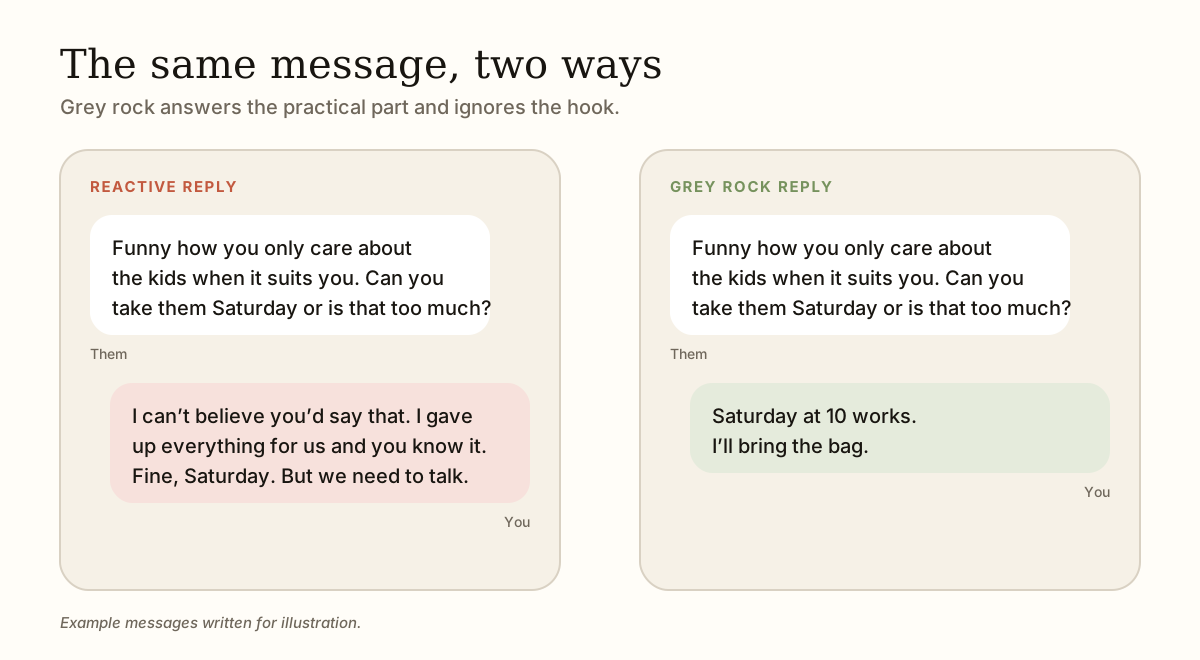
Every suggestion follows the same three rules. It answers only the practical question, if there is one. It contains no feelings, opinions, explanations or news about your life. And it is short enough that there is nothing to pick apart. Compare the two replies below: both agree to Saturday, but only one hands over material for the next argument.
Why the builder sometimes says do not reply
For comments about a new partner, nostalgic “I miss us” messages and most guilt trips from an ex you share nothing with, silence is the clearest boundary. Any reply, even a polite one, tells the other person the message landed and keeps the conversation alive. Where you do share children or a job, the builder suggests replying only to the practical part.
If you are unsure whether a reply would even count as breaking your boundary, check it with Does this break no contact?
Safety: when grey rock is the wrong tool
If you choose “a threat” or paste a message with threatening language, the builder does not suggest replies. Grey rock is meant for people who want a reaction, not for people who may hurt you, and going quiet can make some people escalate. Save the message, tell someone you trust, and contact a domestic violence service or the police. In the US, the National Domestic Violence Hotline is 1-800-799-7233. Our safety page has more options.
The warning-sign check is a simple word match. It will miss some threats and flag some harmless messages. Trust your own sense of danger over the tool.
Privacy
The builder runs entirely in your browser. Replies come from a fixed library of templates, not from an AI service, and nothing you paste is sent to us or stored. Closing the page clears it.
Common questions
What is a grey rock response?
A grey rock response is a brief, factual, emotionless reply that answers only the practical part of a message and ignores the provocation. For example, “Saturday at 10 works” in reply to a jab about your parenting. The aim is to give someone who wants a reaction nothing to work with.
How do you grey rock over text?
Wait before replying, answer only the practical question in one or two sentences, and leave out feelings, explanations and personal news. If there is no practical question, do not reply. Keep all communication in one channel and save the thread.
Is it rude to grey rock someone?
No. Grey rock replies can be perfectly polite. They are simply short and impersonal. You are declining to take part in conflict, not insulting anyone.
Does the reply builder use AI?
No. It picks from a fixed set of templates based on your choices and a simple on-device check of the text you paste. Nothing is sent anywhere.