What Is Modified No Contact? Rules for Co-Parenting and Work
Modified no contact limits talk to practical topics, one channel and set reply windows. Rules, scripts and a message test for co-parenting, work, shared homes.
 By the UnLink Editorial Team · General educational guidance, not therapy
Modified no contact is a boundary that limits communication with a former partner to necessary, practical topics, through one agreed channel, inside set response windows. It is used when full no contact isn’t realistic, such as co-parenting, shared work or a shared home. It protects your recovery, but it isn’t a safety plan.
- Modified no contact keeps the minimum contact your situation requires and removes the personal, emotional layer.
- It rests on four rules: one channel, practical topics only, set response windows, and short neutral replies.
- Decide in advance what counts as an emergency, because that is where the rules most often collapse.
- Parallel parenting is a formal, written version of the same idea. It is not suitable where there is abuse or a threat to a child.
- If there has been abuse, stalking or coercion, get a safety plan from an advocate before setting any contact rules.
What is modified no contact?
Modified no contact, sometimes called limited contact, is the middle path between talking freely and cutting someone off. You decide that contact happens only when it is necessary, only about specific topics, and only through a defined channel. Full no contact means no messages, calls, social media or conversation beyond what can’t be avoided. Modified no contact keeps the minimum you need to function and strips out the personal layer that keeps you stuck.
Like full no contact, it is a boundary for your own recovery, not a tactic to make someone miss you or to pressure them into a response. If the rules are really a way of controlling how they feel, the boundary starts to feel like a game and costs you more energy. For why people use no contact at all, see what the no contact rule is.
Note that “modified no contact” is a community term, not a clinical or legal one. Courts, mediators and family agencies speak of parallel parenting, which is the formal cousin of this idea and is covered below.
When is modified no contact the right choice?
It fits when you can’t or shouldn’t cut contact completely. The usual cases are co-parenting, working with a former partner, and sharing a home, lease or business. A few others come up: a shared pet, a friend group you don’t want to leave, and family events.
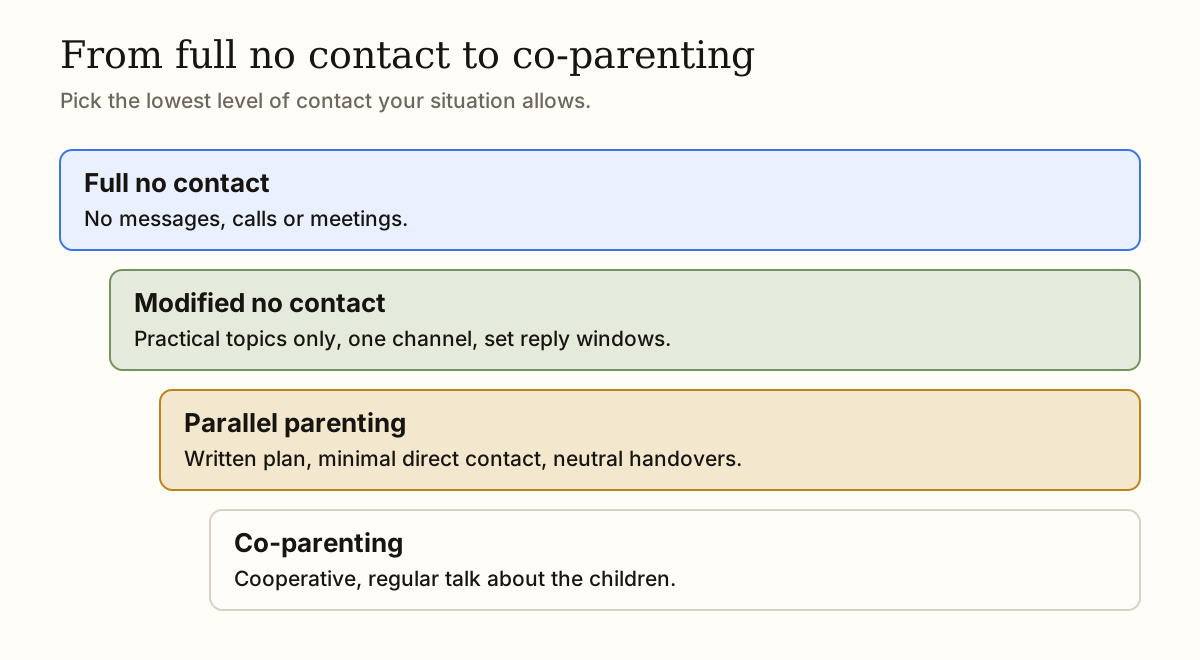
If you can cut contact completely and safely, that is often easier to keep, because there is no daily decision to make. If you can’t, a narrow channel beats a vague one. The ladder below shows where modified no contact sits.
Modified no contact vs grey rock vs parallel parenting: what is the difference?
They overlap, which is why they get confused. Modified no contact is the boundary (how much you talk). Grey rock is a style you use inside that boundary (how you talk). Parallel parenting is a formal arrangement for separated parents, usually written into a plan.
The Department of Justice Canada describes parallel parenting as an arrangement where each parent stays involved but the setup is built to minimize contact between the parents and shield children from ongoing conflict. It also notes that a finding of a threat to the children, or concern about violence toward the other parent, would rule it out. Singapore’s family services site describes it similarly, as an approach where parents have little direct contact and each parents in their own way.
| Approach | What it is | Best when | Watch out for |
|---|---|---|---|
| Full no contact | No messages, calls, meetings or social media. | You share nothing you must coordinate and it’s safe to stop. | Doesn’t work where children, a lease or a workplace tie you together. |
| Modified no contact | Practical topics only, one channel, set response windows. | You must stay in touch but want the emotional layer gone. | Drifting off topic; treating it as a trick to provoke a reaction. |
| Grey rock | A reply style: brief, flat, factual, no personal detail. | Contact can’t be avoided and replies keep turning into arguments. | It can provoke a stronger reaction and isn’t a safety strategy. See the grey rock method. |
| Parallel parenting | A written plan with minimal direct contact between parents. | Parents with high conflict who can’t cooperate but both stay involved. | Not for cases with abuse or a threat to a child; needs a clear, enforceable plan. |
What are the core rules of modified no contact?
Good rules are specific, written down and easy to repeat. “I’ll keep it light” collapses under pressure. Use the list below as a template.
- One channel. A co-parenting app, email or a work ticketing system. Don’t drift to text or social media for personal things.
- Practical topics only. Schedules, handovers, deadlines, bills, documents and safety. Leave out the relationship, the past, other people’s opinions and personal news.
- Response windows. Decide when you reply, such as within one business day, and use a Focus on your iPhone to silence notifications outside it. Apple’s guide to setting up a Focus is linked in the sources.
- Short, neutral replies. Answer the question asked. No explanations, apologies or reassurance. That is grey rock in practice.
- No messengers. Don’t pass personal messages through children, friends or colleagues, in either direction.
- A record. Keep the thread and any agreements, so you can check facts without rereading old messages for emotional reasons.
How do I set up modified no contact for co-parenting?
Your children’s needs come first, and in most cases a custody order or parenting plan already sets the timetable. Modified no contact with a co-parent does not mean cutting off your child. It means personal conversation with the other parent stops and communication about the children becomes logistical and written. This is general information, not legal advice; check what your order requires with a family law professional.
Use a co-parenting app or a shared calendar where you can, so schedules, expenses and changes live in one record. Singapore’s family services guidance suggests short, child-focused written messages, public places for handovers, and never using children as messengers. Those fit this approach well.
There is also a named style for the replies. Bill Eddy’s BIFF method (brief, informative, friendly, firm) suggests short answers that give the needed information, stay civil and close the topic. It comes from practitioner experience and has not been tested in controlled trials, so treat it as a handy template, not proven treatment. The scripts below follow the same spirit.
- Schedule change: “Can we swap Thursday to Friday for the dentist? Please reply by Tuesday.”
- Replying to a request: “Yes, I can take them Friday. Please confirm pickup time in the app.”
- Declining a personal topic: “I’m only going to discuss the children’s logistics here.”
- Emotional message with no child issue in it: no reply, and save it. If it contains a child-related issue, answer that part only.
- Cooling down a heated exchange: “I’m going to pause this and reply tomorrow. Please keep it to the schedule.”
- A new partner comes up: “That’s outside what we’re discussing. Back to Saturday’s pickup.”
What counts as an emergency, and how do I test a message?
Most failures of modified no contact happen at the edges, when a message might be practical or might be bait. Decide the emergency definition now: a sick or injured child, a missed pickup with no answer, a safety concern, a locked-out or flooded home. Anything else can wait for your response window.
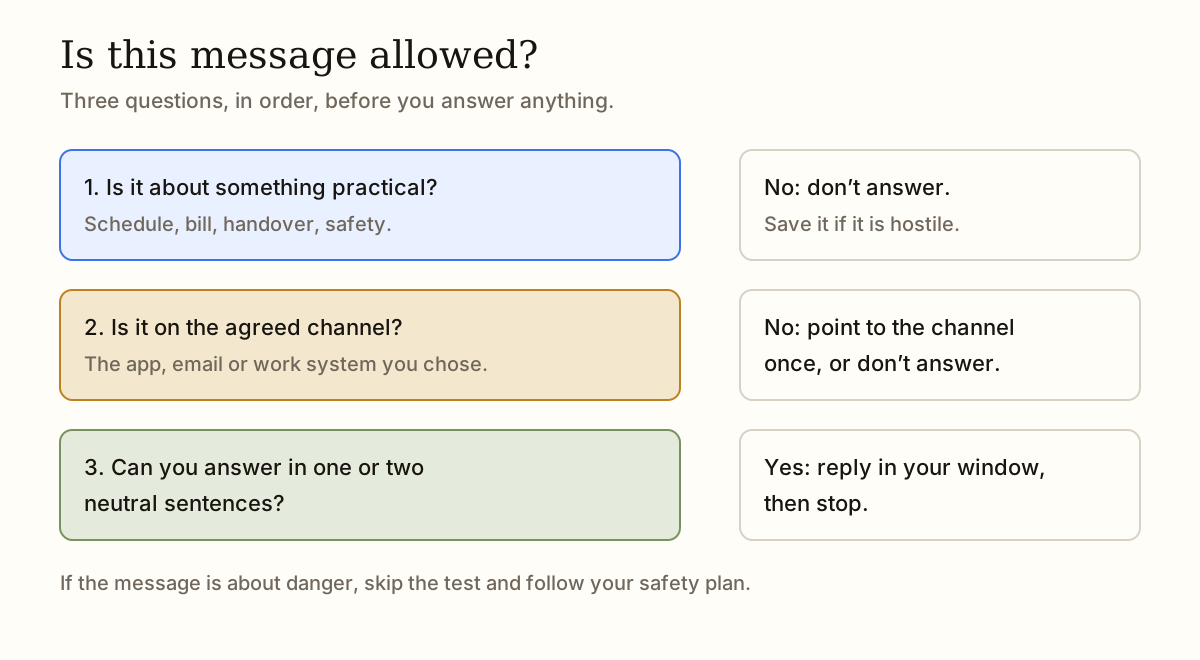
For everything else, run the message through the three questions below. If you’re unsure whether a reply breaks your own rule, the does this break no contact tool checks it privately. And to turn these rules into a one-page plan with your own channel, windows and scripts, use the no contact plan generator.
How do I set up no contact with a coworker?
You can’t leave a job just to avoid one person, and avoidance can be noticed. The aim is professional, documented contact. Move conversations into shared tools such as email, chat channels or a project board. Skip one-to-one lunches, after-hours messages and anything beyond the task.
If the situation affects your ability to work, or the other person behaves unprofessionally, tell your manager or HR. A short, factual note is usually enough to get the arrangement changed. You don’t owe them the backstory.
- Task message: “I’ve updated the report in the shared folder. Let me know if you need the appendix.”
- Declining a social invite: “Thanks, I’m not joining social plans this month, but I hope the team enjoys it.”
- Redirecting a personal comment: “Let’s keep this to the project. I’ll send the figures by end of day.”
- Note to a manager: “I’d like to keep all communication with Sam in writing, on the project channel. Can we agree on that?”
What about a shared home, a friend group or family events?
Shared home: agree who handles what by written message (rent, utilities, move-out dates), keep conversation to the house, and plan a move-out date because modified no contact is hard to sustain under one roof. Shared friends: ask friends not to relay news about each other, and consider seeing them one-to-one for a while. Shared pet: put the schedule in writing, like a children’s schedule.
Family is a different case. If the person you’re stepping back from is a parent or relative, see going no contact with a parent, which has options between full silence and full access. If the person is controlling or manipulative, no contact with a narcissist covers safety-first planning without labelling anyone.
What safety rules apply to modified no contact?
Modified no contact isn’t suitable in every situation. If the relationship involved abuse, coercion, threats, stalking or violence, speak to a domestic violence advocate before setting contact rules, and don’t try to manage a dangerous person with a schedule. Leaving or changing contact can raise risk, so safety planning comes first. The National Domestic Violence Hotline gives confidential help at 1-800-799-7233, or by texting START to 88788, and its plan-for-safety page is in the sources.
Practical steps: keep a log of contact with dates, times and channels. Save threatening messages instead of deleting them. Tell your workplace or your child’s school about safety concerns. If a protective order might apply, talk to a legal professional or support service. If you’re in crisis, call or text 988 in the US, Samaritans on 116 123 in the UK and Ireland, or Tele-MANAS on 14416 in India. More on the safety page.
How do I tell if modified no contact is working?
It’s working when the practical tasks get done, your replies get shorter, and you spend less energy checking your phone. It isn’t working when messages drift off topic, rules keep getting broken, and you rehearse replies in your head. That’s a signal to revisit the plan, bring in a mediator or move to something more formal. The rules are there to be adjusted, not defended at all costs.
On day counts: in modified no contact, count days since the last personal contact (a chat, a reaction, a late-night text), not days since the last logistics message. Otherwise the count never starts. For the wider recovery picture, see how to stop texting your ex.
- Messages regularly go past the agreed topics.
- You reread or draft replies for long stretches.
- You feel anxious, angry or drained after every exchange.
- You’re tempted to use the children or colleagues to relay personal messages.
You do not have to solve the whole relationship tonight. Take one private step that creates space between the feeling and the action.
Build your no-contact plan →Common questions
What is modified no contact?
Modified no contact is a limited form of no contact in which you communicate only about necessary, practical topics, usually through one agreed channel and within set response windows. It is used when full no contact isn’t realistic, such as co-parenting, shared work or a shared home.
Can you do no contact when you co-parent?
Not full no contact, but you can limit contact to the children’s logistics, in writing, through one channel such as a co-parenting app. Personal conversation stops while your child’s schedule and needs stay in place. Follow any custody order and check specifics with a family law professional.
What is parallel parenting?
Parallel parenting is an arrangement for separated parents in which each stays involved with the children but the plan minimizes direct contact between the parents. Communication is usually limited and written. It isn’t suited to situations where there is abuse or a threat to a child.
Is grey rock the same as no contact?
No. Grey rock is a reply style: brief, calm and unremarkable. No contact is a boundary about whether you communicate at all. Grey rock can be used inside modified no contact when you must talk, but it is a coping style and doesn’t guarantee a calmer response.
How do I do no contact with a coworker I see every day?
Keep communication professional and in shared tools like email or project channels. Avoid one-to-one social contact and keep messages to the task. If the situation affects your work, tell your manager or HR in a short factual note and ask for an arrangement that reduces direct contact.
Is limited contact better than full no contact?
It depends. Limited contact is often the only realistic option when you share children, work or a home. Full no contact is usually easier to keep when you can avoid the person entirely. Choose the level that protects your recovery and safety, and review it if it isn’t working.
What do I do if my co-parent keeps breaking the rules?
Reply only inside your window, keep answers to logistics and ignore personal content. Save messages that break the agreement, and raise the pattern with a mediator, a family law professional or the app’s support team. If messages feel threatening, follow the safety steps above.
Should I block my co-parent?
Usually not, because you need a reliable way to reach each other about the children. A better fix is a single channel with notifications limited to your response windows. If there is harassment or threats, save the evidence and ask an advocate or lawyer before changing how you communicate.
If contact involves threats, stalking, coercion, shared children, housing or immediate safety, a general no-contact rule may not fit. Read the safety guidance and seek qualified local help where appropriate.
Sources and further help
- Department of Justice Canada, Making appropriate parenting arrangements in family violence cases (executive summary)
- Singapore Ministry of Social and Family Development, Parallel co-parenting
- Apple Support, Set up a Focus on iPhone
- Apple Support, Screen and filter text messages on iPhone
- National Domestic Violence Hotline, Plan for safety
- 988 Suicide & Crisis Lifeline
Research is cited to explain general patterns, not to diagnose or predict any individual outcome. Sources do not endorse UnLink. Read our editorial principles.
Keep this support one tap away.
UnLink is a free, private no-contact tracker for iPhone: count your days, get through urges and restart without losing your history.