Why Do I Miss My Abusive Ex? Trauma Bonds, Safety and What to Do Next
Why do I miss my abusive ex? Missing them is common and not your fault. Learn how trauma bonds form, why leaving can raise risk, and how to plan for safety.
 By the UnLink Editorial Team · General educational guidance, not therapy
You miss your abusive ex because attachment forms in the whole relationship, and alternating harm and kindness can make the good moments pull hardest. Missing them is common, is not a flaw in you, and is not a sign you should go back. If you feel unsafe, call the US National Domestic Violence Hotline: 1-800-799-7233.
- Missing someone who hurt you is common, and it is not your fault or a sign that you are weak.
- Research on traumatic bonding links strong attachment after leaving to harm that comes and goes and to an imbalance of power in the relationship.
- Leaving an abusive partner can raise risk for a time, so safety planning with an advocate comes before any decision about contact.
- The good moments feeling real does not make the relationship safe. The pattern explains the pull; it does not describe you.
- If you are in danger now, call 911 (US). For support and safety planning, call 1-800-799-7233 or text START to 88788.
Why do I miss my abusive ex?
Because you were attached to them, and attachment does not check whether the relationship was good for you before it forms. You can miss a person and also know they hurt you. Both are true at once, and neither makes you foolish.
You may not use the word “abusive” yet. Maybe you would say it was intense, or that they could be frightening, or that you were always careful about their mood. You do not need to settle on a label to read this page or to get help. Nothing here assumes you did anything wrong, whether you stayed, left, went back or are still deciding.
If any part of this feels urgent, the next section comes before anything else. If you are in immediate danger, call 911 (US) or your local emergency number. For free, confidential support at any hour, call the National Domestic Violence Hotline on 1-800-799-7233, text START to 88788, or use chat on thehotline.org. Internet use can be monitored, so the Hotline suggests clearing your browser history after visiting. There is more on the UnLink safety page.
Is my ex dangerous now that I have left?
It can be, and the risk is a reason to plan before you act. Leaving an abusive partner can raise the danger for a period, particularly if the partner is controlling. Safety planning comes before any contact strategy, including blocking, cutting contact or confronting them.
The research on this is serious. A 2003 study across 11 US cities (Campbell and colleagues) compared 220 women killed by a partner with 343 abused women who survived. Estrangement, especially from a controlling partner, was associated with a higher risk of being killed, as were the partner having a gun and previous threats with a weapon; stalking showed up as a risk in simpler comparisons. Most separations do not end this way, and the study cannot tell any one person where they stand. What it shows is that the weeks and months around leaving deserve a plan.
The National Domestic Violence Hotline says advocates can help you build a personal safety plan that fits your situation, including planning for children and pets, and that advocates are available around the clock by phone or chat. You do not need to be sure it is “bad enough” to call.
If you are still living with the person, or you are not sure you have fully left, contact an advocate before you change anything that they might notice. A sudden block, a changed lock or a cleared thread can be read as defiance.
| Sign | What to do |
|---|---|
| Keeps contacting you after you asked them to stop | Do not argue or explain. Save every message and call log with dates. Tell an advocate before you block or change numbers. |
| Shows up at your home, work or school | Call 911 if you feel in danger. Write down dates, times and what happened. Tell someone at work or school and ask about a protective order. |
| Contacts your family, friends or employer | Ask people not to pass on information. Keep screenshots. Share what is happening with an advocate. |
| Threatens you, your children, pets or themselves | Treat threats as real. Call 911 for immediate danger. Call the Hotline or 988 if you or they are talking about suicide. |
| Seems to know where you are or what you do | Check phone, car, social accounts and shared apps. Use a device they have never touched to look for help. |
| Uses shared accounts, money or the children to stay connected | Document it. Ask a family lawyer or legal aid service about custody and finances, and a protective order if it applies. |
What is a trauma bond?
A trauma bond, or traumatic bonding, is the term for a strong emotional attachment that develops in a relationship where harm and kindness alternate and one person holds more power. It is a description of a pattern, not a diagnosis, and it does not say anything about how smart or strong you are.
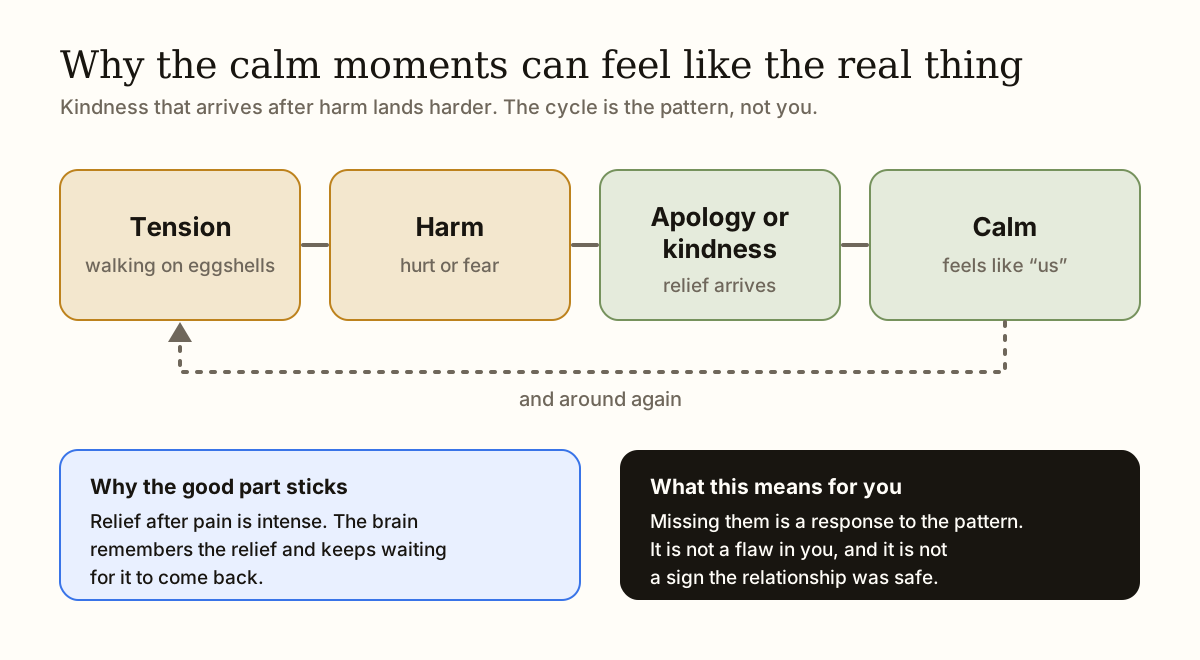
The idea comes from Donald Dutton and Susan Painter. In a 1993 study in Violence and Victims, they interviewed 75 women who had recently left abusive relationships and followed up six months later. How extreme and intermittent the mistreatment had been, and the imbalance of power, were linked to how strongly the women stayed attached to the former partner, to trauma symptoms and to lower self-esteem. By six months, attachment had fallen by about a quarter on average.
Take that with its limits. It is one study of women in the early 1990s, based on interviews and questionnaires, and it shows association, not that the pattern causes attachment in everyone. It is also a theory with critics. But it fits what many people describe: after tension and harm come an apology, tenderness or a calm stretch, and the relief of the calm lands harder because of what came before it.
Why do the good moments stay so vivid?
Because they were the relief. After the sting of a bad day, a good one is not just pleasant; it is the thing you had been waiting for. The mind keeps the picture of that relief close, the first holiday, the apology, the Sunday when they were gentle, and files the harm somewhere harder to reach.
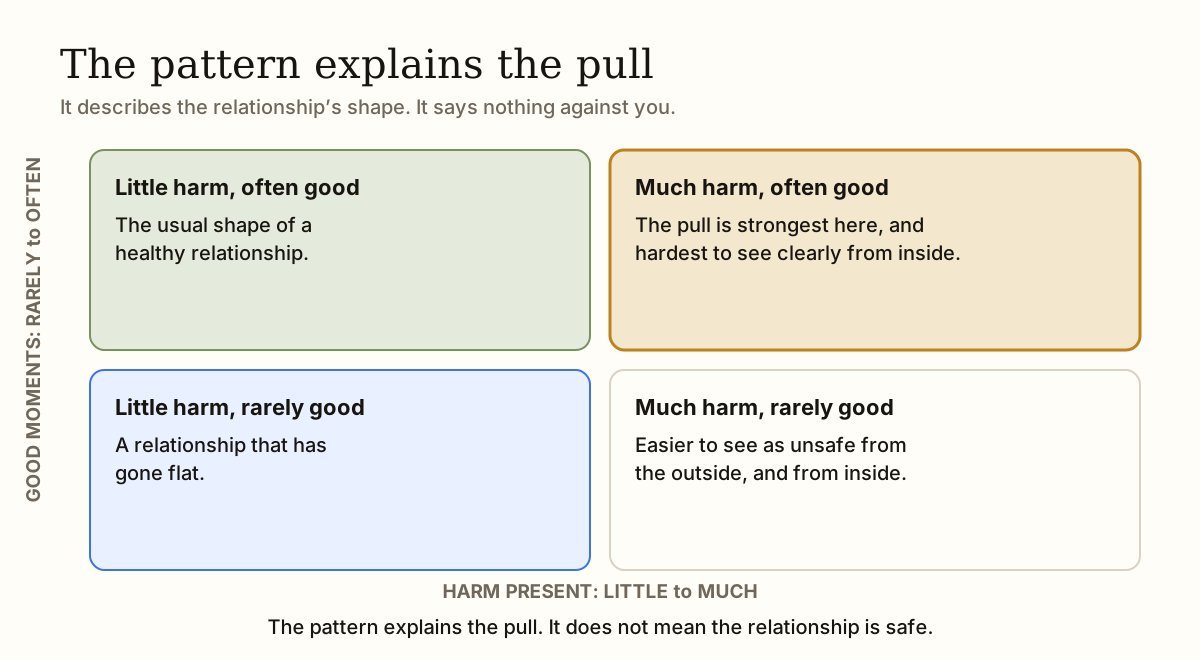
It also helps that you may be missing a future more than a person. You can grieve the home, the family or the “us” you hoped it would turn into. That grief is real, and it is a different thing from evidence that the relationship was safe. Grieving a breakup goes into that loss more broadly.
Strong attachment after a relationship like this is what the research above would lead you to expect. It tells you about the pattern, not about whether you should return to it.
| What you notice | What may be going on | What it does not mean |
|---|---|---|
| Good days feel like the “real” them | Relief after harm is intense, and the brain keeps hoping for it | That the harm was not real, or was your fault |
| You feel physically drawn to check on them or reply | A strong attachment in a relationship of ups and downs, with the body reacting too | That you are weak or “addicted” to being treated badly |
| You are afraid and you miss them in the same hour | Fear and attachment can run together when someone is both a source of comfort and of harm | That you are confused or lying to yourself |
| You remember the best three weeks over the worst three years | Selective memory; hope about the future you wanted | That you should test whether it has changed |
Does missing them mean I should go back?
No. Missing someone tells you about your attachment, not about whether going back would be safe or good for you. People do sometimes go back, and if that is you, it is not a personal failure. What to do if you break no contact is a gentler read on that.
What we would say is this: a relationship that was frightening or controlling does not become safe because you miss it, or because the apology was sincere. Apologies and promises are also part of the cycle. If you are thinking of going back, talk to an advocate first, and think about doing it with a safety plan in place rather than alone. If you are thinking of meeting them “to talk it through”, an advocate can help you decide whether that is safe at all; do not go alone or to a private place.
If the thought of going back is loud, write down, now, in your own words, why you left: three or four specific things that happened. Keep that note where you can read it on the days the good memories are loud. It is a reminder from you to you, not an argument.
What goes into a safety plan?
A safety plan is a short list of who you will call, where you will go and what you will keep, so that you are not working it out in a crisis. An advocate can help you adapt it. The Hotline also covers planning for children and for pets.
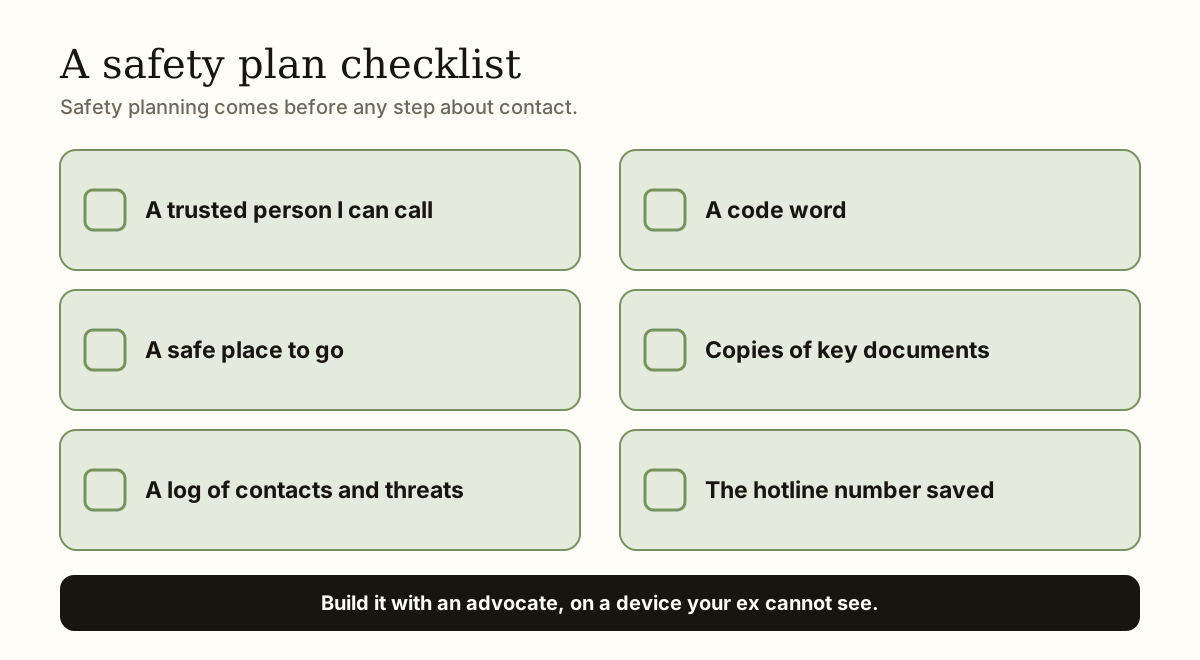
Use a phone, computer or account that your ex cannot see or access when you build it. If you think your phone is monitored, borrow a friend’s or use one at a library.
- A trusted person. One or two people who know the situation and will pick up. Tell them what you need: a call, a place to stay or someone to come with you.
- A code word. A word or short phrase that means “I am not safe, call for help”. Agree it with the people who need to know.
- A safe place to go. Where you will go at short notice, and how you will get there. Keep a little money and a spare key for it.
- Copies of key documents. ID, benefits and financial papers, children’s records, any court papers, and medications. Keep copies with someone safe.
- A log of contacts and threats. Dates, times, what was said or done, with screenshots. Store it where your ex cannot reach it. If you think of a protective order, ask a lawyer or legal aid service whether and how it applies where you live.
- The hotline number saved. Save 1-800-799-7233 under a name that will not raise questions. If you cannot speak, text START to 88788.
What can no contact do here, and what can’t it do?
Not having contact can help your recovery, because every message or visit can pull you back into the cycle. But it is not a safety measure. It will not stop someone who is determined to find you, and doing it suddenly can make some people more dangerous.
So here, the order is: safety plan first, contact decisions second, ideally with an advocate who knows your situation. We are not giving you a script or a technique for dealing with them, because what is safe depends on the person, and a wrong guess can cost you. Anything you do about contact, such as blocking, changing numbers or a protective order, is worth discussing with an advocate first. If you have children with them, a family lawyer or legal aid service can help you work out safe, documented arrangements.
If they keep contacting you, do not reply to argue or explain, and keep every message with its date. Tell an advocate, and call 911 if you feel in danger. If you are struggling with the urge to reach out yourself, the modified no contact guide covers when full no contact is not the right fit, and what to do when your ex texts you during no contact covers the general case. Neither replaces a safety plan.
Where can I get help?
You can get help today, for free, whether or not you have decided anything. In the US, the National Domestic Violence Hotline is 1-800-799-7233 (call), or text START to 88788, or chat on thehotline.org. Outside the US, search for your country’s domestic abuse helpline or ask a doctor, nurse or local domestic violence service.
If you are thinking about harming yourself, call or text 988 in the US. In the UK and Ireland, Samaritans is on 116 123. In India, Tele-MANAS is 14416. If you are in immediate danger, call 911 or your local emergency number.
A therapist who works with abuse and trauma can help with the missing, the shame and the memories. Ask whether they have experience with domestic violence or trauma. If you are not safe from your ex yet, the safety plan comes first and therapy runs alongside it.
Will I stop missing them, and how do I rebuild?
Yes, for most people the missing eases, though nobody can give you a date. In Dutton and Painter’s study, attachment had fallen by about a quarter at six months. Waves are normal. An anniversary, a smell or a song can bring it back without meaning you are going backwards.
Rebuilding starts small and mostly sideways. Rest, regular meals and sleep. People who are good for you, even if you only see one of them. Getting used to making small decisions without checking how someone will react. If anxiety is part of it, anxiety after a breakup has a calm-down plan. For the way attachment can intensify after a breakup, see anxious attachment after a breakup. The wider plan is in how to get over a breakup, though pace yourself against it; you may need more time and more support than a standard breakup.
On the days it hits hardest, do not make any decisions about contact. Put the note about why you left in front of you, eat something, call the person on your list and wait for the wave to pass.
You do not have to solve the whole relationship tonight. Take one private step that creates space between the feeling and the action.
Make a no-contact plan, once your safety plan is in place →Common questions
Is it normal to miss someone who hurt me?
Yes. Attachment forms in the whole relationship, including its good moments, and strong feelings often follow the ending of one that alternated between harm and kindness. Missing them does not mean you want the harm back, and it is not a sign that the relationship was good for you.
What is a trauma bond?
A trauma bond, or traumatic bonding, is a strong emotional attachment that develops when harm and kindness alternate and one partner holds more power. Dutton and Painter’s 1993 study of 75 women who had left abusive relationships linked that pattern to stronger attachment afterwards. It describes a pattern, not a diagnosis.
Can an abusive relationship feel like love?
Yes. The affection, the intensity and the relief after tension can feel like deep love, and the good moments are real moments. Feeling that way does not mean the relationship was healthy or safe, and it is not your fault.
Should I go back to my abusive ex?
Missing someone is not a safety reason to go back. If you are considering it, speak to an advocate first, such as the National Domestic Violence Hotline on 1-800-799-7233, and plan for your safety. Apologies and promises can be part of the same cycle.
Is my ex dangerous after I left?
Leaving can raise risk for a period, especially with a controlling partner, and some people do escalate. You can’t know for certain from outside. Take threats, stalking and unexpected visits seriously, tell an advocate, and call 911 if you feel in immediate danger.
Does no contact keep me safe?
Not on its own. Reducing contact can help your recovery, but it does not stop a determined person, and a sudden cut-off can provoke some people. Make a safety plan with an advocate first, then decide about contact together.
How do I get help if I am afraid?
Call the National Domestic Violence Hotline on 1-800-799-7233 or text START to 88788. It is free, confidential and open all hours. If your devices may be monitored, use a phone or computer your ex cannot see, and clear your browser history. In immediate danger, call 911.
Will I stop missing them?
For most people it eases, though no one can give a date. In a 1993 study of women who had left abusive partners, attachment was lower after six months, and the strongest predictors were how extreme and unpredictable the abuse had been. Waves are normal and are not a setback.
What do I do if they keep trying to contact me?
Do not reply to argue or explain, and keep every message, call log and voicemail with dates. Tell an advocate before blocking or changing numbers. Call 911 if they show up, threaten you or you feel in danger. A lawyer or legal aid service can tell you about protective orders where you live.
Can my ex track my phone after we split?
It is possible, especially through shared accounts, location sharing, a shared cloud login or an app they installed. An advocate or a trusted technician can help you check. Do this carefully, because removing a tracker may alert them. Use a device they have not touched when you look for help.
Is it safe to meet my ex to talk about what happened?
Often it is not. A conversation rarely brings the closure you want from someone who hurt you, and some people use meetings to regain control. Speak to an advocate first. If you do decide to meet, choose a public place, tell someone, and do not go alone or to a private place.
Where can I get help if I am in the US?
Call the National Domestic Violence Hotline on 1-800-799-7233, text START to 88788, or chat at thehotline.org. For immediate danger call 911. For thoughts of suicide, call or text 988.
If contact involves threats, stalking, coercion, shared children, housing or immediate safety, a general no-contact rule may not fit. Read the safety guidance and seek qualified local help where appropriate.
Sources and further help
- National Domestic Violence Hotline: Plan for safety
- Dutton & Painter (1993). Emotional attachments in abusive relationships: a test of traumatic bonding theory. Violence and Victims, 8(2), 105–120
- Campbell et al. (2003). Risk factors for femicide in abusive relationships: results from a multisite case control study. American Journal of Public Health
- 988 Suicide & Crisis Lifeline
- Samaritans (UK and Ireland, 116 123)
Research is cited to explain general patterns, not to diagnose or predict any individual outcome. Sources do not endorse UnLink. Read our editorial principles.
Keep this support one tap away.
UnLink is a free, private no-contact tracker for iPhone: count your days, get through urges and restart without losing your history.