What to Do If You Broke No Contact (and How to Restart)
Broke no contact? Pause, skip the follow-up text, log the trigger, decide whether to reset your count and restart with one guardrail. Scripts included.
 By the UnLink Editorial Team · General educational guidance, not therapy
If you broke no contact, stop and send nothing else. Follow-up messages that explain, apologize or ask “did you get that?” turn one slip into a conversation. Write down what triggered it, decide whether to reset your day count, and restart with one concrete change. A slip tells you where you need support. It does not erase your progress.
- Breaking no contact is a moment to pause, not a reason to send a second message.
- Whether you reset your day count is your call. Pick a rule while you are calm and apply it the same way each time.
- One slip becomes a spiral through the thought “I already blew it”, so the thought matters more than the text.
- A restart works best with one specific guardrail aimed at the trigger and an if-then plan for the next hard moment.
- Repeated slips mean the setup needs changing, and sometimes that the rule itself should.
Did you actually break no contact?
Not every brush with your ex is a break, and being exact about it saves you from either shrugging off a real slip or punishing yourself over a non-event. No contact means you do not start communication with them. Something that happened to you and that you did not answer is a different thing from something you did.
The table sorts the common cases. If you are still unsure, the does this break no contact checker walks through your exact situation, and what the no contact rule actually covers sets out the full definition.
| What happened | Counts as a break? | What to do |
|---|---|---|
| You sent a text, DM, email or voice note | Yes | Log it, send nothing else, follow the steps below. |
| You called, even if it rang out | Yes | Same as a text. Note the time and what led to it. |
| You watched their story or checked their profile | Usually a slip in the habit, not a contact | Log it as a trigger. Mute or unfollow so it is harder next time. |
| You liked or reacted to a post | Yes, most people count it | It is a signal they can see. Treat it as a break and note why you did it. |
| They texted and you did not reply | No | Do not answer. Read what to do when your ex texts you during no contact. |
| They texted and you replied | Yes | It is your contact now. One brief reply is a slip, a long exchange is a restart point. |
| You saw them at an event and spoke briefly | Not if it was unplanned and civil | Keep it short, leave on your terms, and note how it felt. |
| You contacted them about a shared practical matter | No, if it was logistics only | Keep it factual and short. See modified no contact for ongoing situations. |
What to do first when you break no contact
The first step is the least dramatic one: put the phone down and do not send anything else. The urge to repair an impulsive message can create five more. Explaining, apologizing and asking “did you get my message?” all keep the conversation alive, even when the original message was short.
Give yourself a 24-hour rule for any message to that person. Many messages that feel urgent at 11 p.m. look different after sleep. If the contact touched a practical issue, such as shared housing or children, handle only that issue in a brief, factual note. Draft it in advance and review it when you are calmer.
Then do something with your hands and your body for ten minutes. Walk, shower, wash dishes, call a friend who does not need the full story. The 90-second urge reset is built for exactly this moment.
Does breaking no contact reset the count?
It depends on how you defined no contact, and there is no universal rule. Some people reset the counter because the streak is meant to be an honest record of days with no contact at all. Others keep the count and log the slip as a separate event. Either can be fine, as long as it is honest and does not turn into self-punishment.
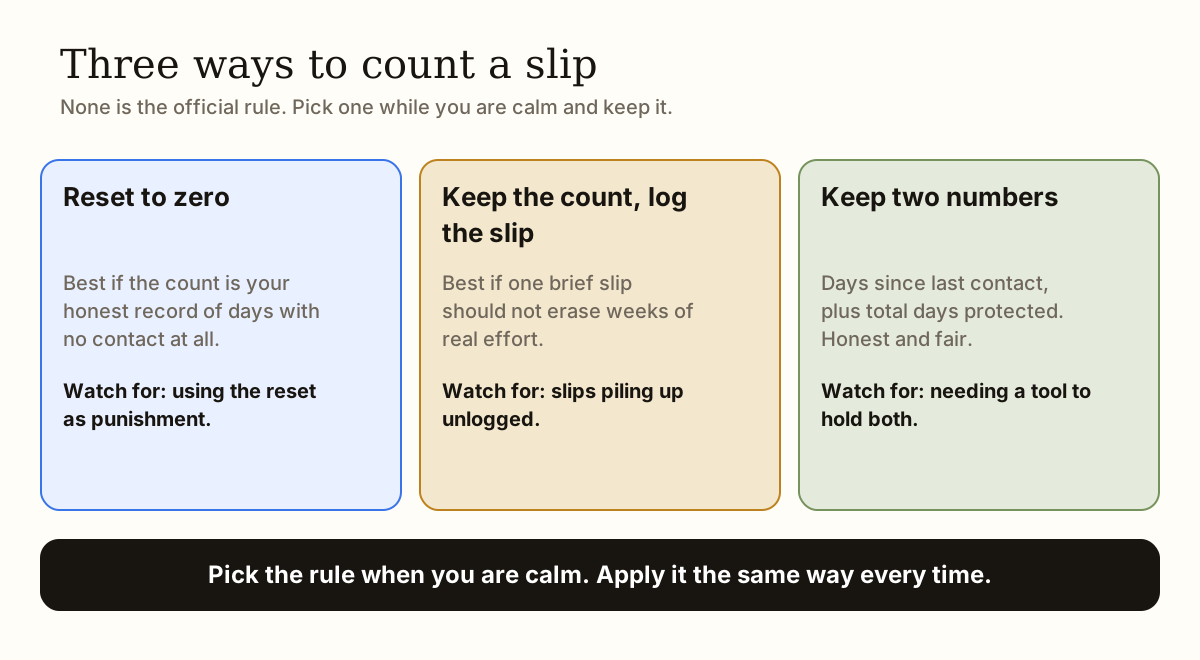
Both camps are right about something. A reset keeps the number truthful. Keeping the count recognizes that three weeks of effort did not vanish because of one bad night. A third option splits the difference by tracking two numbers: days since last contact, and total days you protected.
The one thing that does not work is deciding the rule in the middle of a slip. Decide it now, write it down, and apply it the same way next time.
Why one slip feels like total failure
The text is rarely the damaging part. The thought that comes right after it is: “I already blew it, so it doesn’t matter now.” Addiction researchers call this the abstinence violation effect, where a single lapse is read as proof of failure and leads to more of the behavior. It was described by Marlatt and Gordon in the 1980s, and a 1987 study of people trying to quit smoking by Curry, Marlatt and Gordon found that how people explained a first lapse to themselves was tied to what they did next.
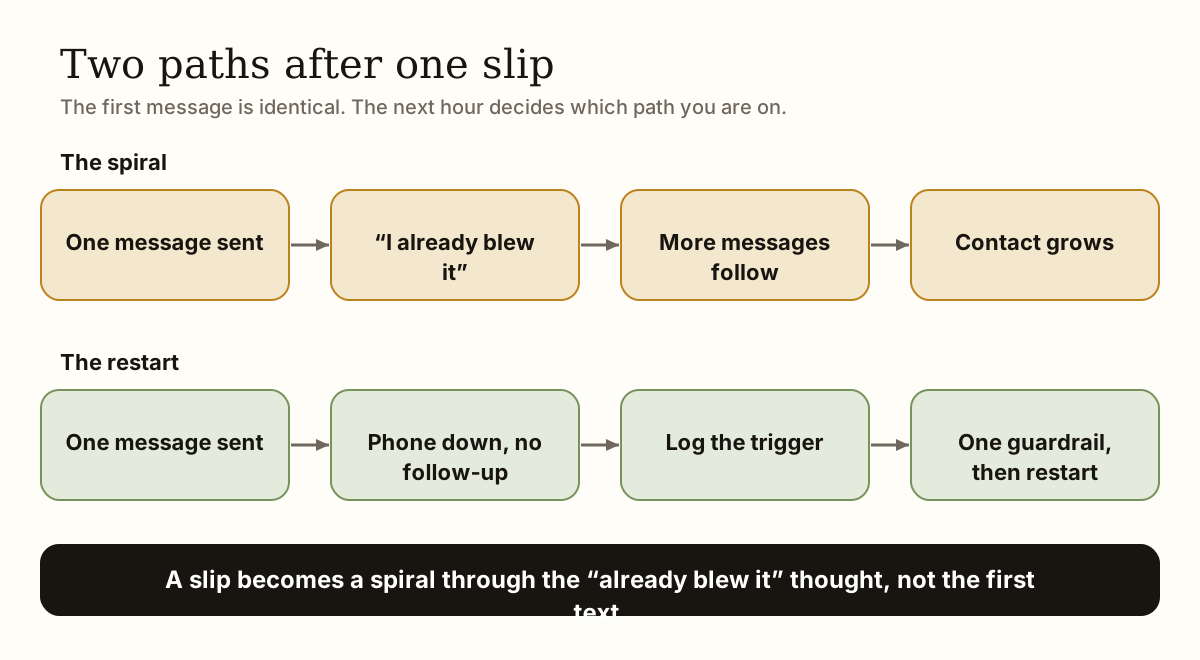
That research was about smoking, not breakups, so treat it as an analogy and not a measurement of your situation. But the pattern will be familiar. You send one message, feel ashamed, and the shame makes the next message feel inevitable. The fix is to treat the slip as one event with a cause, not as a verdict on you.
There is also a biological reason the pull is strong. In a 2010 study of people recently rejected by a partner, Fisher and colleagues found that looking at the ex’s photo activated brain regions tied to reward, motivation and craving. That does not excuse the text, but it explains why willpower alone is a weak plan and why changing the setup works better.
How to review the trigger without prosecuting yourself
Ask what happened in the hour before you reached out. Were you lonely at night, drinking, scrolling a profile, passing a place you shared, or reacting to a birthday or anniversary? A slip usually has a sequence, and the sequence is what you can change. Shame hides that sequence. Curiosity makes it visible.
Notice the feeling underneath the message. Many slips are less about the words and more about relief, reassurance or the wish to feel chosen. If late nights are the problem, why you want to text your ex at night covers that urge in detail, and the steps for stopping the urge to text your ex apply just as much after a slip as before one.
Fill in the template below within a day, in a private note or in UnLink’s Vault. Keep it short. The goal is a pattern you can act on, not a confession.
- When it happened (date, time and where you were):
- What came right before (a photo, a song, a drink, an argument, a date on the calendar):
- What I felt (lonely, angry, anxious, relieved, hopeful):
- What I sent, and what I hoped it would do:
- The one thing I will change next time:
- A person or activity I can turn to instead:
- My restart date and the first check-in I will do:
Things not to send after a slip
These messages feel small in the moment, but each one reopens the loop. If you notice one forming, move the draft into a note and do the next item on your list instead. Avoid sending:
- A follow-up that explains, apologizes for or justifies the first message.
- Anything that asks for a reply, such as “did you read this?” or “are you going to answer?”
- A message to a mutual friend asking them to pass something along or to report how the person is doing.
- A “just one more” clarifying message, even a kind one.
- A message meant to test whether they still care, including a like, story reply or emoji sent as a signal.
- Anything written after midnight or after a drink. Save it, read it in the morning and ask whether it is still a need or a plan.
What if they replied, or didn’t?
If they replied, you now have two decisions: whether to answer, and what the reply means. You can answer briefly and warmly, or not at all. The reply does not oblige you to keep going, and it does not tell you anything certain about how they feel. If you do answer, keep it to one line and stop. The guide on when your ex texts you during no contact has scripts for both.
If they did not reply, the silence will feel loud. Resist reading it. They may be busy, ashamed, hurt, relieved or deliberately holding their own boundary, and you cannot tell which. Checking whether it was read, or looking at their profile for clues, is a second slip waiting to happen. Stopping the social media checking is the practical move here.
Many readers also want to know whether the slip has ruined things. We do not predict what a particular person will do, and no contact is not a technique for changing their mind. Its purpose is your recovery. Judge the slip by what it cost you, and the answer is usually a bad evening, not a lost cause.
How to restart your boundary
Restart by choosing one guardrail that addresses the trigger you identified. If late nights were the problem, set a phone-free hour before bed or add friction to the thread. If checking profiles led you to write, mute or unfollow, or ask a friend to stop passing along updates. The guardrail should be specific enough that you can start it tonight.
Apple’s Screen Time settings include Communication Limits, which can restrict who you can message during set times, and a Screen Time passcode can lock them. They work best when you set them up in a calm moment. The guide to blocking yourself from texting someone lists the iPhone settings, and whether to block your ex weighs the bigger step.
Then write an if-then plan for the next hard moment, such as “If I feel the urge to message after 10 p.m., then I will open my unsent note and do the 90-second reset.” Gollwitzer’s 1999 review of implementation intentions found that specific if-then plans help people follow through on goals. Writing the unsent letter is a good thing to put in the “then”.
UnLink’s relapse-safe restart is built for this: you restart the count without losing your history, notes or the lessons you logged. Starting the calendar again does not mean the earlier days taught you nothing.
What if you keep breaking no contact?
Repeated slips are information about the setup, not a character flaw. Count them honestly and look for what they have in common. The table gives you a way to read the pattern.
One more thing to check is whether the rule itself fits your life. A full cut may be unrealistic if you share children, a workplace or a lease. In that case a structured modified no contact plan is more honest than a rule you break every week. Cycles of getting back in touch and pulling away also carry a cost. A 2009 study of on-off dating relationships by Dailey and colleagues found they were associated with more uncertainty and lower relationship quality.
| Pattern | What it often points to | What to try |
|---|---|---|
| Always late at night | Loneliness and tiredness, with the phone within reach | Charge the phone outside the bedroom and set a Communication Limit after a set hour. |
| After checking their profile | The checking is the real habit | Mute or unfollow, and read the guide on social media checking. |
| After drinking | Lowered inhibition | Delete the thread from your main screen before you go out, and leave with a friend. |
| On dates and anniversaries | Predictable grief spikes | Plan the day in advance and tell one person. See the holiday plan. |
| Every few days, no clear trigger | The boundary may be too rigid, or the grief is still raw | Add support, and consider whether a modified version fits. |
When the slip points to something bigger
Sometimes one contact is a sign that you need more support than a boundary can provide. If urges feel unmanageable, if you are drinking more to get through the night, or if you have thoughts of harming yourself, reach out to a doctor, a counselor you trust or a crisis line. In the US you can call or text 988 at any time. In the UK and Ireland, Samaritans is on 116 123, and in India Tele-MANAS is 14416. Asking for support is not failing. Our safety page has more.
If the relationship involved threats, pressure, coercion or someone who makes you afraid, safety comes first. Leaving can raise risk, so a safety plan comes before any contact strategy. The US National Domestic Violence Hotline is 1-800-799-7233, or text START to 88788.
Step-by-step plan
- Pause before any follow-up
Put the phone face down and wait at least 24 hours before sending anything else to that person.
- Check for safety
If the contact involved threats, pressure or fear, contact a trusted person or the National Domestic Violence Hotline before making any other decision.
- Write down what happened
Fill in the trigger review template with the time, what came right before the message and what you felt.
- Decide about your count
Choose whether to reset the streak, keep it and log the slip, or track two numbers. Write the reason in one sentence.
- Choose one guardrail
Pick one change that targets the trigger, such as a Screen Time Communication Limit, a muted profile or a phone-free hour at night.
- Set an if-then plan
Write it as: “If I feel the urge to message after dark, then I will open my unsent note and do the 90-second reset.”
- Restart on a set day
Choose a restart time, such as tomorrow morning, tell one trusted person your plan and check in with yourself at the end of that day.
You do not have to solve the whole relationship tonight. Take one private step that creates space between the feeling and the action.
Try the 90-second urge reset →Common questions
I broke no contact, now what?
Pause before sending anything else, especially a follow-up explanation or apology. Write down what triggered the message, decide whether to reset your count and add one guardrail that targets the trigger. Restart your boundary when you are steady, not in the middle of the next late-night urge.
Does breaking no contact reset the count?
It can, if you choose to define the streak that way. There is no universal rule. You can also keep the count and record the contact as a separate event, or track days since contact and total days protected. Whichever you choose, your notes and the reasons you chose space still count.
Does one text reset no contact?
It depends on how you defined the boundary when you set it. Many people treat one message as a slip to log rather than a total failure, while others prefer a fresh start. Decide your rule when you are calm, write it down and apply it the same way each time.
Should I apologize or explain after breaking no contact?
Usually another message extends the contact and reopens the loop. Pause unless a practical or safety issue needs correcting, and then keep it to one short, factual sentence written in advance.
Is it too late if I broke no contact?
No. Nothing about one message ends your ability to protect your recovery, and you can restart at any time. Whether the other person responds is out of your hands, and the slip is not a prediction of how they feel.
What if I keep breaking no contact?
Repeated slips are a sign to change the setup, not a reason to give up. Look for the situations that come before each contact, add a guardrail for the most common one and consider support from someone you trust. If the rule does not fit your life, a modified version may be more honest. If the pattern comes with distress you cannot manage, reach out to a doctor or a crisis line.
Will my ex know I broke no contact?
They will know you sent a message, but that does not mean you owe them an explanation. You are not required to follow up. If a response truly needs to happen, keep it brief and practical, and return to your plan.
What if they didn’t reply after I broke no contact?
Silence can mean many things and you cannot read it from outside. Avoid checking whether they saw it or looking at their profile for clues, because both extend the loop. Put your attention on the guardrail you chose and the next small task of the day.
If contact involves threats, stalking, coercion, shared children, housing or immediate safety, a general no-contact rule may not fit. Read the safety guidance and seek qualified local help where appropriate.
Sources and further help
- Fisher HE et al. (2010), Reward, addiction, and emotion regulation systems associated with rejection in love, Journal of Neurophysiology
- Gollwitzer PM (1999), Implementation intentions: strong effects of simple plans, American Psychologist
- Curry S, Marlatt GA, Gordon JR (1987), Abstinence violation effect: validation of an attributional construct with smoking cessation, Journal of Consulting and Clinical Psychology
- Dailey RM et al. (2009), On-again/off-again dating relationships: how are they different from other dating relationships?, Personal Relationships
- Apple Support: Choose who you can communicate with at certain times with Screen Time on iPhone
- National Domestic Violence Hotline: safety planning
- 988 Suicide & Crisis Lifeline (US)
Research is cited to explain general patterns, not to diagnose or predict any individual outcome. Sources do not endorse UnLink. Read our editorial principles.
Keep this support one tap away.
UnLink is a free, private no-contact tracker for iPhone: count your days, get through urges and restart without losing your history.