How to Get Over a Friendship Breakup (and Whether No Contact Applies)
How to get over a friendship breakup: why it hurts, whether no contact applies to friends, scripts for mutual friends, and a plan for the first month.
 By the UnLink Editorial Team · General educational guidance, not therapy
You get over a friendship breakup by treating it as a real loss, giving the grief time, and limiting whatever keeps reopening it. No contact can apply to friends, but it is a choice for your own recovery, not a rule. Decide how much contact you can bear, and tell mutual friends what you need.
- Losing a close friend is a real loss, even though there is no ritual for it and people may not treat it as one.
- With friends, no contact is optional. Choose between full no contact, limited contact and a boundary message based on safety first and pain second.
- Mutual friends do not need to pick a side. A short script for each situation protects you from over-explaining and from using them as messengers.
- Decide whether to repair the friendship after the sharpest pain has passed, using what actually happened rather than how much you miss them.
- If the friendship involved threats, harassment, stalking or control, stop contact, keep records and use the safety page. Do not send an explanation.
How do you get over a friendship breakup when no one takes it seriously?
Start by treating it as a real loss, because it is one. You lost someone who knew your history, your in-jokes and what you sound like when you say you’re fine. There is no card for this, no time off work, and the people around you may say “you’ll make new friends” as if that settled it. The first thing to get over is the idea that you aren’t allowed to be this upset.
The rest is practical. Give yourself permission to grieve. Decide how much contact with the old friend you can handle right now. Work out what to say to the people you both know. Then build a month of small routines, so the hours you used to spend with them don’t sit empty. The sections below take those in turn, plus how to tell whether to try repairing it.
Why does losing a friend hurt so much?
A close friendship does several jobs at once, and an ending removes all of them on the same day. They were the person you texted first with good news, the one who knew which week your family was a mess, the owner of a standing Thursday and a stock of references nobody else gets. Now the person you would normally call about something this bad is the one you can’t call.
Grief researcher Kenneth Doka coined the term disenfranchised grief in 1989 for losses that other people don’t openly acknowledge or publicly support (NPR). Friendship endings often fit. That is why it can feel strange to cry over someone who is alive and well. The grief is about what you had, and the future you assumed.
The research on how adult friendships end is thin. A 2022 review by Vieth, Rothman and Simpson says little work has examined how these endings happen and what follows, and proposes that friendships end by an active route (someone ends it) or a passive one (it fades). Studies of rejection mostly cover romance. Kross and colleagues (2011) found that people thinking about an unwanted breakup while viewing a photo of the ex-partner showed activity in brain areas that also respond to physical pain. That was a romantic breakup, so it doesn’t show that friend breakups hurt the same amount. It does fit what many people describe: rejection by someone close lands in the body.
Expect mixed feelings, arriving together. Sadness, anger, relief, guilt and embarrassment can all show up in one afternoon, and none cancels the others. If you ended it, you are allowed to grieve too.
- Routine. The regular call, the Sunday walk, the lunch you didn’t have to plan.
- A witness. Someone who watched years of your life.
- Shared people. A friend group that now feels like it has two sides.
- Shared plans. The trip, the wedding, the project.
- A version of you. The looser person you were around them.
What kind of friendship breakup was yours?
How it ended changes what helps. Rose (1984) asked college students about close same-sex friendships that had recently ended or faded and found distinct patterns: physical separation, new friends taking over, growing to dislike the friend, and a partner getting in the way. It was a young sample describing the past, so treat it as a starting point. The table below is our own sorting, built for deciding what to do next rather than for research.
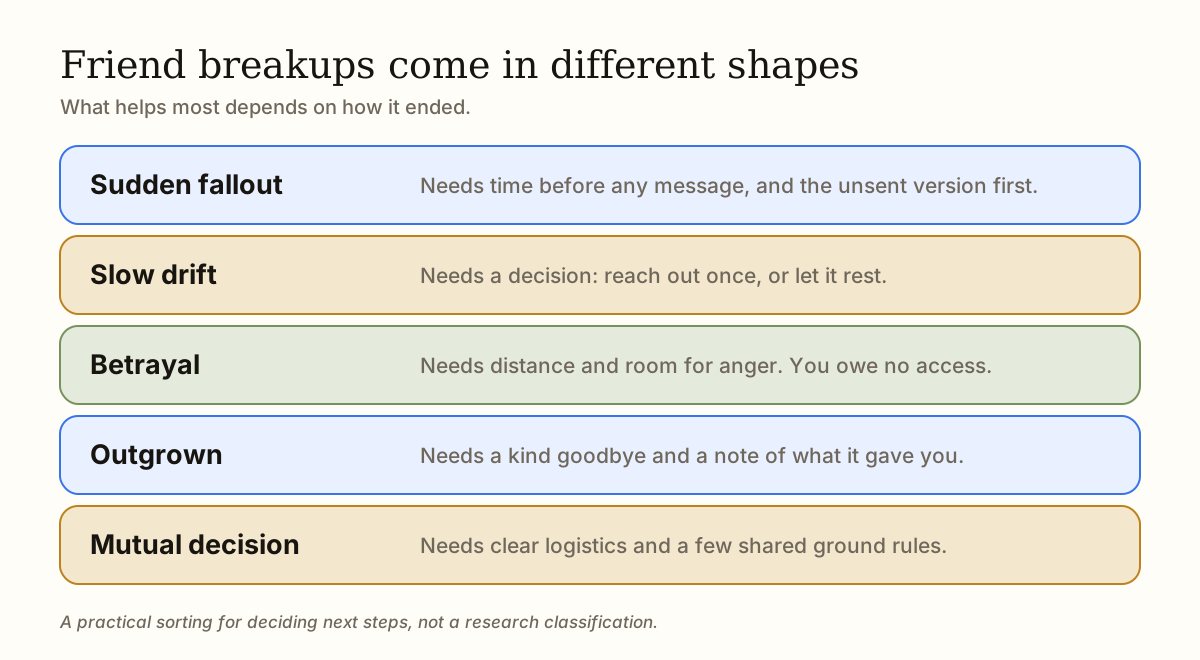
Example: a friendship of ten years ends after a fight over a shared project. You and a friend have been running a small side venture for two years. An argument about credit turns into an argument about everything, and she says she needs “a long break”. This is a sudden fallout with a betrayal edge: you feel she took credit, and she may feel you dismissed her. What fits: no new messages for two weeks, an unsent version of everything you want to say, one factual message to hand over the project logins, and a decision about reaching out only after the sharpest part has passed. What doesn’t fit: a long group-chat explanation at midnight.
| Type | What it often feels like | Usual first step | When no contact may help |
|---|---|---|---|
| Sudden fallout | Shock. Replaying the last conversation. A strong urge to explain. | Wait before sending anything long. Write the long version for yourself. | When each message restarts the fight, or they use contact to argue. |
| Slow drift | A vague ache, guilt about not calling, no one to blame. | Decide whether to reach out once with no pressure, or let it rest. | Rarely. The distance already exists. |
| Betrayal | Anger, humiliation, damaged trust, feeling foolish. | Get your side onto paper. Stop checking what they say about you. | Often. Contact tends to reopen the injury, and you owe no access. |
| Outgrown | Sad but calm, with some relief. | Name what the friendship gave you. Be kind in the logistics. | Seldom. A quiet fade or a warm goodbye usually does it. |
| Mutual decision | Sorrow, respect, awkward logistics. | Agree on small things: belongings, shared events, what to tell people. | Optional. A few weeks of silence can help. |
Does no contact work for friends?
It can, as a choice you make for your own recovery, with no countdown attached. We found no research testing no contact on friend breakups. What carries over is the mechanism: every time you check their profile, reread the thread or ask a mutual friend for news, you reopen the wound. A 2012 study by Marshall found that monitoring an ex-partner on Facebook was associated with more distress and less personal growth. That was about exes. The same pattern is plausible for friends, but untested.
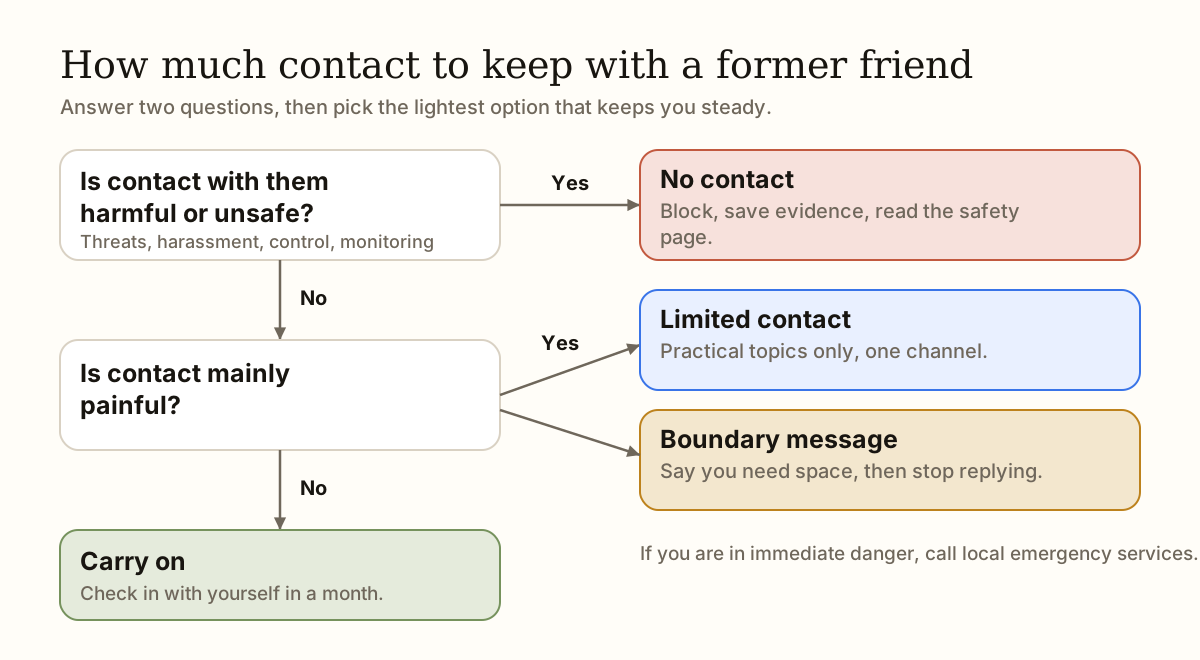
What differs is the web around the friendship. A friend is often tied to your work, family and weekends, so a total cut can cost more than it would with an ex, and it can look like punishment to people who don’t know the story. The useful question is “how much contact is safe, and how much can I carry?” The flow below puts safety first and pain second. For the rule in its romantic form, what the no contact rule is explains where it comes from, and the modified no contact guide covers the middle path for shared work or shared children.
Three options sit on the ladder. Full no contact means no messages or calls, and muted or blocked accounts. Limited contact means practical topics only, through one channel, such as returning belongings. A boundary message is one short message saying you need space, followed by silence if they push back.
- A boundary message: “I care about you, and I need some space to sort out how I feel about what happened. I won’t be replying for a while. I’ll be in touch if that changes.”
- For a friend who keeps pushing: “I’ve said what I need. I’m not going to discuss it further right now.” Then stop replying.
What do I do about mutual friends and group chats?
Don’t make them pick.
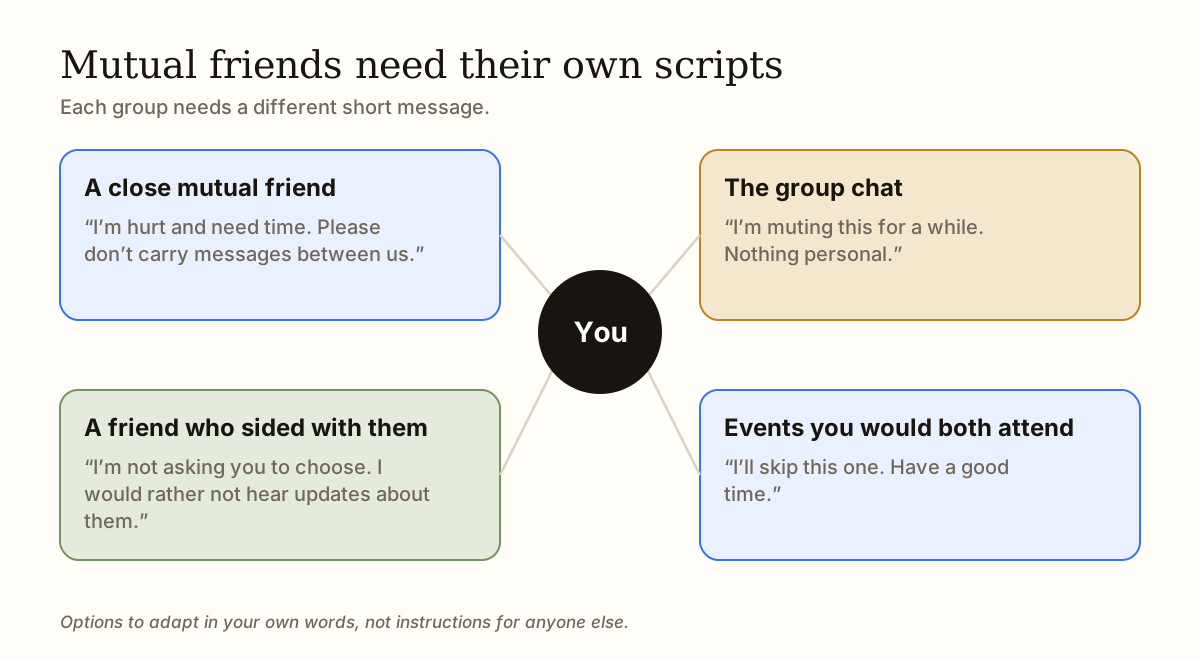
Tell each group the one thing you need, then stop explaining. Mutual friends are not a jury, and every long account you give becomes a story that travels back. Two rules do most of the work: no messengers (nobody carries a message either way) and no recruiting (nobody is asked to take your side).
Decide your lines in advance. Gollwitzer (1999) reviewed evidence that if-then plans, such as “if X happens, then I will say Y”, help people carry out what they intend. When someone asks about the ex-friend at dinner, you won’t have to invent a sentence while your face is hot. Adapt the scripts below in your own words; they are options for you, not instructions for anyone else.
| Situation | An option to adapt |
|---|---|
| A mutual friend asks what happened | “We had a falling out. I’d rather not go through it, but I appreciate you asking.” |
| A friend takes their side and you feel dropped | “I’m not asking you to choose. This hurts, and I need some time. Please don’t pass messages between us.” |
| Someone keeps mentioning the ex-friend | “I’d rather not hear updates about them for now. Can we talk about something else?” |
| You are both in a group chat | Mute it first. If you leave: “I’m stepping out of this chat for a while. Nothing personal.” |
| An event you would both attend | “I’ll skip this one. Have a good time.” You do not need to give a reason. |
Should I try to fix the friendship or let it go?
Decide after the sharpest pain has passed, and decide from what happened, not from how much you miss them. Missing someone tells you about your life. It says little about whether the friendship was good for you. In the first few weeks, the answer is usually “not yet”, and that’s a fine answer.
Repair is worth a try when the harm was specific, both of you seem to want the friendship rather than just relief from the discomfort, and you can say what would be different this time. Letting go is the better call when the pattern was one-sided, your feelings were dismissed again and again, contact leaves you drained for days, or safety was ever in question.
If you do reach out, send one low-pressure message and let it stand: “I’ve been thinking about us. I miss you, and I’m sorry for my part in how it ended. If you’re open to talking, I’d like that. No pressure if not.” Then leave it, and mute their profile while you wait, because waiting for a reply is its own kind of checking.
If a friend ended it without an explanation, you may never get the account you want. Closure after a breakup shows how to build it yourself. Writing helps: Pennebaker (1997) summarised studies in which writing about emotional experiences was followed by health improvements, and our guide to the unsent letter shows how.
- Signs repair may be worth trying: they have acknowledged their part, the harm was a specific event, you both want the friendship, and you can name one thing that would change.
- Signs to let it go: a long pattern of one-sidedness, your feelings dismissed, contact that leaves you worse each time, or any threat, control or harassment.
What does the first month look like?
Think of it as a month of small, boring moves. You are not trying to feel better by Friday. You are trying to stop the daily reopening and to refill the hours the friendship used to fill. The week-by-week plan is in the step-by-step section further down this page.
Write the six steps on a card or in your notes app, because on a bad Tuesday you won’t remember them. And expect a dip. A good week followed by a terrible Sunday is ordinary. Their birthday, a photo from a trip or a song in a shop can pull it open again. When that happens, go back to the first step and write.
What do I do if my former friend reaches out?
Check the safety question first. If the contact is threatening, repeated after you asked them to stop, or comes through other people, don’t reply, save it and see the safety section below. If it is a genuine apology or a practical request, take your time. You don’t owe a reply within the hour.
Replying is optional, and so is the pace. Wait a day, decide what you want (an answer, a handover, a conversation or nothing), then send the smallest message that does it. “Thanks for writing. I need more time, and I’ll be in touch if that changes” is complete. If you’re pulled toward an old pattern, what to do when your ex texts you during no contact has a decision flow that works for friends too.
When should I get support?
Get support if you can’t sleep, eat or work for more than two weeks, if you have stopped doing things you normally enjoy, or if you have any thoughts of harming yourself. A counselor or your doctor can help. In the US, call or text 988. In the UK and Ireland, Samaritans is on 116 123. In India, Tele-MANAS is 14416. Our safety page has more.
A friendship can also be unsafe. If a friend made threats, followed you, monitored your phone, controlled your money or your movements, or kept turning up after you asked them not to, treat it as a safety matter. Stop replying, block, save screenshots and dates, tell someone you trust, and call local emergency services if you feel in immediate danger. Don’t send an explanation. The US National Domestic Violence Hotline (1-800-799-7233, or text START to 88788) can talk through safety planning for relationships that involve control or abuse.
Much of the plan in how to get over a breakup, from sleep to routines, carries over.
Step-by-step plan
- Week 1: write it out, and don’t send it
Write everything you want to say: the version where you are right, the version where you are sorry, the version that is just angry. Keep it. Sending it at 1 a.m. is what most people regret.
- Week 1: reduce the reminders
Mute their stories and posts, take the group photo out of your highlights, and mute the group chat. Muting is enough for now. You can unfollow or block later if it still stings.
- Week 2: tell two people what you need
Pick one or two trusted friends and say exactly what helps: “Ask how I’m doing, but don’t tell me what they’re up to.”
- Week 2: refill the empty slot
Take the recurring thing you did together, such as Thursday dinner or a Sunday walk, and keep it with someone else or swap it for something new. An empty slot invites phone-checking.
- Week 3: sort the practical threads
Return belongings, close shared subscriptions, settle any money, and agree one channel for anything unfinished. Keep these exchanges short and factual.
- Week 4: review and set a check-in date
Ask yourself the repair-or-let-go questions above. Decide on one action, such as a single message or nothing, and put a date in your calendar to check in again in a month.
You do not have to solve the whole relationship tonight. Take one private step that creates space between the feeling and the action.
Closure letter builder: write the unsent version →Common questions
Is it normal to grieve a friend who is still alive?
Yes. Grief follows loss, not death. You lost a person, a routine and a shared future. Doka’s term for grief that others don’t openly recognize is disenfranchised grief, and friendship endings often fit it.
How do I tell a friend I need space?
Keep it short, say it once and make it about you: “I care about you, and I need some space to sort out how I feel. I won’t be replying for a while.” Skip any assessment of what they did, because it invites a debate. If they push, stop replying.
Should I unfollow or block a former friend?
Mute first, since it hides them without sending a signal. Unfollow if seeing them still stings after a couple of weeks. Block if they contact you after you asked them to stop, or if anything felt threatening. Blocking protects you, and you can reverse it.
How do I get over losing my best friend of many years?
A long friendship leaves a bigger gap, so expect it to take longer and arrive in waves. Keep a few things steady (sleep, food, a daily walk), grieve out loud with someone, and write the unsent letter. Consider the repair question once the first sharp weeks have passed.
Can friends also be an unsafe relationship?
Yes. Threats, stalking, monitoring, controlling who you see or turning up unannounced are safety issues in any relationship. Stop replying, block, save screenshots and dates, tell someone you trust, and call local emergency services if you are in immediate danger. The safety page lists support lines.
What do I do if a friend ghosted me without an explanation?
You may never get the explanation, so build your own closure. Write the unsent letter, decide what you think happened, and pick one sentence to hold on to. If you want, send one warm, low-pressure message and then let it rest.
Is it normal to feel embarrassed about a friendship that ended?
Yes. Friendship endings rarely come with a script, so people worry about what it says about them or about having to explain. You don’t have to explain. “We drifted apart” or “we had a falling out” is a complete answer.
My friend ended our friendship and everyone sided with them. What do I do?
Resist arguing your case to the group. Tell the closest one or two people what you need (“I’m not asking you to choose, I just need some time”), step back from the group chat, and spend time with people who feel steady. Some of those friendships will settle in time, and some won’t.
If contact involves threats, stalking, coercion, shared children, housing or immediate safety, a general no-contact rule may not fit. Read the safety guidance and seek qualified local help where appropriate.
Sources and further help
- Rose (1984), How friendships end: patterns among young adults, Journal of Social and Personal Relationships
- Vieth, Rothman & Simpson (2022), Friendship loss and dissolution in adulthood: a conceptual model, Current Opinion in Psychology
- NPR (2021), The importance of mourning losses, even when they seem small (Kenneth Doka on disenfranchised grief)
- Kross et al. (2011), Social rejection shares somatosensory representations with physical pain, PNAS
- Marshall (2012), Facebook surveillance of former romantic partners, Cyberpsychology, Behavior, and Social Networking
- Gollwitzer (1999), Implementation intentions: strong effects of simple plans, American Psychologist
- Pennebaker (1997), Writing about emotional experiences as a therapeutic process, Psychological Science
- 988 Suicide & Crisis Lifeline
- National Domestic Violence Hotline — safety planning
Research is cited to explain general patterns, not to diagnose or predict any individual outcome. Sources do not endorse UnLink. Read our editorial principles.
Keep this support one tap away.
UnLink is a free, private no-contact tracker for iPhone: count your days, get through urges and restart without losing your history.