Grieving a Breakup: What Grief Looks Like When They Are Still Alive
Grieving a breakup is normal even when your ex is alive. See why the five stages do not apply, what you actually lost, why grief comes in waves, and what helps.
 By the UnLink Editorial Team · General educational guidance, not therapy
Grieving a breakup means mourning a real loss: the person, the routine, the future you planned and the version of you that lived inside the relationship. It is normal even when your ex is alive, and it does not move through stages in order. Expect waves, with good weeks and sudden bad days.
- Grieving a breakup is normal even though the other person is alive, and it is not a sign you made the wrong decision.
- The five stages of grief came from work with dying patients, not from breakups, and even their author did not describe them as a fixed sequence.
- A breakup takes several things at once: routine, future, the person, your sense of self, and shared friends and places. Naming which one hurts most tells you what to grieve.
- Grief returns in waves set off by songs, dates and ordinary Tuesdays. A bad week is not proof you are back at the start.
- Get help if low mood lasts most of the day for more than two weeks, if you cannot function, or if you think about harming yourself. In the US, call or text 988.
Can you grieve someone who is still alive?
Yes. Grief is the response to losing something that mattered, and a breakup takes several things at once: a person you saw most days, a routine, a future you had half-lived in your head, and a version of yourself that only existed with them. That your ex is alive, reachable and maybe posting stories does not cancel the loss.
It often makes it harder, because nothing about it is official. There is no funeral, no casserole, no bereavement leave. Friends say “you’ll find someone better” within a week. If you were the one who ended it, you may feel you have no right to be this sad. You do. A good decision can still cost you something real.
The research fits what people describe. Kross and colleagues (2011) found that recalling an intense rejection engaged brain regions that also process physical pain. Fisher and colleagues (2010) scanned people who had been rejected but were still in love, and found that photos of the ex activated reward and craving systems. So breakup grief can feel like sadness and withdrawal at the same time. For the wider recovery plan, start with our guide on how to get over a breakup.
Grieving a breakup: what it looks like and why it does not go in order
You grieve a breakup by letting the loss be a loss: naming what is gone, feeling it in doses, and carrying on with ordinary life in between. There is no required order. Sadness, anger, relief, numbness and longing can all turn up in one afternoon, and the NHS says plainly that there is no right or wrong way to feel after a loss.
It tends to look like this in real life:
- Crying in the car park, then being fine at dinner.
- Anger at them at 10 a.m. and anger at yourself by lunch.
- Relief that the arguing has stopped, and guilt about the relief.
- Numbness, as if the news belongs to someone else.
- Bargaining: if I had said it differently, if I change now, if we try once more.
- A heavy body: no appetite, bad sleep, a chest that feels bruised.
Where did the five stages of grief come from?
The five stages (denial, anger, bargaining, depression, acceptance) come from Elisabeth Kübler-Ross’s 1969 book On Death and Dying, which drew on her work with people who were themselves dying. They were not built from studies of breakups, and they were never a timetable.
Even Kübler-Ross backed away from the idea of a fixed order. In a 2005 book with David Kessler she wrote that the stages are not stops on a linear timeline and that not everyone goes through all of them. A 2017 review by Stroebe, Schut and Boerner went further, arguing that stage theory lacks scientific support and should not guide care for bereaved people. The NHS’s own grief page lists the five stages with the same warning: you may not experience all of them, and not in a set order.
So do the stages apply to breakups? Not as a sequence, and nobody has shown they do. The five words can still be handy as vocabulary. If you recognize denial on Monday and bargaining on Thursday, that is a description, not a position on a ladder. If you are worried you are doing grief wrong because you skipped “acceptance” or went back to “anger”, you are not. For the patterns people report during no contact, which are also not a ladder, see the stages of no contact.
What did you actually lose?
More than the person. A breakup usually takes five things: your daily routine, the future you planned, the person’s presence, your sense of self inside the relationship, and the shared world of friends, places and things. Often the heaviest one is not the one you expected, and naming it changes what you do next.
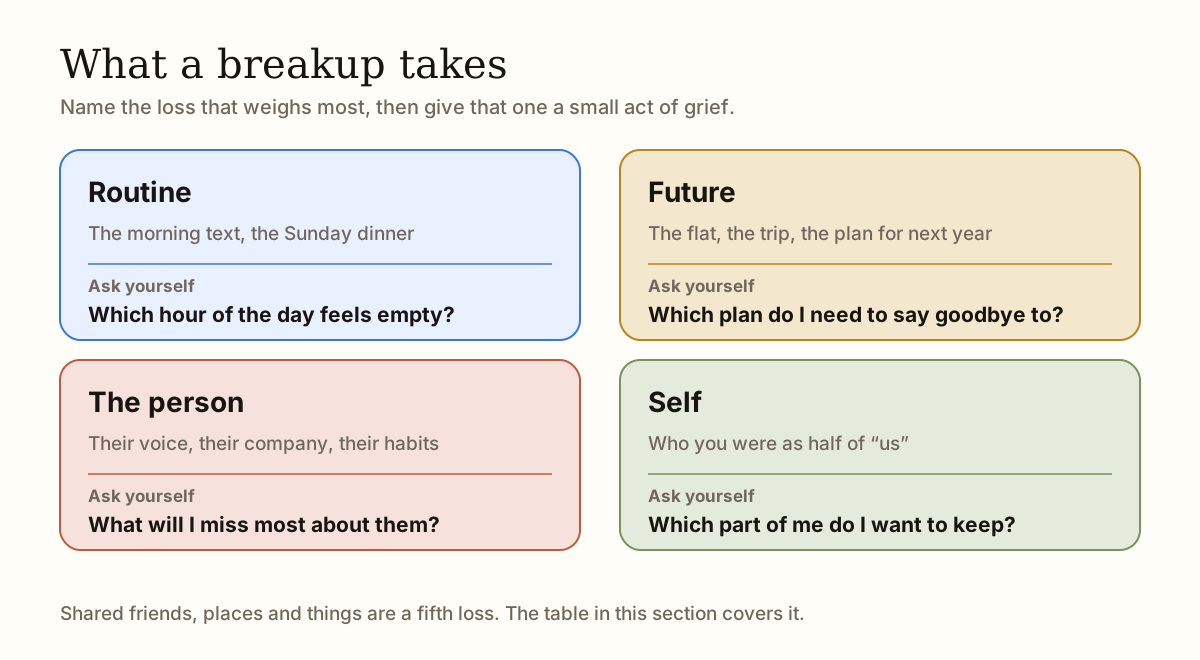
People tend to grieve “the ex” as one big blob, which is exhausting and has no handle on it. Split it up and each loss gets its own, smaller response. The loss of the 7 a.m. call needs a new morning. The loss of the trip you had half-booked in your head needs a goodbye, not a distraction.
| Loss | What it looks like day to day | One small way to grieve it |
|---|---|---|
| Your routine | Reaching for the phone at the time you used to talk. The empty Friday night. Cooking for one and still buying two. | Pick the hour that stings most and give it a new fixed plan this week: a walk, a standing call with a friend. |
| The future you planned | The flat you looked at, the wedding or trip you pictured, the names you joked about. Seeing a couple your age with the life you imagined. | Write the future down in detail, then write one line to it: “I’m letting you go.” Keep the page or burn it. |
| The person | Missing their laugh, their texts, their company on a bad day. Wanting to tell them something funny. | Say what you miss out loud or in an unsent letter. Do not send it. |
| Your sense of self | Not knowing what you like. Missing who you were around them. Feeling like half a sentence. | List three things that were yours before them and do one of them this week. |
| Shared friends, places and things | The friend group that now feels like theirs. The café you used to love. The shared playlist and the hoodie. | Box the objects out of sight. Choose one place to reclaim on your terms, with a friend. |
What is ambiguous loss, and why does it make a breakup harder?
Ambiguous loss is a loss with no clear ending and no official recognition. Pauline Boss, the family therapist who named it, developed the idea with families of missing people and of people with conditions such as dementia, where someone is gone in one sense and present in another (Boss, 2010). A breakup is not the same thing, and we are borrowing the concept, not claiming it fits exactly. But it explains something people notice: grief is harder to settle when the person is still out there.
It shows up in three common ways. Your ex is alive and in your group chat. The relationship ended but nobody said it clearly, as in a situationship, or you were on and off. Or you still share a child, a lease or a workplace, so the loss is never fully allowed to be a loss. A 2009 study of on-off relationships (Dailey and colleagues) found them associated with more uncertainty and lower relationship quality, which is the raw material of ambiguity.
You cannot make the situation unambiguous by willpower, but you can build the markers that death provides for free. Decide what counts as the end date, and write it down. Mark it with something physical, such as returning the key, packing the box or a walk you do once. Then cut the sources of reopening that you control. That does not have to mean total silence: if you share children, modified no contact keeps contact brief and practical. If you can go fully quiet, the no contact rule is one way to stop the ending being renegotiated every week.
Why does grief after a breakup come in waves?
Because grief is triggered, not scheduled. A song, an anniversary, a photo or an ordinary Tuesday can bring the loss back at full size, even after weeks of feeling fine. This is the usual shape, not a setback. The NHS describes the same pattern for bereavement: strong feelings can arrive unexpectedly, and they come and go.
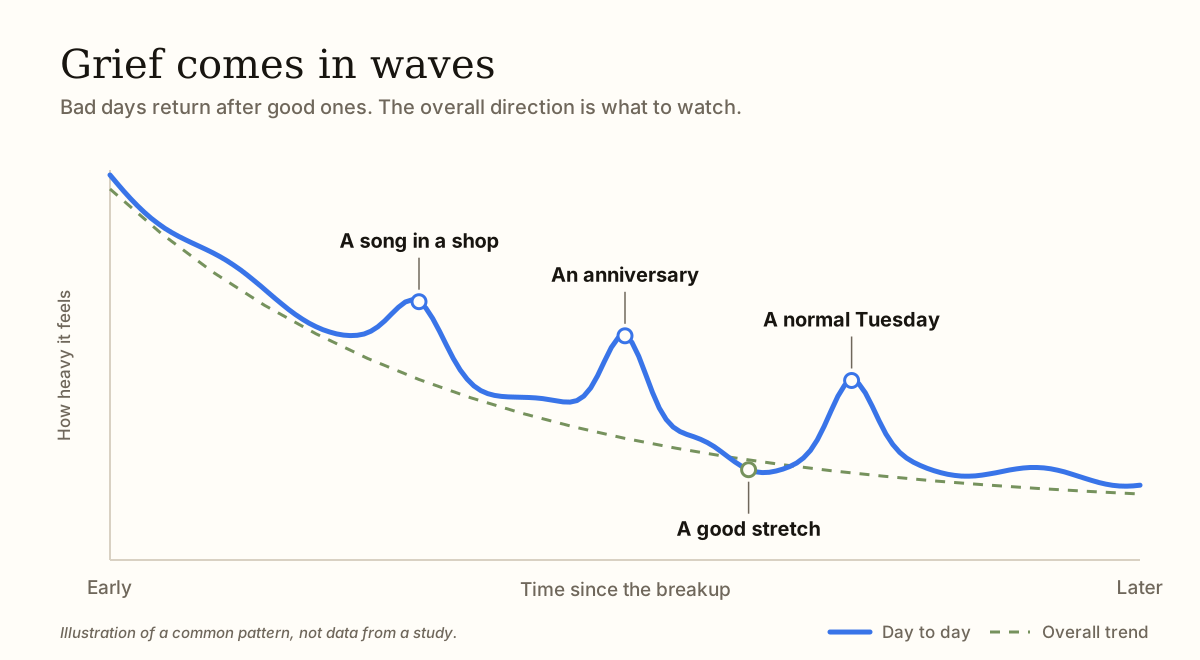
The waves are also easier to ride when you know your triggers. Dates (their birthday, the day you met, the holiday you always spent together) are predictable. Songs and shops are not. The worst ones are the normal days that go quiet, because nothing is distracting you.
It also helps to know you may be a poor judge of how long this will last. In a 2008 study that followed dating students for months, those who went on to break up had predicted more distress than they reported feeling afterwards (Eastwick and colleagues). Your worst week is not a forecast.
How long does grief last after a breakup? Nobody can say. Longer relationships, shared homes or children, a sudden ending, no clear explanation and an on-off history can all stretch it out. Most people see the intensity ease over weeks to months, with gaps that widen. For a rough estimate based on your own situation, use the breakup recovery time calculator, and read how long it takes to get over a breakup for what shortens or lengthens the timeline.
What helps with grief after a breakup?
Four things have reasonable support or plain good sense behind them: writing it out, marking the ending, talking to people who can bear it, and moving between feeling the loss and getting on with life.
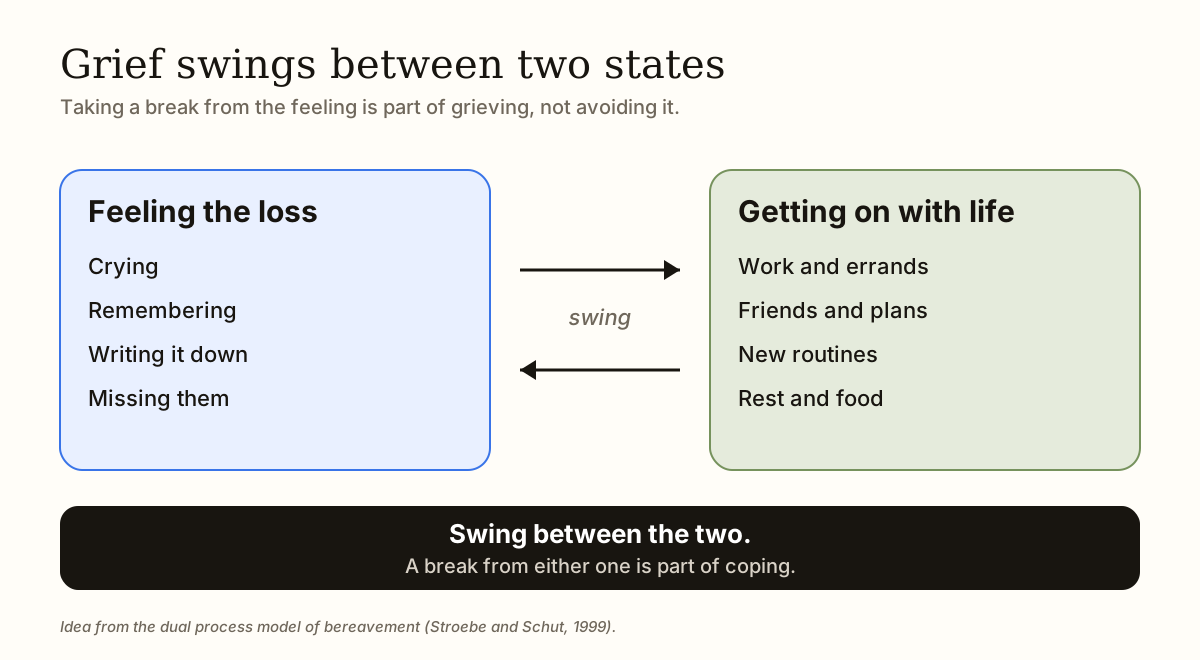
Stroebe and Schut’s dual process model (1999) describes bereaved people moving back and forth between facing the loss and dealing with everyday demands, and treats time off from grief as part of coping. The model was built for bereavement, not breakups, but the rhythm will sound familiar. You are allowed to watch a film and laugh. That is not avoiding it.
- Write it down. Expressive writing, about your deepest thoughts and feelings for 15 to 20 minutes over several days, has been linked to better health and wellbeing (Pennebaker, 1997). Our guide to writing an unsent letter gives the format. If you use the premium Vault in UnLink, a free no-contact tracker for iPhone, the letter stays private on your phone.
- Mark the ending. Pack the box, move the photo, change one thing in the room. Grief without a ritual drifts, so make a small one.
- Choose who hears it. One or two people who can hear the same story twice, and not the mutual friend who reports back. Say what you want from them: “I don’t need advice, I need you to listen.”
- Reduce what reopens the wound. Checking their profile pulls you back to the first week. How to stop checking your ex’s social media covers the setup, and how to stop thinking about your ex deals with the loop in your head.
- Look after the basics. Sleep, food, a walk, some light. If nights are the worst part, can’t sleep after a breakup has a plan.
When does grief turn into depression or anxiety?
Grief after a breakup becomes something to take to a doctor or therapist when it is not easing, when you cannot manage daily life, or when you think about harming yourself. For depression, the NHS advises seeking help if low mood and related symptoms are there most of the day, nearly every day, for more than two weeks. A shorter spell does not rule out a problem.
Grief and depression overlap, and only a clinician can tell them apart, so treat this list as a prompt to ask, not a diagnosis. Talk to your GP, doctor or a therapist if:
- you cannot sleep, eat or work for weeks, and it is not lifting
- you feel hopeless, worthless or that nothing will ever matter again
- you are drinking or using more to get through the days
- you have panic, racing thoughts or constant dread (see anxiety after a breakup)
- you have pulled away from everyone, and your sadness is getting heavier
- the grief has not eased at all as months go by
| Grief after a breakup often looks like | Reasons to get help soon | |
|---|---|---|
| Mood | Waves of sadness with gaps of ease, laughing at something and then crying | Low most of the day, nearly every day, for more than two weeks, with no gaps |
| Daily life | Harder, but you get through work and basics most days | Unable to work, look after yourself or leave the house |
| Thoughts | Missing them, going over what happened | Hopelessness, feeling worthless, or any thought of harming yourself |
| Direction | Intensity eases, with gaps that widen | Getting worse or flat as months pass |
If you are in crisis, or the ex was not safe
If you are thinking about suicide or you feel you might act on a thought of harming yourself, contact someone now, before reading anything else. In the US, call or text 988. In the UK and Ireland, call Samaritans on 116 123. In India, call Tele-MANAS on 14416. Anywhere else, contact local emergency services. You do not have to be sure it is serious enough to call.
If the relationship involved abuse, threats or stalking, grief and fear can sit together, and leaving can raise risk. In the US, the National Domestic Violence Hotline is 1-800-799-7233 (or text START to 88788), and our safety page lists more. Plan for safety before you plan any contact strategy. For the missing-them side of an unsafe relationship, read depression after a breakup and talk to a professional.
You do not have to solve the whole relationship tonight. Take one private step that creates space between the feeling and the action.
Breakup recovery time calculator →Common questions
Is it normal to grieve a breakup when the person is still alive?
Yes. Grief is a response to losing something that mattered, not only to a death. A breakup takes the person’s presence, a routine, a planned future and your place in a shared life, and that is enough to produce real grief even if they are one text away.
Can you grieve someone who is not dead?
You can, and many people do. Grief after a breakup, a divorce, an estrangement or a friendship ending is the same kind of response to loss. It can feel more confusing because the other person is still out there, which keeps part of you waiting.
Do the stages of grief apply to breakups?
Not as a sequence. The five stages came from work with dying patients, not breakups, and a 2017 review argued that stage theory lacks scientific support. You may recognize some of the feelings, such as anger or bargaining, but there is no required order and no stage you can fail.
What are the five stages of grief after a breakup?
The model lists denial, anger, bargaining, depression and acceptance. It was developed for people facing death, and not for breakups. People often feel versions of these after a breakup, but they come in any order, repeat, overlap or do not appear at all.
How long does grief last after a breakup?
There is no reliable number. The sharpest phase often eases over weeks to months, with waves returning around dates and triggers. Long relationships, shared homes or children, and unclear endings can make it longer. If it is not easing at all as months pass, talk to a clinician.
Why do I feel grief even though I left the relationship?
Because leaving does not stop the losses. You can lose the routine, the future you imagined and your shared friends even when ending it was right. Relief and grief can sit side by side, and one does not cancel the other.
Is it wrong to grieve a relationship I wanted to end?
No. Grieving does not mean you made the wrong decision, and it is not a sign you should go back. It means something real ended, even if it was painful or the right choice. You can mourn what was good, and what you hoped for, and still be sure.
Is it possible to grieve a relationship that was unhealthy?
Yes, and it often brings guilt on top of the sadness. You may miss the good moments and the hope, along with feeling relieved. If the relationship involved abuse or control, grief is common, and the pull to go back can be strong. Talk to a specialist, and see our safety page.
How do I stop grieving the future I planned?
You grieve it rather than stop it. Write out the future in detail: the home, the trips, the names. Then write a goodbye to it, and keep a second page for a future you still want that does not depend on them. The first page lets the loss be real, and the second gives you somewhere to point.
How do I know if my grief is getting worse?
Watch the direction over weeks, not a single day. Worse looks like more hopelessness, less sleep and eating, pulling away from people, drinking more, or being unable to work. Any thought of harming yourself is a reason to call 988 (US), Samaritans on 116 123 (UK and Ireland) or Tele-MANAS on 14416 (India) today.
Is it normal to cry about an ex years after a breakup?
Yes. A song, a place or a date can bring a sharp moment back long after the main grief has settled. A brief ache that passes is normal. It is worth talking to someone if it still stops you from living your life or has not eased in years.
If contact involves threats, stalking, coercion, shared children, housing or immediate safety, a general no-contact rule may not fit. Read the safety guidance and seek qualified local help where appropriate.
Sources and further help
- Kross et al. (2011). Social rejection shares somatosensory representations with physical pain. PNAS.
- Fisher et al. (2010). Reward, addiction, and emotion regulation systems associated with rejection in love. Journal of Neurophysiology.
- Stroebe, Schut & Boerner (2017). Cautioning health-care professionals: bereaved persons are misguided through the stages of grief. Omega.
- Stroebe & Schut (1999). The dual process model of coping with bereavement: rationale and description. Death Studies.
- Boss (2010). The trauma and complicated grief of ambiguous loss. Pastoral Psychology.
- Dailey et al. (2009). On-again/off-again dating relationships. Personal Relationships.
- Eastwick et al. (2008). Mispredicting distress following romantic breakup. Journal of Experimental Social Psychology.
- Pennebaker (1997). Writing about emotional experiences as a therapeutic process. Psychological Science.
- NHS. Grief, bereavement and loss.
- NHS. Symptoms of depression in adults.
- 988 Suicide & Crisis Lifeline.
- National Domestic Violence Hotline. Plan for safety.
Research is cited to explain general patterns, not to diagnose or predict any individual outcome. Sources do not endorse UnLink. Read our editorial principles.
Keep this support one tap away.
UnLink is a free, private no-contact tracker for iPhone: count your days, get through urges and restart without losing your history.