Do You Need No Contact After a Situationship? A Practical Plan
Wondering if you need no contact after a situationship? See why it hurts, whether to send a closing message, scripts for ghosting and “let’s stay friends”.
 By the UnLink Editorial Team · General educational guidance, not therapy
Yes, no contact is often worth doing after a situationship, even though nothing was officially defined. No rule requires it, but stepping back gives you room to grieve an unclear ending and stops the checking loop. A short closing message is optional. Pick a plan you can keep, and expect the first two weeks to be hardest.
- A situationship can hurt as much as a relationship, even when it was never labelled, because the loss of routine, closeness and imagined future is real.
- No contact after a situationship is a boundary you choose for your own recovery, not a rule you owe anyone.
- You have three honest ways to end it: a short closing message, silence, or one clear question with a deadline. All three are fine.
- Specific if-then plans for urges and profile checking make the first weeks much easier than willpower alone.
- If the missing doesn’t ease, or you feel hopeless, talk to someone. Support is not only for “real” breakups.
What is a situationship, and why is it so confusing to end?
A situationship is a romantic or intimate connection with no agreed label. You may have seen each other regularly, shared plans or intimacy, and felt close, but never agreed to be exclusive or to call it a relationship. That gap is what makes the ending confusing. There was no breakup, no official reason to grieve, and often no conversation at all. You may catch yourself wondering whether you’re allowed to feel hurt.
You are. And the ambiguity itself is stressful. A 2009 study by Dailey and colleagues found that on-again, off-again relationships were associated with more uncertainty and lower relationship quality than other dating relationships. A situationship isn’t the same thing, but the pattern rhymes: when the status is unclear, uncertainty can keep you checking and hoping.
Why can ending a situationship hurt as much as a breakup?
Because the loss is real, even if nobody named it. You lose a routine, a person you cared about, a future you imagined, and often the chance to ask what you wanted to ask. In a 2011 study, Kross and colleagues found that recalling an intense recent romantic rejection engaged brain regions that also respond to physical pain. That study was about rejection by a partner, not situationships specifically, so read it cautiously. It still helps explain why the hurt can feel physical and why it isn’t weakness.
The other half is also true. A 2007 study by Lewandowski and Bizzoco found that people who left lower-quality relationships often reported personal growth afterwards. You can grieve the closeness and feel relief that the uncertainty is over. Both can be true in the same week.
| What a breakup usually has | What a situationship ending often lacks | What helps |
|---|---|---|
| A named relationship to grieve | A label, so friends say “it wasn’t even real” | Name the loss yourself: what you had, hoped for and lost. |
| A conversation that marks the end | Fading replies, or no conversation at all | Choose your own ending: a closing message or silence. |
| Shared rituals people recognize | Private routines nobody else saw | Tell one friend the whole story, not the short version. |
| Clear next steps (return things, update friends) | No steps, so contact just drifts on | Set a boundary and a first-two-weeks plan. |
Do you need no contact after a situationship?
No rule requires it and no day count applies. The question is whether ongoing contact is keeping you stuck. Stepping back usually helps if any of these sound familiar: you keep checking whether they’ve messaged, you rehearse replies you never send, your mood depends on how fast they answer, or you reopen the thread to reread old messages.
If you’re on friendly terms and honestly want a friendship later, that’s your call. But many people find a friendship can’t start while the romantic hope is still alive. Ask yourself what staying in touch is really for. If the answer is “to keep a door open”, that is usually what keeps the pain going. For the wider picture of how the rule works, see what the no contact rule is.
If you want a plan written down, the no contact plan generator builds one in a few minutes.
Why do I miss someone who never committed to me?
Partly because the uncertainty was the hook. Hot-and-cold contact keeps your attention locked on the next message, and the reward arrives unpredictably, which can make a person feel more compelling than they were in daily life. You miss the version of them you were waiting for as well as the person.
That intensity has a name worth knowing: limerence, an obsessive, hope-driven attachment that can feel exactly like love. Limerence vs love explains how to tell them apart, and the limerence quiz is a private way to check. If the feelings are about someone you never actually dated, how to get over someone you never dated goes deeper. And why you miss your ex covers the missing itself.
Should you send a closing message after a situationship?
It’s optional, and it works only if it is short, final and free of questions. A closing message can help when the ending was never discussed, because it gives you something clear to point to. It backfires when you’re sending it to get a reaction or an explanation, because that reopens the conversation you’re trying to close.
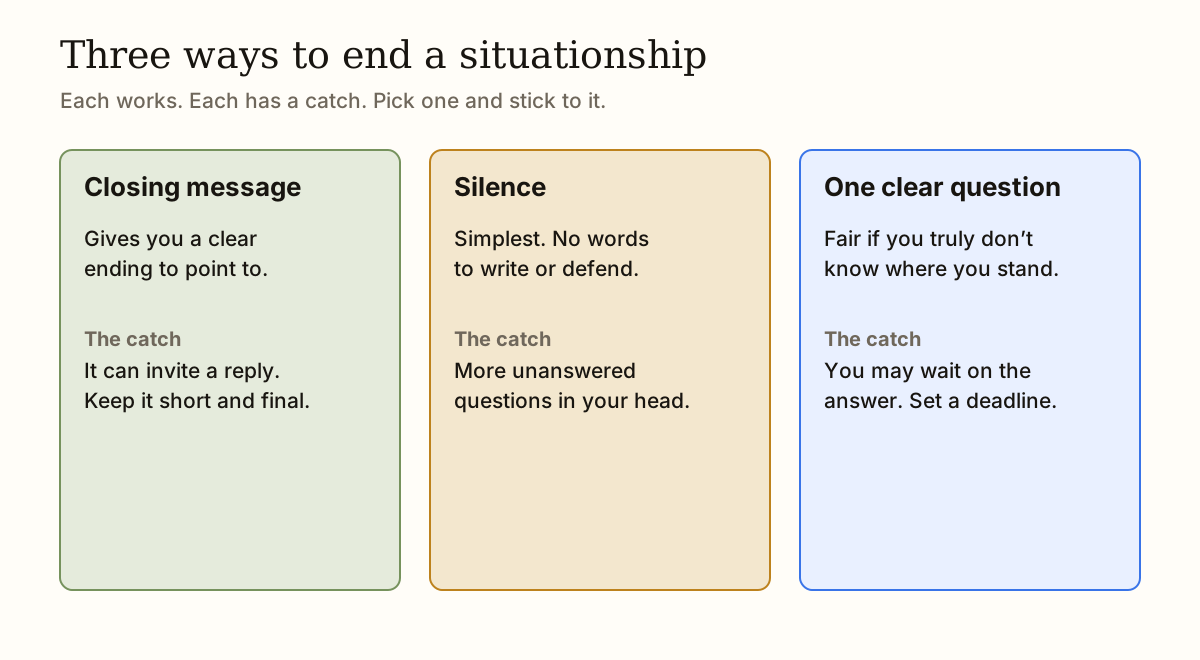
If you truly don’t know where you stand, there’s a third option: ask one clear question with a deadline, and treat silence as your answer. Whichever you choose, contact stops afterwards.
- Closing message: “I’ve thought about it and I want to step back from talking. I wish you well, and I won’t be replying to messages going forward.”
- Shorter: “I’m going to step back from talking. Take care.”
- One clear question: “I need to know where this is going. If you’re not sure by Friday, I’ll take that as my answer and step back.”
- No message: stop replying. Silence is a valid ending, though it may leave more questions.
What if they ghost you, say “let’s stay friends”, or keep texting?
You don’t owe a reply to any of it. If they faded out, you can still close the loop for yourself: mute the thread, and treat the silence as the answer. A fade is an answer, even an unkind one.
If they respond to your closing message with a friendship offer or a late “hey”, keep your reply short and consistent with your boundary. The goal is to avoid negotiating the boundary itself, because each negotiation keeps the situation open.
- Friendship offer: “I’m not able to be friends right now, so I won’t be in touch. I hope you’re doing well.”
- A late “hey”: no reply, or after a day: “I’ve made my decision and I’m sticking to it.”
- Breadcrumbing (an occasional like or message to keep you hooked): mute them, and don’t reply to anything that isn’t a clear plan.
- If they keep messaging after a clear reply: stop answering, save the messages, and block if the contact is unwanted. If it turns threatening, see the safety page.
How do you stop texting a situationship?
The urge usually arrives at the same times: late at night, after a drink, when you’re bored. Plan for those moments. Gollwitzer’s 1999 review found that simple “if X, then Y” plans help people follow through on goals, so decide in advance what you’ll do instead of relying on willpower at 11:40 p.m.
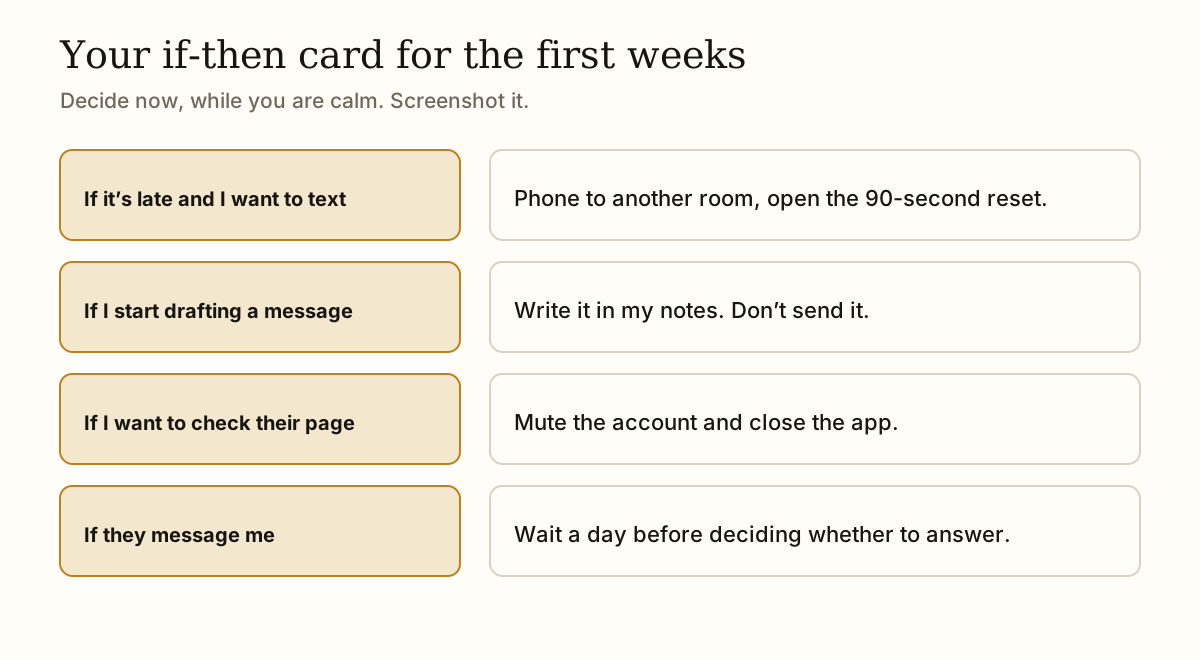
The urge also tends to rise, peak and fade if you don’t act on it. In a 2009 study by Bowen and Marlatt, smokers who were taught to watch an urge rise and fall without acting on it smoked fewer cigarettes afterwards, although the urges themselves didn’t drop. That was a study of smokers, not romantic contact, so use it as a general technique. Notice the urge, name it, breathe, and let it crest.
Writing helps with the part that has nowhere to go. Pennebaker’s 1997 work on expressive writing linked writing about emotional experiences to benefits in several studies. A letter you never send, in a notebook or the Vault in UnLink’s premium version, gives the feelings somewhere to land. The guide on how to stop texting someone has more tactics.
What about their social media, mutual friends and work?
Checking their profile is one of the easiest ways to stay stuck. A 2012 study by Marshall found that more monitoring of an ex’s Facebook was associated with more distress, less personal growth and more longing. The study was correlational, so it can’t prove cause, but it matches what many people report. Mute, unfollow or archive their account and take the app off your home screen. How to stop checking your ex’s social media goes step by step.
If you share friends, ask them not to report on each other, and see them one-to-one for a few weeks. If you share work, keep contact to the task and see the rules in modified no contact.
How will I know I am ready to move on, and when should I get help?
Signs of moving on: they no longer take over your day, you can look back with more clarity, and you’ve stopped rehearsing messages. There is no fixed number of days. If you’re unsure, how long no contact should last explains why day counts are checkpoints, not rules, and the signs you’re over your ex list works for situationships too.
A situationship ending can still bring low mood, trouble sleeping and a lot of shame. If it lasts, or you feel hopeless, talk to someone you trust or a clinician. In the US, call or text 988; in the UK and Ireland, Samaritans on 116 123; in India, Tele-MANAS on 14416. You can track your days and urges in UnLink on your iPhone to see how things change.
Step-by-step plan
- Name what the situation was
Write down what the connection involved, what you hoped for and what you were uncertain about. Naming the loss gives the grief somewhere to land, even though it was never officially defined.
- Decide your boundary
Choose whether you will stop contact entirely, or limit it to a specific purpose such as work. Make the decision for your own recovery, not to change how they feel.
- Choose your ending
Pick a closing message, silence, or one clear question with a deadline. If you want a message, keep it short and final, with no invitations.
- Set if-then plans for urges
Write three if-then plans for the moments you are most likely to text, such as late at night or after a drink. Keep them somewhere you can see them.
- Protect your social media and phone
Mute or unfollow their accounts, remove the app from your home screen, and turn off notifications from the thread you are no longer using.
- Plan support for the first two weeks
Arrange time with friends, a routine for evenings, and a short daily check-in with yourself. Expect the first two weeks to be the most intense, and plan for it.
- Review your progress each week
Once a week, note how often you were tempted, how you responded, and whether your mood is steadier. Adjust the plan if something is not working.
You do not have to solve the whole relationship tonight. Take one private step that creates space between the feeling and the action.
Build your no-contact plan →Common questions
Do you need no contact after a situationship?
No rule requires it, but many people find stepping back helpful, especially if they keep checking for messages or their mood depends on contact. No contact is a boundary you choose for your own recovery, and you can decide the level that fits your patterns.
How do I stop texting a situationship?
Write specific if-then plans for the moments you are most likely to text, such as late at night. Move drafts into your notes, mute their accounts and keep the phone out of reach in the hardest hours. Plan support for the first two weeks, when the urge is usually strongest.
Should I send a closing text after a situationship?
It is optional. A short, final message with no questions can give you a clear ending. Don’t send one if you hope for a reaction or an explanation, because that often reopens the conversation. Silence is also a valid way to end things.
Why does a situationship ending hurt so much?
You lose a routine, a person you cared about and the future you imagined, often without a conversation to mark it. Ambiguity makes it harder to close the chapter. Research on romantic rejection suggests the pain can feel physical, which is a normal response to a real loss.
How long does it take to get over a situationship?
There is no fixed time, and it varies with how long it lasted and how much uncertainty was involved. Instead of counting toward a magic date, watch your own signs: whether you still check for messages, rehearse replies or reread old threads. Those tell you more than a number.
Can you be friends with someone after a situationship?
Sometimes, but usually not straight away. A friendship tends to work only once the romantic hope has faded, which often takes space. If you feel pulled to stay close mainly to keep a door open, it is probably too soon.
What if my situationship ghosted me?
Treat the silence as the answer, even though it is an unkind one. You can send a closing message for your own sake or simply mute the thread and begin no contact. Chasing an explanation usually extends the loop.
Is it normal to feel this sad over someone I never dated?
Yes. Attachment forms through closeness, routine and hope, not through a label. The loss of those things is real, and you do not need a title to justify grief. If the sadness is heavy or lasts for weeks, talk to someone you trust or a professional.
If contact involves threats, stalking, coercion, shared children, housing or immediate safety, a general no-contact rule may not fit. Read the safety guidance and seek qualified local help where appropriate.
Sources and further help
- Kross E et al. (2011), Social rejection shares somatosensory representations with physical pain, PNAS
- Lewandowski GW & Bizzoco NM (2007), Addition through subtraction, Journal of Positive Psychology
- Dailey RM et al. (2009), On-again/off-again dating relationships, Personal Relationships
- Marshall TC (2012), Facebook surveillance of former romantic partners, Cyberpsychology, Behavior, and Social Networking
- Gollwitzer PM (1999), Implementation intentions: strong effects of simple plans, American Psychologist
- Bowen S & Marlatt A (2009), Surfing the urge: brief mindfulness-based intervention for college student smokers, Psychology of Addictive Behaviors
- Pennebaker JW (1997), Writing about emotional experiences as a therapeutic process, Psychological Science
- National Domestic Violence Hotline — safety planning
- 988 Suicide & Crisis Lifeline — US crisis support
Research is cited to explain general patterns, not to diagnose or predict any individual outcome. Sources do not endorse UnLink. Read our editorial principles.
Keep this support one tap away.
UnLink is a free, private no-contact tracker for iPhone: count your days, get through urges and restart without losing your history.