How to Stop Texting Someone, Even When You Really Want To
How to stop texting someone, including how to stop texting someone so much: an if-then plan, a before-you-send check, scripts and what to do when they go quiet.
 By the UnLink Editorial Team · General educational guidance, not therapy
To stop texting someone, decide the boundary while you are calm, then put a specific if-then plan between the urge and the send button. Ask what the message is for before you send it: logistics can go, reassurance cannot be answered by a text. Remove easy access, and never send a second message to fill a silence.
- Decide the boundary while you are calm and write it down, so the urge has something to argue with.
- An if-then plan such as “If I open their name to type, then I will write it in Notes and wait until morning” makes the next step automatic.
- Most texts you want to send are asking for reassurance, a reaction or closure, and a reply rarely supplies any of those for long.
- If you text someone so much that it strains the relationship, tell them directly and agree a rhythm instead of just going silent.
- If contact with the person feels unsafe or controlling, get support before you change how you communicate.
Why the urge to text someone is so hard to switch off
The pull to send a message is not just a bad habit. In a 2010 study of people recently rejected by a partner, Fisher and colleagues found that viewing that person’s photo activated brain regions linked to reward, motivation and craving. That is one reason an unanswered text can feel urgent in your body and not only in your head.
Pain is part of it too. Kross and colleagues (2011) found that recalling an intense recent romantic rejection engaged regions that also respond to physical pain. Wanting to reach out is an understandable response to a real loss. It does not mean you are failing, and it does not mean you have to act on it.
Who are you trying to stop texting?
People type this phrase for very different reasons. The mechanics overlap, but the boundary that fits is not the same for an ex, a crush who sends mixed signals, a friend who has become draining, a partner you text all day, or a parent you cannot talk to without conflict. Pick the row that sounds like you.
Situationships and on-and-off connections carry a particular trap. Research by Dailey and colleagues (2009) found that on-again, off-again relationships were associated with more uncertainty and lower relationship quality than other dating relationships. Uncertainty keeps the texting going, because each message feels like it might finally clarify things. The guide on no contact after a situationship goes into that case.
| Who it is | What the text is usually for | Boundary that fits |
|---|---|---|
| An ex | Reassurance, closure, checking they are okay, or one more taste of them | No texts at all for a set stretch, with the thread out of sight. See how to stop texting your ex. |
| A situationship or crush | Clarity about where you stand, or a hit of attention | Stop initiating, and let their effort decide. Do not send a second message. |
| A friend or colleague who drains you | Keeping the peace, or guilt about not replying | Fewer, shorter replies on your schedule. No announcement needed. |
| A partner you text constantly | Calming anxiety, or staying connected during the day | Agree a rhythm out loud, with set windows and a plan for when one of you is busy. |
| A family member | Duty, or hope the next message will go differently | Practical topics only. See modified no contact. |
How to stop texting someone so much
There is no number of texts per day that counts as too many. The better test is what the texting does to you and to them. If you feel a wave of relief after sending and dread while you wait, if you check the delivered line, or if the other person has started to reply less and less, the texting has probably turned into a way of managing your own anxiety.
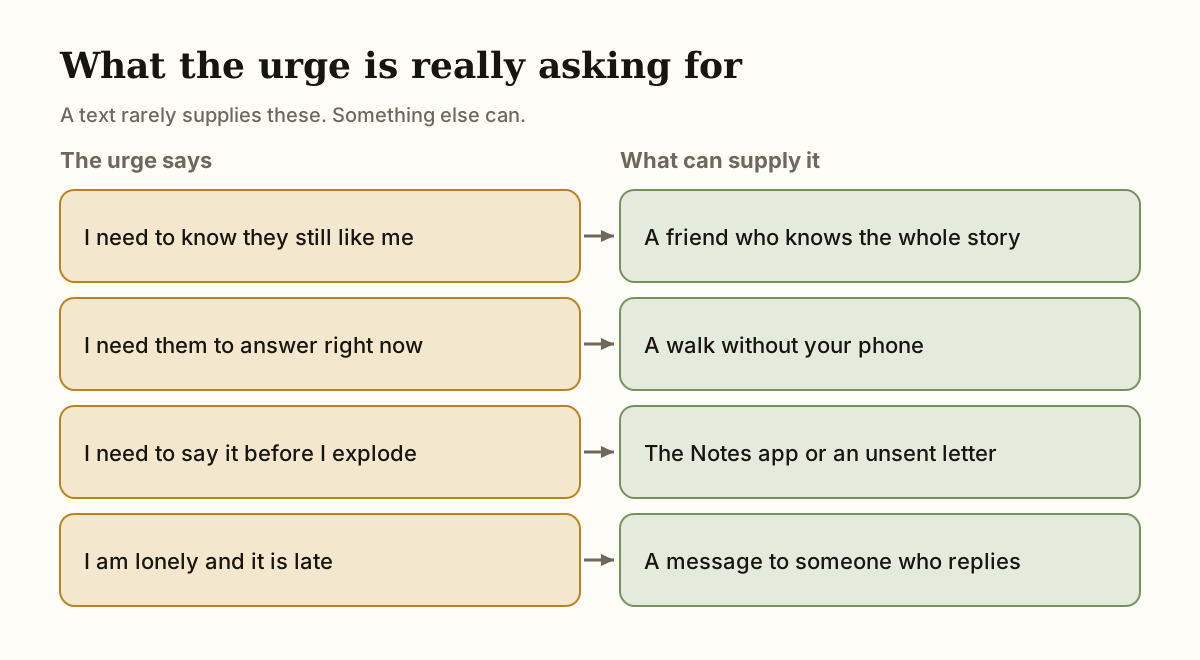
Start by working out what the text is asking for. In most cases it is one of four things, and the text answers none of them for long. Reassurance wears off in minutes, so you send again. A reply buys an evening and then you need the next one. Saying it out loud is better done somewhere that does not require an answer.
Then pick one change you can keep. Batch your messages into two or three windows a day. Turn off the banner so a reply does not pull you back in. Move the app off the home screen. If you are in an ongoing relationship or friendship, tell them what you are doing, because silence with no explanation reads as a mood. A script that works: “I’ve noticed I text you a lot when I’m anxious and I’m trying to do less of it. If I go quiet for a while, it isn’t about you. I’ll call you tonight.”
Write an if-then plan for the moment you reach for the phone
A general promise to “not text them” is hard to keep at 11 p.m. A specific plan is easier. Gollwitzer’s 1999 review of implementation intentions found that simple if-then plans, such as “If X happens, then I will do Y,” help people follow through on goals. The decision is made in advance, so you do not have to make it fresh while you are hurting.
Write two or three plans and keep them where you will see them. Each needs a trigger you can recognize and an action that takes under a minute. If night is your hardest window, why you want to text your ex at night explains why, and what to do instead of texting has alternatives you can pick from.
- If I open their name to type, then I will close the app and open a note instead.
- If I write a message I would not send in daylight, then it stays in the note until morning.
- If the urge comes after a drink, then the phone goes in another room and I text a friend who knows the plan.
- If I check whether they have read my message, then the phone goes face down and I walk for five minutes.
- If I catch myself rehearsing what to say, then I write it as a note to myself, not a text to them.
What to ask yourself before you send
The aim of a pre-send check is not a perfect message. It is to notice what the message is for. Logistics, such as a pickup time or a bill, can go. Anything that hopes for a particular response should take the slower route: write it in your notes, wait until morning, and then decide.
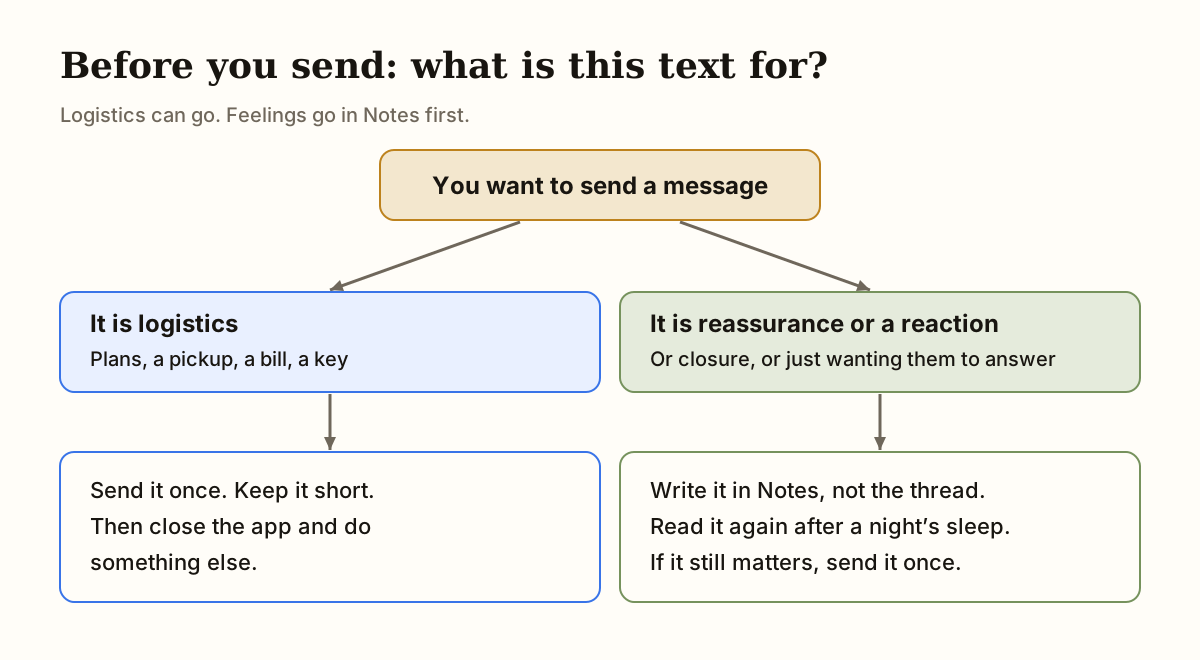
If you cannot honestly say yes to “Would I be fine if they never replied?”, the message is probably a request for relief rather than communication. That is useful information, and it is a reason to wait.
- Am I trying to get a reaction, an apology or a reply right now?
- Have I already sent something today, and did it get the response I wanted?
- Would I be fine if they never replied to this message?
- Am I writing this at a time of day when I usually feel worst?
- Does this add something new, or does it repeat what I have already said?
- Could I wait until tomorrow and still have the same reason to send it?
What to do when they do not reply
Silence is the hardest part, because it invites a story. You start reading meaning into the gap, or deciding how many messages count as a real attempt. A second or third text rarely changes the situation, and it often hands the other person another reason to pull back while you feel worse.
Give the silence its own time. Decide in advance how long you will wait before doing anything at all, and what you will do with that time. If the waiting is making you anxious, the anxiety is worth attention in its own right, and a friend or a page of journaling helps more than another text. UnLink, a free no-contact tracker for iPhone, has urge support built for this window, and you can log what you felt so the pattern is easier to spot next time.
If the silence is part of a pattern of mixed signals, you do not have to solve it by texting. You can decide that you will not chase, and let the unanswered message be an answer you can live with. If they do reply later, what to do when your ex texts you during no contact covers how to respond without restarting the cycle.
Double-texting, and what to do after you already sent one
Double-texting is one of the most common slips. The first message goes out, nothing comes back, and a second follows with more explanation, a joke or a question. If you have done this, the goal is to stop the cycle, not to fix the first message.
Leave both unanswered and run the plan you wrote earlier. Then note what triggered it, because the trigger is the part you can change. If you want a clearer script for a message that has already gone out, what to do if you break no contact covers the next steps in more detail.
Let the urge rise and fall without acting on it
Urge surfing is a technique from smoking research: you watch an urge climb and fall without acting on it. In a study of college student smokers, Bowen and Marlatt (2009) found that a brief urge surfing instruction did not make the urges weaker, but participants smoked fewer cigarettes. The context is different from texting, and nobody has tested it on texting, but the skill is the same: you can have the urge and not send.
Try it for two minutes. Say what is happening (“I want to text them”), notice where it sits in your body, and count breaths while it peaks. Each time you wait through a wave without sending, you collect evidence that waiting is possible.
Make it physically harder to send
Willpower is a poor plan at 1 a.m., so change the phone. Archive the thread, turn on Hide Alerts, move the app off your home screen, and, if the pull is strong, add a limit that someone else controls. The guide on how to block yourself from texting someone walks through the iPhone Screen Time setup and the Android options, and should you block your ex compares blocking, muting and archiving.
The same applies to the thing you write when you cannot send. A note or an unsent letter lets the words exist without a recipient.
When the person is someone you love
Stopping texting a family member, close friend or someone you live or work with is different. You may need to stay in contact for practical reasons, or you may be stepping back from a relationship that has become harmful. In both cases the boundary is your own, and it can be made without a dramatic announcement.
If you are doing this because the contact feels unsafe, controlling or threatening, the priority is safety rather than silence. Leaving or going quiet can change how someone reacts, so read the National Domestic Violence Hotline’s safety planning guidance first. In the US the Hotline is 1-800-799-7233, or text START to 88788, and our safety page lists crisis lines in other countries.
- Name the boundary in one sentence, such as “I am going to stop texting you outside of the things we need to plan.”
- Keep messages to the practical content you need, with nothing that asks for reassurance.
- Decide what you will do if they reply with pressure or guilt, before it happens.
- Tell one person you trust what you are doing, so you are not holding it alone.
Step-by-step plan
- Write the boundary while you are calm
Choose one sentence that says what you will and will not do, such as no texts to them, or no texts outside practical plans. Write it where you will see it.
- Set up one if-then plan for the trigger
Pick the moment that pulls you most, such as late at night or after a drink, and write “If that happens, then I will do this instead.” Keep the action under a minute.
- Remove the easy access
Archive the thread, turn on Hide Alerts, and move the messaging app off your home screen for the hours that are hardest.
- Check what the message is for before you send
If it is logistics, send it once. If it is hoping for reassurance, a reaction or closure, write it in a note and read it again tomorrow.
- Wait out the silence on purpose
Decide in advance how long you will wait for a reply, and do not send a second message to fill the gap. Use the time for something you chose beforehand.
- Review the pattern after a week
Note which triggers came up, which plans you used and what happened next. Adjust the plan rather than judging yourself for the slips.
You do not have to solve the whole relationship tonight. Take one private step that creates space between the feeling and the action.
Private decision tool before you send →Common questions
How do I stop texting someone so much?
Work out what the texting is asking for, usually reassurance or a reply, then change one thing you can keep: two or three set message windows, no banners, the app off your home screen. If it is a partner or friend, say so out loud and agree a rhythm. Do not send a second message to fill a silence.
How do I stop texting someone who does not text back?
Decide in advance that you will not follow up, and plan what you will do while you wait. An unanswered text is rarely a problem more words can solve. Ask what you need from this person, and if you still want to stay in contact.
How do I stop texting someone I like?
Let their effort set the pace: send one message, then wait for a reply before the next. Keep your own days full so the phone is not the main event. If you feel stuck in a loop of mixed signals, treat it like a situationship and set a boundary.
How do I stop contacting someone I love?
Name the boundary in one clear sentence, keep messages to what is necessary, and decide what you will do if they push back. If the contact feels unsafe or controlling, get support before changing how you communicate. Limited contact is often more realistic than a full stop for family or shared situations.
How do I stop myself from messaging someone when I am drunk or lonely?
Set the plan before you drink or go to bed: phone in another room, or handed to a friend. Keep the unsent message in a note and read it in the morning. Urges rise and fall, and waiting out one wave makes the next one easier to wait out.
Is it normal to keep wanting to text someone I am trying to stop talking to?
Yes. Research on romantic rejection has found that viewing a former partner’s photo can activate brain regions linked to reward and craving. Wanting contact does not mean the boundary is wrong. It means the boundary needs structure and support.
What is urge surfing, and does it work for texting?
Urge surfing is noticing an urge as it rises, peaks and falls without acting on it. It comes from a study of smokers, where the urges did not shrink but people smoked less. Nobody has tested it on texting, but the skill carries over: you can feel the urge and not send.
What should I do after I already sent a text I regret?
Stop there. A second message usually makes things harder. Run the plan you wrote earlier, let the unanswered message be what it is, and write down what triggered it so the next plan is more specific.
If contact involves threats, stalking, coercion, shared children, housing or immediate safety, a general no-contact rule may not fit. Read the safety guidance and seek qualified local help where appropriate.
Sources and further help
- Fisher HE et al. (2010), Reward, addiction, and emotion regulation systems associated with rejection in love
- Kross E et al. (2011), Social rejection shares somatosensory representations with physical pain
- Gollwitzer PM (1999), Implementation intentions: strong effects of simple plans
- Bowen S & Marlatt GA (2009), Surfing the urge: brief mindfulness-based intervention for college student smokers
- Dailey RM et al. (2009), On-again/off-again dating relationships
- National Domestic Violence Hotline: safety planning
- 988 Suicide & Crisis Lifeline — US crisis support
Research is cited to explain general patterns, not to diagnose or predict any individual outcome. Sources do not endorse UnLink. Read our editorial principles.
Keep this support one tap away.
UnLink is a free, private no-contact tracker for iPhone: count your days, get through urges and restart without losing your history.