Limerence vs Love: How to Tell the Difference After a Breakup
Limerence vs love: what Tennov’s 1979 term means, eight differences in one table, why uncertainty fuels it, a three-question check, and what to do next.
 By the UnLink Editorial Team · General educational guidance, not therapy
Limerence vs love comes down to what the feeling needs. Limerence is an involuntary, intense longing that needs the other person’s response and grows with uncertainty. Love is an attachment to the whole person that can stay steady once you know them. The two overlap, and neither label is a diagnosis.
- Limerence is a term coined by psychologist Dorothy Tennov in her 1979 book Love and Limerence. It describes an involuntary, intense longing for one person, with intrusive thoughts and a need for them to feel the same way.
- It is not a clinical diagnosis, and the research is young: its authors say the first published questionnaire to measure it appeared in 2025. Treat any comparison, including ours, as a set of questions to ask yourself and not as a test.
- Intensity does not separate limerence from love, because real love can be intense and uncertain too. What separates them is what the feeling needs: limerence tends to need uncertainty and a response, love tends to hold up once you know who the person is.
- On-off contact is the easiest way to keep limerence going, and silence can make it louder before it quiets. That is not proof that no contact is failing.
- You can work with it after a breakup: stop feeding the uncertainty, log the pattern, plan for the trigger moments, and get support if the thoughts take over for weeks.
What is limerence?
Limerence is an involuntary, intense longing focused on one person, with intrusive thoughts about them and a need for them to feel the same way. The word comes from the American psychologist Dorothy Tennov, who introduced it in her 1979 book Love and Limerence: The Experience of Being in Love as a way to separate this state from the many things people call love.
Two cautions before you use the word as a label. Limerence is not a diagnosis: it is not in the DSM-5, and a 2021 case study noted that no validated screening tools or standard treatment protocols existed (Wyant, 2021). And the science is early. A 2025 paper in Psychological Reports described what its authors present as the first published measure of limerence, tested on people who said they had experienced it (Marshall et al., 2025). What follows is a description of a pattern, not a test you can pass or fail.
People often meet the word after an on-off relationship, a sudden ending or a situationship. If what you feel is closer to missing than to longing, why do I miss my ex covers that.
Limerence vs love: what is the actual difference?
Limerence needs the other person’s response to stay alive, and it feeds on uncertainty. Love, in the sense most people mean, is an attachment to the whole person that can stay steady once you know them. The catch is that love can also be intense, anxious and uncertain, so no single trait settles it. The panels below show where they overlap.
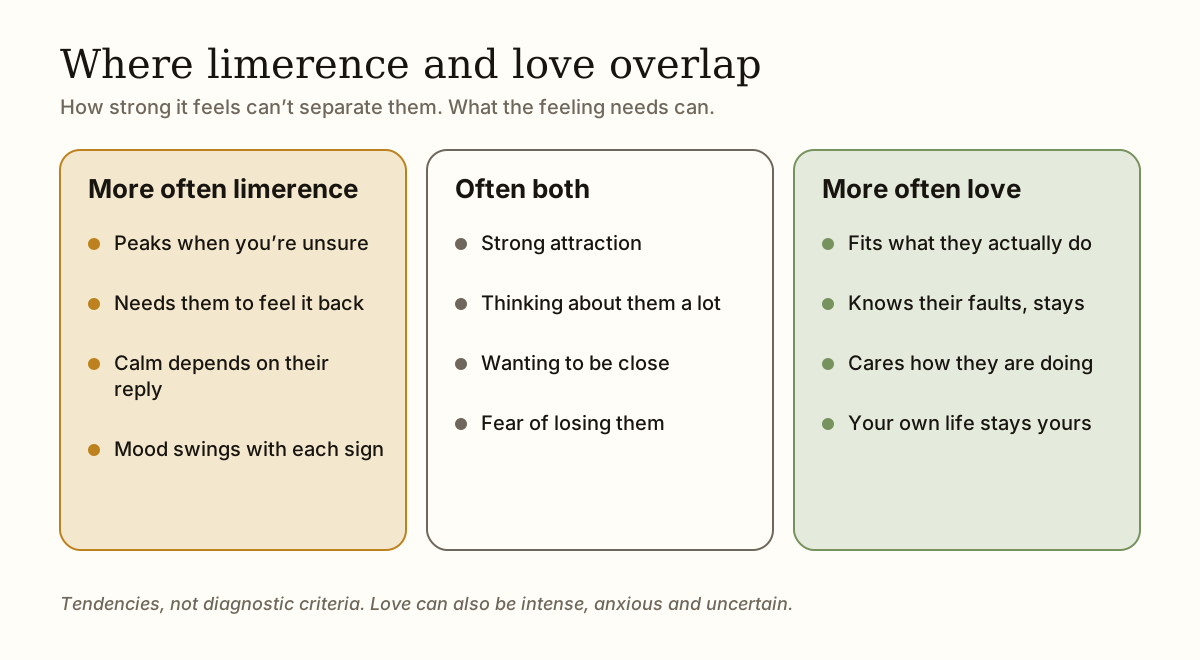
The table pulls eight differences apart. Read it as questions to ask yourself, not as diagnostic criteria. Most people will recognize themselves on both sides of several rows.
| What to compare | Limerence tends to | Love tends to | What to notice |
|---|---|---|---|
| What sets it off | Flare up at signs of interest: a reply, a like, a warm look, a mixed signal. | Grow with time together and what you learn about the person. | Is the feeling built from what you know, or from what you’ve imagined? |
| Uncertainty | Intensify when you can’t tell how they feel. | Settle once you know where you stand, although love can feel uncertain too. | When you picture them clearly interested, does the charge drain? |
| When contact stops | Rise, as the gap fills with replaying and guessing. | Hurt, then ease as ordinary life fills back in. | Is the silence making it louder or quieter? |
| Where calm comes from | Depend on their response and presence. | Come partly from your own life, even when they are far away. | Could you get through a whole day with no news of them? |
| Their actual behavior | Get filtered through hope; warning signs are explained away. | Shape the feeling: what they do matters. | Would you tell a friend to stay, given what they’ve actually done? |
| Focus | Center on what they think of you and whether they will feel it back. | Center on them as a whole person and on the two of you. | How much of your thinking is about their reaction to you? |
| When they are kind | Bring relief, then a need for more or a fear it will stop. | Bring warmth without a need to prove it will last. | Does kindness settle you, or only reset the wanting? |
| Describing them | Lean on strengths, or on a version built from fragments. | Include faults and specific details, and stay. | Can you name three things about them that frustrate you? |
Why does uncertainty make my feelings stronger?
Because an open question about how they feel keeps your reward system guessing, and unpredictable rewards grab attention harder than reliable ones. Researchers who write about limerence describe it this way: the more uncertain you are about the other person’s feelings, the more you want them and the more you ruminate, and your mood rises and falls with every perceived sign of affection or disapproval (Marshall et al., 2025).
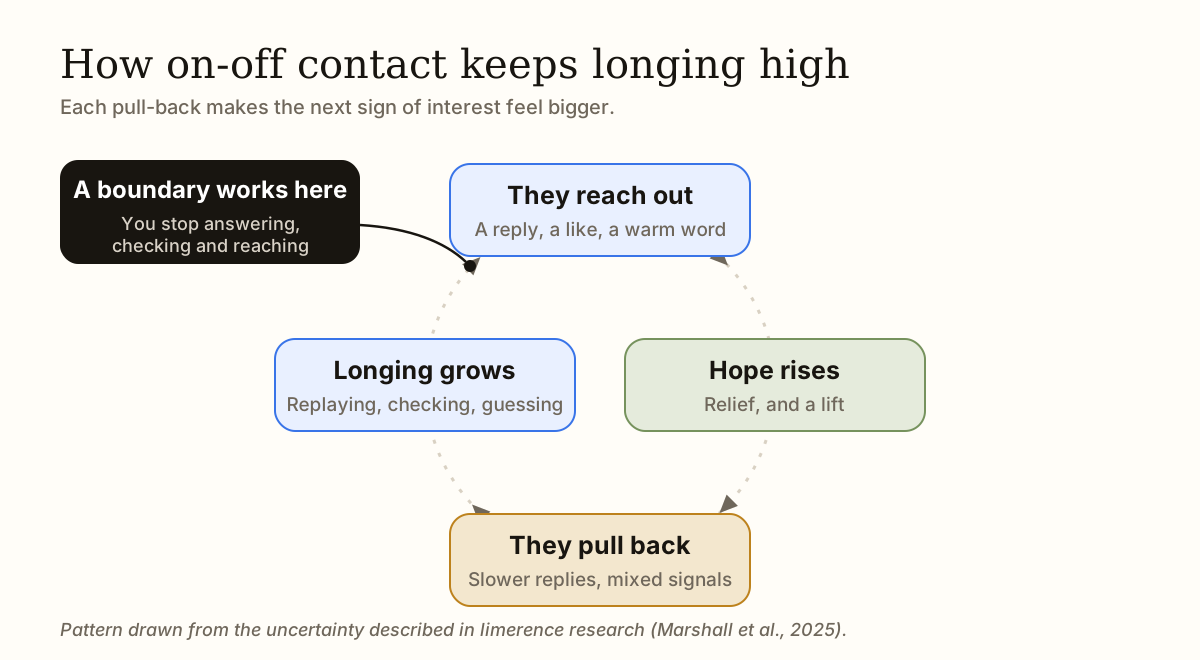
There is a laboratory parallel, with a big caveat. In monkeys, dopamine neurons showed a sustained signal that tracked how uncertain a reward was, strongest when the odds were even (Fiorillo et al., 2003). That is an animal study of rewards, not of love. Read it as a reason unpredictable rewards pull so hard, not as a measurement of anyone’s feelings.
On-off relationships build this easily. In a 2009 comparison, couples who had broken up and gotten back together reported more uncertainty and lower relationship quality than couples who hadn’t (Dailey et al., 2009). Each reunion is a reward, each pull-back a loss, and you never know which is next. The same holds in a situationship where nobody has said what this is, which our guide to no contact after a situationship covers.
None of this is about their motives. They may be confused, busy or kind. It is about what an unpredictable pattern does to you. A no-contact boundary works on the one part you control: you stop answering, checking and reaching, and the loop loses its fuel.
Can you love someone and still have limerence?
Yes. The two overlap, and a person can feel both about the same someone. You can care how they are doing and still check their profile all day. The difference shows in which one is steering.
Intensity can’t settle it either. Brain scans of people newly and intensely in love (Aron et al., 2005) and of people recently rejected in love (Fisher et al., 2010) both show reward-system activity when they look at the person. Neither study was about limerence, so neither can tell the states apart. That is the point: how strong it feels doesn’t say which one you have.
A better question is whether the wanting would survive clarity. If their feelings and behavior were plain tomorrow, would you still want what you want from them? If part of the answer is no, part of what you’re holding is the wanting itself. People with a more anxious attachment style can find this harder to sort out, and anxious attachment after a breakup explains why.
What do limerence and love look like over four months?
Example: the same four months, read two ways. The events are identical in both columns. Only the response differs.
| When | What happens | Timeline A (reads as limerence) | Timeline B (reads as love) |
|---|---|---|---|
| Week 1 | A first date goes well. They say “let’s do this again.” | You replay it for days and reread their messages for hidden meaning. | You enjoy it, think of them now and then, and get on with your week. |
| Week 3 | They take two days to reply during a busy week. | Two days feels like a verdict. You draft four replies and watch for read receipts. | You notice the gap, feel a bit flat, and ask how their week is going. |
| Week 6 | They cancel once, then are warm again. | Relief floods in, bigger than before the cancellation. You plan around the next sign. | Mild disappointment, a new plan. The warmth is welcome. |
| Week 10 | They say they’re unsure where this is going and step back. | Longing spikes. You reread everything. The feeling is strongest now that they’re least available. | You feel the loss clearly and can tell a friend what you valued about them. |
| Month 4 | No contact. | You still think of them daily, and the thoughts are mostly about what they thought of you. | The sadness has loosened with activity. Thoughts of them come and go, and you can plan a weekend. |
How do I know if I’m in limerence or in love?
Ask three questions and count your yeses. A lean is the most anyone can honestly give you.
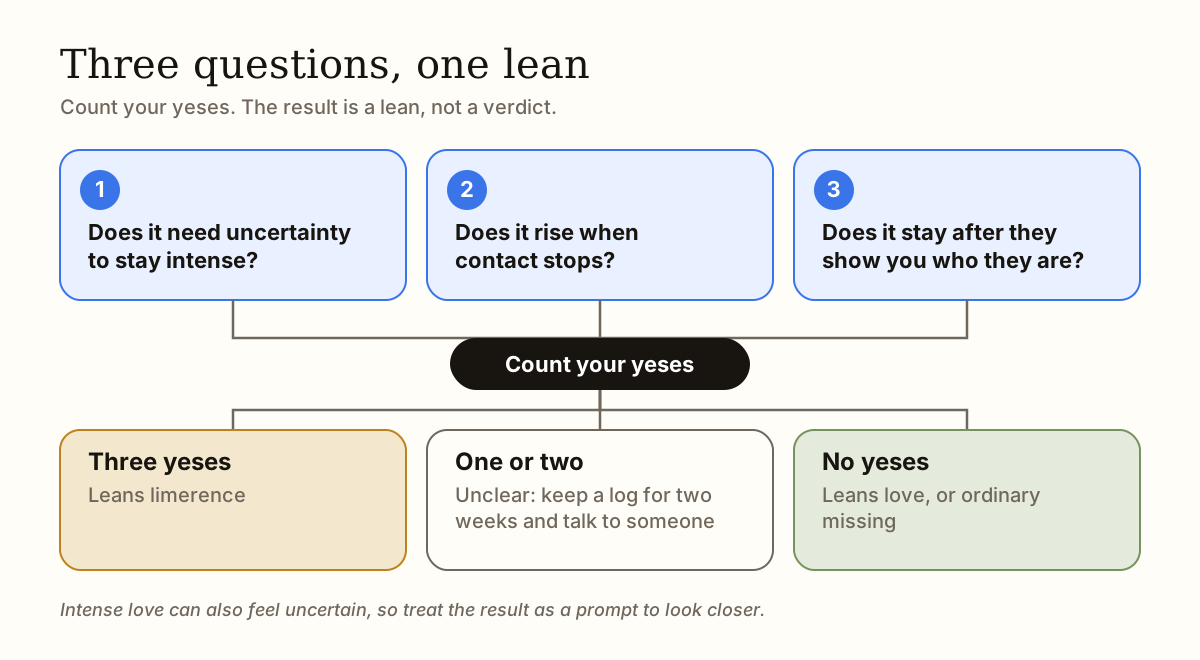
- Does it need uncertainty to stay intense? Picture them clearly and kindly interested. If part of the charge drains away, the uncertainty was doing some of the work.
- Does it rise when contact stops? Grief usually moves with time and company. Wanting a sign tends to circle your phone.
- Does it stay after they show you who they are? If they have been inconsistent, unkind or clear that they don’t want this, and you reinterpret instead of updating, take note.
What happens to the feeling when contact stops?
It can get louder before it gets quieter, and that doesn’t mean no contact is failing. Without new information, the mind fills the gap. Limerence is described as relying heavily on imagined interactions with the person (Willmott & Bentley, 2015, as summarized by Marshall et al., 2025), and a study of people recently rejected in love found craving-related brain activity when they looked at the ex (Fisher et al., 2010).
Looking feeds it. A 2012 study of Facebook use after breakups found that monitoring an ex was associated with more distress and less personal growth (Marshall, 2012). It is correlational, but it’s a reason to mute and archive. Nobody has measured how limerence behaves in no contact specifically, so treat this as an informed expectation, not a finding.
It helps to know which ache you have. Grief for a person and a life usually shifts when you move and see people. Wanting a sign tends to stay near the phone. Our guides to the no-contact rule and the stages of no contact describe what the early weeks often feel like.
Does limerence go away?
The intensity usually changes, but there is no reliable timeline and it doesn’t always fade on its own. A small qualitative study of six people (Willmott & Bentley, 2015), as summarized in the 2025 questionnaire paper, put episodes at roughly one to seven years. Tennov described several endings: lasting rejection, the feeling being returned, or the focus moving to someone new, and later researchers added settling into friendship (Marshall et al., 2025). Popular articles quote tidy ranges in months, and the ones we checked cite no study for the number.
What tends to shift it is a clear answer, distance and something else to put your attention into. Therapy may help too. One published case study, written up by the patient herself, describes cognitive behavioral techniques adapted from OCD treatment shrinking the time she spent in limerent rituals (Wyant, 2021). It is a single person, so it shows what a therapist might try, not that it works.
How do I get over limerence after a breakup?
Work on the loop, not on the person. You can’t talk yourself out of wanting, but you can stop supplying the uncertainty that fuels it. The step-by-step plan below follows that order, and our breakup recovery guide has the wider plan.
Plan the moments in advance. Gollwitzer (1999) reviewed research on if-then plans and found they help people follow through on intentions. Example: If I catch myself rereading their last message, then I’ll put the phone in another room and text a friend instead. For the urge itself, see how to stop texting your ex and how to stop thinking about your ex.
When is a strong feeling a reason to get support?
When it takes over your days. If intrusive thoughts, lost sleep or trouble functioning last for weeks, talk to a GP or therapist. Limerence isn’t a diagnosis, but the distress is real and a clinician can help whatever it’s called. The NHS advises seeing a GP if low mood lasts most of the day, every day, for more than two weeks (NHS, “Symptoms: clinical depression”).
If you have been sending messages to someone who asked you to stop, turning up where they are or going through their things, stop there. It can frighten them, it can carry legal consequences, and support exists for the compulsion behind it. If an ex ever frightened or controlled you, safety planning comes first: the National Domestic Violence Hotline is 1-800-799-7233, or text START to 88788.
If you have thoughts of harming yourself, get help now. In the US, call or text 988. In the UK and Ireland, call Samaritans on 116 123. In India, call Tele-MANAS on 14416. More options are on our safety page.
Step-by-step plan
- Stop feeding the uncertainty
Mute or archive them, stop checking for signs, and decide in advance that you won’t answer a message while the pull is at its peak. Each sign you chase resets the loop.
- Log the cycle for two weeks
Each time the pull spikes, note the time, what happened just before and what you did next. After two weeks you can see whether it follows contact, silence or a particular trigger.
- Write if-then plans for the worst moments
Pick your two worst moments, such as late evening or after a mutual friend mentions them, and write what you will do: “If X, then I will Y.” Keep Y small and physical.
- Put the message in a letter you don’t send
Say all of it on paper or in a note, then leave it unsent. How to write an unsent letter shows how.
- Spend attention on something that answers back
Pick one standing plan a week, with a person or a skill that gives you feedback. Spare attention is what limerence eats, so give it somewhere else to go.
- Tell one person the pattern, not just the pain
Say it plainly: “I keep waiting for a sign from them.” Said aloud, it loses some of its pull, and someone else can notice when you’re slipping.
You do not have to solve the whole relationship tonight. Take one private step that creates space between the feeling and the action.
Take the limerence quiz →Common questions
Is limerence a real psychological term?
It is a real term in the research literature, introduced by Dorothy Tennov in 1979 and used in later qualitative and questionnaire studies. It is not a formal diagnosis in the DSM-5, and the research is still limited, so it describes a pattern rather than a condition.
Who came up with the word limerence?
American psychologist Dorothy Tennov introduced it in her 1979 book Love and Limerence: The Experience of Being in Love. She used it to describe an involuntary state of intense longing and preoccupation, and to separate that state from the many other things people mean by love.
Is limerence the same as an unhealthy attachment?
Not exactly. Limerence is a pattern of intense longing, intrusive thoughts and need for reciprocation, while an unhealthy attachment describes how a relationship works. They can overlap, and Willmott and Bentley (2015) linked limerence to attachment anxiety. Neither is a verdict on you, and both can be worked with.
Why do I feel more attached when they pull away?
Uncertainty keeps your reward system guessing, and signs of interest tend to feel bigger when they are scarce. On-off contact produces exactly that. It tells you about the pattern, not about whether they are right for you or feel the same.
Does limerence always end when the relationship ends?
No. Without new information the mind can keep replaying and imagining, and one published account describes episodes lasting from one to seven years. Distance, a clear answer and new places for your attention tend to help, but there is no guaranteed timeline.
Can limerence happen without a relationship at all?
Yes. Limerence is described as attachment to a person, and in many accounts that person is unavailable or doesn’t return the feeling (Tennov, 1979, as summarized by Marshall et al., 2025), so a relationship isn’t required. The feeling attaches to the person, or to an imagined version of them.
How long does limerence last?
There is no reliable number. A small qualitative study put episodes at roughly one to seven years, and popular articles quote shorter ranges without sources. Less uncertainty, less checking and more support tend to help.
Is limerence a mental illness?
Not as a diagnosis: it is not in the DSM-5. Researchers still debate how to describe it, but it can cause real distress and get in the way of daily life. If it does, a GP or therapist can help whatever label is used.
Can limerence turn into love?
It can happen. Tennov described one way an episode ends as the feeling being returned (Marshall et al., 2025). What follows depends on whether the feeling survives getting to know the actual person, with their faults and their own pace. Plenty doesn’t, and that isn’t a failure on your part.
If contact involves threats, stalking, coercion, shared children, housing or immediate safety, a general no-contact rule may not fit. Read the safety guidance and seek qualified local help where appropriate.
Sources and further help
- Tennov (1979) — Love and Limerence: The Experience of Being in Love. Stein and Day (catalog record)
- Marshall et al. (2025) — Development and validation of the Limerence Questionnaire (LQ-11). Psychological Reports
- Willmott & Bentley (2015) — Exploring the lived-experience of limerence: a journey toward authenticity. The Qualitative Report
- Wyant (2021) — Treatment of limerence using a cognitive behavioral approach: a case study. Journal of Patient Experience
- Dailey et al. (2009) — On-again/off-again dating relationships: how are they different from other dating relationships?
- Fiorillo, Tobler & Schultz (2003) — Discrete coding of reward probability and uncertainty by dopamine neurons. Science
- Aron et al. (2005) — Reward, motivation, and emotion systems associated with early-stage intense romantic love. Journal of Neurophysiology
- Fisher et al. (2010) — Reward, addiction, and emotion regulation systems associated with rejection in love
- Marshall (2012) — Facebook surveillance of former romantic partners: associations with postbreakup recovery and personal growth
- Gollwitzer (1999) — Implementation intentions: strong effects of simple plans
- NHS — Symptoms: clinical depression
- The National Domestic Violence Hotline — Plan for safety
- 988 Suicide & Crisis Lifeline — US crisis support
Research is cited to explain general patterns, not to diagnose or predict any individual outcome. Sources do not endorse UnLink. Read our editorial principles.
Keep this support one tap away.
UnLink is a free, private no-contact tracker for iPhone: count your days, get through urges and restart without losing your history.