How to Stop Loving Someone (and What Actually Fades)
How to stop loving someone you still love: what fades attachment, what keeps it alive, a six-step plan, and an honest answer on how long it takes.
 By the UnLink Editorial Team · General educational guidance, not therapy
You usually can’t stop loving someone on command, but the attachment does loosen. What speeds that up is less contact and fewer checks, a daily life that no longer revolves around them, and accepting that the relationship is over. What slows it down is checking, rehearsing conversations and keeping hope open.
- Love for an ex has no off switch. What changes, for most people, is how much of the day it runs.
- In a 28-day study of 58 young adults after a breakup, love for the ex declined steadily, and staying in contact slowed that decline.
- Checking, rehearsing, keeping a hope open and comparing everyone to them are the habits that keep the feeling at full strength.
- Acceptance and hope are two different things. You can accept the ending and still hope, and sorting which is which is the most useful exercise on this page.
- If the love is tangled with fear, control or safety, get support before changing anything about contact.
Can you stop loving someone?
Not on command. Love for an ex is an attachment, built from months or years of routine, inside jokes and being each other’s first call, and attachments don’t have an off switch. What does change, for most people, is how much of your day the feeling runs. It gets quieter and further apart long before it fully goes, if it ever does.
There is research behind that. Sbarra and Emery (2005) tracked 58 young adults for 28 days after a serious dating relationship ended. Love for the ex declined steadily across that month, while sadness, anger and relief followed curved paths instead. People who stayed in contact with the ex saw their love and sadness decline more slowly. It was a short window and a young sample, so treat it as a direction and not a schedule.
So the useful question isn’t “how do I switch it off?” It’s “what loosens this, and what keeps tightening it?” The rest of this page answers that. If the missing is the louder part, start with why you miss your ex. If you suspect the pull is closer to obsession than love, limerence vs love draws the line.
What does “letting go” of someone you love actually mean?
Letting go means the relationship stops being the thing you organize your thoughts, hours and hopes around. That is all it means, and it is more modest than most advice makes it sound.
It also helps to say what it doesn’t mean.
- It isn’t forgetting. You will remember them. Some of it will be fond.
- It isn’t acting numb. Performing “I’m fine” for friends while checking their story at midnight is a performance, not a loosening.
- It isn’t hating them. Hate keeps you in a full-time relationship with them, just with the sign flipped.
- It isn’t rewriting the past. You don’t have to decide you were never really in love. “It was real and it’s over” is allowed.
- It isn’t a vow never to speak again. It is a change in what you are waiting for.
What makes feelings for an ex fade faster?
Four things have some support: less exposure, a life that doesn’t revolve around them, seeing the relationship accurately, and accepting that it is over. None is a cure. All of them work slowly, and they work best together.
Here is what each one rests on, and where the evidence stops.
- Less exposure. In people who had been rejected but were still in love, looking at a photo of the ex activated brain areas linked to reward and craving (Fisher et al., 2010). Each look is a small hit of that. In a study of Facebook use after breakups, monitoring an ex’s profile was associated with more distress and less personal growth (Marshall, 2012). Both are correlational or lab findings, but they point the same way as the 28-day study above.
- A day with other occupants. This one is practical experience more than research. Attachment lives in time slots: the commute call, the Sunday brunch, the text before sleep. Put something small in each slot and it stops signalling “them”.
- Seeing the relationship accurately. In a lab study of people upset about a breakup, deliberately thinking negatively about the ex lowered love feelings during the task, though it felt unpleasant. Distraction lifted mood without changing love feelings (Langeslag and Sanchez, 2018). It was one session, so it shows a lever exists, not that it lasts. Do it as a short, written review and not a nightly habit.
- Acceptance. In the 58-person study that Sbarra reported in 2006, acceptance of the breakup helped explain why securely attached people recovered from sadness sooner, while higher love and more preoccupation with the ex were linked to slower recovery. That is correlational. It shows acceptance travels with recovery, not that forcing yourself to “accept” causes it.
What keeps the love going?
The same four habits show up again and again: checking, rehearsing, keeping a hope open and comparing everyone to them. None of them feels like holding on. Each feels like coping, which is why they are hard to spot.
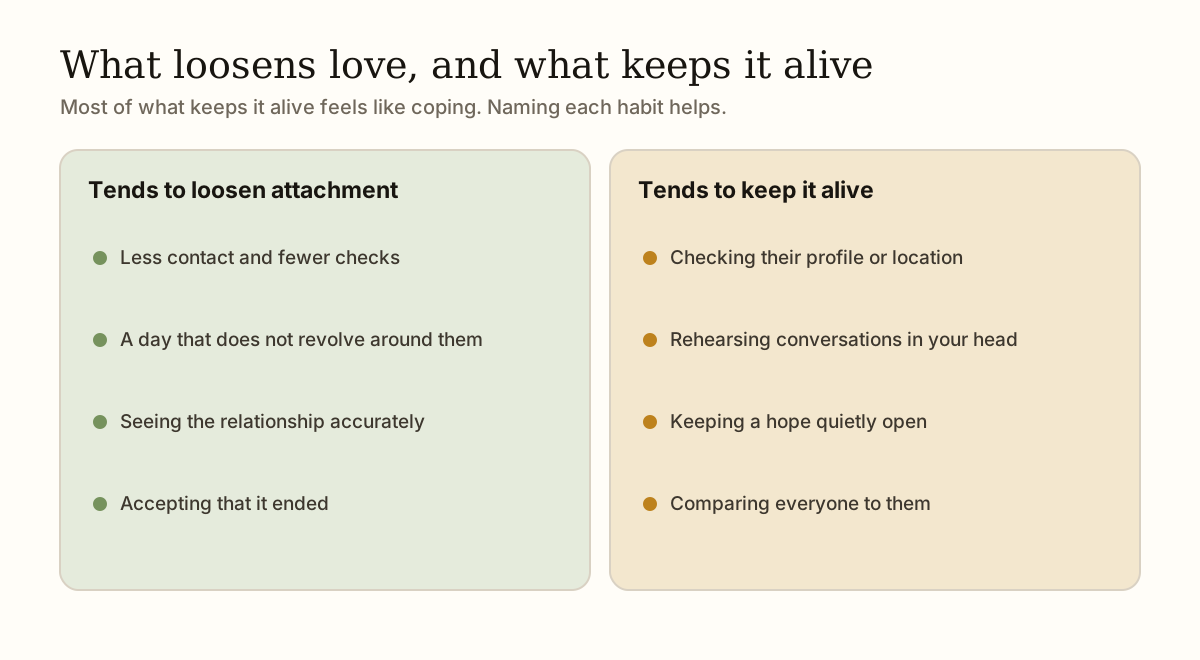
The table puts the habits that loosen attachment next to the ones that hold it in place, with the mechanism in one line. The diagram above it is the short version.
You don’t need to change all eight overnight. Pick the keep-alive habit you did most this week and start there.
| Habit | Effect | Why, in one line |
|---|---|---|
| Less contact and fewer checks | Loosens | Each message or look is a small reward for the craving, and fewer rewards means fewer cues (Fisher et al., 2010; Sbarra and Emery, 2005). |
| A day that doesn’t revolve around them | Loosens | New people and routines fill the slots the relationship used to occupy, so those slots stop sending the old signal. |
| Seeing the relationship accurately | Loosens | A written, one-sitting review of what it cost you cuts the idealizing that fuels longing (Langeslag and Sanchez, 2018). |
| Accepting the ending | Loosens | Acceptance goes along with faster recovery from sadness (Sbarra, 2006), and it frees energy you were spending on arguing with reality. |
| Checking their profile, story or location | Holds | It hands the craving system a new cue and a possible reward every time (Marshall, 2012). |
| Rehearsing conversations in your head | Holds | Each run-through reopens the same story and ends in the same place: no answer from them. |
| Keeping a hope open | Holds | While “maybe” is alive, the loss stays undecided, and every message or silence becomes an event to interpret. |
| Comparing everyone to them | Holds | It measures real, present people against a memory that distance has polished. |
How do you get over an ex you still love?
Slowly, through small and slightly dull repetitions, while you still love them. The common mistake is waiting for the love to fade before changing anything. It runs the other way: the changes are what loosen it.
The step-by-step plan below puts the pieces in order. For the wider picture, the full breakup recovery guide has a 12-week plan, and this page goes deeper on the love itself.
Two rules sit under every step. First, you don’t need to feel less before you act differently. Second, a slip is a data point, not a verdict, and there is a way to handle one that doesn’t wipe out your progress.
And if you are asking how to get over someone you still love without contacting them: you make the contact route boring and hard. Mute, archive, move the apps off your home screen, and put a delay between the urge and the send. The steps below do exactly that.
Why do my feelings come back when I think I’m over it?
Because attachment is tied to cues, not to a score you can bank. A song in a shop, a mutual friend’s wedding, a dream or an ordinary Sunday evening can set the feeling off again, and a return doesn’t erase the weeks before it. Researchers describe post-breakup emotion as moving in curves, not in a straight line (Sbarra and Emery, 2005).
Example: month 5. Three days in the same week, and what to do on each.
- Tuesday, quiet. At 3 p.m. you realize you haven’t thought about them since breakfast. Do nothing with it except write it down. That note is evidence for the bad days.
- Friday, a trigger. A shared friend says they’re “doing great”. Your stomach drops and your thumb heads for their profile. Run your if-then plan from step 3: leave the room, text a friend, don’t check. The feeling can stay. The check doesn’t have to happen.
- Sunday night, nothing set it off. The missing is huge anyway. Treat it like weather and not like information about the relationship. Sunday evening used to be theirs, so walk, call someone, and give the slot a new occupant.
Acceptance and hope: what do you do with each?
Acceptance and hope are separate dials. You can accept that the relationship is over and still hope. You can accept nothing and hope for everything. Sorting what you know from what you are hoping for is probably the most useful ten minutes on this page.
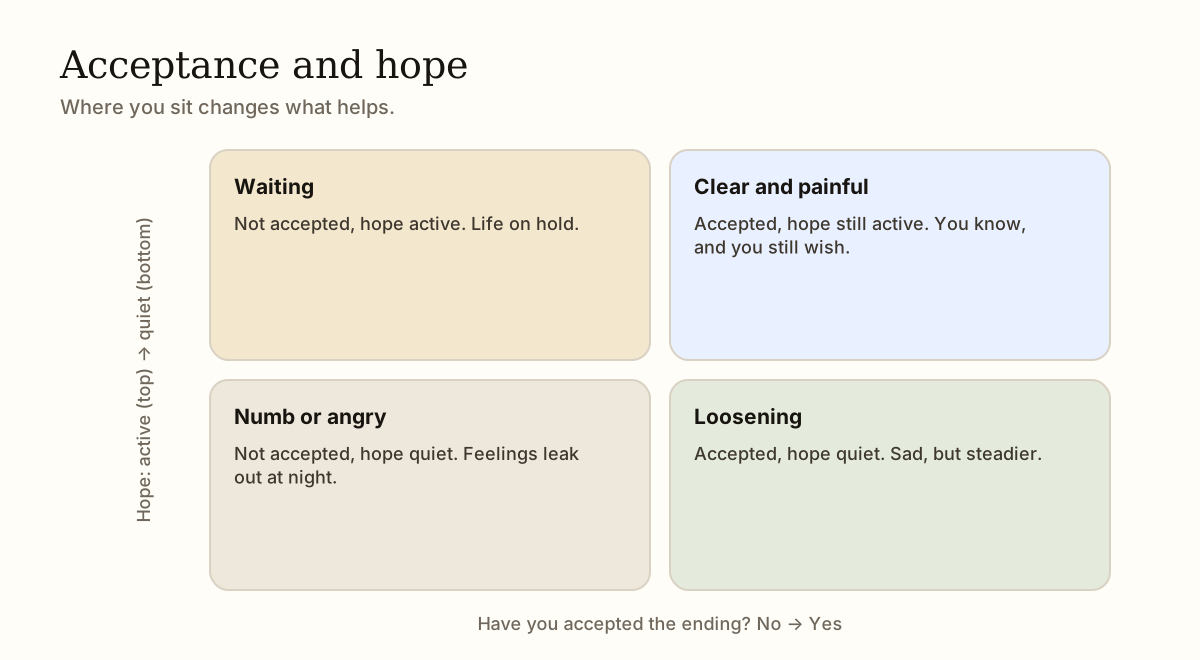
Fill the left column below from things you could prove: dates, words, what happened. Fill the middle column from wishes. If a wish starts making your plans for the weekend, move it back to the page, where it can stay as long as it likes. Hope can sit in a notebook. It doesn’t get to drive your thumb.
If you’re not sure you want to let go at all, that is allowed. Pick a review date instead of a verdict: “I’ll reassess in a month, and until then I keep the distance.” The answer is often easier to read from further away. If the doubt is mostly about whether reconnecting could work, does no contact work? looks at that honestly.
| What I know | What I’m still hoping for | What to do with it |
|---|---|---|
| We ended it, and the reasons haven’t changed. | That one conversation would change the answer. | Keep the reasons where you can see them. The hope goes in a notebook, not in a message. |
| They haven’t been in touch, or their replies are thin. | That the silence means they’re struggling too. | Silence tells you nothing reliable about what a particular person feels. Count it as no information and don’t build a story on it. |
| I miss who I was with them. | That I could only be that person with them. | List the parts of that version of you that don’t need them, and do one of those things this week. |
| I can’t picture a future without them. | That I’ll never find this again. | Forecasts after breakups run gloomy (Eastwick et al., 2008). Write “I can’t picture it yet” in place of “there is no future”. |
How long does it take to stop loving someone?
There is no honest number. Attachment eases unevenly, with rises along the way, and the speed depends on the length of the relationship, how it ended, how much contact continues and what else is going on in your life.
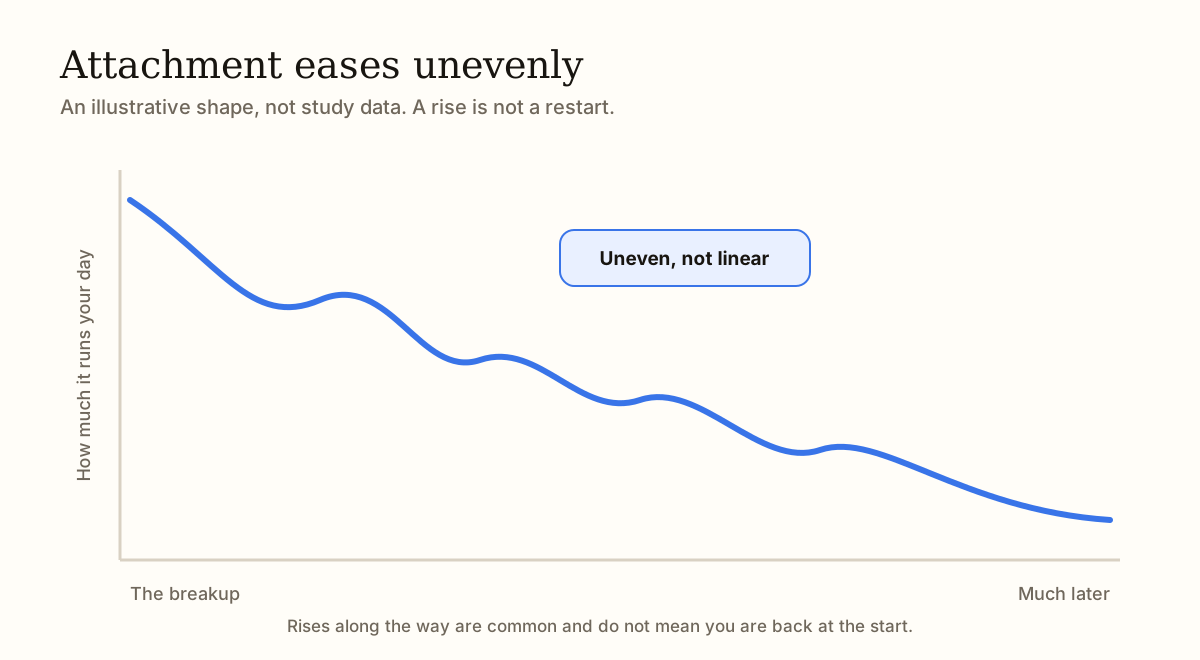
Two findings are worth holding onto. First, you will probably feel better sooner than you predict. In a small study of 26 people who broke up during a nine-month study, the distress they forecast beforehand was well above what they reported afterward, and the people most in love overestimated the most (Eastwick et al., 2008). Second, contact is the factor that reliably slows things down (Sbarra and Emery, 2005).
The full picture on timing, including what stretches it, is in how long it takes to get over a breakup.
Is it normal to still love someone years later? Many people carry some affection for a long-term ex for a long time, in a softer form: fond, a little sad, not urgent. The test isn’t whether any love remains. It’s whether it is steering your decisions, your phone and your Sundays.
When the love is tangled with fear or safety
Sometimes “I can’t stop loving them” is partly something else: fear, dependence, or a pattern where good days follow bad ones and keep you hooked. If the relationship involved threats, control, being cut off from people or any violence, or you feel unsafe now, letting go on your own schedule may not be safe. Leaving or cutting contact can be the riskiest moment, so safety planning comes before any contact strategy. Why you miss an abusive ex goes into that pull, and the UnLink safety page lists more help.
If you are in the US, the National Domestic Violence Hotline is 1-800-799-7233, or text START to 88788. If the sadness is heavy and you are having thoughts of harming yourself, call or text 988 in the US, Samaritans on 116 123 in the UK and Ireland, or Tele-MANAS on 14416 in India. You don’t have to be sure it’s “bad enough” to call.
Step-by-step plan
- Say both halves out loud
“I still love them, and this relationship is over.” Write it or say it. Arguing with the first half uses up the energy you need for the second.
- Cut the cues you control
Mute or unfollow, archive the thread instead of deleting it, and move the photos into a folder you open on purpose, never by accident. The guides on checking an ex’s social media cover the specifics.
- Write one if-then plan for your worst hour
Gollwitzer’s (1999) review of research on if-then plans found that tying a specific situation to a specific response makes people more likely to follow through. Example: “If it’s 11 p.m. and I open their profile, then the phone goes in the kitchen and I text a friend.” For ideas, see what to do instead of texting your ex.
- Give each shared time slot a new occupant
List the slots they used to fill: the commute call, Sunday morning, the end of the workday. Put one small, specific thing in each, such as a podcast, a walk or a standing call with a friend.
- Do one honest review, once
In one sitting, with an end time, write what the relationship cost you and what you needed that you didn’t get. Then close the page. Done nightly, a review turns into the rumination that thinking about your ex describes.
- Check the trend weekly, not the feeling hourly
Once a week, note whether the love is louder, the same or quieter than last week, and which habits you kept. One bad Sunday doesn’t cancel a quieter month.
You do not have to solve the whole relationship tonight. Take one private step that creates space between the feeling and the action.
Take the Do I miss my ex? quiz →Common questions
Will I ever stop loving my ex?
For most people the feeling fades from constant to occasional and from sharp to soft. Whether a trace of affection remains varies, and it doesn’t mean you have failed. The goal is that it stops running your decisions.
Does time alone make you stop loving someone?
Time helps, but time spent checking their profile or staying in touch tends to slow the process. In the 28-day study by Sbarra and Emery (2005), continued contact with an ex was linked to a slower decline in love and sadness. Time plus distance works better than time alone.
Is it bad that I still love them?
No. Still loving someone doesn’t mean the relationship was right, that you should reconcile, or that you’re failing at recovery. “I love them and it’s over” can both be true.
Should I tell them I still love them?
Ask first what you want the message to do. If the aim is relief, write it as an unsent letter and read it again in a week. If the aim is to change their answer, remember that you already know the relationship ended, and telling them is likely to reopen the wound without settling anything.
What does acceptance of a breakup actually mean?
It means you stop arguing with the fact that the relationship ended, even though you don’t like it. It doesn’t mean you’re happy about it, that you agree with their reasons, or that the love has gone. In the Sbarra (2006) study, acceptance of the ending was linked to recovering from sadness sooner.
Why does love feel stronger after a break?
Often it isn’t stronger. It’s less buffered. The daily friction is gone, memory favors the good scenes, and nothing is competing for your attention. In people rejected but still in love, a photo of the ex activated reward and craving areas (Fisher et al., 2010), which can feel like love intensifying.
How do I stop loving someone who doesn’t love me back?
You do the same things, with one extra rule: stop looking for signals. When love isn’t returned, silence and mixed messages keep the hope alive, so the exposure cuts and the hope-versus-knowledge exercise above matter even more. Lean on friends who will tell you the truth kindly.
Can you stop loving someone or does it just fade?
It fades, and you help it fade. You can’t decide the feeling away, but you can change the habits that feed it. Think of it as turning down a volume knob over weeks and months, with the odd rise along the way.
How do I get over someone I still love without contacting them?
Make contact hard and the urge short-lived. Mute and archive their accounts, move messaging apps off your home screen, and write an if-then plan for the hour you’re most likely to reach out. Put the urge somewhere else: a note, a walk or a call to a friend.
Is it normal to still love someone years after a breakup?
Yes, in a softer form. Many people keep some affection for a long-term ex. It becomes a problem only when it keeps you from forming new ties or sends you back to checking and contacting them. If it does, a therapist can help.
If contact involves threats, stalking, coercion, shared children, housing or immediate safety, a general no-contact rule may not fit. Read the safety guidance and seek qualified local help where appropriate.
Sources and further help
- Sbarra & Emery (2005) — The emotional sequelae of nonmarital relationship dissolution: analysis of change and intraindividual variability over time
- Sbarra (2006) — Predicting the onset of emotional recovery following nonmarital relationship dissolution: survival analyses of sadness and anger
- Eastwick et al. (2008) — Mispredicting distress following romantic breakup
- Fisher et al. (2010) — Reward, addiction, and emotion regulation systems associated with rejection in love
- Langeslag & Sanchez (2018) — Down-regulation of love feelings after a romantic break-up
- Marshall (2012) — Facebook surveillance of former romantic partners
- Gollwitzer (1999) — Implementation intentions: strong effects of simple plans
- The National Domestic Violence Hotline — Plan for safety
- 988 Suicide & Crisis Lifeline
Research is cited to explain general patterns, not to diagnose or predict any individual outcome. Sources do not endorse UnLink. Read our editorial principles.
Keep this support one tap away.
UnLink is a free, private no-contact tracker for iPhone: count your days, get through urges and restart without losing your history.