What to Do After a Breakup: A 14-Day Checklist
What to do after a breakup, day by day for two weeks: four short checklists, a table for shared belongings, three messages to send, and when to get support.
 By the UnLink Editorial Team · General educational guidance, not therapy
What to do after a breakup comes down to an order: basics first, then the practical jobs, then a small daily routine. On day one, eat, set up the night and tell one person. On days two and three, sort shared accounts, money and belongings. Week one is a minimal routine, and week two is noticing what is changing.
- Day one is for the person, not the problem: eat something, set up the night, tell one person, and postpone one big decision.
- Days two and three are for admin: one list of what you share, three piles for belongings, and three ready-made messages so you do not draft them while upset.
- In week one you only need a floor: the same wake time, fresh air, small meals, one human voice and an evening plan. Three out of five is a good day.
- Fine on Tuesday and flattened on Thursday is the usual pattern. In a small 2008 study of 26 people who split up, forecasts made beforehand overshot how bad they later felt (Eastwick et al., 2008).
- If low mood, broken sleep or lost appetite fill most of every day for more than two weeks, see a doctor (NHS). If you have thoughts of not wanting to be alive, call or text 988 in the US.
What to do after a breakup, day by day for two weeks
Do the basics first, then the practical jobs, then build a small routine. That order matters because the first week is mostly your body and your admin. The thinking comes later. This page is a two-week checklist in four blocks: day 1, days 2 and 3, week 1 and week 2.
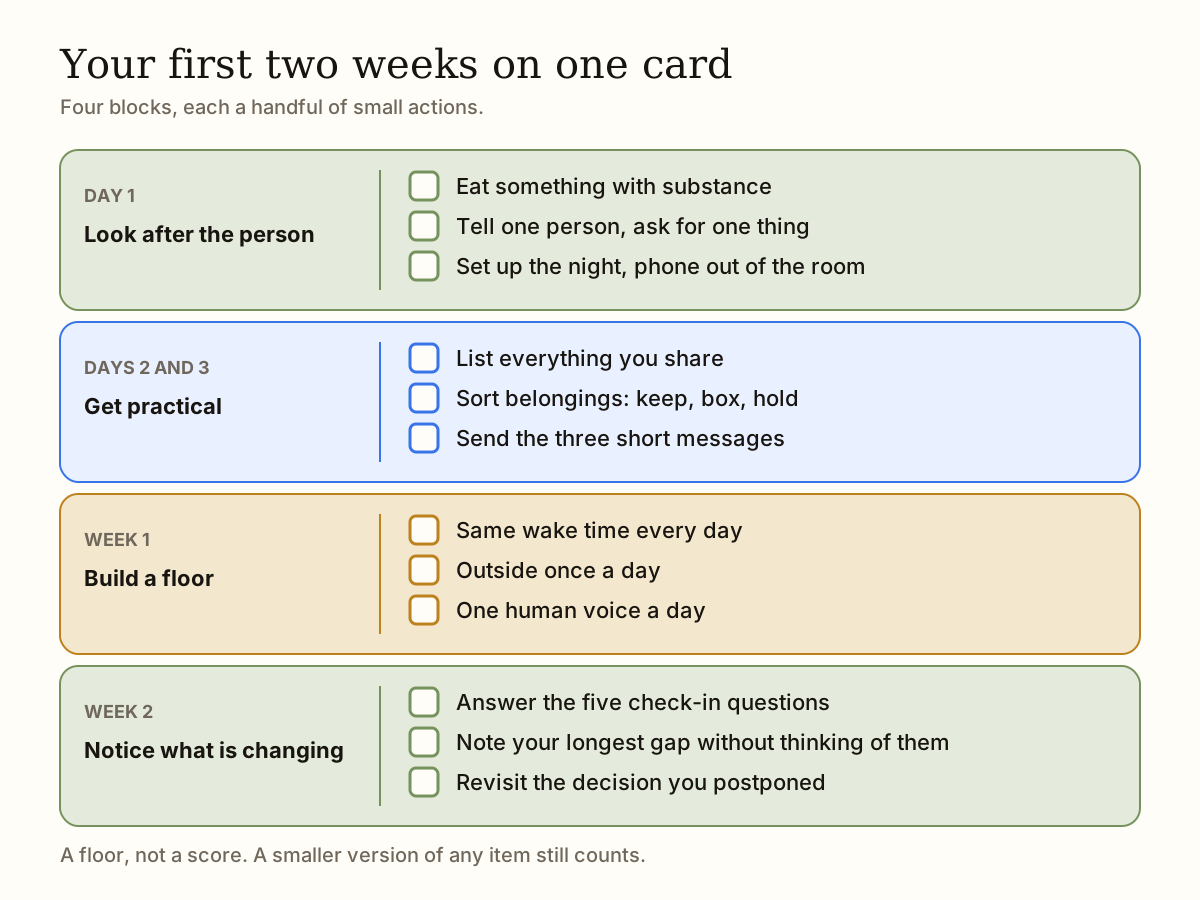
It is short on purpose. You are probably tired, and forty items is just another way of feeling behind. Any item can be done in a smaller version.
Two things it leaves out. The reasoning behind the early days and the emotional work of the following months are in the guide to getting over a breakup, with its 72-hour section and 12-week plan. The contact boundary (blocking, muting, passcodes) is in the first 30 days of no contact. This page is about looking after you and sorting out the stuff.
What should I do first after a breakup? Day 1
Eat something, drink some water and tell one person. If that is all you manage, day one is complete. Today is about looking after the body that took the shock. Do whichever of these you can:
- Eat something with substance. Toast with peanut butter counts. Appetite will not tell you the truth today, so go by the clock.
- Drink a full glass of water, and another before bed.
- Tell one person, and ask for one thing. “Can you stay on the phone while I make dinner?” is easier for a friend to say yes to than “I’m not okay”.
- Decide what tomorrow looks like. If you have work or school, send your manager or tutor one line (a template is further down), or take the day.
- Postpone one decision. Choose the loudest one (moving out, quitting, telling everyone) and write “not before” and a date two weeks from now on a sticky note.
- Set up the night. Aim for rest, not sleep: lights low, phone charging across the room or in the hall, the usual alarm. The NHS advises no alcohol, tea or coffee in the six hours before bed, so wine fails that rule on the night you most want sleep. If the nights stay bad, see what to do when you can’t sleep after a breakup.
- If you live together, do not settle who is leaving tonight. Sleep elsewhere if you can, even on a friend’s sofa, and talk about the flat after you have slept.
Days 2 and 3: how do I sort out shared accounts, money and keys?
Make one list of everything the two of you share, in one sitting, and deal only with the urgent items. Urgent means money is leaving, or someone else can see or reach your things. Everything else can wait for week two.
- List what you share: lease, utilities, phone plan, streaming, cloud storage, car, insurance, a joint account or card, a pet.
- Mark each one “urgent” or “can wait”. A joint account, a rent deadline or your card on their subscription is urgent. A shared playlist can wait.
- Protect your own accounts first. Change the password on your email, since it resets everything else, then banking. Log out of shared devices and take your card off any plan in their name.
- Check what your phone shares. On iOS 16 or later, Safety Check (Settings, then Privacy & Security) lets you review and change what you share with people and apps, including location (Apple Support). Stop any shared location in Maps or family apps too.
- Write down every date in the next 30 days: rent, bills, a deposit deadline.
- Archive, don’t delete, anything with money or agreements in it. Lease emails and who paid what may matter later for a deposit, an insurer or, if you share children, a lawyer.
How do I deal with shared belongings after a breakup?
Sort things into three piles, keep, box and hold, and decide nothing permanent yet. Your judgment about what matters is at its worst this week, and a bin bag is hard to undo. “Hold” means a friend keeps the item until you have had a month or two, and it suits the thing in the box under your bed that still feels like it is watching you.
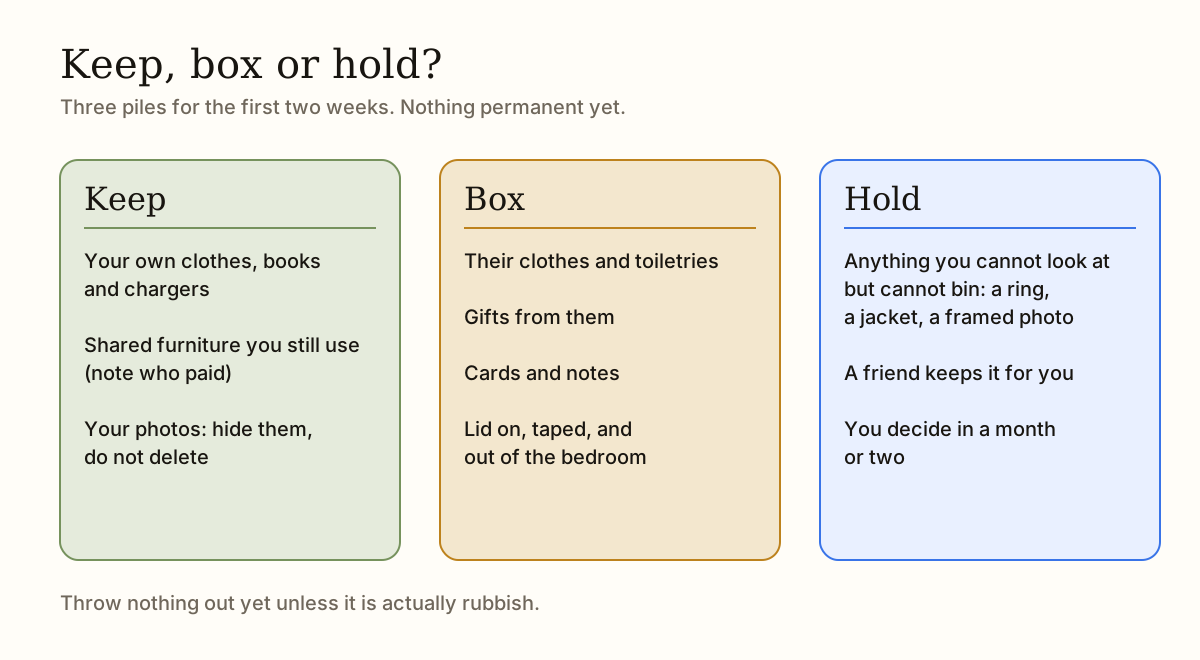
| Item | This fortnight | Why |
|---|---|---|
| Their things at your place | Box it | Lid on, out of the bedroom. Arrange pickup later with one practical message. |
| Gifts from them | Box it, or hold | Neither keeping nor binning is a week-one decision. |
| Photos on your phone | Move, don’t delete | Hide them in the Photos app or an archive folder so they stop surfacing. |
| Your things at their place | Ask for them in one batch | Offer a time window by message, or send a friend. If you are afraid of your ex, use a friend or an advocate and do not go yourself. |
| Things you bought together | Keep using them | Note who paid what and settle it in a month. |
| Shared accounts and playlists | Separate | Download what you want, then remove yourself or take ownership. |
| Joint rent or bills | Keep paying your share | Keep a record of every payment. |
| A pet you share | Agree a temporary routine | Animals cannot wait. Agree a practical schedule in writing and decide the rest later. |
What do I tell friends, family and work after a breakup?
Tell the fewest people who can help, in the fewest words, using ready-made messages so you do not draft them while upset. Three templates follow: change the brackets and send them as they are.
For family, send one message to one person and let them pass it on. If you do not want to hear “I never liked them”, say so first. Do not ask mutual friends for news of your ex; that is checking by proxy.
- To a friend: “Hi [name]. [Ex] and I split up. I don’t need advice yet, just company. Could you call me tonight or come over on Saturday?”
- To a manager: “Hi [name], I’m dealing with something personal this week, so I may be slower than usual. I’m okay and I’ll tell you if I need anything. Could we move [deadline] to Friday?”
- To a landlord or housemate: “Hi [name], [ex] and I are no longer together. I’d like to talk about how we update [the lease / the bills / who is staying] by [date]. I’d prefer to do it in writing so we have a record.”
What do I do in the first week after a breakup? Build a floor
Keep a minimum daily routine and let everything else wait. The aim is a day small enough to finish. This is a floor, not a goal: three of the five things in the list below makes a good day.
Example: day 6, a Thursday. You wake at 7:10, the same alarm as all week, and feel the drop in your stomach before your eyes are open. Toast at the counter counts as breakfast. At work you are slow, but you send the email about the rent you had put off. At lunch you write the evening plan on a sticky note: call Maya at seven, then a walk. The call goes well.
At ten to nine the flat goes quiet and you open their last message, which you have read thirty times. You put the phone in the hall, write “I want to ask why” in your notes app, and make tea. At 10:30 you lie down with the lamp on. You managed four of the five things, had a bad evening and got through it. What to do instead of texting your ex has a fixed plan for that exact minute. Here is what held the day up:
- The same wake time every day, weekends included. The NHS advises getting up at the same time each day, even after a poor night.
- Some fresh air, at least a walk to the corner and back.
- Small meals at set times, even half portions.
- One human voice a day. A call, a voice note or a coffee with someone who is not your ex. Connecting with other people and being physically active are two of the NHS’s five steps to mental wellbeing.
- A plan for the evening, written at lunchtime. Evenings are when the quiet gets loud.
Week 2: how do I notice what is changing?
Answer five questions in a note every couple of days, and look at the direction across the week, not at one day. Slow movement is invisible from inside any single evening.
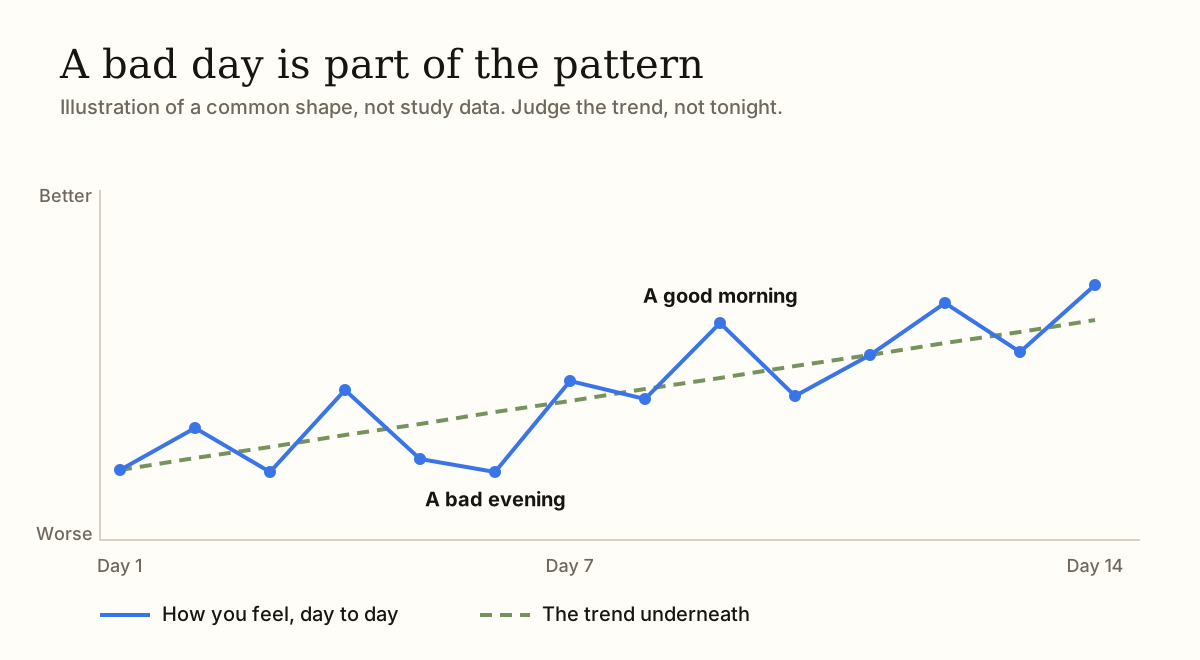
In a small 2008 study, 26 people forecast how distressed they would feel if they broke up, then did. Afterwards they reported less distress than they had predicted, and it eased faster than they expected (Eastwick et al., 2008). The sample is small, but your worst-case guess is not a forecast. Spikes will still come. The guide to getting over a breakup covers how to tell you are healing.
- Did I sleep a bit better than last week? Roughly is fine.
- What was my longest stretch today without thinking about them?
- Did I eat and get outside without arguing with myself?
- What set me off, and did I act on it?
- Who did I talk to, and how did it go?
What should I avoid in the first two weeks?
Postpone rather than ban: most of these are fine in month three. The risk in the first fortnight is acting on a feeling that will have changed by Friday.
Checking up on an ex online is one to watch. A 2012 study of Facebook use after breakups found that monitoring a former partner was associated with more distress and less personal growth (Marshall, 2012). It was correlational: a link, not a cause. If checking is a pull for you, the guide to stopping social media checking has a plan.
| Tempting move | Why it costs you now | Do this instead |
|---|---|---|
| Quitting, moving city, adopting a dog, a tattoo | Your judgment is at its weakest and these are hard to undo | Put it on the sticky note with a date two weeks out. |
| Rereading the whole chat history | You read the best week and the worst week and skip the ordinary middle | Archive the thread and leave it closed. |
| Drinking to sleep | The NHS advises no alcohol in the six hours before bed | Water, something warm, lights low, phone out of the room. |
| A rebound to feel wanted | Fine for its own sake. To feel chosen, it can leave you lonelier at 7 a.m. | Ask how you will feel the next morning. Call a friend first. |
| One last conversation for answers | It rarely gives the answer you wanted, and it restarts the clock | Write the questions down and keep them. Logistics go in one batched message, or via a friend. |
How do I know when I need more support after a breakup?
See a doctor if low mood, broken sleep or lost appetite fill most of every day for more than two weeks. The NHS lists persistent low mood, hopelessness, disturbed sleep and changes in appetite among the symptoms of depression, and advises seeing a GP when they last most of the day, every day, for more than two weeks. It adds that low mood may improve after a short time, so that line is for symptoms that stay, not one bad stretch. For sleep alone, it suggests a GP if changing your habits has not helped or the trouble has lasted months. Our guide to depression after a breakup goes through the signs.
Get help sooner if you cannot work, are drinking much more, or have any thoughts of not wanting to be alive. In the US, call or text 988. In the UK and Ireland, Samaritans is 116 123. In India, Tele-MANAS is 14416. If you are in immediate danger, call your local emergency number.
If you were afraid of your ex, treat the practical jobs differently. Talk to an advocate before you arrange pickups, change accounts or tell them where you are staying. In the US, the National Domestic Violence Hotline is 1-800-799-7233 (text START to 88788) and has a safety-planning guide. More options are on our safety page.
What comes next after the first two weeks?
For the longer arc, the 12-week recovery plan picks up where this page stops. If the contact boundary is where you struggle, the first 30 days of no contact is the setup, and self-care after a breakup has bad-day versions of the daily floor. To build a plan around your own situation, try the no contact plan generator.
Today, the only job is day one: eat something, set up the night and tell one person.
Step-by-step plan
- Day 1: look after the person
Eat, drink water, tell one person, postpone one decision and set up the night with your phone out of the bedroom.
- Days 2 and 3: get practical
List what you share, deal with the urgent items, sort belongings into keep, box and hold, and send three short messages.
- Week 1: build a floor
Keep the same wake time, get outside daily, eat small meals, speak to one person a day and plan each evening at lunchtime.
- Week 2: notice what is changing
Answer five check-in questions every couple of days and judge the direction across the week.
You do not have to solve the whole relationship tonight. Take one private step that creates space between the feeling and the action.
No contact plan generator →Common questions
What should I do the day after a breakup?
Eat something, drink water and tell one person what happened. Keep the day small: one practical job, such as a message to work, and one thing for you, such as a walk. Do not try to understand the breakup yet.
Should I make big decisions right after a breakup?
Postpone them if you can. Quitting, moving city or ending friendships are hard to undo, and your judgment is at its weakest now. Write the decision on a note with a date two weeks away, then look again. Urgent practical matters such as rent are different: do those first.
How do I get through the first night after a breakup?
Aim for rest, not sleep. Lie down at your usual time with the lights low and the phone out of reach, and skip alcohol, tea and coffee for the six hours before bed, as the NHS advises. Message one person before you lie down, so someone knows it is a rough night.
Is it normal to feel fine one day and terrible the next?
Yes. Recovery jags up and down, with good stretches followed by sharp dips. One bad evening does not erase progress, so compare this week with last week, not tonight with this morning.
What should I do with gifts and photos from my ex?
Throw nothing out for now. Box the gifts, or ask a friend to hold them. Move photos to a hidden album or archive folder instead of deleting them, and decide in a month or two.
When should I start a routine again after a breakup?
From day two or three, once the urgent admin is sorted. Start with the floor: the same wake time, fresh air, small meals, one human voice a day. Add more only when that feels easy, and treat a missed day as a missed day, not a restart.
What should I do in the two weeks after a breakup?
Basics on day one, accounts, money and belongings on days two and three, a minimal routine in week one, and a check-in in week two. Avoid big decisions, drinking to sleep and rereading old messages.
What do I do when a breakup just happened and I can’t stop crying?
Let it happen, and keep the basics going while it does. Sit down, drink water, and call or message one person. Crying tends to come in waves and pass. If low mood fills most of every day for more than two weeks, see a doctor, and in the US call or text 988 if you have thoughts of not wanting to be alive.
If contact involves threats, stalking, coercion, shared children, housing or immediate safety, a general no-contact rule may not fit. Read the safety guidance and seek qualified local help where appropriate.
Sources and further help
- Eastwick PW, Finkel EJ, Krishnamurti T, Loewenstein G (2008), Mispredicting distress following romantic breakup: Revealing the time course of the affective forecasting error, Journal of Experimental Social Psychology
- Marshall TC (2012), Facebook surveillance of former romantic partners: associations with postbreakup recovery and personal growth, Cyberpsychology, Behavior, and Social Networking
- NHS, Insomnia
- NHS, Symptoms of clinical depression
- NHS, Five steps to mental wellbeing
- Apple Support, How Safety Check works on iPhone
- 988 Suicide & Crisis Lifeline (US)
- National Domestic Violence Hotline: plan for safety
Research is cited to explain general patterns, not to diagnose or predict any individual outcome. Sources do not endorse UnLink. Read our editorial principles.
Keep this support one tap away.
UnLink is a free, private no-contact tracker for iPhone: count your days, get through urges and restart without losing your history.