Depression After a Breakup: Normal Grief or Something More?
Depression after a breakup: how to tell ordinary grief from depression, the signs to take to a doctor, what to do this week, and crisis lines if you are at risk.
 By the UnLink Editorial Team · General educational guidance, not therapy
Feeling very low after a breakup is normal, and a breakup can also trigger depression. NIMH and the NHS both point to low mood or lost interest most of the day, nearly every day, for two weeks or more as the time to see a doctor. If you are thinking of harming yourself, call or text 988 now.
- Deep sadness after a breakup is expected, and it can still become depression. The difference is mostly how long it lasts, how much it takes from your daily life and whether anything lifts it.
- NIMH and the NHS both use two weeks of symptoms, most of the day and nearly every day, as the marker for getting medical help. You can book sooner if you are struggling to function.
- This page cannot diagnose you. Only a doctor or therapist can, and the script below helps you start that conversation.
- Small steps count when you are low: tell one person, protect one basic, take one step toward an appointment.
- If you are thinking about suicide or self-harm, contact a crisis line or emergency services now: 988 in the US, Samaritans 116 123 in the UK and Ireland, Tele-MANAS 14416 in India.
If you are thinking about hurting yourself, start here
If you are thinking about ending your life or hurting yourself, contact one of these before you read anything else. They are free, and reaching out is what they exist for.
- United States: call or text 988 (the 988 Suicide & Crisis Lifeline), or chat at 988lifeline.org. It is open 24/7 and confidential.
- UK and Ireland: call Samaritans on 116 123, free, day or night.
- India: call Tele-MANAS on 14416, the national mental health helpline.
- Anywhere: if you have already hurt yourself, or you might act tonight, call your local emergency number (911, 999 or similar) or go to the nearest emergency department. Ask someone to stay with you.
Is it normal to feel this low after a breakup?
Yes. Feeling flattened for weeks after a breakup is common, and it does not mean something is wrong with you. A breakup takes a person, a routine and a future in one go, and your body treats it as the loss it is.
It can feel physical for a reason. Kross and colleagues (2011) found that recalling an intense rejection engaged brain regions that also process physical pain. The heavy chest and the lead-limbed mornings are not you being dramatic.
Can a breakup cause clinical depression? It can raise the risk. In a large community sample of older adolescents, a recent romantic break-up was associated with a higher likelihood of a first episode of major depression (Monroe et al., 1999). That is one study in teenagers, and most people who go through a breakup do not develop depression. It is still a good reason to take a long low stretch seriously instead of telling yourself to toughen up.
So the useful question is not “am I sad?” You are. It is how long this has gone on, how much of your life it is taking, and whether anything lifts it.
Depression after a breakup: normal grief or something more?
Grief and depression overlap, and only a doctor or therapist can tell you which one you are in. What you can do is compare the shape of what you are feeling: how long, how heavy, and what it is doing to your days. Our guide to grieving a breakup covers grief itself, including why it comes in waves.
Treat the table as a rough guide, not a test. A breakup can produce any of these signs for a while, and one column does not cancel the other. If most of your answers sit on the right, or you honestly cannot tell, make the appointment.
| A hard stretch of grief often looks like | Worth a doctor’s visit when | |
|---|---|---|
| Duration | Heavy days with easier ones mixed in. Your mood moves with the day, the place or the company. | Low mood or lost interest most of the day, nearly every day, for two weeks or more. The NHS and NIMH both use this length as the marker. |
| Function | Work, eating and washing feel harder, but you mostly manage them. | Basic tasks keep slipping. You are missing work or school, or cannot get up and look after yourself. |
| Enjoyment | You can still enjoy something for a minute: a joke, a meal, a friend’s company. | Little or nothing feels enjoyable, including things you normally love. |
| Sleep and appetite | Sleep is rough and food is unappealing, mostly tied to thoughts of the breakup. | Sleep and appetite stay disrupted, with low energy and poor concentration that do not ease. |
| Self-worth | You feel rejected and doubt yourself at times, but you still see yourself as basically okay. | Persistent worthlessness or heavy guilt, or a settled sense that nothing will get better. |
| Thoughts of self-harm | Any thought of suicide or self-harm moves you to the right-hand column, whatever else is true. | Emergency. Call or text 988 (US), call Samaritans 116 123 (UK and Ireland) or Tele-MANAS 14416 (India), or call your local emergency number. |
What are the signs of depression after a breakup?
The core signs are a low or empty mood, or losing interest in most things, lasting most of the day, nearly every day, for at least two weeks. NIMH says a depression diagnosis needs symptoms like that for at least two weeks, including one of those two. The NHS tells people to see a GP for more than two weeks of symptoms most of the day, every day.
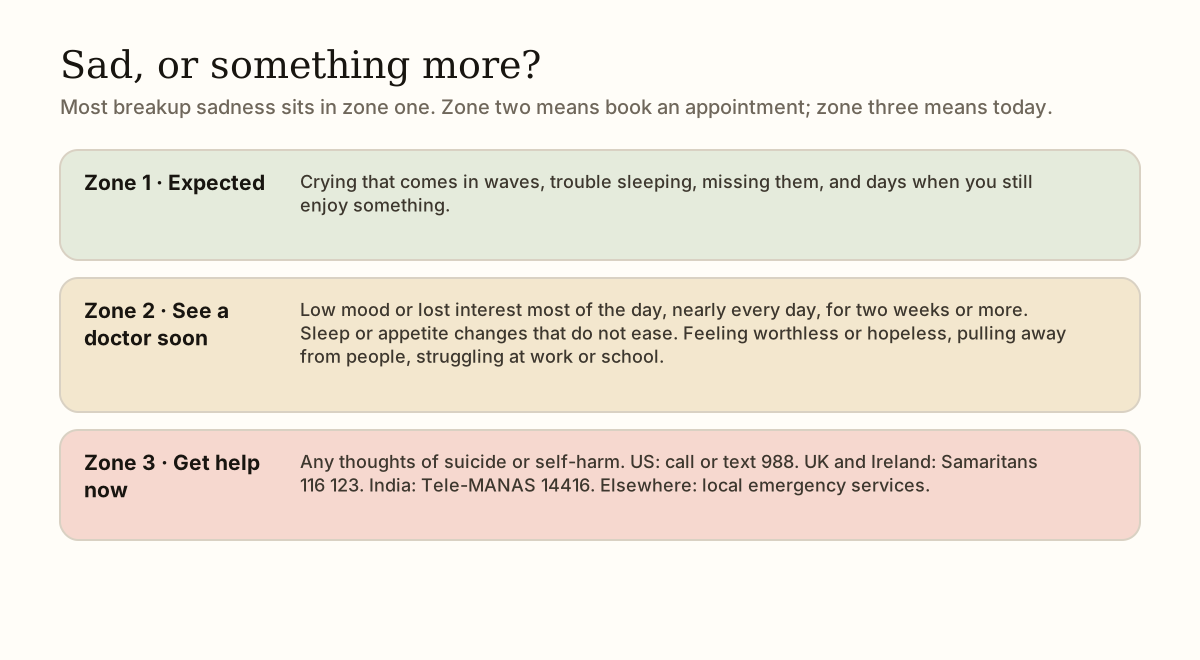
Both lists add other signs that tend to come along with it:
- feeling hopeless, guilty or worthless, or unusually irritable
- sleeping much more or much less, and eating more or less than usual
- low energy, or moving and speaking more slowly
- trouble concentrating or making decisions
- pulling away from friends and dropping hobbies
- unexplained aches and pains
- drinking or using drugs more than usual
- thoughts of death or suicide
Is it normal to not want to get out of bed after a breakup?
For a weekend, or the first few days, yes. Staying under the duvet and feeling numb or empty is a common response to a shock.
The pattern worth reporting is most days across two weeks, with sleep, eating and work all sliding at once. A breakup can cause nearly every item on the list above for a few days without it being depression, which is why the length matters so much. The two weeks is the diagnostic marker and the NHS’s point for seeing a GP. It is not a stopwatch you have to wait out. If you are struggling to function on day four, you can still make the call.
How long does depression last after a breakup?
Nobody can give you a number, and a breakup does not come with a clinical timetable. The NHS notes that a low mood may improve after a short time, whereas depression is a sadness that lasts weeks or months rather than a few days.
It helps to know that people are poor forecasters of their own pain. In a study that followed people through relationships over several months, those who went on to break up predicted more distress than they felt, and their real distress faded faster than their forecasts (Eastwick et al., 2008). Your worst night is not a prediction. That is an average finding, though, and it cannot tell you whether you are the exception.
When you see a doctor, they will usually ask when it started, how long it has lasted, how often it happens and whether it stops you doing your normal activities (NIMH). If the low mood is getting heavier rather than lighter several weeks in, treat that as the signal, whatever the calendar says. The breakup recovery time estimator shows what tends to stretch an ordinary recovery, but it cannot tell you whether you are depressed.
What to do this week if you are low
Keep it small. When you are low, a twelve-point plan is just one more thing to fail at. You are aiming for three small things this week and one step toward an appointment.
The steps below support you. They do not replace treatment, and you can do them while you wait to be seen. For the longer plan, see how to get over a breakup, and for the first two weeks specifically, what to do after a breakup.
What do I say to my doctor about breakup depression?
Start with the plain version: you have been low since a breakup and you are worried it is not lifting. You do not need to prove it is bad enough. NIMH suggests jotting down your symptoms before the visit.
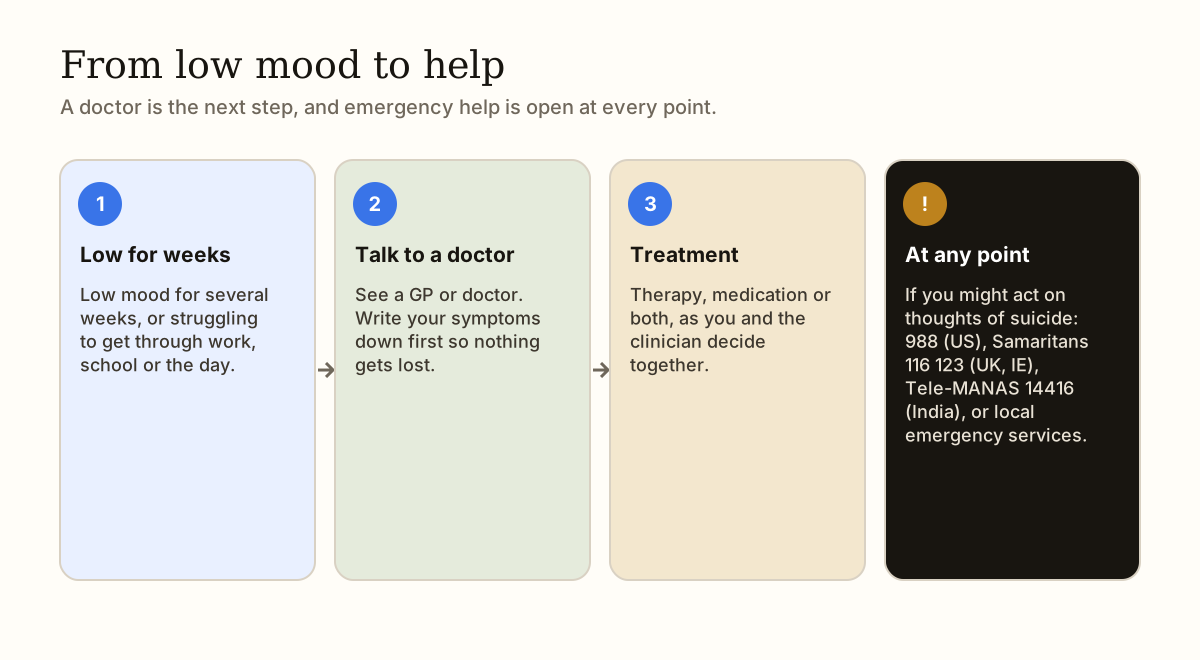
You can read from this, or send it as a message when you book:
- “My relationship ended about [number] weeks ago. Since then I’ve felt low or empty most days.”
- “These have changed: [sleep, appetite, concentration, energy].”
- “I’ve stopped enjoying [a thing you normally like], and [work, school, looking after myself] is harder than usual.”
- “I have / haven’t had thoughts of harming myself.” If you have, say so in the first minute so there is time to deal with it.
- “I’ve had depression or anxiety before,” or “I’m drinking more than usual,” if either is true.
- “What are my options, and what should I do if it gets worse before my next appointment?”
| Option | What it is | Worth knowing |
|---|---|---|
| Talking therapy | Psychotherapy, in person or virtual. In England you can refer yourself to NHS Talking Therapies for depression without seeing a GP first. | The NHS offers talking therapies such as CBT for mild depression, and usually combines them with medication for moderate to severe depression. |
| Medication | Antidepressants, prescribed by a doctor. | NIMH says they usually take 4 to 8 weeks to work, and sleep, appetite and concentration often improve before mood does. Do not stop one suddenly without asking your prescriber. |
| Lifestyle and self-help | Exercise, guided self-help, cutting back on alcohol, regular meals. | The NHS lists these alongside treatment for milder depression. They are not a replacement for treatment when symptoms are moderate or severe. |
How do I help a friend who is low after a breakup?
Ask directly how they are doing, listen without fixing, and keep showing up in small ways. A text that says “I’m dropping off dinner at 7, no need to talk” is easier to accept than “let me know if you need anything”.
NIMH advises encouraging someone you think is depressed to see a mental health professional. You can offer to sit beside them while they book the appointment, or to go with them. Avoid “snap out of it” and “you’ll find someone else”.
If your friend talks about suicide, do not leave them alone, and call or text 988 together (Samaritans on 116 123 in the UK and Ireland, Tele-MANAS on 14416 in India). NIMH lists 988 for anyone worried about someone else too. In an emergency, call your local emergency number.
Who can I call if I am thinking of hurting myself?
The same numbers as at the top of this page, because they matter more than anything else here.
In the US, call or text 988. In the UK and Ireland, call Samaritans on 116 123. In India, call Tele-MANAS on 14416. Elsewhere, call your local emergency number. Our safety page has more.
If your ex has been controlling, threatening or violent, the end of the relationship can be a higher-risk time, and safety planning comes before any plan about contact. In the US, the National Domestic Violence Hotline is 1-800-799-7233, or text START to 88788.
Call, text or tell the next person you see. You do not need the right words, only to say that you are not okay.
Step-by-step plan
- Tell one person how low you are
Send one honest message: “I’m not doing well since the breakup. Can I call you tonight?” You do not need to explain everything. One person knowing is the point.
- Protect one daily basic
Pick one of sleep, a meal, or ten minutes outside, and guard it. Our guides on self-care after a breakup and sleeping after a breakup have specifics.
- Take one step toward an appointment
Write down your symptoms and when they started, then book the visit or message your doctor’s office. If you cannot manage the call, ask a friend to sit with you while you do it.
- Write down your mood once a day
A one-line note with a score out of ten and what happened is enough. After a week or two you have something concrete to show a clinician.
You do not have to solve the whole relationship tonight. Take one private step that creates space between the feeling and the action.
Estimate your breakup recovery time →Common questions
How do I know if I’m depressed after a breakup?
You cannot know for sure without a doctor or therapist, and this page cannot diagnose you. The signs to take seriously are low mood or lost interest most of the day, nearly every day, for two weeks or more, or struggling to function at work, school or home. If that sounds like you, or you are unsure, book an appointment.
Is it normal to be depressed after a breakup?
Feeling very low is normal. Being clinically depressed is less common, but a breakup can trigger it, especially if it was sudden, felt like betrayal, or you have had depression before. If your low mood is lasting and affecting your life, it deserves a conversation with a doctor.
How long does depression last after a breakup?
There is no reliable number. The NHS describes depression as sadness that lasts weeks or months instead of a few days, while a low mood may improve after a short time. If it is not easing or is getting heavier several weeks in, see a doctor rather than waiting it out.
What’s the difference between grief and depression after a breakup?
Grief tends to come in waves, with some relief and enjoyment mixed in, and you mostly keep your sense of self-worth. Depression is more constant, takes the enjoyment out of most things and often brings guilt or worthlessness. They can overlap, so a doctor is the right person to tell them apart.
Should I see a doctor about being sad after a breakup?
Yes, if the low mood has lasted two weeks or more, most days, or if it is stopping you from working, sleeping, eating or looking after yourself. You can also go sooner. A doctor can check what is going on and offer support, and going does not commit you to medication.
What are the signs of depression after a breakup?
The main signs are persistent low mood or loss of interest, plus things like hopelessness, guilt, changes in sleep and appetite, low energy, poor concentration, pulling away from people and sometimes aches and pains. Thoughts of death or suicide are also a sign and need help straight away.
Can a breakup cause clinical depression?
It can contribute. In a large study of older adolescents, a recent romantic break-up was associated with a higher likelihood of a first episode of major depression (Monroe et al., 1999). Most people do not develop depression after a breakup, but risk is higher with betrayal, an unexpected ending or a history of depression.
Is it normal to not want to get out of bed after a breakup?
For a few days, yes. If it is most days for two weeks and your eating, sleep and work are slipping too, tell a doctor. Start with the smallest step: sit up, drink water, open a window, and message one person.
Can therapy help with depression after a breakup?
NIMH says depression treatment typically involves psychotherapy, medication or both, and the NHS recommends talking therapies such as CBT. A therapist can also help you work through the breakup itself. Ask your doctor, or in England you can self-refer to NHS Talking Therapies.
Is it normal to feel numb for weeks after a breakup?
Numbness is a common response to shock and loss, and it often eases. If you feel flat and nothing gives you any pleasure for two weeks or more, or you feel disconnected from daily life, mention it to a doctor.
Who can I call right now if I’m thinking of hurting myself after a breakup?
In the US, call or text 988. In the UK and Ireland, call Samaritans on 116 123. In India, call Tele-MANAS on 14416. If you might act tonight, call your local emergency number and ask someone to stay with you.
If contact involves threats, stalking, coercion, shared children, housing or immediate safety, a general no-contact rule may not fit. Read the safety guidance and seek qualified local help where appropriate.
Sources and further help
- NIMH — Depression (symptoms, two-week duration, treatment, 988)
- NHS — Symptoms of depression in adults (see a GP after more than 2 weeks)
- NHS — Depression in adults: overview and treatment
- NHS — Talking therapies (self-referral in England)
- Kross et al. (2011) — Social rejection shares somatosensory representations with physical pain
- Monroe et al. (1999) — Life events and depression in adolescence: relationship loss as a prospective risk factor for first onset of major depressive disorder
- Eastwick et al. (2008) — Mispredicting distress following romantic breakup
- 988 Suicide & Crisis Lifeline
- Samaritans (UK and Ireland)
- National Domestic Violence Hotline — Plan for safety
Research is cited to explain general patterns, not to diagnose or predict any individual outcome. Sources do not endorse UnLink. Read our editorial principles.
Keep this support one tap away.
UnLink is a free, private no-contact tracker for iPhone: count your days, get through urges and restart without losing your history.