How to Get Over a Long-Term Relationship: Rebuild Your Life, Not Just Your Heart
How to get over a long-term relationship: a six-week plan for accounts, belongings and friends, an inventory of what you lost, and prompts for who you are now.
 By the UnLink Editorial Team · General educational guidance, not therapy
To get over a long-term relationship, treat it as two jobs: rebuild the practical life you shared, then rebuild who you are on your own. Start with accounts, belongings and money, one area a week, and put big decisions off. Then add one routine and one plan that belong only to you.
- A long relationship takes more than a person with it: a home, money, friends, routines and a sense of who you are. Splitting the loss into those areas makes it workable.
- Nobody can promise how long recovery takes. The scope of the loss, not weakness, is why it can feel so large.
- Do the practical side in order, one area a week over about six weeks, and hold off on big decisions such as moving cities or selling a home if you can.
- Rebuild identity in small tests: a few prompts, one solo routine and one plan in your name. Breakup research links a clearer sense of self to less distress.
- If low mood lasts most of the day, every day, for more than two weeks, see a doctor. If you feel unsafe with your ex, safety planning comes before any contact plan.
How to get over a long-term relationship when it was your whole life
Treat it as two jobs: the practical life you shared, and the person you are on your own. Do the practical job first and in small pieces, because a tangle of passwords, bills and boxes makes everything else harder. Do the second job slowly, because it can’t be rushed.
If the relationship lasted years, you lost more than a partner. You lost a household, a shared calendar, a default plus-one and a way of describing yourself that began with “we”. Feeling flattened is a proportionate reaction to that, and it doesn’t mean you’re doing it wrong.
This page is specifically about long relationships. For the whole recovery plan, start with our guide to getting over a breakup, and for the first couple of weeks, what to do after a breakup.
Why does a long-term breakup hurt so much?
Because it touches more parts of your life at once. A short relationship can end and leave your home, money and friendships mostly where they were. A long one is woven into all of them, so every area gets pulled on in the same week.
The self is one of those areas. In a 2010 study, Slotter, Gardner and Finkel found that after a breakup people’s self-concept changed in content and became less clear, and that the drop in clarity uniquely predicted how distressed they felt. “Who am I without you?” is a real question with real effects, and not only a song lyric.
Nobody can give you an honest finish date. Our page on how long it takes to get over a breakup covers what tends to lengthen or shorten it. Here, the useful move is to cut the loss into pieces small enough to work on.
Who am I without them? Six prompts to start
You find out slowly, by trying things, and writing helps you notice. Larson and Sbarra (2015) followed recently separated young adults for nine weeks. Those who completed more rounds of detailed assessments showed larger gains in self-concept clarity, and that gain accounted for lower breakup-related distress, including loneliness. The study can’t say which part helped, so treat the prompts below as practice at thinking about yourself, not a proven treatment.
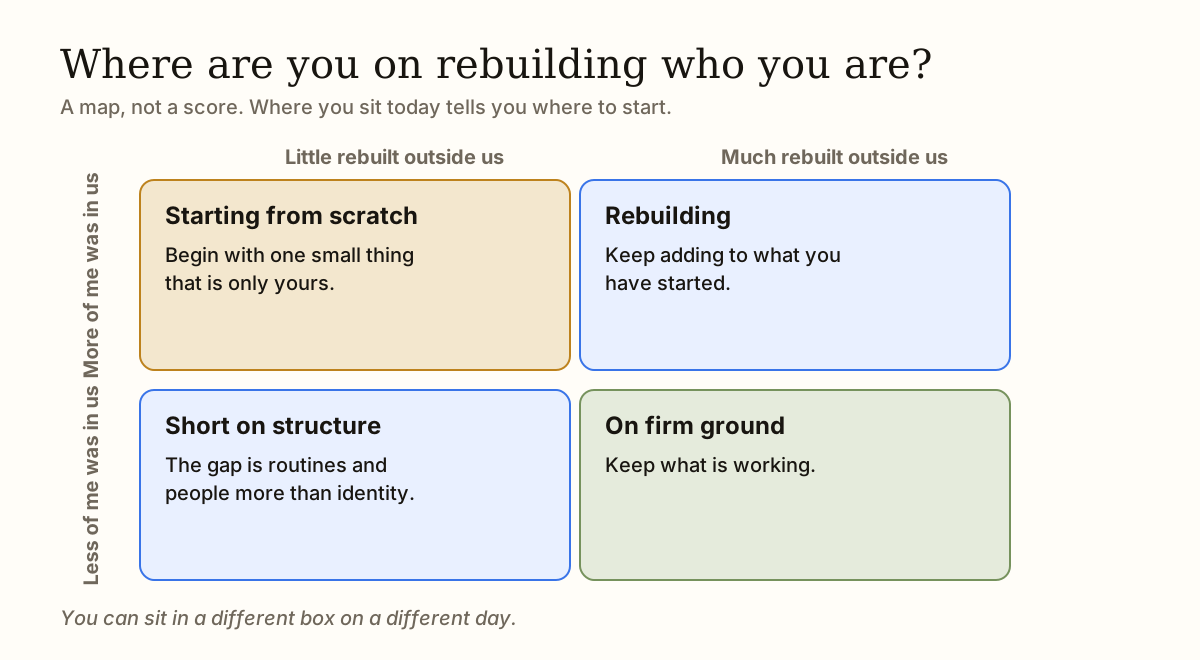
- Write ten sentences that begin “I am” and don’t include anyone else’s name.
- Before the relationship started, what did you do with a free Saturday? Which of those things still appeal?
- What did you do mainly because they liked it? Which of those do you want to keep anyway?
- Which small preferences did you stop saying out loud: food, music, how to spend a holiday?
- Which friends were yours before the relationship, and when did you last speak to them?
- Finish this sentence: “One thing that is true of me, whether or not I’m in a relationship, is…”
What did the relationship hold? An inventory
List the areas of life the relationship held up, then give each a first step and a person to ask. One huge loss becomes seven small jobs. Do it on paper or in a notes app, and be literal.
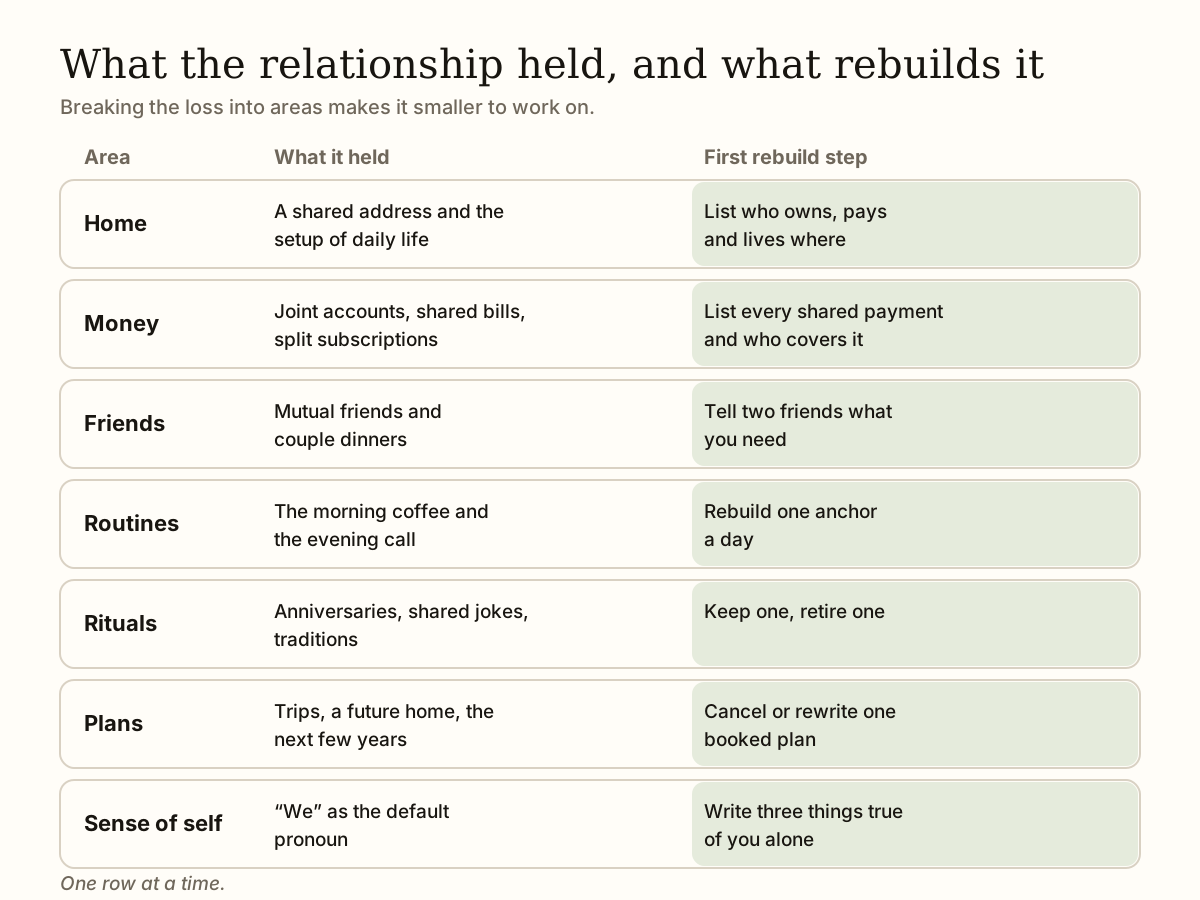
Pay attention to the rows that surprise you. People often expect the loss to sit under “sense of self” and find the heaviest weight under “routines” or “friends”.
| Area | What it held | First rebuild step | Who to ask for help |
|---|---|---|---|
| Home | A shared address, the setup of daily life, a second person on hand | List who owns, rents, pays and lives where. Decide nothing yet | A friend to sit with you; a landlord, lawyer or housing adviser if a lease or ownership is involved |
| Money | Joint accounts, shared bills, split subscriptions | List every shared payment and who covers it this month | Your bank; a lawyer or mediator if you’re married or co-own property |
| Friends | Mutual friends, couple dinners, a social life on autopilot | Tell two people what you need and see one friend one-on-one | The friends who were yours before the relationship |
| Routines | The morning coffee, the evening call, who cooked | Rebuild one anchor for the morning and one for the evening | A friend or sibling for a daily check-in |
| Rituals | Anniversaries, in-jokes, a Sunday habit | Keep one, retire one, replace one | A friend who can be with you on the dates that sting |
| Plans | Trips, a future home, the next five years | Cancel or rewrite one booked plan, and leave the five-year question for later | A trusted friend; a counselor if the future feels blank |
| Sense of self | “We” as the default, a partner’s view of you | Write three things true of you alone | A friend who knew you before; a therapist if you feel stuck |
How do you handle a shared home and finances without making it worse?
Separate gathering information from making decisions. In the first weeks, only collect facts: whose name is on the lease or mortgage, what each of you pays, what is joint and what is in one name. Big decisions, such as selling, buying out a share or moving cities, can usually wait until the first wave has passed, unless safety or money forces the issue.
Should you move out right away? Not necessarily. If you can both stay safely for now, a calm decision beats one made at 2 a.m. If staying is unsafe or unbearable, go to a friend or relative and sort the rest later.
Keep money talk in writing and about logistics: “I’ll cover the electric bill this month. Can we split the rent on the 1st?” Keep copies of the lease, statements and shared documents. If you’re married or co-own property, rules differ by country and state, so a short session with a lawyer or mediator is worth it. We can’t give legal or financial advice here.
On your phone, change passwords for accounts you shared and review location sharing. In Find My you can stop sharing your location with one person, and Apple says they won’t be notified. Apple’s guide to Family Sharing explains how to leave a group or remove a member. If you’re worried about how your ex will react, or you feel unsafe, Apple’s Safety Check can stop sharing quickly.
What do I do about shared friends?
Tell them what you need, once, and let that be enough. Most mutual friends don’t know whether to pick a side, call you both or say nothing, so many say nothing. A short note gives them a script.
Example: “Hi [name], I wanted you to hear it from me: [ex] and I have split up. I’m okay, and I’d like to keep seeing you. What would help most is time together one-on-one for now, and no news about [ex] or passing on messages. Thank you for understanding.”
Some friends will drift, some will lean toward one of you, and some will surprise you by showing up. You don’t have to settle that in week three. Don’t ask anyone to choose, and put your energy into the people who make the evening easier. Skipping updates also helps: a 2012 study (Marshall) found that monitoring an ex on Facebook was associated with more distress and less personal growth, and news through mutual friends can work the same way. If your social life has gone quiet, our guide to loneliness after a breakup has a plan for rebuilding the empty hours.
What is a good six-week plan for the practical side?
One area per week, in this order: accounts and money, belongings, friends, a solo routine, a plan without them, then a review. The order puts the things that can go wrong or cost money first, and the things that need energy later, when you’ll have more of it.
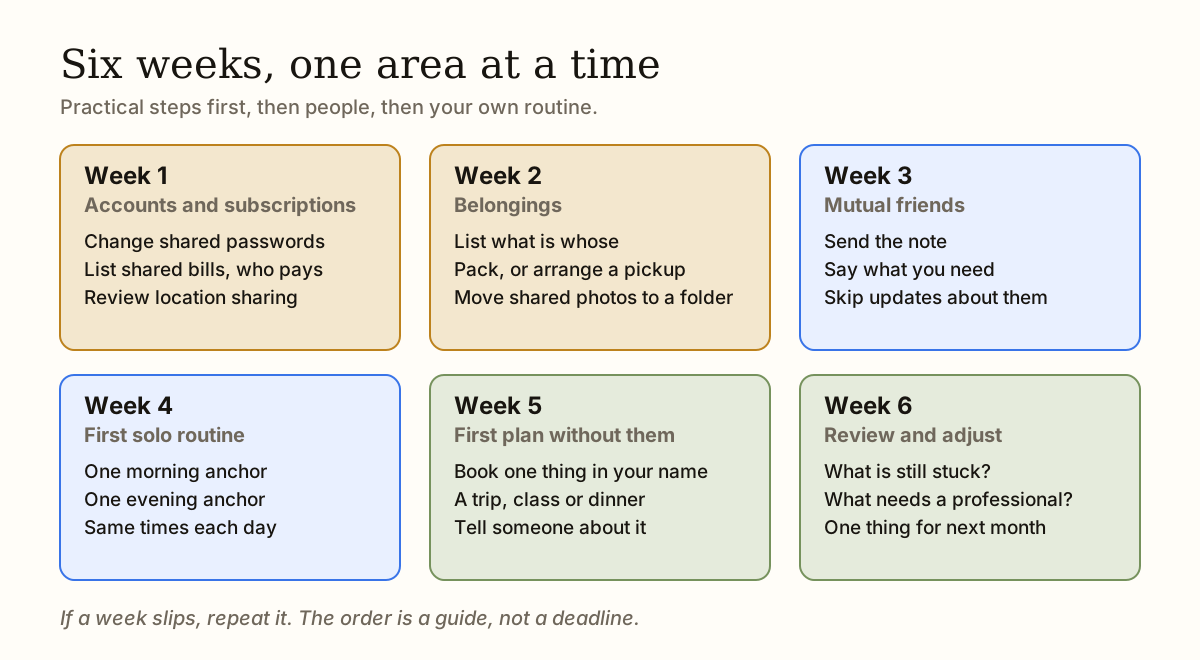
It is a guide, not a deadline. If week two falls apart, repeat it. Share houses, pets and children will stretch the first weeks, and that’s fine.
What do I do when the old routines hurt?
Expect ambushes, and plan for the three biggest. After years together, ordinary things carry them: the second mug, 6 p.m. when they would have been home, their side of the bed. You can’t remove all of it, so give the hardest moments a different shape.
- The 6 p.m. gap: eat somewhere else in the home, call someone while you cook, or book a weekly dinner with a friend.
- The Sunday habit: keep the day and change what is in it: a new route, a different café, a class.
- The bedroom: move the bed, change the sheets or sleep on the other side.
- The shared playlist or show: start a new playlist and pause the series you watched together.
What if I don’t know what to do with my time?
That is the time-slot problem, and it has a plan: map the hours the relationship filled, then give each one a small replacement. Our guide to rebuilding your time after a breakup walks through it. Add the basics from self-care after a breakup, because sleep and food come before any grand reinvention.
Then try one solo thing a week that is small and slightly new: eating out alone, a class, a walk somewhere you have never been. If it’s awkward, that’s information and not a verdict on whether you can enjoy your own company.
Does no contact still apply when you share a home or money?
A strict version often can’t, and a modified version can. If you share a lease, a pet or children, you need a channel for logistics. Keep it narrow: one topic, in writing, at set times, with no feelings in the thread. Our modified no contact guide covers how, and what to do if you break no contact covers a slip.
If you have no ongoing ties, the full rule is simpler, and what the no contact rule is explains it.
If your ex has been abusive, controlling or frightening, safety planning comes before any contact plan, and leaving can raise risk. The US National Domestic Violence Hotline (1-800-799-7233, text START to 88788) can help you plan, and our safety page lists more.
When should you get extra support?
See a doctor if low mood lasts most of the day, every day, for more than two weeks, as the NHS advises. Withdrawing from friends, dropping hobbies, disturbed sleep and appetite changes are on its list of depression symptoms. Our guide to depression after a breakup covers what to say at the appointment.
A counselor can also help with the identity side, and a lawyer or mediator with the legal side. Neither is a failure to cope.
If you are thinking about suicide or self-harm, contact a crisis line or emergency services now. In the US, call or text 988. In the UK and Ireland, call Samaritans on 116 123. In India, call Tele-MANAS on 14416. Start this week with the inventory table and fill in one row.
Step-by-step plan
- Week 1: accounts, money and subscriptions
Change passwords you shared, list every shared payment and who covers it, and review location sharing. Collect facts about the lease, mortgage and joint accounts, and decide nothing yet.
- Week 2: belongings and documents
List what is whose, pack your things or arrange a pickup, and move shared photos into a folder you can open later. Keep copies of the lease, statements and anything legal.
- Week 3: mutual friends
Send the note, say what you need, and ask for time together instead of news. See one friend one-on-one.
- Week 4: your first solo routine
Set one morning anchor and one evening anchor at the same times each day, small enough to survive a bad day.
- Week 5: a plan without them
Book one thing in your name, such as a class, a trip or a dinner, and tell someone about it.
- Week 6: review and adjust
List what is still stuck and what needs a professional, such as a lawyer, a counselor or a doctor. Pick one thing for next month.
You do not have to solve the whole relationship tonight. Take one private step that creates space between the feeling and the action.
Estimate your breakup recovery time →Common questions
How long does it take to recover from a long-term relationship?
No honest number exists, because it depends on how much of your life was tied up in the relationship, who ended it, your support and what else is going on. Expect good weeks and bad ones. The breakup recovery time estimator gives a rough planning range and shows which factors are slowing you down, but it is not a prediction.
Is it normal to feel lost months after a breakup?
Yes. Months in, the practical rush is over and the quiet arrives, and that is when the missing routines and the unclear sense of self show up. Feeling lost is common after a long relationship. If it comes with low mood most of the day for more than two weeks, speak to a doctor.
Should I move out right away?
Not necessarily. If you can both stay safely for a few weeks, a calm decision usually beats a rushed one. If staying is unsafe, or the tension is making things worse, stay with someone else and sort the details later. If there has been abuse, plan your move with a domestic violence advocate first.
What if our friends take sides?
Some will, and it is rarely personal. Send one clear note about what you need, ask for one-on-one time and avoid asking anyone to choose. Put your energy into the friends who make things easier, and let the rest settle in their own time.
Does no contact still apply when you share a home or money?
A strict version usually can’t. Use a modified version: logistics only, in writing, at set times, with no feelings in the thread. If you have children, a pet or a lease together, keep the channel as narrow as possible and review it when the shared ties end.
How do I rebuild my life after a 10-year relationship ends?
Work in this order: stabilize the practical side (accounts, money, belongings), cover sleep and food, then rebuild people, routines and plans one at a time. Use the inventory to see what the relationship held. Nothing about ten years can be rebuilt in a month, so aim for one new routine and one new plan.
I don’t know who I am without my partner anymore. What do I do?
Treat it as a question to explore, not a crisis to fix this week. Answer one of the six prompts a day, call a friend who knew you before the relationship, and try one small solo thing. A clearer sense of self tends to come from doing, not from thinking harder.
Is it normal to forget who I was before the relationship?
It is very common after years together, because preferences and habits blend. Research on breakups finds that self-concept can become less clear afterward. Old photos, old friends and the question “what did I do with a free Saturday?” are good ways back in.
What should I do first after moving out of a shared home?
Sort sleep, food and a few familiar objects first, then change shared passwords and note which bills are still joint. Set up one morning and one evening routine in the new place. Leave decorating and big plans for later.
How do I start over in a new place after a long relationship ends?
If you can, wait a few weeks before a big move, since grief can make a new city look like an escape. If you do move, pick one regular activity in your first week so that you meet the same faces more than once. Keep one old friend on a weekly call while the new place feels strange.
If contact involves threats, stalking, coercion, shared children, housing or immediate safety, a general no-contact rule may not fit. Read the safety guidance and seek qualified local help where appropriate.
Sources and further help
- Slotter, Gardner & Finkel (2010) — Who am I without you? The influence of romantic breakup on the self-concept
- Larson & Sbarra (2015) — Participating in research on romantic breakups promotes emotional recovery via changes in self-concept clarity
- Marshall (2012) — Facebook surveillance of former romantic partners
- NHS — Symptoms of depression in adults
- Apple Support — Share your location with iPhone
- Apple Support — Leave or remove a member from a Family Sharing group
- 988 Suicide & Crisis Lifeline
- The National Domestic Violence Hotline
- National Domestic Violence Hotline — safety planning
Research is cited to explain general patterns, not to diagnose or predict any individual outcome. Sources do not endorse UnLink. Read our editorial principles.
Keep this support one tap away.
UnLink is a free, private no-contact tracker for iPhone: count your days, get through urges and restart without losing your history.