Loneliness After a Breakup: How to Rebuild Your Time
Loneliness after a breakup eases when the empty hours have a plan. Map the evenings and weekends your ex filled, then use scripts to reach out this week.
 By the UnLink Editorial Team · General educational guidance, not therapy
Loneliness after a breakup comes largely from the hours your ex used to fill, so the fix is to give those hours a plan. Map the slots that now feel empty, usually weeknight evenings and weekends. Put one small replacement in each, ideally with another person, and start with a single evening this week.
- Loneliness after a breakup is often about the specific hours and routines your ex filled, so the fix is practical as well as emotional.
- Map four slots: weeknight evenings, weekend mornings, weekend evenings and late nights. Rebuild one this week and add others later.
- Loneliness makes your ex’s name the most familiar thing on your screen. A planned alternative for the empty hour works better than willpower.
- Keep asks small and specific. A message with a day, a time and an end time is easier for a friend to say yes to than “we should catch up”.
- If low mood lasts most of the day, every day, for more than two weeks, see a doctor. If you are thinking about harming yourself, call or text 988 in the US.
Why do I feel so lonely after a breakup?
Because your partner was holding up a large part of your week, and that part is now empty. A relationship fills particular hours: the call on the walk home, dinner, the Sunday lie-in, the one person who heard how your day went. Take the person away and the hours stay behind, unstaffed.
There is a body side to it as well. In a 2011 brain-imaging study (Kross and colleagues), people who had recently been rejected by a partner showed activity in pain-related brain regions when they recalled the rejection. The ache you feel at 7 p.m. is not you being dramatic.
Loneliness also doesn’t need an empty room. The NHS notes that you can feel lonely around friends and family, and in a relationship. So a busy group chat and a hollow evening can sit side by side.
Why you miss one particular person is a separate question, and our guide to why you miss your ex covers it. This page deals with the hours.
Loneliness after a breakup: how to rebuild your time, slot by slot
The most practical way to deal with loneliness after a breakup is to treat part of it as a scheduling problem. List the time slots the relationship used to fill, then give each one a small, specific plan. A vague intention (“I should see people more”) loses to a quiet apartment at 7 p.m.
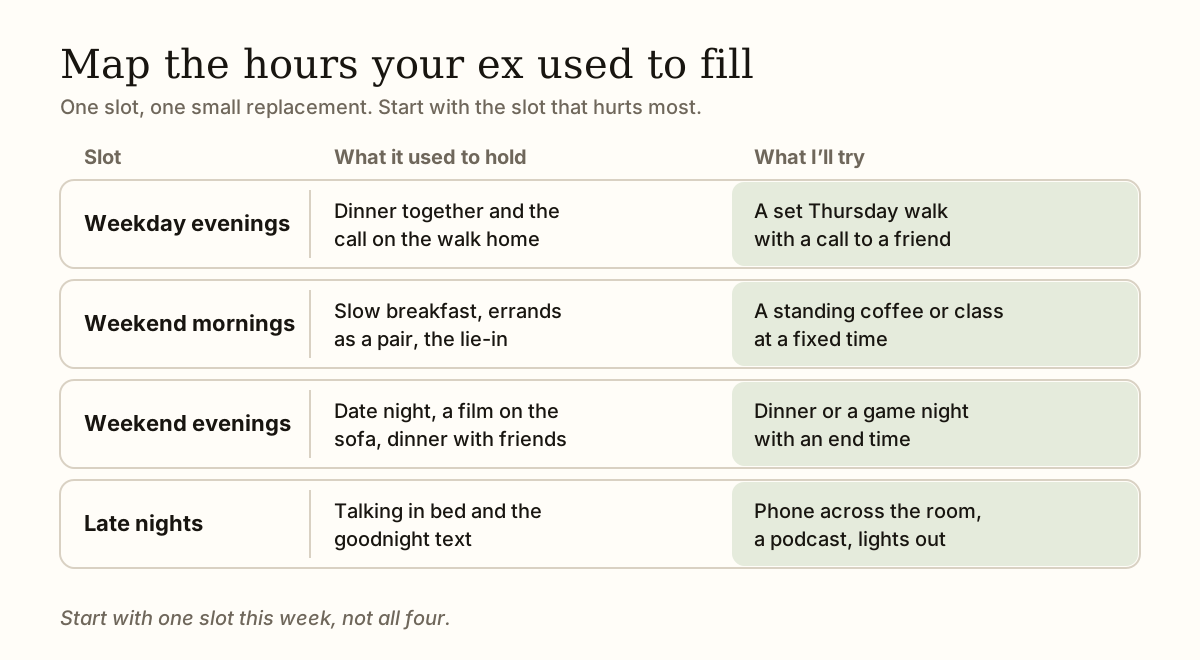
Four slots usually do the most damage: weeknight evenings, weekend mornings, weekend evenings and late nights. If you had them, add the couple events, such as their friends’ dinners, the family visit and the standing Sunday plan. The grid below shows the idea, and the table underneath gives more detail.
| Time slot | What the relationship filled | A small replacement | A person or place |
|---|---|---|---|
| Weekday evening | Dinner together, the call on the walk home, someone to tell about your day | A set Thursday walk with a phone call, or a weekly class | A friend or sibling by phone; a gym, studio or community class |
| Weekend morning | A slow breakfast, errands as a pair, the lie-in | A standing coffee or a long walk at a time you can’t negotiate with yourself | A neighbor or friend; a market, café or park |
| Weekend evening | Date night, a film on the sofa, dinner with their friends | Dinner or a game night with a start and an end time | Friends or family; a friend’s kitchen table |
| Late night | Talking in bed, the goodnight text, falling asleep next to someone | A fixed wind-down: phone charging in another room, a podcast with voices, lights out | A charger across the room; a podcast or radio show |
| Couple events | Their friends’ dinners, family visits, the standing Sunday plan | Swap the old Sunday plan for a new standing plan at the same time | A friend who shared the Sunday; a parent or sibling |
How do I map the hours my ex used to fill?
Take ten minutes with a notes app or a piece of paper, in daylight and not at midnight. You are collecting facts, not feelings.
- Write the slots down the left side: weeknight evenings, weekend mornings, weekend evenings, late nights.
- Beside each, write what actually happened in it. “Cooked while they told me about work” is more useful than “dinner”, because it shows what you lost (company, a listener) and not just the activity.
- Circle the slot that hurts most. That is the one you rebuild first.
- Mark any slot that wasn’t really about your ex. Some weekend mornings feel empty because plans with friends quietly stopped when you got together.
How do I fill the time I used to spend with my ex?
Choose one replacement per slot, then start with only one. Make it small, specific and timed: “Thursday, 6:30, the walk to the canal while I call a friend” beats “exercise more”. A person, a place or a body in motion all count.
Attach it to a cue so you don’t have to find motivation. Gollwitzer’s 1999 review of if-then planning found that tying an action to a specific trigger helps people follow through. “If it’s 6:30 on Thursday, I put my shoes on and call a friend from the pavement.” On a flat day, the cue still works.
For weekends, give each one an anchor in the morning and one in the evening, and leave the middle open. A class, a market or a long walk covers the morning. A dinner at someone’s house, a film or a fixed-time call covers the evening. Two anchors cover the hours that tend to bite.
You don’t need to fill every hour, and some solitude is fine. The aim is that you choose the time alone instead of falling into it. One planned evening a week for two weeks beats seven planned evenings you cancel.
Why does loneliness make me want to text my ex?
Because they are the fastest cure you know. One message breaks the quiet, and a reply feels like company. The lonely text is rarely about something you need to say. It is about the ache at 8 p.m., and their name happens to be the closest one.
A quick test: would a warm call from a good friend take the edge off? If so, you want company more than you want them. If the edge stays and only their voice would do, that is closer to missing them, and the Do I miss my ex? quiz helps separate the two.
Reaching out to them usually costs more than it gives. A 2012 study of Facebook use after breakups (Marshall) found that monitoring an ex online was associated with more distress and less personal growth. Checking on them is a poor stand-in for people.
Put the replacement in place before the urge. “If I’m about to open their thread because I’m lonely, I message one person from the ladder below instead.” For the sixty seconds when the urge peaks, see what to do instead of texting your ex. If it hits at night, read why you want to text your ex at night, and if you want a barrier, how to block yourself from texting someone.
How do I ask a friend to hang out when I feel low?
Climb one rung at a time, and make each ask smaller than feels necessary. The NHS says even a brief chat can really help when you feel alone, and that it can help the other person too. You are not imposing, and a specific ask is easier to accept than an open one.
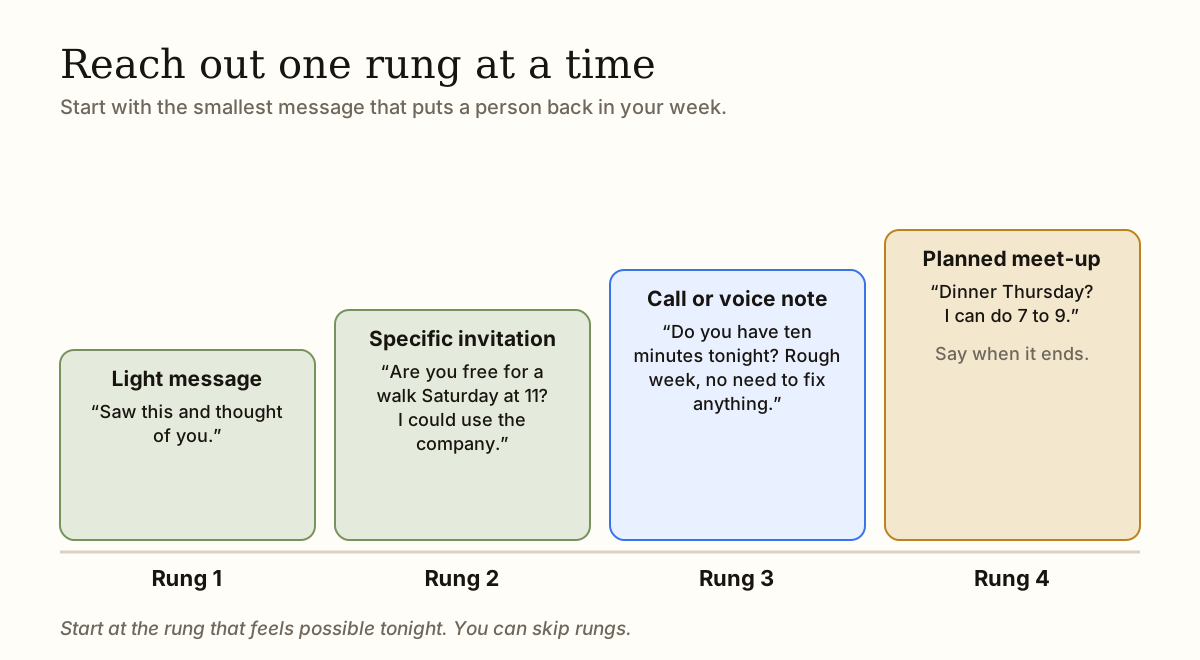
- Rung 1, a light message: “Saw this and thought of you.” No ask attached.
- Rung 2, a specific invitation: “Are you free for a walk Saturday at 11? I could use the company.”
- Rung 3, a call or voice note: “Do you have ten minutes tonight? Rough week, no need to fix anything.”
- Rung 4, a planned meet-up: “Dinner Thursday? I can do 7 to 9.”
Who haven’t I seen in a while?
Scroll your contacts and pick three names you saw less once you were a couple. Reconnecting doesn’t need an occasion. Reply to something they posted, or send the rung-1 message. If it has been months, a plain line works: “It’s been too long, and I’d like to change that.” You don’t owe an explanation.
An end time helps both of you. It makes the invitation lighter for them, and it gives you an exit if your energy drops. Ask mutual friends for time with them, not news about your ex. Updates are the quickest way to turn a good evening into a bad night.
What should I do on low-energy evenings?
Pick from a short menu you wrote on a better day, because you won’t invent one at 7 p.m. when everything feels heavy. The aim is something that gives you company or structure without asking you to leave the house.
- Call or send a voice note while you make dinner or fold laundry.
- Put on a podcast or radio show with voices in it and cook something that takes twenty minutes.
- Join an online group or game night built around something you like. The NHS lists in-person and online groups as ways to meet people.
- Take a ten-minute walk around the block at dusk, phone in your pocket.
- Finish one tiny household job: a drawer, the fridge shelf, one pile of bills.
- Write down what you wish you could say to them, using our unsent letter guide, and don’t send it.
- Set a bedtime and keep it. An early night counts as a plan.
How do I make friends after a breakup?
Slowly, and through repetition. Friendships tend to form where you see the same faces regularly, such as a weekly class, a volunteering shift, a run club or a standing game night. The NHS suggests joining a group or class, visiting public places and volunteering. Nobody can promise how quickly any of that will feel close, so don’t treat the first awkward evening as a verdict.
Go three times before you decide whether a group suits you. Low mood can make everyone seem less interesting than they are, and it can make you seem quieter than you are.
How long does loneliness last, and when is it more than loneliness?
Nobody can give you a date. Loneliness after a breakup tends to come in waves and to ease as new routines and people take over the old slots, which is why rebuilding them matters more than waiting. For wider timelines, see how long it takes to get over a breakup.
See a doctor if low mood lasts most of the day, every day, for more than two weeks, as the NHS advises, or if your own efforts aren’t helping. The NHS also lists withdrawing from friends, dropping social activities and neglecting hobbies among the signs of depression. Our guide to depression after a breakup covers what to say to a doctor.
If you are thinking about suicide or self-harm, contact a crisis line or emergency services now. In the US, call or text 988. In the UK and Ireland, call Samaritans on 116 123. In India, call Tele-MANAS on 14416. If your ex was abusive or you feel unsafe, the US National Domestic Violence Hotline is 1-800-799-7233 (text START to 88788). More is on our safety page.
For the whole recovery plan, start with our guide to getting over a breakup. Then pick your first slot, put it in your calendar and do that one thing.
Step-by-step plan
- Choose the slot that hurts most
Look at the time-slot map and circle the one you dread: usually a weeknight evening or a weekend evening.
- Pick one small replacement
Choose something you could do even when tired: a walk with a call, a class, dinner at a friend’s, a podcast and an early night.
- Put a time on it and tell one person
Write the day and hour in your calendar and send one person a message from the ladder, so the plan exists outside your head.
- Write the if-then
Finish the sentence “If it is [day, time], then I will [action]”, and add a backup for the urge to text your ex.
- Do it for the planned length only
Stay for the time you set, then stop. Decide afterward whether to repeat it or try another slot.
You do not have to solve the whole relationship tonight. Take one private step that creates space between the feeling and the action.
Take the “Do I miss my ex?” quiz →Common questions
How long does loneliness last after a breakup?
There is no reliable number, and anyone who gives you one is guessing. Loneliness usually comes in waves and eases as new routines and people fill the slots your ex used to occupy. A rough week after a better one is normal, and it is not a setback.
Is it normal to feel lonely after a breakup even with friends?
Yes. The NHS says you don’t have to be alone to feel lonely, and that many people feel lonely around friends and family. Friends may not be the ones who filled your particular evenings, so the gap is still there. Telling one of them honestly how you feel often helps more than another group night.
Is it normal to feel lonelier after a breakup than I did before it?
It is common. A partner often becomes the main listener and the default plan, so losing them removes several things at once. You may also have seen friends less while you were together. The loneliness points to a gap you can rebuild, not to something wrong with you.
What should I do in the evenings after a breakup?
Give each evening a shape instead of waiting to see how you feel. Pick one thing from a short menu: a call while you cook, a walk, an online group, a podcast with voices, then bed at a set time. Choose it before you sit down, so the evening is not decided by the urge to open their thread.
Is it okay to be alone on weekends after a breakup?
Yes, as long as it is partly chosen. Some quiet time helps you rest and process. Give the weekend a morning anchor and an evening anchor, and keep the rest loose, so alone time doesn’t slide into twelve hours of scrolling and silence.
What are low-effort ways to socialize after a breakup?
Voice notes, a short call while you do chores, replying to a friend’s story, a walk with one person, or an online group around something you like. A standing coffee at a fixed time takes almost no decisions. Start with the lightest option that still involves a real person.
How do I make friends after a breakup?
Go where the same people gather regularly: a class, volunteering, a club or a weekly game night. The NHS suggests joining a group or class and volunteering. Expect it to take a while, and give a group a few visits before you decide.
When is loneliness a sign of depression?
The NHS advises seeing a GP if low mood lasts most of the day, every day, for more than two weeks, or if your own efforts aren’t helping. Pulling away from friends and dropping hobbies are also listed signs. Loneliness on its own is not depression, but the two can overlap, and a doctor can tell them apart.
Why does loneliness make me want to text my ex?
They are the quickest known source of comfort, and one message can break the quiet. The urge is usually about the empty hour more than about anything you need to say. Plan a replacement for that hour in advance and keep a rung-1 message ready for a friend.
If contact involves threats, stalking, coercion, shared children, housing or immediate safety, a general no-contact rule may not fit. Read the safety guidance and seek qualified local help where appropriate.
Sources and further help
- Kross et al. (2011) — Social rejection shares somatosensory representations with physical pain
- Marshall (2012) — Facebook surveillance of former romantic partners
- Gollwitzer (1999) — Implementation intentions: strong effects of simple plans
- NHS — Get help with loneliness
- NHS Every Mind Matters — Loneliness
- NHS — Symptoms of depression in adults
- 988 Suicide & Crisis Lifeline
- The National Domestic Violence Hotline
- National Domestic Violence Hotline — safety planning
Research is cited to explain general patterns, not to diagnose or predict any individual outcome. Sources do not endorse UnLink. Read our editorial principles.
Keep this support one tap away.
UnLink is a free, private no-contact tracker for iPhone: count your days, get through urges and restart without losing your history.