Does No Contact Work?
Does no contact work? It can help you recover, but it won’t reliably make an ex miss you or come back. What the research shows and how to judge it.
 By the UnLink Editorial Team · General educational guidance, not therapy
Yes, no contact often works for your own recovery: it cuts the reminders that keep the pull alive and gives you room to think clearly. It does not reliably make an ex miss you or come back, and nothing guarantees either. Judge it by how you feel and function, not by whether they reach out.
- No contact can help your recovery by creating distance and reducing the reminders that keep the pull going.
- No contact does not reliably make an ex miss you or come back, and no version of it guarantees a reconciliation.
- We found no controlled trial of no contact itself, so the evidence is adjacent: studies of exposure to an ex and contact after separation.
- Using silence to provoke missing or guilt usually keeps you watching for reactions, which blocks recovery.
- Some situations, such as shared children, housing or safety risks, need a modified approach or safety planning instead of strict silence.
What can no contact do for my recovery?
No contact is most useful as a boundary you set for yourself. When you stop messaging, calling and checking, you remove many of the small moments that keep the relationship active in your mind. A message arrives and your heart jumps. You open their profile and spend an hour reading into a photo. Each of those moments gives the pull another chance to restart.
Fisher and colleagues (2010) found that people recently rejected by a partner showed reward and craving-related brain activity when they looked at that person’s photo. That research does not test no contact directly, but it helps explain why reducing exposure can make the urge quieter over time. Fewer triggers means fewer chances for the craving to be reinforced. No contact also gives you room to notice what you actually want without the constant back-and-forth. Clarity is often the first thing people say they gain.
Does no contact make them miss you?
Sometimes people reach out after a stretch of silence. Sometimes they do not. Silence does not cause missing, and nobody can tell you what a particular person feels or will do. Claims that it does often rest on coaches’ own client surveys, which are self-selected and cannot show cause and effect.
When someone does get in touch, the reasons are mixed: habit, loneliness, guilt, curiosity, a birthday or a holiday, and sometimes a real wish to talk. A message tells you what they felt in that moment. It does not tell you what has changed.
You are allowed to hope for a reconciliation. Keep the hope out of the strategy, though. Dailey and colleagues (2009) found that on-again, off-again relationships were associated with more uncertainty and lower relationship quality than other dating relationships. If they do reach out, the useful question is not “did it work?” but “has anything that ended this changed, and do I want it?” The guide on what to do when your ex texts you during no contact has scripts for replying or not replying.
| What happens | What it can mean | What it does not prove |
|---|---|---|
| A “happy birthday” or holiday message | Habit, politeness, a pang of nostalgia | That they want you back or have changed |
| “I miss you” late at night | They feel it right now, and loneliness is loud at night | That they will still feel it, or act on it, in daylight |
| They view or like your story | Curiosity, or an itch to check on you | An invitation to reply |
| Complete silence from them | Many things, including their own boundary or hurt | That no contact failed. You are not scoring them |
Why does using no contact as a tactic keep me hooked?
When no contact becomes a strategy to get a reaction, you are still organizing your life around the other person. Your attention shifts from your own recovery to watching for signs. Did they see my story? Did they notice I stopped replying? Did they mention me to a friend? Each answer leads to another round of checking, and the relationship stays at the center of your thinking.
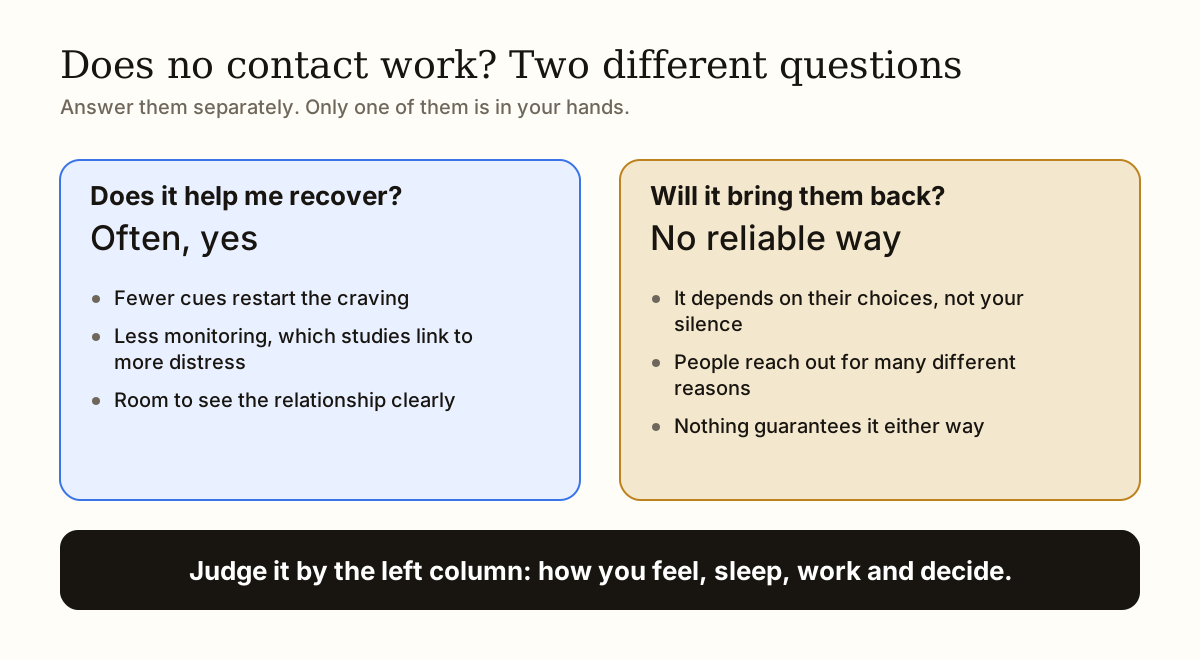
This is why the honest answer to “does no contact work?” depends on what you mean by work. If the goal is to make someone come back, it is not a dependable method, and it tends to keep you hooked in the meantime. If the goal is to heal and get your life back, it can be very effective, precisely because it stops depending on them.
What does the research actually show about no contact?
We did not find a controlled trial that tests “no contact” as a named method. What exists is adjacent research on exposure to an ex and on contact after separation. It is mostly correlational, which means it shows associations, not cause and effect, and the samples are often students or recently separated adults.
Read the table with that in mind. It supports the recovery claim reasonably well and the “makes them miss you” claim not at all.
| Claim | What the evidence says | Caveat |
|---|---|---|
| It reduces the pull | Fisher et al. (2010): recently rejected people showed reward and craving-related activity when viewing their ex’s photo | A brain-imaging study of photos, not a test of no contact |
| Watching an ex’s life slows recovery | Marshall (2012): more Facebook monitoring was associated with more distress and less personal growth | Correlational; 2012 survey of mostly students |
| Contact can prolong distress | O’Hara et al. (2020): in 122 recently separated married adults, more in-person contact predicted higher distress two months later, in people without children | Married separations; observational; no effect found at the same time point |
| Leaving can make room for growth | Lewandowski & Bizzoco (2007): people who left lower-quality relationships often reported growth and positive emotions | About relationships that ended, not about silence, and not every ex was low quality |
| It makes them miss you or come back | No study we found supports this | Coach surveys are self-selected |
What should “working” actually mean?
Success in no contact is easier to judge when you measure it by your own life rather than by their response. Progress rarely runs in a straight line, and it often shows up more quietly than people expect. If you are still working out what the rule covers, what the no contact rule is explains the basics, and the no contact calculator can show your day count without turning it into a deadline. These are signs it is working for you:
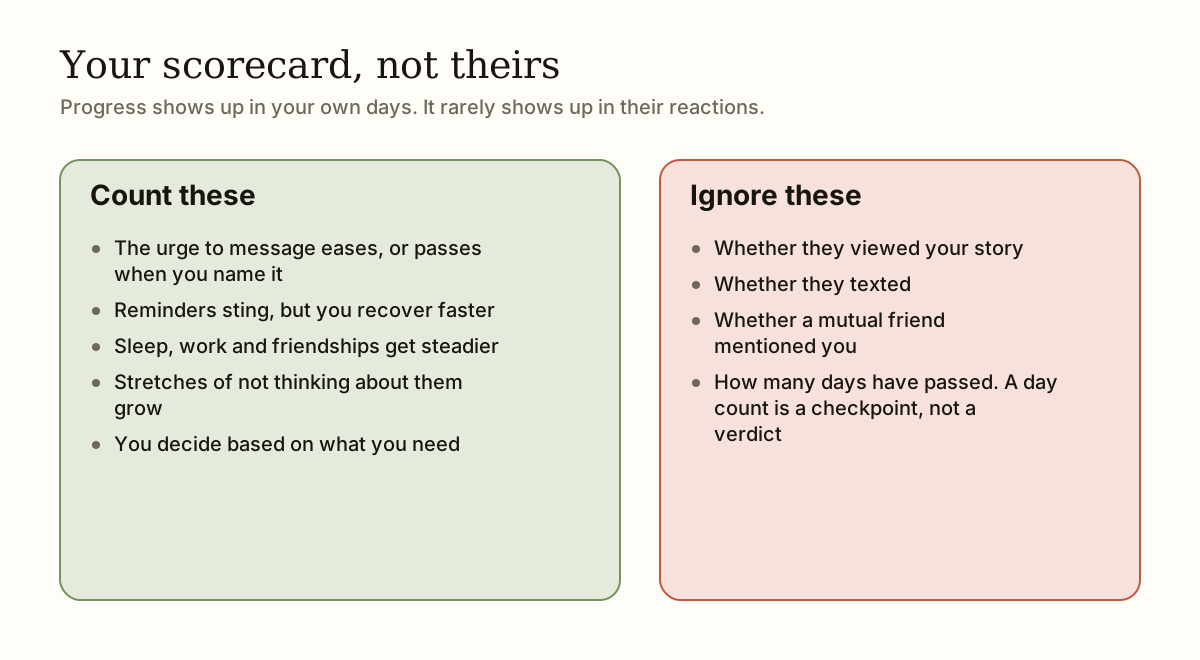
- The urge to message them feels less intense, and you can name it instead of acting on it, or it passes.
- Hearing their name or seeing a reminder still stings, but you recover faster than you used to.
- You make decisions based on what you need, not on what you think they will feel.
- Your sleep, work and friendships are getting steadier instead of being pushed aside.
- You can talk about the relationship without spiraling, even if you still feel sad, and you notice stretches of not thinking about them at all.
Why does no contact feel worse before it gets better?
Early no contact often brings strong urges, because the relationship was a source of frequent attention and reassurance, and your brain is used to checking for both. The pull can feel stronger before it gets easier. That does not mean it is failing. It is a reason to plan support for the hardest moments, such as late evenings, weekends and anniversaries.
Attachment style is one lens people use here. People who tend toward anxious attachment often find the early weeks hardest, and anxious attachment after a breakup explains why. Treat any style as a description of a pattern, not a prediction of how a particular ex will respond, which is why “does no contact work on an avoidant ex?” has no reliable answer.
For what tends to come when, see the stages of no contact and the first 30 days of no contact. There is no universal number of days that guarantees results, and how long no contact should last explains how to use day counts as checkpoints instead of rules.
When does no contact not work, or not apply?
Strict silence is not always safe or practical. It also fails in predictable ways, which are worth knowing before you start.
- You share children, a home, a lease or a workplace. You may need logistics-only contact, and modified no contact explains how to keep it business-only.
- The relationship involved abuse, threats, coercion or stalking. Leaving and cutting contact can raise risk, so safety planning comes first. See our safety page. In the US, the National Domestic Violence Hotline is 1-800-799-7233, or text START to 88788. If you are dealing with a partner whose behavior felt controlling or manipulative, no contact with a narcissist puts safety first.
- You are using it as a test or a punishment, and checking for their reaction every day. That is monitoring with extra steps.
- You keep slipping because the phone is always in reach. How to block yourself from texting someone adds friction where willpower runs out.
What if they reach out, seem to have moved on, or I slip?
Sooner or later many people hear from an ex during no contact, or see them with someone new. Either can bring relief, anger, hope and fear all at once. Decide ahead of time how you will respond rather than in the moment when your feelings are strongest. If you see them seemingly fine or already dating, that is not evidence that no contact failed, and my ex moved on fast explains what that does and does not mean.
If you have already slipped and replied, that does not automatically mean no contact has failed. It means you have information about what the trigger was. What to do if you break no contact explains how to reset without shame, and the wider recovery plan is in how to get over a breakup. UnLink also keeps your history when you restart, so the days you protected are not wiped out.
If you ever feel unable to keep yourself safe, call or text 988 in the US, Samaritans on 116 123 in the UK and Ireland, or Tele-MANAS on 14416 in India.
You do not have to solve the whole relationship tonight. Take one private step that creates space between the feeling and the action.
No contact day calculator →Common questions
Does no contact work on exes?
No contact can work well for your own recovery, because it creates distance and reduces the reminders that keep the pull going. It does not reliably make an ex come back, and nothing guarantees an outcome either way. Its value is in how it helps you heal, not in what it causes them to do.
Does no contact make them miss you?
Sometimes people reach out after a stretch of silence, but there is no reliable way to make someone miss you. Using no contact to provoke a reaction tends to keep you watching for signs and stuck in the relationship. Judging it by whether they come back usually leads to frustration.
Is no contact a good idea after a breakup?
For many people, a period of no contact helps them recover, because it reduces contact-driven craving and gives them room to think clearly. It is a boundary you set for your own wellbeing, not a route to reconciliation. If there are shared children, housing or safety concerns, a modified approach may be better.
Does no contact work if I was the one who was dumped?
It can, and it is often the case where it helps most, because the urge to ask for explanations or another chance is strongest. The benefit is the same: less exposure, fewer reminders and more room to recover. It will not change their decision, so treat it as protection for you.
Does no contact work on an avoidant ex?
There is no reliable answer. Attachment styles describe patterns, not predictions for one person, and the claims you see online come mostly from coaches. If the goal is your own recovery, no contact works the same way whatever their style. If the goal is getting them to respond, nothing can promise that.
What is a no contact success story?
A useful sign of success is that you feel steadier, sleep better and make decisions for your own life, whether or not your ex ever reaches out. Many people describe getting clearer about what went wrong and what they want next. This is a personal measure, not a promise of any particular outcome.
How long should no contact last?
There is no universal number of days that guarantees results, and day counts work better as checkpoints than as rules. Focus on whether the urge is easing and your life is becoming steadier. Our guide on how long no contact should last explains how to think about timing.
Why does no contact sometimes make me feel worse at first?
Early no contact often brings strong urges, because the relationship was a source of frequent attention and reassurance. The pull can feel stronger before it gets easier. That does not mean it is failing, but it is a reason to plan support for the hardest moments.
If contact involves threats, stalking, coercion, shared children, housing or immediate safety, a general no-contact rule may not fit. Read the safety guidance and seek qualified local help where appropriate.
Sources and further help
- Fisher HE et al. (2010), Reward, addiction, and emotion regulation systems associated with rejection in love, Journal of Neurophysiology
- Marshall TC (2012), Facebook surveillance of former romantic partners: associations with postbreakup recovery and personal growth, Cyberpsychology, Behavior, and Social Networking
- O’Hara KL et al. (2020), Contact with an ex-partner is associated with psychological distress after marital separation, Clinical Psychological Science
- Dailey RM et al. (2009), On-again/off-again dating relationships: how are they different from other dating relationships?, Personal Relationships
- Lewandowski GW & Bizzoco NM (2007), Addition through subtraction: growth following the dissolution of a low quality relationship, Journal of Positive Psychology
- National Domestic Violence Hotline: safety planning
- 988 Suicide & Crisis Lifeline (US)
Research is cited to explain general patterns, not to diagnose or predict any individual outcome. Sources do not endorse UnLink. Read our editorial principles.
Keep this support one tap away.
UnLink is a free, private no-contact tracker for iPhone: count your days, get through urges and restart without losing your history.