The Grey Rock Method: How It Works, Examples and When Not to Use It
The grey rock method means giving brief, flat, unemotional replies to someone who feeds on reactions. How to do it, real examples, and when it is unsafe.
 By the UnLink Editorial Team · General educational guidance, not therapy
The grey rock method means making yourself as uninteresting as a grey rock to someone who feeds on your emotional reactions. You keep contact brief, factual and flat, share nothing personal, and do not take the bait. It is meant for situations where you cannot go fully no contact, such as co-parenting, work or family. It is not a safety plan for abuse.
- Grey rock is a way of behaving in contact you cannot avoid. It is not a level of contact, and it is not needed once contact ends.
- It works by removing the reward. If drama, guilt or attention is what someone gets from pushing you, a flat reply leaves them with nothing to work with.
- Expect a short spike first. When a pattern stops being rewarded, it often gets louder before it fades.
- Do not use grey rock as your main protection if you are in physical danger, being stalked or being threatened. It can escalate some abusers. Use a safety plan instead.
- It has a cost. Staying flat with someone who knows your buttons is tiring, so pair it with real support and a place to put what you are not saying.
What is the grey rock method?
Picture the dullest object you can: a grey rock on a path. Nobody stops to argue with it, flatter it or try to make it cry. The grey rock method borrows that idea. When someone keeps provoking you, guilt-tripping you or pulling you back into old fights, you become that rock. You answer the practical part of what they say, briefly and without emotion, and you give them nothing else.
The term came out of online support communities for people leaving narcissistic and high-conflict relationships rather than from clinical research. It is now widely used by therapists and mediators, alongside similar techniques such as Bill Eddy’s BIFF responses (brief, informative, friendly, firm). What they share is one insight: some people are not looking for an answer. They are looking for a reaction.
People spell it both ways: grey rock in British English, gray rock in American English. It is the same method.
Grey rock vs no contact vs modified contact
The most common confusion is treating grey rock as a step between contact and no contact. It is better understood as a style you use inside whatever contact remains.
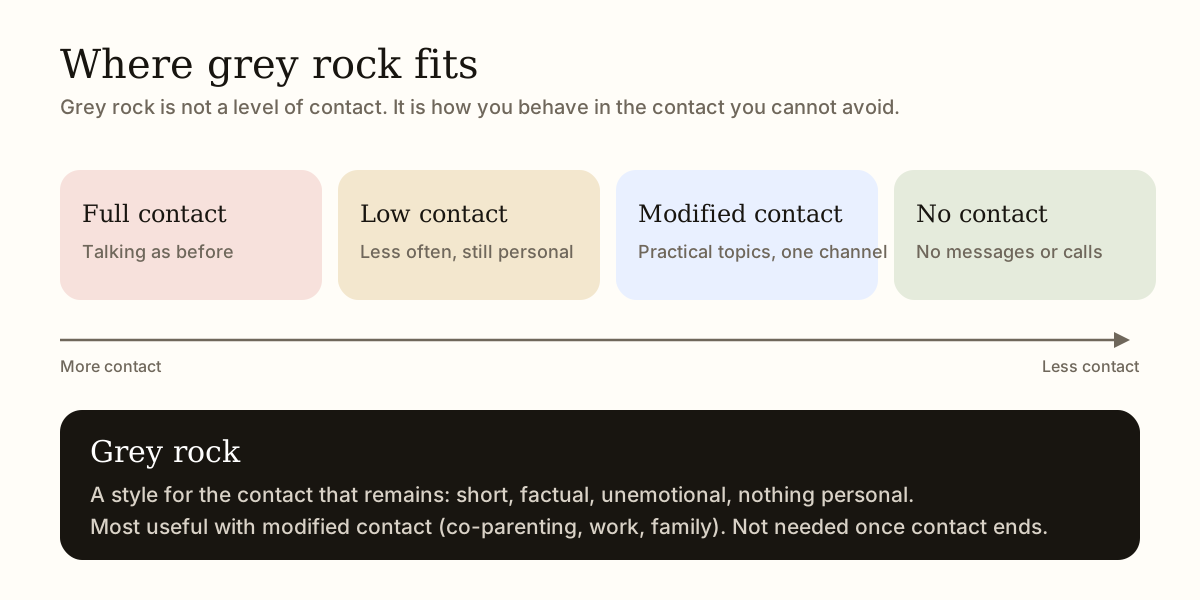
- If you can go fully no contact safely, that is usually simpler than grey rock. See what the no contact rule is.
- If you cannot, set the rules of contact first with modified no contact, then use grey rock for how you show up in it.
| Approach | What it means | Best for |
|---|---|---|
| No contact | No messages, calls, visits or checking their profiles | Ending a relationship with no shared children, home or job |
| Modified contact | Contact limited to practical topics, through one channel, at set times | Co-parenting, shared housing, a shared workplace |
| Grey rock | Flat, brief, factual behaviour during the contact that remains | Someone who provokes, guilt-trips or fishes for reactions |
| BIFF reply | A brief, informative, friendly, firm written response | Hostile emails or texts, especially if a court or HR may read them later |
Why grey rock works
Behaviour that gets rewarded continues. For someone who enjoys conflict, control or attention, your anger, tears, long explanations and apologies are all rewards. Each one teaches them that pushing works. Grey rock takes the reward away. A reply like “Noted. Pickup is at five” answers the logistics and offers nothing to fight about.
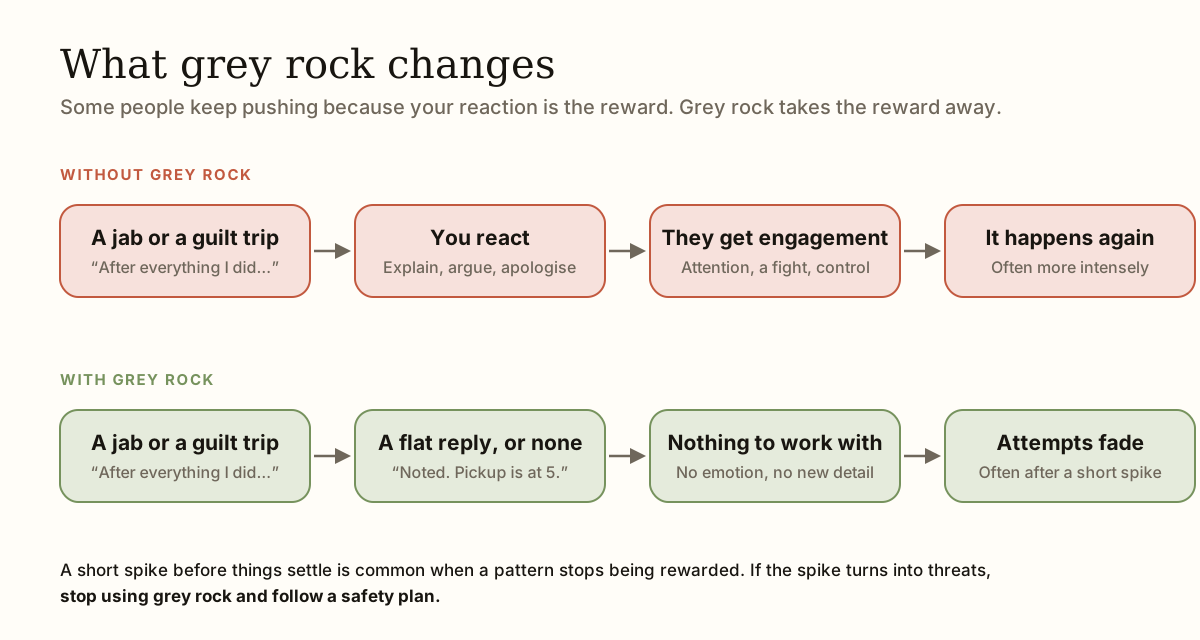
- It does not reward the bait. There is no reaction to collect and no new detail to use against you later.
- It ends the intermittent pay-off. Relationships that swing between warmth and cruelty can build an unusually strong bond, which research on abusive relationships calls traumatic bonding (Dutton and Painter, 1993). Staying flat interrupts the cycle of hope and hurt on your side as well as theirs.
- It protects your recovery. Every heated exchange reopens the wound. Short, boring replies keep your nervous system out of the fight.
- It creates a clean record. If a court, mediator or HR team ever reads the thread, calm and factual messages work in your favour.
When not to use grey rock
This is the most important section on this page. Grey rock is a communication technique, not protection. It assumes the other person is pushing for a reaction, not that they intend you harm. When that assumption is wrong, going flat can make some people escalate to get the response they are used to.
Do not rely on grey rock as your main strategy if any of these are true. Instead, contact a domestic violence service and make a safety plan. In the US, the National Domestic Violence Hotline is 1-800-799-7233, and our safety page lists more options.
- They have hurt you physically, threatened to, or threatened your children, pets or family.
- They are stalking you, turning up uninvited, tracking your phone or monitoring your accounts.
- They have threatened suicide or self-harm to control what you do.
- They control your money, your documents or where you live.
- You feel afraid of what they will do if you stop responding the way they expect.
Grey rock examples
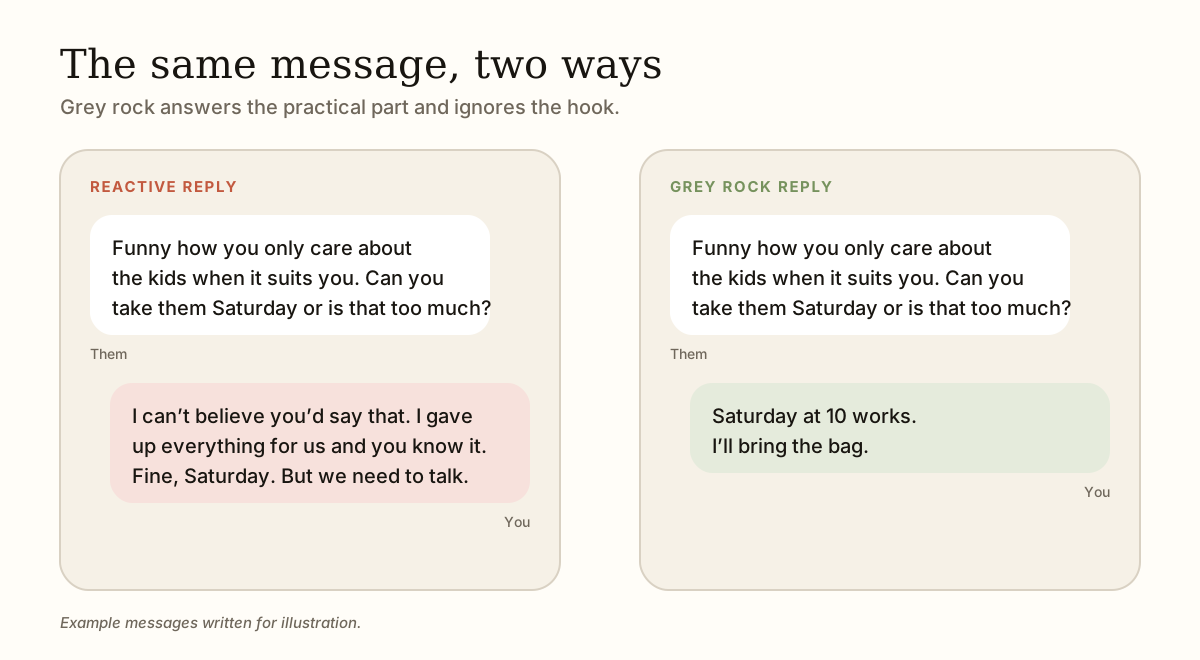
Good grey rock replies have three features. They answer only the practical question, if there is one. They contain no feelings, opinions or personal news. And they are short enough that there is nothing to pick apart.
- A guilt trip: “I guess I just meant nothing to you.” Grey rock: no reply. Or, if a reply is needed for logistics: “I’ll drop your things off on Thursday.”
- Bait about a new partner: “Hope your new friend knows what they’re getting.” Grey rock: no reply.
- A co-parenting jab: “You’re always late. Typical.” Grey rock: “I’ll be there at 5.”
- “Can we talk?”: “We need to talk about us. Call me.” Grey rock: “I’m keeping things to the kids’ schedule. Anything else can go through email.”
- A compliment or love-bomb: “I saw a photo of you today. You looked amazing. I miss us.” Grey rock: no reply.
- A provocation at work: “Bet you loved getting credit for my idea.” Grey rock: “The slides are in the shared folder.”
- Fishing for information: “So where are you living now? Are you seeing anyone?” Grey rock: “I’d rather keep it to the handover.”
- A family event dig: “Still single? Shame.” Grey rock: “Mm.” Then move to another conversation.
- An accusation: “Everyone knows what you did.” Grey rock: no reply. Save the message.
- A real logistics question: “Can you sign the school form?” Grey rock: “Yes. I’ll return it Monday.”
Grey rock in person
Face to face is harder, because your face and voice can give you away. Keep answers to a few words. Use a neutral tone and steady, unhurried movements. Look at something practical, like the car seat, the paperwork or your calendar, rather than holding their gaze. Have an exit line ready (“I need to head off”) and use it before you feel cornered. If you are meeting for a handover, choose a public place, or a supervised exchange centre if things have been tense.
What to expect when you start
For the first week or two, it may get worse. When a behaviour that used to work stops working, people often try harder before they give up. Psychologists call this an extinction burst, and it is well documented in behaviour research (Lerman and Iwata, 1995). Messages may get longer, nastier, sweeter or more frequent. That spike is usually a sign the method is working, not that it is failing.
There are two exceptions. If the spike moves toward threats, stalking or turning up uninvited, stop and follow the safety guidance above. And if you share children, keep every message about them answered, briefly. Grey rock is never a reason to ignore your child’s needs.
The cost of grey rock, and how to look after yourself
Staying flat with someone who knows exactly which buttons to press is exhausting. Many people describe it as holding their breath. It can also feel wrong if you are naturally warm and open, as though you are becoming someone you are not. You are not. You are choosing where your energy goes.
Give everything you are not saying somewhere to land. Write the furious reply in a private note and leave it unsent (our unsent letter guide helps). Talk to a friend after a hard exchange. Keep a simple log of what was sent and when, which helps if things ever become legal and stops you rereading the thread for emotional reasons. A therapist who understands high-conflict relationships can make a real difference here.
Step-by-step plan
- Decide what contact is truly necessary
List the topics you have to discuss: children, money, property, work tasks. Everything else is off the table. If nothing is necessary, consider full no contact instead.
- Choose one channel
Move communication to email, a co-parenting app or a work system where you can. Written messages give you time to stay flat and leave a record.
- Answer only the practical question
Reply to the logistics in one or two sentences. Ignore the insult, the guilt and the bait, even if it is the part that hurts most.
- Remove feeling and detail
No opinions, no news about your life, no explanations, no apologies for things you did not do. Shorter is better.
- Wait before you reply
Unless it is urgent, wait a few hours or until the next day. If you need help getting the wording flat, use the grey rock reply builder.
- Expect a spike and hold steady
Messages may get worse before they ease off. Stay consistent. Inconsistency teaches them that pushing harder sometimes works.
- Look after yourself after each exchange
Write what you wanted to say somewhere private, move your body, or call a friend. Log the message and close the thread.
You do not have to solve the whole relationship tonight. Take one private step that creates space between the feeling and the action.
Build a grey rock reply →Common questions
Does grey rock work on narcissists?
It often reduces provocations from people who want attention or a reaction, which is why it is popular for dealing with narcissistic or high-conflict exes. It does not change who they are, and it can cause a short spike before things settle. If there is any risk of violence, use a safety plan rather than relying on grey rock.
Is the grey rock method manipulative?
No. You are not trying to make someone feel or do anything. You are declining to take part in a pattern that harms you, while still handling necessary practical matters. That is a boundary, not manipulation.
How long should you grey rock someone?
For as long as contact has to continue and the person keeps fishing for reactions. Many people find provocations drop off after a few weeks of consistency. If contact can end completely, no contact is usually simpler and kinder to you.
Can grey rock backfire?
Yes. Some people escalate when they stop getting a reaction, and a few become dangerous. If messages move toward threats, stalking or turning up uninvited, stop using grey rock as your main approach and contact a domestic violence service.
Can I use grey rock with a co-parent?
Yes, and it is one of the most common uses. Keep every message about the children answered, briefly and factually, through one channel such as a co-parenting app. Leave out everything about the relationship. See modified no contact for rules that pair well with it.
What is the difference between grey rock and BIFF?
BIFF, developed by Bill Eddy of the High Conflict Institute, is a structure for written replies: brief, informative, friendly and firm. Grey rock is the broader idea of giving no emotional reaction. They work well together, and a BIFF reply is often slightly warmer, which can suit messages a court or HR team may read.
Should I tell them I am using grey rock?
Usually not. Announcing it invites argument about it. Simply start replying differently. The change in your behaviour says everything that needs saying.
If contact involves threats, stalking, coercion, shared children, housing or immediate safety, a general no-contact rule may not fit. Read the safety guidance and seek qualified local help where appropriate.
Sources and further help
- Dutton & Painter (1993) — Emotional attachments in abusive relationships: a test of traumatic bonding theory
- Lerman & Iwata (1995) — Prevalence of the extinction burst and its attenuation during treatment
- High Conflict Institute — Bill Eddy’s BIFF response method
- National Domestic Violence Hotline — safety planning
- 988 Suicide & Crisis Lifeline — US crisis support
Research is cited to explain general patterns, not to diagnose or predict any individual outcome. Sources do not endorse UnLink. Read our editorial principles.
Keep this support one tap away.
UnLink is a free, private no-contact tracker for iPhone: count your days, get through urges and restart without losing your history.